The Opposite of Addiction Is Connection: Building Your Liberation Tribe
Introduction: The Cage Was Never About the Drug
I want to tell you about a moment that changed the way I understand everything I thought I knew about addiction, freedom, and what it means to be human.
A few years ago I sat across from a man who had been in and out of treatment seven times. He had done the detox programs. He had worked the steps. He had white knuckled his way through months of sobriety, only to relapse again and again. When I asked him what was missing, he did not say a better program or a stronger medication. He looked at the table and said, very quietly, “I have no one.”
That was the answer. That was always the answer.
The conversation around addiction and mental health has been dominated for decades by a single story: that certain substances are so chemically powerful they hijack the brain and enslave the will. That story is not entirely wrong. But it is radically incomplete. Because as the science of addiction and connection makes clearer with every passing year, what we call addiction is often less about the pull of a substance and more about the push of a life that feels unbearable to inhabit alone.
The loneliness that lives underneath so much substance use and compulsive behavior is not a character flaw. It is not weakness. It is a signal, the same signal that makes a cold and isolated rat reach for morphine water while a rat surrounded by friends and play and warmth almost never does. It is your neural system crying out for what it was designed to receive: the warmth, safety, and belonging of genuine human connection.
This article is about that signal. It is about what the research actually shows, what the Rat Park experiment revealed that mainstream treatment still has not fully absorbed, and most importantly, what it looks like in practice to build what I call your Liberation Tribe. The community that does not just support your recovery. The community that makes recovery feel like the natural, joyful, obvious choice.
Because the opposite of addiction is not white knuckling your way to sobriety. It is connection. Deep, real, life giving connection. And you can build it. Starting today.
The Science Behind Addiction and Connection
Let's start with what the research actually says, because it is more fascinating and more hopeful than almost anything you will hear in a standard treatment setting.
For most of the twentieth century, addiction science operated from a cage based model, literally and figuratively. The classic experiments that established our understanding of substance dependency placed lone rats in small boxes with two water bottles, one plain and one laced with morphine or cocaine. The rats, isolated and bored, chose the drug water compulsively. Researchers concluded: the drug itself is irresistible. The drug causes addiction.
That conclusion shaped policy, treatment, and stigma for generations.
But it was built on a profoundly flawed premise: that a rat's behavior in total isolation tells us something meaningful about human behavior in social context. It does not.
What the neuroscience of the past decade has revealed is that the brain's endogenous opioid system, the very circuitry that produces feelings of warmth, safety, and pleasure in social bonding, is the same system that is hijacked by opioid drugs. As a landmark 2024 study in Biological Psychiatry demonstrated, the endogenous opioid system plays a central role in the formation and maintenance of social bonds across the lifespan, and chronic opioid use appears to be particularly corrosive to close relationships, precisely because it artificially floods the system that would otherwise be activated by real human connection.
Translation: your brain literally uses the same reward pathway for belonging as it does for heroin. When genuine belonging is absent, the brain is primed to seek that pathway through any available substitute.
A 2022 editorial in Frontiers in Psychiatry titled “Human Connection as a Treatment for Addiction” (PMC9318152) reviewed evidence showing that more human connection and higher quality human connection predicted higher levels of recovery capital and greater growth in that capital over time. The authors concluded that human connection should be considered a core treatment mechanism, not merely a social support supplement.
Research into oxytocin, often called the bonding molecule, reinforces this picture. A 2025 comprehensive review in PMC (PMC11981257) documented how oxytocin modulates the neural circuits linked to stress response, emotional regulation, and social reward. When those circuits are activated by authentic connection, the stress system quiets, the craving system loses power, and the neural system finds the safety it has been searching for.
This is not soft psychology. This is hard neuroscience pointing in the same direction that every great wisdom tradition has always pointed: we heal in relationship. We suffer in isolation.
For a deeper exploration of how the brain navigates stress, bonding, and behavior, I highly recommend the Wellness + Wisdom conversation with Andrew Huberman, who breaks down the neuroscience of social connection with remarkable clarity. And for the emotional intelligence tools that help you show up fully in those connections, explore our emotional intelligence resource hub.
The Rat Park Revolution: What the Cages Were Really About
In the late 1970s, a Canadian psychologist named Bruce Alexander looked at the standard addiction experiments and asked a radical question: what if the cage itself is the variable we have been ignoring?
The classic lab setup put a lone rat in a small, barren box with nothing to do but eat, drink, and exist in isolation. Under those conditions, rats reliably chose drug water over plain water, and the scientific world took this as proof that certain substances were inherently, chemically irresistible.
Alexander and his colleagues at Simon Fraser University built something different. They constructed a large, enriched environment they called Rat Park, complete with tunnels to explore, platforms for climbing, wood chips to scatter, running wheels for exercise, and most importantly, abundant social company, including rats of both sexes and space for natural social behavior. They filled it with life.
Then they ran the same experiment.
The results were striking. Rats in Rat Park did not become addicted. Even rats that had been previously isolated and had developed what looked like compulsive drug use consumed dramatically less morphine once they were placed in the enriched social environment. In some conditions, the isolated caged males drank 19 times more morphine than the Rat Park males.
Alexander's conclusion was deceptively simple: the opposite of addiction is not sobriety. It is a life worth living. A life with belonging, stimulation, purpose, and community.
What this experiment illuminated was not that drugs have no chemical power. They do. It was that the social and environmental context in which a person lives determines, to a very large degree, whether that chemical power ever gets its hooks in. Put a human being in the equivalent of a barren cage, stripped of meaningful work, loving relationships, community, and purpose, and the pull of any available escape becomes enormous. Give that same human being a rich, connected, purposeful life and the pull diminishes dramatically.
This is why the trauma conversation matters so much in addiction work. Gabor Maté, one of the most important voices on this topic, explains in his work that addiction is not a choice or a moral failing. It is an adaptation to suffering. You can hear his full perspective in our Wellness + Wisdom conversation with Gabor Maté. His framing, combined with the Rat Park research, points toward the same truth: build the park, and the cage loses its power.
The question shifts from “how do I stop?” to “what am I missing that makes stopping feel impossible?” And almost always, what is missing is connection.
Loneliness and Addiction: The Hidden Epidemic
We are living through two epidemics simultaneously, and they are not unrelated.
The United States Surgeon General declared in 2023 that the country is experiencing a loneliness epidemic. By 2025, the World Health Organization estimated that loneliness contributes to more than 871,000 deaths annually worldwide, more than 100 people every single hour, dying at least in part from the absence of meaningful human connection.
Those numbers are staggering. And they exist in the same landscape as an addiction crisis that has claimed hundreds of thousands more lives.
The overlap is not coincidental.
Research published in PubMed under the title “The Role of Social Isolation in Opioid Addiction” (PMID 33681992) found that opioid use disorder is consistently associated with heightened feelings of social isolation, increased suicide risk, and at the community level, lower social capital. The relationship is bidirectional: loneliness drives substance use, and substance use deepens loneliness, creating a cycle that standard treatment approaches often fail to interrupt because they treat the drug without addressing the disconnection.
A 2024 PubMed study, “Opioid Regulation of Social Homeostasis: Connecting Loneliness to Addiction” (PMID 39608698), introduced the concept of “social homeostasis,” the idea that the brain maintains a set point of social connection the same way it maintains a set point for temperature or blood sugar. When social connection falls below that set point, the neural system generates a drive to restore it. If genuine connection is not available, anything that mimics the neurochemical signature of belonging, including opioids, which trigger the same endogenous circuits as social warmth, will be recruited as a substitute.
This is why loneliness and addiction are not separate problems that happen to co occur. They are the same problem wearing two faces.
A 2025 Sage Journals study on treating the cycle of social isolation and substance misuse in young adults found that loneliness must be identified as a core risk factor in every stage of recovery work, and that opportunities for authentic connection need to be embedded structurally into treatment and aftercare, not left to chance.
The male loneliness epidemic deserves particular mention here. Research consistently shows that men are significantly less likely to maintain close friendships or seek emotional support as they age, and this gap is lethal. The rates of both addiction and suicide in men track closely with rates of social isolation. This is not about weakness. It is about a culture that has systematically stripped men of the permission and the skills to connect deeply.
Understanding this is part of the deeper work available through our social wellness resources and explored at length in our loneliness resource hub. The path out of loneliness is not complicated. But it requires courage, and it requires community.
Johann Hari and the Lost Connections Framework
In 2015, journalist Johann Hari published Chasing the Scream: The First and Last Days of the War on Drugs, a sweeping examination of a century of drug policy and what it got catastrophically wrong. The book's central argument, drawn from interviews with neuroscientists, addiction specialists, and people living through addiction, was that the War on Drugs had been built on a fundamentally incorrect model of what addiction actually is.
Then in 2018, Hari followed with Lost Connections: Uncovering the Real Causes of Depression and the Unexpected Solutions, which extended the same analysis to mental health more broadly. In both books, the finding was the same: the dominant story we tell about addiction and depression, that they are primarily chemical disorders requiring chemical solutions, ignores the deeper reality that they are most often responses to disconnection from the things that make human life meaningful.
Hari's now famous TED Talk crystallized the core insight in a single sentence: “The opposite of addiction is not sobriety. It is human connection.”
That sentence traveled around the world. And for many people, it was the first time the experience of their own struggle or the struggle of someone they loved finally made sense at a deep level. Not “there is something broken in my brain that I need to fix with a program.” But “there is something missing in my life that I need to build with people.”
Hari's framework in Lost Connections identifies several specific forms of disconnection that drive suffering: disconnection from meaningful work, from other people, from meaningful values, from childhood trauma, from status and respect, from the natural world, and from a hopeful future. Each of these, he argues, is a social and environmental problem that requires social and environmental solutions, not just pharmaceutical ones.
His concept of “social prescribing,” where clinicians help people reconnect to community, purpose, and belonging as a primary treatment, aligns exactly with what the neuroscience is now confirming. And it aligns with what Josh Trent has been teaching through the Wellness Pentagon framework for years: you cannot heal one dimension of a human life while leaving the others untouched.
You can hear a full exploration of Johann Hari's ideas in the Wellness + Wisdom episode with Johann Hari. It remains one of the most listened episodes in the show's history, because it names something that millions of people already sensed but had never heard said out loud: you are not broken. You are lonely. And that is fixable.
Hari's work is not without critics, and it is worth noting that the full picture of addiction is complex, involving genetics, childhood trauma, co occurring mental health conditions, and yes, neurochemistry. But his central contribution, the reframing from “bad drug” to “missing connection,” has been enormously liberating for people who spent years trying to fix themselves when what they needed was to find their people.
For the emotional and psychological tools to begin that process, explore our resources on self love, healing, and our Wellness + Wisdom episode with Brené Brown on vulnerability and belonging.
The Wellness Pentagon: Social Wellness as a Recovery Pillar
If you have spent any time in the Wellness + Wisdom ecosystem, you have encountered the Wellness Pentagon, the five pillar framework at the heart of everything we teach. The five pillars are Physical, Emotional, Mental, Spiritual, and Social wellness, and the insight behind the framework is simple but profound: genuine wellbeing requires all five dimensions to be nourished. Not just one or two. All five.
Addiction almost always represents an imbalance across multiple pillars simultaneously, and that is precisely why single modality treatment so often fails.
Here is what that looks like in practice:
Physical: Chronic substance use dysregulates the body at every level, sleep, hormones, gut microbiome, immune function, inflammation. Physical recovery requires intentional attention to movement, nutrition, and rest, not because these are “nice to have” but because a body in chronic dysregulation is a body that will continue to seek relief through any available means. Our resources on breathwork and somatic healing are specifically designed to help the body process what the mind has carried for too long.
Emotional: Most addiction has emotional roots. A childhood in which emotion was unsafe to express. A relationship in which vulnerability was punished. A trauma that was never processed. The emotional intelligence work we offer is not about venting feelings. It is about developing the capacity to feel, process, and communicate your inner world without needing to escape from it.
Mental: The stories we tell ourselves about our worth, our capability, and our belonging shape our behavior far more than most people realize. Mental wellness in recovery means examining and updating those stories, replacing the shame narrative of addiction with a growth narrative of liberation.
Spiritual: This does not mean religion, though for many people it does. Spiritual wellness means having a sense of meaning, purpose, and connection to something larger than the immediate moment. It means knowing why you are here and what you are living for. When that is present, the pull of escape weakens enormously. When it is absent, almost anything becomes a substitute for it.
Social: This is where addiction and connection converge most directly. Social wellness is not about having a lot of acquaintances. It is about having genuine bonds, relationships in which you are known, accepted, and valued as you actually are. It is about belonging to a community that holds your growth as sacred. It is, in the language of this article, about having your Liberation Tribe.
The Wellness Pentagon approach treats recovery not as the subtraction of a bad habit but as the construction of a full life. Sobriety without meaning is just an absence. Recovery through the Wellness Pentagon is the active building of presence: physical vitality, emotional depth, mental clarity, spiritual purpose, and social belonging working together as an integrated whole.
To explore this framework in more depth and see how it maps to your own life, visit the Liberated Life framework and our full Wellness + Wisdom Podcast archive, where hundreds of episodes explore each pillar in detail.
What a Liberation Tribe Actually Looks Like
The word “tribe” gets used a lot in wellness circles, sometimes so loosely it loses meaning. Let me be specific about what I mean, because the Liberation Tribe is a very particular kind of community and it is worth understanding what makes it different from a social group or a support group or a network of acquaintances.
A Liberation Tribe is a community in which the central currency is authentic growth, not performance. Where vulnerability is not just tolerated but celebrated as courage. Where your worst days are met with compassion rather than judgment, and your best days are celebrated rather than envied. Where people have explicitly committed to their own liberation and, by being in your life, support yours.
It does not have to be large. Research on social support and recovery consistently shows that quality matters far more than quantity. Three deeply honest, genuinely caring relationships do more for your neural system and your recovery than thirty surface level connections. You are not building a following. You are building a family of choice.
The Liberation Tribe is characterized by a few specific qualities:
Shared values over shared history: The most powerful communities are not built around what people have been through together (though shared experience is meaningful). They are built around where people are going together. A tribe united by a shared vision of liberation, health, and full aliveness has a magnetic pull toward growth rather than a gravitational pull toward the past.
Structured vulnerability: Connection does not happen automatically when people are placed in proximity to each other. It requires intentional vulnerability, the willingness to say what is actually true rather than what is socially safe. The best tribes create containers for this, regular practices, rituals, and conversations designed to move people below the surface into genuine knowing of each other.
Mutual accountability without shame: This is a delicate balance, and it is crucial. Accountability in the Liberation Tribe looks like, “I see you, I believe in you, and I am going to hold you to the version of yourself you told me you want to be.” It does not look like surveillance, judgment, or punishment. Shame drives people back into hiding and isolation. Loving accountability draws them forward.
Celebration as a practice: Joy is not a reward for achievement. It is a practice, and it is one of the most powerful antidotes to the pull of escape. Tribes that celebrate each other's milestones, small and large, are building a reservoir of positive neural association with being present, sober, and growing. That reservoir becomes its own form of protection.
To understand what this looks like at the community level, explore our Wellness + Wisdom community and our resources on recovery. And for the relational and emotional architecture of deep connection, our episode with Brené Brown on shame, vulnerability, and belonging is essential listening.
How to Build Your Recovery Through Connection Practice
Building genuine connection is a practice. Not an event, not a onetime decision, but an ongoing, intentional cultivation. Here is what that looks like in real life.
Start with one honest conversation. Not a performance of wellness. Not a curated version of your story. One real conversation where you say something true that you would normally keep hidden. This does not have to happen with a stranger. It can happen with someone you have known for years but never allowed to fully know you. One honest conversation is where every Liberation Tribe begins.
Audit your current connections for nourishment. Not every relationship in your life is neutral. Some connections actively support your growth; others drain it. Some relationships are built on a shared identity of suffering or complaint; others are built on shared aspiration. This is not about cutting people off (though sometimes that is appropriate). It is about investing more intentional time and energy in the relationships that move you toward life and less in the ones that pull you toward escape.
Join a practice community. The most reliable way to build genuine connection is through shared practice: a meditation group, a breathwork circle, a hiking community, a somatic healing workshop. Shared embodied experience, not just shared conversation, builds neural bonds with remarkable speed. When you move, breathe, and process alongside other people, the walls come down in ways that purely verbal exchange rarely achieves. Explore our meditation and breathwork resources to find practices that can be done in community.
Work with a mentor or coach. One of the fastest ways to accelerate recovery through connection is to have a relationship with someone who has walked the path before you and who can see both where you are and where you are capable of going. This is a specific form of connection that combines accountability, wisdom, and genuine care in a way that peer relationships, wonderful as they are, cannot fully replicate.
Create or join a recovery circle. This is a small group (four to eight people works well) that meets regularly with the explicit purpose of mutual support and growth. It is different from a support group in one important way: the focus is not primarily on the problem but on the vision. What kind of life do you want to build? Who do you want to become? How can we support each other in becoming that? This forward facing orientation is the difference between a circle that helps people survive and one that helps them thrive.
Use digital connection as a bridge, not a destination. Online communities can be a genuine source of belonging, especially for people whose geography or circumstances limit their access to in person tribe. But digital connection is most powerful when it functions as a bridge to deeper, embodied relationship. Let it introduce you to people; then invest in making those connections real.
For a practical roadmap to the Liberated Life approach to connection based recovery, explore our Liberated Life framework and our full About Josh Trent page for context on the philosophy behind this work.
The Role of Breathwork and Somatic Healing in Community
Here is something that took me years to understand: you cannot think your way into belonging. You can understand intellectually that connection is safe. You can believe, at a cognitive level, that you deserve love and community. And still your body will flinch. Still you will find yourself pulling away at the moment of real contact, because the neural system learned long ago that closeness means danger.
This is why somatic healing is not optional in recovery through connection work. It is the foundation.
Somatic healing works at the level of the body's stored experience, the places where old fears and old wounds live not as memories but as physical contractions, bracing patterns, and automatic retreat responses. When you do breathwork or somatic work in a group setting, something remarkable happens: your neural system begins to register that being in close proximity to other people is safe, and not just safe but nourishing. The body learns what the mind already wanted to believe.
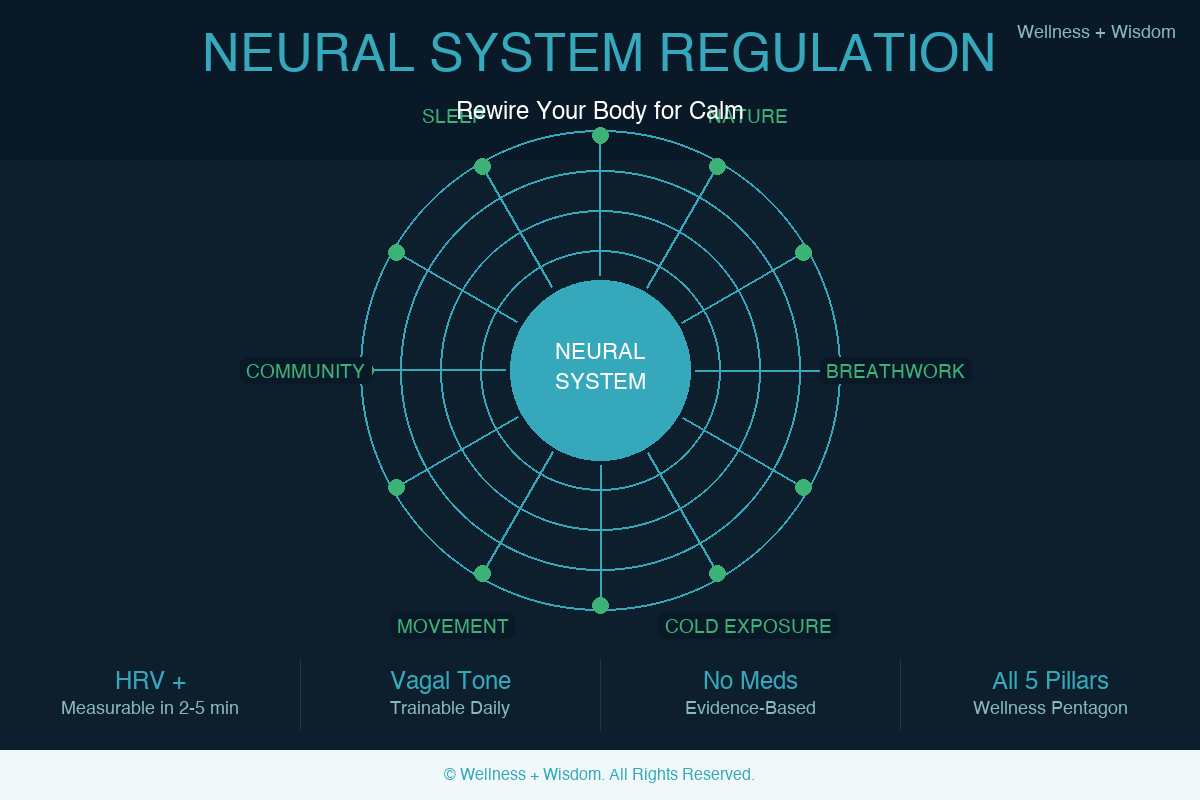
Breathwork, in particular, is one of the most powerful tools available for this process. Conscious breathing activates the parasympathetic branch of the neural system, shifting the body out of fight or flight and into the rest and connect state where genuine relationship is possible. Done in a group, it creates a shared physiological experience of safety and openness that accelerates bonding in ways that conversation alone rarely can.
We have seen this again and again in the Wellness + Wisdom community: people who have been in isolation for years, who have tried multiple treatment approaches, who know all the right words about connection but cannot seem to let anyone close, coming into a breathwork circle and feeling something shift. Not because the breathing magically solved their problems. But because it helped their neural system stop bracing against the possibility of belonging.
The research supports this. The oxytocin response, that cascade of bonding chemistry that makes connection feel safe and rewarding, is activated not just by words and ideas but by shared physical experience: synchronized breathing, touch, movement, and eye contact. Group breathwork activates all of these simultaneously, which is part of why it is so effective as a community healing modality.
For more on how to integrate breathwork and somatic healing into your recovery practice, explore our resources at wellnessandwisdom.com/breathwork and wellnessandwisdom.com somatic healing. And for the nutritional foundation that supports both neural system regulation and emotional resilience, the Wellness + Wisdom episode with Dr. Mark Hyman is an excellent complement.
Common Obstacles to Building Connection in Recovery
I want to be honest about the challenges, because building connection when you are in recovery or moving through isolation is genuinely hard. Here are the most common obstacles and what to do about them.
Shame. Shame tells you that if people really knew you, they would leave. It is the voice that says your story is too much, your past too dark, your present too messy to be welcome in community. Shame is also, neurobiologically, a direct driver of isolation and addiction. The research on this is extensive, and Brené Brown has documented it more clearly than anyone. The antidote to shame is not positive self talk. It is empathy, and empathy requires sharing your truth with at least one safe person. The shame loses its power the moment it is witnessed without judgment. To explore this more deeply, listen to our conversation with Brené Brown and visit our self love resources.
Trust deficits. Many people who struggle with addiction have a history of relationships in which trust was repeatedly broken, sometimes through betrayal, sometimes through abandonment, sometimes through the very unpredictability of a childhood in a home shaped by someone else's substance use or mental illness. Trust deficits are real and they are legitimate. The path forward is not to force trust before it has been earned but to build it incrementally, through repeated small experiences of reliability and care. Start with a therapist, a sponsor, or a coach before attempting to open to a wider community.
Social anxiety. This is extraordinarily common in recovery and often goes unaddressed. Social anxiety makes the very thing that heals most frightening. Somatic healing, breathwork, and gradual exposure in safe containers are the most effective tools here. Medication can be a support for some people. But the goal is not to eliminate the anxiety before connecting. It is to connect while tolerating the anxiety, which over time rewires the neural system's response to social situations.
The wrong community. Not all connection is healing. Communities built around shared suffering without a forward orientation can deepen rather than relieve isolation. Online communities can perform belonging while actually increasing disconnection. The wrong friends can celebrate the old version of you while the new one is trying to be born. This is not an argument against community. It is an argument for discernment. Choose communities that pull you toward your best self, not ones that are more comfortable with your worst.
Geographic isolation. This is real, and it disproportionately affects rural communities that already have higher rates of substance use and lower rates of treatment access. The answer includes online communities, telehealth, and peer support programs, but it also includes the intentional creation of local connection through whatever is available: a church, a hiking club, a recovery residence, a volunteer opportunity. Connection can be built anywhere that people are willing to be honest with each other.
To support yourself through these obstacles with the full range of tools available, explore our resources on trauma healing, mental health, and our healing hub. And remember that the work of building connection is not a solo project. That is rather the whole point.
Frequently Asked Questions About Addiction and Connection
What does “the opposite of addiction is connection” mean?
The phrase, popularized by journalist and author Johann Hari, means that addiction is not simply a chemical dependency. It is fundamentally a response to disconnection, isolation, and unmet belonging needs. When people have rich, meaningful bonds with other human beings, their drive to escape into substances or compulsive behaviors dramatically decreases. The neurobiological research confirms this: the same brain pathways that govern social bonding also govern the reward circuits targeted by drugs. Genuine connection at the neural level competes with the pull of substances for the same reward signals.
How does loneliness contribute to addiction?
Loneliness and addiction share a bidirectional relationship. Loneliness creates chronic stress and pain, and substances offer temporary relief from that pain. As the addiction deepens, it further isolates the individual, worsening the loneliness that drove the behavior in the first place. Research published in Biological Psychiatry in 2024 found that the endogenous opioid system is directly involved in both social bonding and addiction vulnerability. The WHO estimated in 2025 that loneliness contributes to more than 871,000 deaths annually worldwide. The cycle of loneliness and addiction requires a social solution, not just an individual one.
Can community actually help with addiction recovery?
Yes, and the evidence is compelling. A survey by Recovery Café in Seattle found that 70 percent of members felt the community program helped prevent relapse, and 69 percent said community activities helped them stay substance free longer. Treatment programs emphasizing social bonds, including 12 step communities and therapeutic communities, produce better long term outcomes than purely individual focused treatment. Increasing psychosocial resources and opportunities for genuine social bonding is now recognized as a core mechanism of recovery through connection, not just a nice to have supplement.
What is the Wellness Pentagon approach to addiction recovery?
Josh Trent's Wellness Pentagon is a five pillar framework encompassing Physical, Emotional, Mental, Spiritual, and Social wellness. True recovery is not just the absence of a substance. It is the presence of a full life across all five dimensions. The Wellness Pentagon approach treats addiction as a whole person imbalance, addressing the emotional wounds underneath the behavior, the mental patterns that sustain it, the spiritual disconnection that deepens it, the physical dysregulation it causes, and the social isolation that triggers it.
How do I start building a recovery tribe?
Start with one honest conversation. The liberation tribe is built one authentic connection at a time. Practical starting points include joining a community centered on shared values (not just shared struggles), starting a regular breathwork or somatic healing practice in a group setting, connecting with a recovery aligned coach or mentor, and using structured peer support programs. The key is moving from isolation into environments where vulnerability is safe and growth is celebrated. The Liberated Life community at liberatedlife.com is designed specifically for this.
What is community healing in the context of addiction?
Community healing means that recovery is not a solo project. It recognizes that addiction emerged in the context of disconnection and that genuine healing requires reconnection within a safe, supportive group. Community healing includes shared rituals, collective breathwork, mutual accountability, celebrating milestones together, and building a social identity rooted in growth rather than shame. Research consistently shows that the quality of a person's social network after treatment is one of the strongest predictors of long term recovery success.
Your Next Step: Join the Liberated Life Tribe
You have read the science. You have met Bruce Alexander's rats in their park and understood what the cage was really about. You have heard Johann Hari's argument and felt, perhaps, the recognition of something you already knew but had not yet put into words. You have understood the Wellness Pentagon and why social wellness is not a luxury pillar but the foundation everything else rests on.
Now comes the part that the research cannot do for you: the step into community.
The Liberated Life is a community built for exactly this. Not a support group defined by what you are recovering from, but a tribe defined by where you are going. A community of people who have decided, sometimes after years of struggle and isolation, that they are done living small and alone. That they are ready to do the work of building a full, connected, joyful life. That they want to do it alongside people who understand the journey from the inside.
In the Liberated Life community, you will find:
- Weekly live breathwork and somatic healing sessions in community
- Deep dive conversations on the science and practice of connection based recovery
- A tribe of people committed to their liberation across all five pillars of the Wellness Pentagon
- Direct access to coaching, mentorship, and the wisdom of the Wellness + Wisdom ecosystem
- A space where your vulnerability is met with respect and your growth is celebrated with genuine joy
This is not about achieving perfect sobriety. It is about building a life so rich, so connected, and so full of meaning that the pull of escape loses its power. The cage was never about the drug. And the park was never about the rats. It was always about what happens when living creatures are given what they actually need.
You are invited. Come exactly as you are.
Join the Liberated Life Tribe at liberatedlife.com
And if you are just beginning to explore this work, start with the Wellness + Wisdom Podcast, a free library of hundreds of conversations on every dimension of human healing and growth. The episodes with Johann Hari, Gabor Maté, and Brené Brown are essential starting points for the addiction and connection conversation.
You do not have to do this alone. You were never supposed to.
About Josh Trent
Josh Trent is the founder of Wellness + Wisdom and host of the Wellness + Wisdom Podcast. He is a certified life and wellness coach, breathwork facilitator, and emotional intelligence expert. Josh has spent 17 years studying the science and art of human optimization so that people can live in full self love, vitality, and joy. His work integrates cutting edge neuroscience, ancient wisdom traditions, and practical tools for building a life that is fully alive across every dimension. Connect with Josh and explore the full Wellness + Wisdom resource library at wellnessandwisdom.com.