
By Josh Trent, Identity Transformation Architect and host of the Wellness + Wisdom Podcast
Your spirit was never lost. It just got drowned out. The work is turning the volume back up on the signal that was always there.
Spiritual wellness is the dimension of your health that keeps you connected to meaning, to purpose, and to something far larger than your to do list. In a world engineered to fracture your attention every few seconds, that connection is the first thing to go quiet and the last thing most people think to protect. This is not a small loss. When your inner signal fades, everything else in your life starts to feel slightly off, even when the outer picture looks fine.
Let me be clear from the start. This part of your health is not a luxury, an escape, or a soft add on to the real work. It is a load bearing wall. You can eat clean, train hard, sleep well, and still feel hollow if this one dimension is starving. So let us talk about what spiritual wellness actually is, why the age of distraction works so hard to take it from you, what it does inside your body, and the simple daily path back to your own inner signal.
Table of Contents
- What Spiritual Wellness Actually Is
- Why the Age of Distraction Hijacks Your Inner Signal
- Signs Your Inner Signal Is Running Low
- What Spiritual Wellness Does to Your Biology
- Spiritual Wellness and the Wellness Pentagon
- The Inner Signal: How to Hear It Again
- Daily Practices to Strengthen Spiritual Wellness
- Spiritual Wellness vs Religion: Clearing the Confusion
- Frequently Asked Questions
- Studies and External Resources
- About Josh Trent
What Spiritual Wellness Actually Is
Spiritual wellness is the felt sense that your life has meaning, that you are connected to Creator and God, and that you belong to something sacred and larger than yourself. It is not about doctrine, and it is not about being perfect. It is about staying in living relationship with the part of you that knows why you are here.
Most people confuse this dimension with religion, or with a vague feeling of calm after a yoga class. Both miss the heart of it. Religion can be a vehicle for it, and calm can be a fruit of it, but the thing itself runs deeper. It is the quiet inner knowing that your days mean something, that your suffering is not pointless, and that you are held.
In the Wellness Pentagon™, the spiritual dimension is the one most people treat as optional. Yet it is the keel of the whole ship. When it is healthy, the other four dimensions stop competing and start cooperating. When it is neglected, you can have money, muscle, and a sharp mind and still feel like you are drifting.
Here is the simplest definition I can offer. Spiritual wellness is what you feel when your outer life and your inner signal point the same direction. The gap between those two is where most modern suffering lives. Close the gap and a strange thing happens. Joy stops being something you chase and becomes something you return to.
The difference between connection and performance
A lot of seekers get trapped in spiritual performance. They collect practices, retreats, books, and crystals, and they still feel empty, because none of it touched the actual relationship at the center. This part of your life is not a resume. It is a relationship. You do not earn it by doing more. You access it by getting quiet enough to remember it was never gone.
This is the same liberation we teach inside the L.I.F.E. Method™. The L in L.I.F.E.™ stands for Liberation, and the first thing most people need liberation from is the belief that their worth is a performance. Real spiritual wellness begins the moment you stop auditioning for your own life.
Why the Age of Distraction Hijacks Your Inner Signal
The age of distraction hijacks your inner signal by keeping your attention pointed everywhere except inward. That is not an accident. Entire industries are paid to capture the exact attention your inner life depends on, and they are very good at their job.
Think about the architecture of a normal day. You wake and reach for a glowing rectangle before your feet touch the floor. Notifications, headlines, and other people's lives flood in before you have heard a single one of your own thoughts. By the time you could have checked in with your spirit, your attention has already been spent twelve times over.
Your spirit speaks in a whisper. The world shouts. When the shouting never stops, the whisper does not disappear, but you stop being able to hear it. This is the real cost of constant input. It is not just lost time. It is lost contact with your inner signal, and that contact is the raw material of a healthy inner life.
I am not here to demonize technology. I built a career partly on digital health tools. The point is sovereignty. A phone is a fine servant and a brutal master. When the device sets the rhythm of your inner life, your spirit becomes whatever is left over after the algorithm takes its cut. That is no way to live.
Distraction is a numbing strategy
Here is the uncomfortable truth. A lot of distraction is not innocent. It is a way to avoid feeling. When something inside you aches, the easiest move is to reach for input that drowns it out. The scroll is a sedative. The constant noise is anesthesia.
This is why reclaiming your spirit can feel hard at first. The moment the noise stops, the feelings you were outrunning catch up. That is not a problem. That is the doorway. Learning to stay present with what surfaces, instead of numbing it, is the same skill we build through breath in box breathing and through the 90 second emotion rule. The feeling is not your enemy. The avoidance is.
Signs Your Inner Signal Is Running Low
Your inner signal is running low when life starts to feel mechanical, even though nothing is obviously wrong. This is the quiet emergency most people never name, because it does not show up on a blood panel. It shows up as a slow flattening of color in your days.
A few signs tend to show up together. You feel busy but not fulfilled. You accomplish things and feel nothing. You reach for your phone in every empty moment, because stillness has started to feel unbearable. You move through the week on autopilot and cannot quite remember what you were living for. None of this means something is wrong with you. It means your spirit has been starved of attention.
Another common sign is a low grade restlessness that no amount of productivity satisfies. You keep adding goals, hoping the next one will finally land, and the landing never comes. That restlessness is often the inner signal trying to get through. It is not asking for more achievement. It is asking for contact.
There is good news inside this. The fact that you can feel the flatness at all means the signal is still alive. A truly dead line does not register static. The discomfort you feel is your spirit knocking. The practices later in this guide are simply ways to answer the door. This is also why the dark night of the soul so often precedes the deepest growth. The ache is the beginning of the return.
What Spiritual Wellness Does to Your Biology
Spiritual wellness is not only good for your soul. It measurably changes your body, your mind, and your longevity. The science here is far stronger than most people realize, and it has been building quietly for decades.
Duke University researcher Harold Koenig conducted one of the largest reviews of this field, examining data based studies published across more than a century of peer reviewed research. His work found that greater spirituality and religious engagement was consistently linked with better mental health markers, including more wellbeing, more hope, more optimism, and less depression and anxiety. You can read the open access review of his findings in ISRN Psychiatry.
The physical health side is just as striking. In a later update published in Advances in Mind Body Medicine, Koenig summarized work showing that among more than one hundred studies on spirituality and mortality, most found that people with stronger spiritual lives tended toward greater longevity. Meaning does something protective in the body. It is not magic. It is biology responding to a life that feels worth living.
There is also a beautiful clue about what happens in the brain. A study led by Judson Brewer at Yale, published in the Proceedings of the National Academy of Sciences, found that experienced meditators showed quieter activity in the default mode network, the brain circuitry tied to mind wandering and self referential worry. The researchers noted that this wandering, busy default state correlates with unhappiness. Contemplative practice, the engine room of a healthy spirit, appears to turn the volume down on the very chatter that keeps us anxious.
Put those threads together and a clear picture emerges. A rich spiritual life is linked to a calmer mind, a more regulated body, and a longer life. This is the same mind body bridge we explored in depth in psychoneuroimmunology, the science of how your inner state shapes your physical health. Your spirit and your cells are in constant conversation.
Meaning as a buffer against stress
One of the clearest mechanisms is meaning. When life feels meaningful, the same hard event lands softer in your body. A loss is still a loss, but it is held inside a larger story, and that story changes the biology of how you carry it. This is part of why spiritual wellness shows up as better stress regulation and a more resilient neural system over time.
It connects directly to Emotional Epigenetics™. Your environment, your beliefs, and your emotional patterns shape how your genes express. A life rich in meaning and connection is an epigenetic signal of safety. A life of chronic distraction and disconnection is a signal of threat. In the most literal sense, your spirit is sending instructions to your own biology.
Spiritual Wellness and the Wellness Pentagon
Spiritual wellness is one of the five dimensions of the Wellness Pentagon™, and it is the one that quietly governs the other four. The five sides are Physical, Mental, Emotional, Spiritual, and Financial, and the central teaching is simple. Neglect one side and you undermine them all.
Most wellness culture obsesses over the physical and ignores the spiritual. We track macros, steps, and sleep scores while the deepest dimension goes completely unmeasured. That imbalance is exactly why so many objectively healthy people feel quietly miserable. Their bodies are optimized and their spirits are starving.
When you tend this dimension, the others get easier. Physical discipline stops feeling like punishment and becomes devotion. Financial choices stop being driven by fear and start being driven by purpose. Emotional storms pass faster because you are anchored in something steady. You can explore how this plays out across the whole framework in our breakdown of the Wellness Pentagon and its five dimensions.
The spiritual dimension, in our work, is specifically about Connection to Creator and God. Not connection to a vague something. A real, living, personal relationship with the sacred. That specificity matters. A vague spirituality gives vague results. A real relationship gives real peace.
The Inner Signal: How to Hear It Again
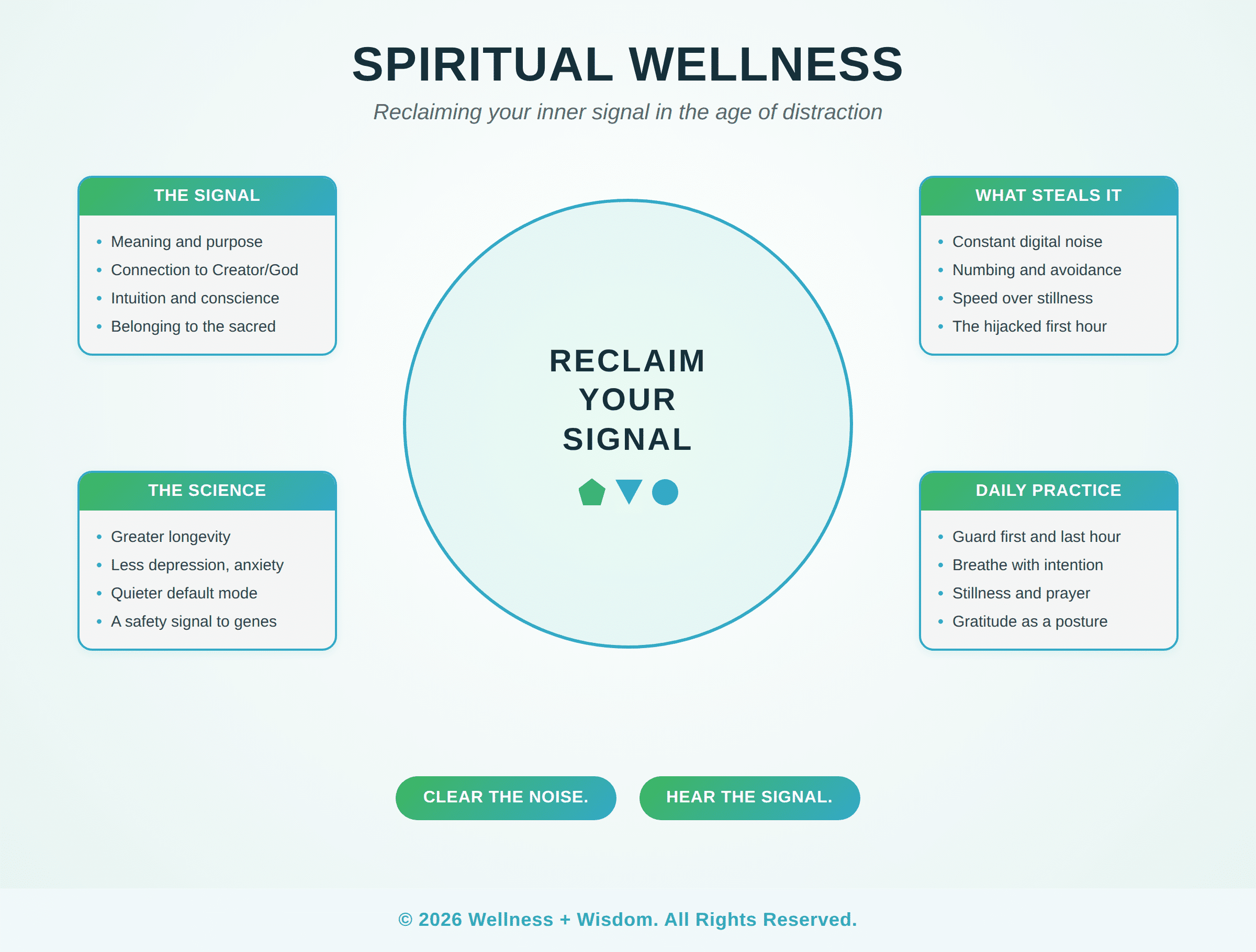
Your inner signal is the steady inner knowing that guides you toward truth, and you hear it again by creating enough silence for the whisper to land. It was never deleted. It was only buried under noise. The work is not to build a new signal. The work is to clear the static.
I describe the inner signal as the place where intuition, conscience, and spirit meet. It is the part of you that knew, long before your mind caught up, that a relationship was wrong or a decision was right. Reconnecting to spirit is largely the practice of trusting that signal again after years of being told to ignore it.
Reclaiming it follows a pattern I have watched in thousands of people, including myself. First comes the silence, which feels uncomfortable. Then comes the noticing, where you start to catch the whisper. Then comes the trusting, where you act on it even when it is inconvenient. Then comes the living, where the signal becomes the steady compass of your days. That progression is the heart of identity transformation, because the version of you that lives by the signal is not the version that lived by the noise.
Why the signal feels louder when you slow down
Speed is the enemy of the signal. When you move fast all day, you live in reaction, and reaction has no room for the whisper. When you slow down, even for a few minutes, the signal gets a chance to surface. This is why almost every spiritual tradition on earth prescribes stillness in some form. They all discovered the same thing. The signal speaks in the spaces between.
Daily Practices to Strengthen Spiritual Wellness
You strengthen spiritual wellness through small, consistent practices that protect your attention and open a channel to the sacred. You do not need a monastery. You need a handful of daily moments where you choose the whisper over the noise. Here are the practices I lean on and teach.
1. Protect the first and last hour
The first hour after waking and the last hour before sleep are sacred real estate for your inner life. Guard them. Keep the glowing rectangle out of both. Begin and end your day in contact with your own inner signal instead of the algorithm's. This single boundary changes more than any app ever will.
2. Breathe with intention
Breath is the bridge between the thinking mind and the feeling body, and it is the fastest doorway back to your spirit. A few minutes of slow, conscious breathing settles the neural system and opens the inner channel. This is the foundation of our BREATHE™ work, and you can start with the simple structure in our guide to box breathing for beginners. When the body calms, the signal gets louder.
3. Practice stillness and prayer
Stillness is where Connection to Creator and God becomes felt rather than theoretical. Whether you call it prayer, meditation, or sitting in silence, the act is the same. You stop performing and start listening. The Yale research on quieting the default mode network suggests this is not just nourishing for the spirit but neurologically real.
4. Move slowly and hum gently
When stillness feels too far away, gentle movement and soft humming can carry you there. A slow walk in nature with no phone, or a few minutes of low humming on the exhale, can soothe the body and reopen the inner channel. These are accessible, joy forward ways to regulate without forcing anything, and they pair well with the tools in our guide to neural system regulation.
5. Keep an emotional inventory
A healthy spirit requires honesty about what you actually feel. A short daily check in, where you name what is moving through you without judging it, keeps the channel clear. Unfelt emotion is static on the line. This practice pairs beautifully with our work on emotional intelligence for adults and the deeper patterns we trace through bioenergetic memory.
6. Practice gratitude as a posture
Gratitude is the quickest on ramp back to your spirit because it instantly reorients you toward abundance. When you name what is good, your attention leaves the scarcity loop and returns to the present, where the sacred actually lives. Make it a posture, not just a journal entry.
Spiritual Wellness vs Religion: Clearing the Confusion
Spiritual wellness and religion are related but not identical. Religion is a structured tradition of beliefs and practices, while this dimension of health is the living quality of your connection to the sacred. You can have one without the other, though they are strongest together.
Some people have deep religion and a shallow inner life. They follow every rule and feel nothing. Others have a rich connection to spirit with no formal religion at all. They feel held and connected without a tradition to name it. Neither is wrong. The goal is not to win a label. The goal is real, felt Connection to Creator and God.
In my own life, the practices that revived my spirit were not about adopting someone else's certainty. They were about getting honest, getting quiet, and getting humble enough to listen. If a religious tradition helps you do that, beautiful. If a simple morning of breath and prayer does it, equally beautiful. The fruit is the test, not the form.
This is part of why we keep the language precise. A vague spirituality that asks nothing of you tends to give very little back. A real relationship with the sacred, tended daily, changes your whole life. That is the difference between spiritual decoration and genuine spiritual vitality.
The trap of spiritual bypassing
One warning. This work is not about using spirituality to skip your healing. When people use lofty ideas to avoid feeling their pain or doing their inner work, that is spiritual bypassing, and it stalls real growth. True connection to spirit includes your shadow, your grief, and your humanity. It does not float above them. This is the same integration we teach as the I in the L.I.F.E. Method™, and it is why genuine spiritual growth and breaking generational patterns go hand in hand.
Bringing It All Together
Spiritual wellness is the dimension of health that holds the rest together, and in an age built to distract you, protecting it is one of the most countercultural and courageous things you can do. You reclaim it not by adding more, but by clearing the noise until your inner signal becomes audible again.
Start small. Protect one hour. Breathe for five minutes. Sit in silence and listen for the whisper you have been outrunning. The signal is still there, patient as ever, waiting for you to turn the volume back up. Your spirit never left. It just got drowned out, and the drowning can end today. The same return is possible whether you are healing your inner child or simply learning to sit still for the first time in years.
If you want a community walking this same path, this is exactly what we built the Liberated Life Tribe for. Join the Liberated Life Tribe and receive your 10 day Self Liberation Blueprint at liberatedlife.com. You can also explore hundreds of conversations on this topic across our latest episodes and find supportive tools in the store.
Frequently Asked Questions
What is spiritual wellness?
Spiritual wellness is the dimension of health that keeps you connected to meaning, purpose, and Connection to Creator and God. It is the felt sense that your life matters and that you belong to something sacred and larger than yourself. It is a living relationship, not a performance.
How is it different from religion?
Religion is a structured tradition of beliefs and practices, while this dimension of health is the living quality of your connection to the sacred. Religion can be a vehicle for it, but you can have either one without the other. The goal is real, felt connection rather than the label itself.
Does it actually affect physical health?
Yes. Large reviews of peer reviewed research, including the work of Duke researcher Harold Koenig, link stronger spiritual lives with better mental health, greater longevity, and lower rates of depression and anxiety. Meaning and connection send signals of safety to the body that influence stress and even gene expression.
How do I start improving my spiritual wellness?
Start by protecting the first and last hour of your day from screens, breathing with intention for a few minutes, and sitting in short daily silence to hear your inner signal. Add gratitude as a posture and keep a brief emotional inventory. Small, consistent practices matter far more than grand gestures.
What is the inner signal?
The inner signal is the steady inner knowing where intuition, conscience, and spirit meet. It guides you toward truth and was never deleted, only buried under noise. Reconnecting is largely the practice of clearing the static so you can hear and trust that signal again.
Can spirituality become a form of avoidance?
It can, if it becomes spiritual bypassing. That is when people use lofty ideas to skip feeling their pain or doing their inner work. True spiritual wellness includes your grief, your shadow, and your humanity rather than floating above them, which is why it pairs with real emotional healing.
Studies and External Resources
The science in this article rests on peer reviewed research and authoritative resources. These are the studies and sources referenced throughout.
- Religion, spirituality, and health: the research and clinical implications. ISRN Psychiatry, 2012. PubMed: 23762764
- Religion, spirituality, and health: a review and update. Adv Mind Body Med, 2015. PubMed: 26026153
- Meditation experience is associated with differences in default mode network activity and connectivity. Proc Natl Acad Sci U S A, 2011. PubMed: 22114193
About Josh Trent
Josh Trent is an Identity Transformation Architect and the award winning host of the Wellness + Wisdom Podcast, with over 15 million downloads since 2015. He is the creator of the L.I.F.E. Method™ Identity Transformation System and steward of the Emotional Epigenetics™ and BREATHE: Breath + Wellness™ systems of self mastery, impacting over 1,000 students worldwide. Josh lives in Austin, Texas with his wife Carrie, daughter Nayah, and son Novah. Learn more about my story and explore our programs.
Peace and power,
Josh Trent
Disclosure: We may earn a commission from certain links on this site when you make a purchase, at no extra cost to you. These commissions help support Wellness + Wisdom and do not affect the products or resources we choose to recommend. Full disclosure .