
“Emotional intelligence is not a gift some people are born with and others are not. It is a skill. And like every skill, it can be learned, practiced, and woven into the fabric of who you are at any age. Your brain is designed for this. The only question is whether you are ready to begin.”
Josh Trent
Emotional Intelligence Is a Learnable Skill, and the Timing Has Never Been Better
Let me start with the most freeing truth in this entire conversation. Emotional intelligence is not a fixed trait you were either blessed with or denied at birth. It is a skill, which means it can be learned, practiced, and built at any age. The research backs this all the way down. A 2025 study in Frontiers in Psychology tracked 28,000 adults across 166 countries and found that people with higher emotional intelligence were more than ten times more likely to report strong outcomes in their relationships, their effectiveness, and their overall quality of life. Ten times. That is not a personality lottery. That is a learnable advantage waiting for you to claim it.
That same study did find that global emotional intelligence has slipped in recent years, with the steepest dips in optimism and inner motivation. The researchers named it the emotional recession. I am not here to ring an alarm bell about it, because fear has never once helped a single person grow. I am here to point at the opening it creates. When a skill becomes rare, it becomes valuable, and the person who chooses to build it stands out in every room they walk into.
This matters even more as artificial intelligence takes over more of the thinking work. Machines are getting remarkably good at logic and information. What they cannot do is read the energy in a room, stay steady under pressure, or build the kind of trust that makes another person feel truly seen. Those are emotional skills, and they are becoming the most human and most valuable capacities you can develop.
I have been exploring this for over a decade on the Wellness + Wisdom Podcast, and every neuroscientist, somatic therapist, and teacher I sit with lands in the same place. Emotional intelligence is the foundational skill that shapes the quality of your inner life, your relationships, and your capacity to live free. The science is clear that adults can build it, measurably, starting today.
Here is what I want to say to you directly. Most of us were never taught any of this. Not in school. Not at home. Not anywhere. If that is you, hear me clearly. The gap is not a flaw in you. It is simply a skill nobody handed you yet, and you get to pick it up now. What follows is a clear, science grounded, and genuinely joyful guide to building real emotional intelligence as an adult, wherever you are starting from.
Why Most Adults Were Never Taught Emotional Skills
Before we talk about how to build emotional intelligence, it helps to understand why so many of us arrive at adulthood without it. Because when you understand the why, you stop blaming yourself for the gap, and that shift in perspective is itself the first act of emotional intelligence.
A 2025 study published in PubMed Central examined the relationship between childhood emotional maltreatment and emotional intelligence in young women. The findings were striking: adults who experienced emotional neglect as children, not dramatic abuse, but simply the absence of emotional attunement from caregivers, showed significantly lower scores across all major domains of emotional intelligence. And emotional neglect is far more common than most people realize. It does not leave visible marks. It is simply the quiet, persistent absence of someone asking what you were feeling, validating what you experienced, or modeling what healthy emotional processing looks like.
Think about the messages so many of us absorbed growing up. “Stop crying.” “You are being too sensitive.” “Suck it up.” Or, just as formative, nothing at all. No one naming what they felt. No one sitting with discomfort. No repair after conflict. No modeling of vulnerability as a form of strength. These are not small absences. They are the very curriculum of emotional development, and for millions of adults, that curriculum was simply never delivered.
In my work with the framework I have developed over decades of personal healing, I have come to understand that these patterns often go deeper than personal history. Within the Emotional Epigenetics framework, emotional patterns can be transmitted across generations. The way your grandparents processed grief, the way your parents responded to conflict, these shaped not only your upbringing but potentially your biological predisposition to handle certain emotions in certain ways. You may have inherited more than your eye color. You may have inherited an emotional blueprint.
This is not discouraging. It is liberating. Because when you understand that your emotional habits are learned, conditioned, and in some cases inherited, you also understand that they are not who you are at your core. They are patterns. And patterns can be changed. I go deep on this in the Emotional Epigenetics solocast, which I recommend listening to alongside this article for a fuller picture.
Cultural conditioning layers on top of personal history. Boys in many cultures are still taught that emotions are weakness. Girls are often taught to feel everything intensely but never express it cleanly. Neither pattern produces emotional intelligence. Both produce adults who are doing their best with the tools they were given, which often means no tools at all.
What Emotional Intelligence Actually Is
The term “emotional intelligence” was formally introduced in 1990 by psychologists Peter Salovey and John Mayer, who defined it as the ability to perceive, understand, manage, and use emotions to guide thinking and action. Their four ability model remains the most rigorous academic definition in the field, and it has been replicated and validated in hundreds of peer reviewed studies since.
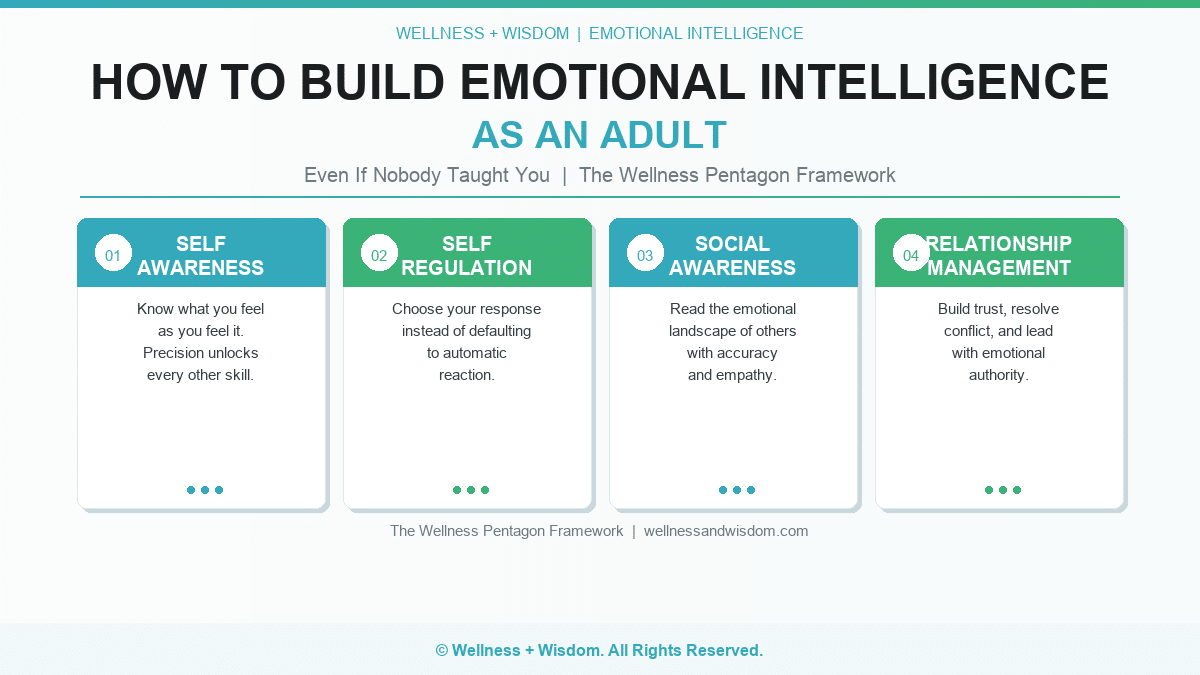
Daniel Goleman later popularized the concept for mainstream audiences in his landmark 1995 book, translating the academic framework into four practical competencies: self awareness, self regulation, social awareness, and relationship management. His version is more accessible and has been widely adopted in leadership development, organizational psychology, and education. Goleman's critics, including Mayer and Salovey themselves, argue his model blends emotional intelligence with personality traits and cognitive intelligence in ways that blur the scientific boundaries. Both perspectives offer something valuable. The academic model gives us precision. Goleman's model gives us a practical map.
What emotional intelligence is NOT is worth clarifying, because misconceptions about this are exactly what keep some adults from taking it seriously. Emotional intelligence is not being perpetually nice. It is not avoiding hard conversations. It is not crying at commercials or spending hours processing every feeling. Highly emotionally intelligent people are sometimes direct, even blunt. What distinguishes them is not softness but skill: they know what they feel, they understand why, they can regulate their state effectively, and they can read and navigate the emotional landscape of other people with both empathy and intention.
The data on why emotional intelligence matters is substantial. A comprehensive 2026 review published in Sage Journals examined emotional intelligence and leader outcomes across thousands of subjects and found strong correlations with performance, team effectiveness, and individual wellbeing. Data from organizational research shows that emotional intelligence accounts for 58 percent of job performance across all role types, and that 90 percent of top performers in any field score high in emotional intelligence. The good news embedded in all of this is simple: emotional intelligence is a learnable skill, not a fixed trait. You build it. Deliberately. Over time.
The Neuroscience: Your Adult Brain Can Still Learn This
One of the most transformative shifts in modern neuroscience is the collapse of the old belief that the adult brain is essentially fixed. We now know with considerable certainty that this is not true. The adult brain retains what researchers call neuroplasticity: the capacity to form new neural connections, reorganize existing ones, and literally reshape its structure in response to experience, practice, and intention.
This matters enormously when we talk about emotional intelligence adults are trying to develop. It means the window for emotional growth does not close at puberty or at thirty or at any other milestone. It remains open throughout your life.
A pivotal study accessible through PubMed Central examined emotion regulation and its relationship to brain plasticity. The research demonstrated that consistent emotional regulation practice produces measurable changes in the prefrontal cortex, the region of your brain most responsible for executive function, considered decision making, and impulse control. Adults who engaged in regular mindfulness and cognitive reappraisal practices showed increased grey matter density in emotional regulation centers of the brain. Put simply: your brain can grow new emotional circuitry.
A 2025 study in Frontiers in Behavioral Neuroscience extended these findings further, examining how explicit emotion regulation strategies produce neuroplastic changes even in adults who experienced significant early trauma. Both cognitive reappraisal (changing how you interpret a situation) and acceptance based approaches (allowing feelings without fighting them) produced measurable neural changes in adult subjects. The study concluded that the neurological substrate for emotional learning remains responsive throughout adult life.
What drives these changes? Three mechanisms appear most consistently in the research:
- Regular mindfulness meditation, which increases neurogenesis and synaptic plasticity in areas governing self awareness and emotional regulation
- Cognitive reappraisal practice, which trains the prefrontal cortex to intervene more effectively when the amygdala, your brain's threat detection system, activates
- Consistent interpersonal repair work, which builds the social neural circuits governing empathy, attunement, and relational trust
The key word across all three is consistent. Neural system rewiring is cumulative. Each time you pause before reacting, each time you name a feeling accurately, each time you choose curiosity over defensiveness in a difficult conversation, you are laying down a new neural pathway. Over weeks and months, those pathways become highways. The latest podcast episodes include deep conversations with neuroscientists who explain this process in ways that will make it feel real and actionable for you.
The neural system connection matters here in a specific way. Many people think of emotional regulation as a purely psychological process, something that happens in the mind. But emotion is a full body event. Your neural system, the intricate network connecting your brain to your body, carries emotional information in both directions. Learning to work with your body's signals is not separate from developing emotional intelligence. For adults, it is often the fastest entry point into genuine emotional skill.
Emotional Intelligence and the Wellness Pentagon
At Wellness + Wisdom, we use a framework called the Wellness Pentagon to map the five interconnected dimensions of a genuinely healthy human life: Physical, Mental, Emotional, Spiritual, and Financial wellness. These are not separate categories. They are a living, dynamic system. When one dimension is chronically underdeveloped, the others are pulled toward dysfunction in its wake.
In my experience working with thousands of people over the past decade, the Emotional dimension is the one most often sitting at the center of systemic imbalance when someone feels stuck across multiple areas of life. Here is why:
Physical wellness suffers when emotions are chronically suppressed or unprocessed. Unmetabolized feelings live in the body as muscle tension, inflammation, disrupted sleep, and compromised immune function. The field of psychoneuroimmunology has documented extensively how emotional states generate direct physiological consequences at the cellular level. What you feel affects how your body functions, period.
Mental wellness suffers when emotional intelligence is low. Emotional dysregulation is one of the primary drivers of anxiety, depression, and chronic stress. When you cannot accurately identify what you feel, you cannot address what is actually wrong. You end up in cycles of rumination, avoidance, and reactivity that compound over time.
Spiritual wellness suffers when emotional intelligence is underdeveloped, because authentic connection to something larger than yourself requires honest self knowledge. You cannot surrender to meaning or live in genuine alignment with your values if you are constantly managed by emotional states you cannot recognize or regulate.
Financial wellness suffers in ways that are underappreciated. Emotional reactivity drives impulsive spending, fear based financial paralysis, and the kind of scarcity thinking that keeps people making the same financial decisions over and over regardless of outcome. Studies consistently link emotional dysregulation to poor financial decision making under stress.
The inverse is equally true and far more interesting. When you build genuine emotional intelligence, every other dimension of the Wellness Pentagon begins to improve alongside it. Relationships improve. The body relaxes. Mental clarity increases. Meaning deepens. Financial decisions get more intentional. This is why developing emotional intelligence as an adult is not a personality enhancement project. It is a foundational life upgrade that touches everything. The programs we offer at Wellness + Wisdom are built around this interconnected reality from the ground up.
The Four Pillars of Emotional Intelligence You Can Build Now
Drawing on both the Mayer Salovey academic framework and Goleman practical model, here are the four core competencies you can develop as an adult. Each builds on the last, and the sequence matters.
Pillar 1: Self Awareness
Self awareness is the foundation, and without it the other three cannot hold. It means knowing what you feel as you feel it, reading the physical signals like the tight chest or the dropping stomach, and having a vocabulary precise enough to tell frustration from disappointment. Most adults use only a few emotion words. Psychologists call precise naming emotional granularity, and research links it to stronger regulation, because the act of naming a feeling begins to metabolize it. In my own journey, learning to see these patterns honestly was the most transformative shift I made. You cannot change what you cannot see.
Pillar 2: Self Regulation
Self regulation is managing your emotional states rather than being managed by them. It is not suppression. It is feeling what you feel, processing it honestly, and choosing your response. The neural system is central here. When the amygdala reads a threat, whether a lion or an email from your boss, it floods you with stress chemistry that makes calm response hard. Regulation trains the prefrontal cortex to pause, breathe, and reframe. Our BREATHE: Breath and Wellness program is built around this pillar, because breathwork is the most direct tool we have for real time neural system regulation.
Pillar 3: Social Awareness
Social awareness is empathy in its most precise form, accurately perceiving another person emotional experience without losing yourself in it. Socially aware people read nonverbal cues, hear the subtext, and notice when someone says I am fine while their posture says otherwise. It grows as self awareness deepens, which is why the sequence matters, start inside, then expand outward. On the conscious parenting solocast, I explore how social awareness in family life is one of the highest leverage skills an adult can build.
Pillar 4: Relationship Management
The fourth pillar is where the others converge in action. Relationship management is using self awareness, regulation, and social awareness together to communicate clearly, handle conflict, and build trust that holds through real difficulty. Adults strong here lead with authority, parent with presence and boundaries, and partner with honesty and care. This is not a soft skill. The research on organizational performance and health outcomes points to it as one of the most consequential competencies we develop, and it is built one honest interaction at a time.
Emotional Awareness Practice: Where to Begin
The most common mistake adults make is trying to overhaul their entire inner life in a weekend. Emotional skills are built through repetition, not revelation. Here are four foundational practices to begin with.
The Morning Emotional Check In
Before you open your phone, take two minutes to notice what you actually feel, not what you think you should feel. Name it, and if more than one feeling is present, even better. Research on emotional granularity shows that accurately labeling an emotion reduces its physical intensity within minutes. It is a short pause at the threshold of your day to meet your inner life before the world starts pulling on you.
The Body Scan for Emotional Information
Emotions are physical events before they are conscious ones, and your body knows what you feel before your mind does. Once a day, scan slowly from head to feet and notice tightness, warmth, or ease. Anxiety often lives in the chest and throat, grief in the heart and upper belly, anger in the jaw and hands, shame in the lower belly. Over time you build a precise personal map of how your body speaks emotion.
The Emotional Vocabulary Expansion Practice
When you feel something, resist labeling it simply bad or off and push for specificity. Are you melancholy or depleted, irritated or furious, nervous or terrified? Each distinction carries different information about what you actually need. A rich emotional vocabulary is not being overly emotional, it is precision, and precision enables skilled action. The Wellness + Wisdom blog has more on this.
The Pause and Name Technique
In the moment of activation, name what is happening internally. I am noticing anger. There is fear here. This simple labeling activates the prefrontal cortex and reduces amygdala reactivity. Research by neuroscientist Matthew Lieberman at UCLA on affect labeling shows that putting feelings into words produces measurable drops in amygdala activity. You are using language to regulate your neural system, and it works.
Learn Emotional Intelligence: A Month by Month Framework
If you are committed to learning emotional intelligence as an adult, here is a realistic progression. Think of it like physical training, consistent effort over time produces lasting structural change.
Month 1: Foundation Through Self Awareness
Spend the first month entirely on self awareness. Do the morning check in daily, keep a brief evening feelings journal, and expand your emotional vocabulary. Do not try to change anything yet. The goal is honest insight into your patterns, including the ones you would rather not see. By month end most people catch emotions earlier, creating the sliver of space between stimulus and response that Viktor Frankl called the territory of freedom.
Month 2: Building Self Regulation
Month 2 focuses on regulation, and this is where breathwork becomes central. Practice one conscious breathing technique daily, box breathing, the physiological sigh, or the four seven eight pattern all have research support. Use the pause and name technique in real time, and develop intentional responses to your most consistent triggers. The Wellness + Wisdom store has tools designed for this stage.
Month 3: Expanding Outward
With self awareness and regulation underneath you, Month 3 opens to social awareness and relationships. Practice genuine active listening once a day, use pause and name before responding in conflict, and express your own feelings clearly to people you trust. Building from the inside out, in sequence, with daily consistency produces more lasting change than working all four pillars at once. The L.I.F.E. Method program walks you through exactly this with guidance and community.
Common Blocks When You Try to Learn Emotional Skills
Even with a clear framework, most adults hit predictable obstacles. Here are the common ones and how to work through each.
I Am Not That Kind of Person
Many adults, especially men raised in emotionally restrictive cultures, believe emotional intelligence is for other people. It is simply inaccurate. These are cognitive skills grounded in neuroscience, equally accessible regardless of gender or personality. Some of the most emotionally intelligent people I know are veterans, elite athletes, and executives who chose to build these skills because they understood how much they mattered.
Fear of Vulnerability
If you were taught that emotional expression is weakness, even private honesty can feel threatening. Start smaller than you think you need to. The morning check in is completely private, so build a relationship with your own emotional world before sharing it with anyone. Trust, including trust in yourself, is built gradually.
Overwhelm With Strong Feelings
Some people avoid awareness because when they start paying attention, what is there is large, grief held for years or anger compressed for decades. This deserves real support. If opening up surfaces more than you can process alone, please work with a therapist or somatic practitioner. Asking for the right help is itself an emotionally intelligent move.
Impatience With the Process
We live in a culture of instant results, and emotional skill is a slow practice. The neural rewiring takes weeks and months, not days. If you are still reacting the old way two weeks in, remember you are building new neural architecture. Trust the accumulation. The Liberated Life Tribe exists for exactly those moments of discouragement.
Frequently Asked Questions About Building Emotional Intelligence as an Adult
Can adults really learn emotional intelligence, or is it fixed by childhood?
Adults can genuinely learn emotional intelligence. This is one of the most important and hopeful findings in modern neuroscience. The adult brain retains neuroplasticity throughout life, meaning it can form new neural connections and reorganize emotional circuits with consistent practice. While early childhood experiences do shape our initial emotional patterns and predispositions, peer reviewed research across multiple institutions confirms that structured training, breathwork, mindfulness, and daily emotional awareness practices produce measurable improvements in EQ across adult populations of all ages and backgrounds. The process takes longer than it would have in childhood, and it requires sustained daily effort, but it is entirely real and entirely achievable. The emotional skills you did not learn as a child are available to you right now.
How long does it take to see real improvement in emotional intelligence?
Most people begin noticing meaningful shifts within four to eight weeks of consistent daily practice. These early shifts tend to appear first in self awareness: catching emotions earlier in the escalation cycle, naming them more accurately, and having a brief window of conscious choice before reacting where no such window existed before. Deeper changes in social awareness and relationship management typically emerge over three to six months of sustained practice. Research on neuroplasticity confirms that the brain changes underlying these improvements accumulate gradually rather than suddenly. Brief daily practice sustained over months consistently outperforms intensive periodic workshops in producing lasting change. Patience is not passive. In emotional development, patience is itself a practice.
What is the single most important emotional skill to develop first?
Self awareness is the foundational skill without which the others cannot fully develop. Before you can regulate your emotions, you need to be able to accurately perceive and name what you are feeling. Before you can read others' emotional states with accuracy, you need fluency in reading your own. Before you can manage relationships skillfully, you need a clear, honest map of how your own emotional patterns operate. Start with the self awareness practices described in this article: the morning check in, the body scan, the emotional vocabulary expansion, and the pause and name technique. Everything else builds on what you establish here. Do not rush to the social skills before you have built the inner foundation.
Is emotional intelligence the same thing as being a highly emotional person?
No, and this is an important distinction. Emotional intelligence and emotional intensity are entirely different dimensions. Some highly emotionally intelligent people are naturally calm and not particularly expressive. Some very emotionally intense people have low EQ because they are reactive and struggle to regulate or accurately understand what they are experiencing. Emotional intelligence is about accuracy and skill, not intensity or expressiveness. It means knowing what you feel, understanding why you feel it, managing those feelings effectively, and navigating the emotional landscape of relationships with both empathy and intentionality. You can be a quiet, reserved person and have very high emotional intelligence, or you can be dramatically expressive and have quite low EQ. The two are not reliably correlated.
How does emotional intelligence connect to mental health?
The relationship between emotional intelligence and mental health is bidirectional and clinically significant. Higher emotional intelligence is consistently associated with lower rates of anxiety, depression, and stress related illness, as well as greater resilience when mental health challenges do arise. This is partly because people with stronger EQ recognize emotional distress earlier, seek appropriate support more readily, process difficult experiences rather than suppressing them, and maintain the meaningful social connections that serve as some of the most powerful protective factors for mental health. At the same time, active mental health challenges can temporarily reduce EQ functioning, particularly in the areas of emotional regulation and social awareness under stress. Supporting both simultaneously, which good therapy and practices like breathwork do, accelerates progress in both directions.
What role does the body play in developing emotional intelligence?
The body plays a central role that most traditional approaches to emotional intelligence dramatically underemphasize. Emotions are first and foremost physical events: changes in neural firing, hormonal secretion, muscle tension, heart rate variability, and breathing patterns. The felt sense in the body is often the earliest and most accurate signal of what you are experiencing emotionally, arriving before conscious awareness has caught up. Practices that develop body awareness, including breathwork, somatic therapy, yoga, qigong, and body scanning, are therefore among the most effective tools for building emotional intelligence in adults. The neural system connection between your body and your emotional experience is direct and immediate. Learning to read and work with your body is not supplementary to developing emotional intelligence. For most adults, it is the most powerful entry point available.
Your Emotional Intelligence Journey Starts Here
What you have just read is a beginning. The real transformation happens in practice, in community, with the right tools around you and people who understand what you are building.
The Liberated Life Tribe is where adults who are serious about building genuine emotional intelligence, healing inherited patterns, and living from authentic joy come to do that work together. When you join, you receive the 10 Day Self Liberation Blueprint, a step by step experience designed to establish the foundational practices of emotional freedom in your daily life.
Join the Liberated Life Tribe and Get Your 10 Day Self Liberation Blueprint
You can also explore the full range of programs available through the Liberated Life Tribe, or view all pricing and program options here. For more conversations on emotional intelligence, neural system health, conscious relationships, and the science of human transformation, subscribe to the Wellness + Wisdom Podcast wherever you listen to podcasts.
Studies and External Resources
The science in this article rests on peer reviewed research and authoritative resources. These are the studies and sources referenced throughout.
- Emotion regulation and brain plasticity: expressive suppression use predicts anterior insula volume. Neuroimage, 2011. PubMed Central: 3161031
- Read the full study. View source via Frontiers
- Read the full study. View source via Frontiers
- Experiences of childhood emotional maltreatment and emotional intelligence in young women. Front Psychiatry, 2025. PubMed Central: 12271162
- Read the full review. View source via SAGE
About Josh Trent
Josh Trent is an Identity Transformation Architect and the award winning host of the Wellness + Wisdom Podcast, with over 15 million downloads since 2015. He is the creator of the L.I.F.E. Method™ Identity Transformation System and steward of the Emotional Epigenetics™ and BREATHE: Breath + Wellness™ systems of self mastery, impacting over 1,000 students worldwide. Josh lives in Austin, Texas with his wife Carrie, daughter Nayah, and son Novah. Read Josh's full story here.
Ready to begin? Join the Liberated Life Tribe and receive your 10 Day Self Liberation Blueprint at liberatedlife.com.
Disclosure: We may earn a commission from certain links on this site when you make a purchase, at no extra cost to you. These commissions help support Wellness + Wisdom and do not affect the products or resources we choose to recommend. Full disclosure .