
By Josh Trent | April 9, 2026 | Spirituality
“The patterns you inherited were survival strategies. The ones you choose now are liberation strategies. That is the difference between being a product of your lineage and being the author of it.”
Learning how to break generational curse patterns begins with one honest question. If you have ever looked at a pattern in your life and thought, where did this even come from? you are asking exactly the right question. The anxiety that tightens in your chest before a difficult conversation. The way money always seems to disappear. The relationship cycles that feel like reruns of your parents' marriage. These are not character flaws. They are inherited programs, written into your biology long before you arrived on the planet, and the good news is this: you can absolutely break a generational curse once you understand what it actually is and how it actually works.
I know, because I have lived it. I have also spent years studying the science and hosting over 800 conversations on the Wellness + Wisdom Podcast with researchers, therapists, epigeneticists, and healers who have dedicated their lives to understanding how ancestral patterns transmit across generations and, more importantly, how those patterns can be interrupted, transformed, and replaced with something entirely new.
The framework that ties all of this together is what I call Emotional Epigenetics, and in this article I am going to walk you through both the science and the practice so that you leave here with a real roadmap. Not theory. Not wishful thinking. A path that begins with awareness and moves, step by step, into the embodied transformation your whole lineage has been waiting for.
What Science Reveals When We Ask How to Break a Generational Curse
The phrase “generational curse” comes from religious and spiritual traditions, but science has spent the last three decades catching up to what those traditions intuitively understood: the wounds of one generation do not stay contained in that generation. They travel. They reshape biology. And they show up in children and grandchildren who never experienced the original trauma themselves.
This is not metaphor. It is epigenetics.
The field of epigenetics studies how environmental experiences, emotional states, chronic stress, and trauma can chemically alter the way genes are expressed without changing the underlying DNA sequence itself. Think of your DNA as the hardware and your epigenome as the software. Trauma and chronic stress rewrite the software. Then that rewritten software gets passed on.
Emotional Epigenetics: The Framework That Changes Everything
In my work, I teach a concept called Emotional Epigenetics, which brings together three converging forces that shape your genetic expression:
- Emotional Patterns: The bioenergetic memory your cells carry, the inherited emotional responses that activate before your conscious mind can intervene, and the trauma imprints that live in your body as sensation and behavior.
- Unconscious Beliefs: The inherited mindset, the limiting beliefs coded in before you were old enough to question them, and the negative conditioning that has shaped your sense of what is possible and what is safe.
- Environment: The epigenetic signals sent by your lifestyle, relationships, community, nutrition, breathwork practice, and even the quality of your attention every single day.
All three of these forces converge to determine which genes get switched on and which stay silent. A landmark 2026 study published in Frontiers in Psychiatry documented specific epigenetic changes associated with multigenerational trauma, including accelerated biological aging and sex specific DNA methylation patterns in the NR3C1 gene, which is the gene that regulates your stress response. What the researchers found matters enormously: these changes showed up across three generations from the original traumatic exposure. Three generations. That means the person who is suffering today may be expressing a chemical signature that was written before they were born.
The NR3C1 gene governs glucocorticoid receptors, the molecular machinery that tells your body how to respond to stress. When that gene is hypermethylated from ancestral trauma, your neural system runs hotter than it should. You experience anxiety as a baseline, not as a response to a real threat. You feel danger in neutral moments. You interpret safe relationships as risky. This is not weakness. This is inherited software that was never updated.
The FKBP5 gene, also implicated in this research, modulates the HPA axis, which is your body's central stress regulation circuit. The OXTR gene, which governs oxytocin signaling, affects your capacity for social bonding and trust. These three genes together form something like a generational legacy of how your ancestors survived, encoded in your cells, waiting for you to either reinforce the pattern or rewrite it.
Here is what makes this worth celebrating: the same science that explains how patterns get encoded also explains how they can be released. Epigenetic marks are not permanent. The research on mindfulness, breathwork, and somatic practice consistently shows that these interventions can measurably alter methylation patterns on exactly these genes. The prison has a door. The L.I.F.E. Method is one of the keys.
The Latest Research Confirms Breaking Family Cycles Is Biologically Possible
April 2026 is a significant moment in the science of intergenerational trauma. Multiple independent research teams are publishing findings that reinforce the same truth: breaking family cycles is not a poetic hope. It is a biological fact, and it is happening at the level of DNA methylation, oxytocin signaling, and HPA axis function in people who commit to healing work.
The Syrian Refugee Study That Changed How We See Inherited Pain
A groundbreaking 2025 paper in Nature Scientific Reports examined three generations of Syrian refugee families and documented the first ever report of an intergenerational epigenetic signature of violence exposure. The researchers identified 14 differentially methylated regions associated with germline exposure to violence, meaning patterns that showed up in children who were conceived after their parent's trauma, not during it. They also found 21 additional regions associated with direct exposure, and most of these regions showed the same directional change across all three generations.
What this tells us is that the emotional and biological impact of violence, displacement, and chronic fear does not stay with the person who experienced it. It becomes a heritable pattern. Children and grandchildren carry epigenetic signatures of events they never personally witnessed.
Now here is the hope embedded in that finding: if a pattern can be encoded through lived experience, it can be decoded through a different kind of lived experience. That is exactly what intergenerational healing is. It is a new set of experiences, embodied, practiced, and sustained, that writes a different message into the same genetic machinery.
What Holocaust Survivor Research Reveals Three Generations Later
A companion study from the same journal examined the third and fourth generation descendants of Holocaust survivors and found measurable epigenetic variation in the oxytocin system, specifically in the OXTR gene, along with documented HPA axis alterations and sympathetic neural system dysregulation. These individuals showed psychological patterns and biological signatures that traced directly to trauma their grandparents and great grandparents experienced.
But here is what the researchers also found, and this is the part that matters most: the quality of social and emotional bonds within these families served as a significant protective factor. The families that maintained strong intergenerational emotional connection showed less severe epigenetic impact. Love, expressed through secure attachment and attuned relationship, is itself an epigenetic intervention.
This is not soft science. Pioneering researcher Rachel Yehuda and her team at Mount Sinai demonstrated in their foundational 2016 study, which you can read at PubMed ID 26410355, that Holocaust survivors passed measurable FKBP5 gene methylation changes to their children. These changes were not present in Jewish families who had not experienced the Holocaust, which confirmed that the transmission was specifically linked to the traumatic exposure, not to ethnic or demographic factors.
And in one of the most celebrated studies in behavioral epigenetics, researchers Dias and Ressler demonstrated in 2014 that a fear response associated with a specific scent could be passed to the next two generations of mice through epigenetic inheritance. The offspring had never smelled the scent in a threatening context. They had never been conditioned. But they were born already fearing it. The fear was in their genes.
The extinction of that fear response, meaning the reversal of the inherited pattern, was also documented. New experiences, consistently and safely offered, rewrote the epigenetic code. Healing is not just possible. It is biologically designed into the system. The Wellness Pentagon framework I teach holds this as a foundational truth: every dimension of your wellbeing participates in the healing process.
Awareness Is the First Door You Walk Through to Break Generational Curse Patterns
Science tells us the pattern exists. Spirituality tells us we can transcend it. But awareness is the bridge. You cannot change what you cannot see, and most generational patterns operate entirely below the threshold of conscious awareness. They feel like personality. They feel like instinct. They feel like just the way life is. The work of awareness is to realize: this is not just the way life is. This is the way your family has survived, and there is a different way available to you now.
How to Recognize Generational Patterns in Your Own Life
Generational patterns do not announce themselves with a sign. They show up as recurring themes that seem inexplicably familiar, even in brand new situations. Here are some of the most common ones I encounter in the Liberated Life Tribe community and in my own life:
- Financial contraction: A persistent sense that money is unsafe, scarce, or tied to shame. An inability to hold wealth even when income improves. This often traces to a grandparent or a grandparent of a grandparent who lived through depression, poverty, or economic violence.
- Relational hypervigilance: Scanning for rejection or betrayal in relationships that are actually safe. Difficulty trusting partners, friends, or community. Often traces to a pattern of abandonment or relational unpredictability in earlier generations.
- Achievement as survival: Compulsive productivity rooted not in joy but in a deep fear that rest equals failure or worthlessness. Often inherited from parents or grandparents who used work as the primary safety strategy.
- Emotional shutdown: The inability to access or express a full emotional range. Inherited from environments where big feelings were dangerous, ridiculed, or simply never modeled.
- Spiritual disconnection: A feeling of being fundamentally separate from something greater, even when surrounded by beauty and love. Often rooted in ancestral religious trauma or intergenerational grief that was never processed.
When you look at this list, do any of them feel uncomfortably familiar? That recognition is not cause for despair. It is the beginning of awareness. And awareness, as I have seen across thousands of healing conversations, is the moment the cycle begins to turn.
The Three Questions That Begin the Awareness Process
When I work with people on identifying their inherited trauma and generational patterns, I offer three foundational questions. These are not therapy exercises to rush through. Sit with them. Journal them. Let them breathe.
Question one: Where in your life does your reaction feel disproportionate to the actual situation? This gap, between what is happening and how intensely your system responds, is often where a generational pattern is living.
Question two: What did your parents or grandparents believe about love, money, safety, or God that you absorbed before you could evaluate it? Not what they said they believed. What they demonstrated through their behavior, their silences, and their fears.
Question three: If you could write a letter to the version of yourself that was seven years old, what would you want that child to know that nobody told them? The answer to that question is usually the exact thing a generation before you also did not know, and also needed.
These questions move you from simply experiencing a pattern to witnessing it. That witnessing is the beginning of choice. And choice is the foundation of conscious parenting and conscious living.
Embodiment Transforms Intergenerational Healing from Insight to Freedom
Here is the hard truth that most healing content will not tell you: awareness alone will not break a generational curse. I have worked with deeply insightful people who understand their patterns intellectually with absolute clarity. They can name the inherited belief. They can trace it through three generations. They can explain the epigenetic mechanism. And then they find themselves doing the exact same thing their parents did, because the body has not caught up with the mind.
This is not failure. This is the nature of how patterns are stored.
Why the Body Holds What the Mind Has Already Understood
Generational patterns are not stored in your prefrontal cortex, the part of your brain where rational thought and insight live. They are stored in your limbic system, your brainstem, your fascia, your gut, and the electrochemical signaling of your neural system. They live below the reach of most talk based therapies. You can spend years in conversation about a pattern and still find your body activating it without permission, because the body has its own memory, and it is older and faster than your thoughts.
This is why the somatic revolution in healing has accelerated so dramatically in 2026. The Psychotherapy Networker's Somatic Trauma Healing Summit this spring reflects what practitioners have been confirming for years: healing has to happen in the body, not just in the story about the body. It has to be felt, moved, breathed, and metabolized at the cellular level. This is what somatic healing makes possible.
Breathwork as the Bridge Between Awareness and Embodied Change
Of all the embodiment practices I have studied and personally used, breathwork stands alone as the most direct bridge between conscious awareness and cellular transformation. Here is why: the breath is the only system in your body that is simultaneously automatic and consciously controllable. It runs on its own when you sleep. It responds to your neural system state without asking permission. And it responds to your conscious direction in real time, which means through your breath you have a lever into your autonomic neural system, into the very system that has been running your inherited stress responses for decades.
In my BREATHE program, I teach breath as the primary tool for neural system regulation and for accessing the stored bioenergetic memory that lives below conscious thought. When you breathe in specific patterns, you activate the parasympathetic branch of your neural system, you lower cortisol, you create the biochemical conditions under which new epigenetic signals can be written. You are not just relaxing. You are communicating safety to a neural system that has been coded for threat.
The research on this is consistent and growing. The 2025 Frontiers in Psychiatry review of clinical epigenetics documented that mindfulness based interventions can measurably reduce methylation of the FKBP5 and SLC6A4 genes, the same genes implicated in inherited stress vulnerability. Your breath practice is not a luxury. It is epigenetic medicine.
The L.I.F.E. Method: A Roadmap for Embodied Transformation
The L.I.F.E. Method I developed is a four part framework for identity transformation that addresses generational patterns at the level of the body, the belief system, and the soul. The four pillars are Love, Integration, Forgiveness, and Embodiment, and each one addresses a different layer of the inherited pattern:
- Love is the energy that makes it safe to look at what was previously too painful to see. It is the compassionate witness you become to your own inherited experience.
- Integration is the process of bringing fragmented parts of your history into a coherent whole, including the parts that came before you were born.
- Forgiveness is not the same as condoning. It is the act of releasing the energetic charge that keeps you tethered to the pattern. Forgiveness is the epigenetic reset.
- Embodiment is where the transformation becomes permanent. It is the living practice that writes the new code into your cells every day.
When someone completes the six week L.I.F.E. Method program, they do not just feel different. They behave differently. Their relationships change. Their relationship to money changes. Their children report that something is different about them. This is not coincidence. It is the downstream effect of cellular transformation working its way outward into every dimension of a life.
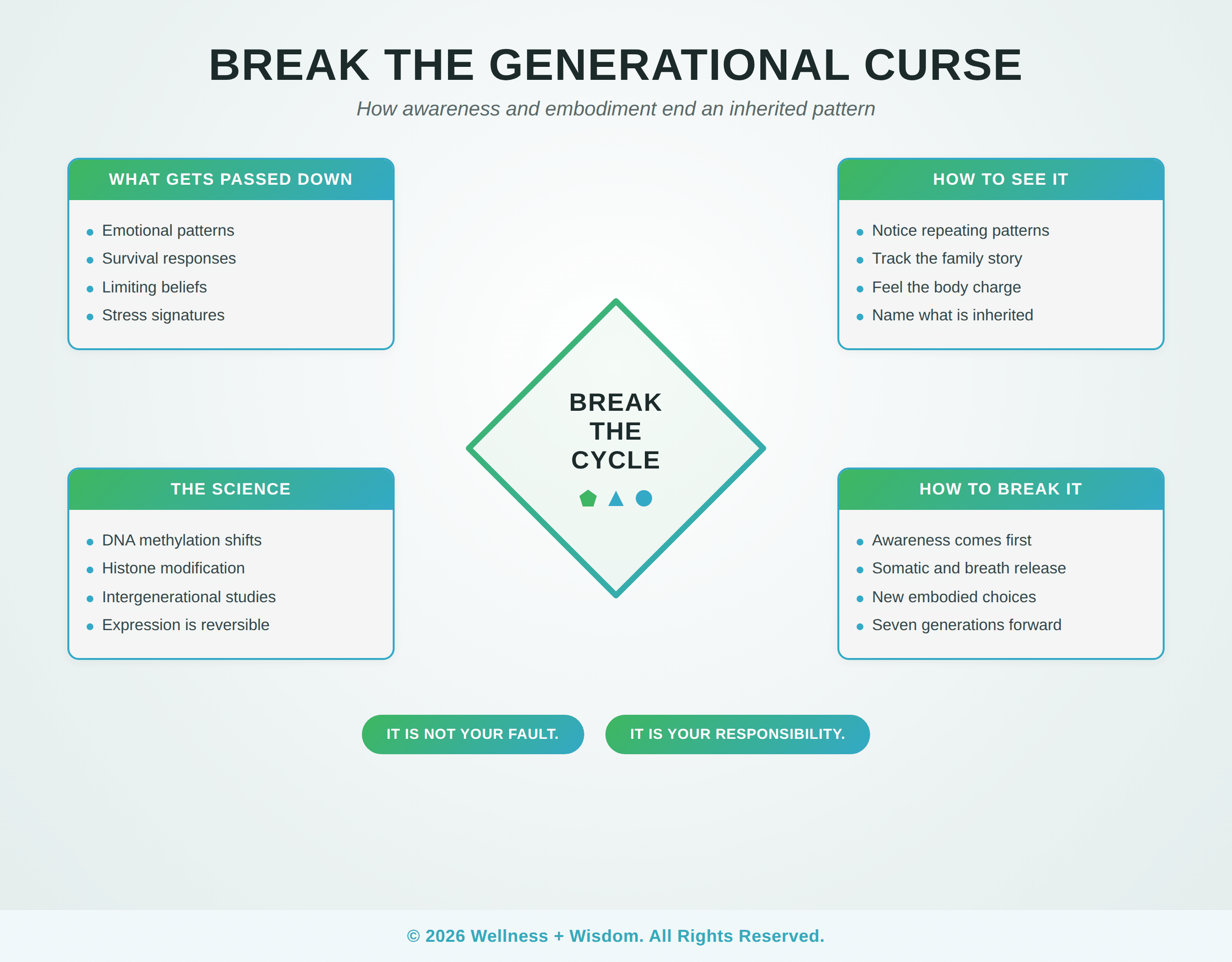
Five Practices That Break Generational Patterns at the Cellular Level
Understanding is not transformation. Practice is transformation. What follows are five specific practices that, used consistently, create the conditions for genuine epigenetic change. These are the practices I return to personally and that I teach across all of my work, including in the conversations about conscious parenting that have become some of the most listened to episodes on the podcast.
Practice One: Somatic Inquiry
Somatic inquiry is the practice of asking your body questions and listening to its answers through sensation rather than thought. It sounds simple. It is profoundly powerful.
The practice begins by sitting quietly, placing one hand on your chest and one on your belly, and asking: Where in my body do I feel my family's anxiety? or Where does my inherited fear of scarcity live? You are not looking for a cognitive answer. You are looking for a physical sensation, tightness, heat, constriction, numbness, weight. Whatever your body offers is the truth of where the pattern is stored.
Once you can locate it in the body, you breathe into it. You stay with it without trying to change it or fix it. You let it know it has been seen. This is what the body has been waiting for. It has been running the pattern in large part because nobody ever came to acknowledge it. When you show up as a witness to your own somatic experience, you begin the process of metabolizing what was stored.
The practice of somatic inquiry is the foundation of the healing work I have written about across dozens of articles and teach in every program I run. It is accessible to anyone, anywhere, at any time. No equipment required. No therapist needed to begin.
Practice Two: Ancestral Acknowledgment Breathwork
This is a specific breathwork protocol I have developed over years of teaching and personal practice. It combines conscious breathing with intentional ancestral acknowledgment, and it works because it engages both the body and the relational field simultaneously.
The practice takes approximately 20 minutes. Find a comfortable position, either lying down or seated with a straight spine. Begin breathing in a connected rhythm, meaning the exhale flows directly into the next inhale without a pause, and the inhale flows directly into the exhale without holding. This connected breathing style activates the limbic system and allows suppressed emotional material to surface safely.
As you breathe, bring to mind a specific ancestor. It does not have to be someone you knew. It can be your grandmother's grandmother whose name you barely know. Breathe with the intention of acknowledging what she carried. You are not taking on her burden. You are witnessing it. You are completing a circuit of recognition that was left open.
At the end of the session, speak aloud or silently: I see what you carried. I honor your survival. What belonged to you, I return to you with love. What is mine, I choose to carry differently.
This is not ritual for ritual's sake. It is a precision tool for shifting the emotional relationship between your present neural system and the inherited material living in your cells.
Practice Three: Daily Neural System Regulation
You cannot do deep healing work from a dysregulated neural system. This is not an opinion. It is neuroscience. When your system is in a chronic state of activation, the prefrontal cortex goes offline, the limbic system dominates, and you are neurologically incapable of integrating new information at the depth required for lasting change.
Daily neural system regulation is the prerequisite to everything else. And it does not have to be complicated. Twenty minutes of conscious breathwork in the morning. Cold water exposure to activate the vagal tone. Walking in nature without a phone. These are not wellness trends. These are ancient inputs that your biology is designed to respond to, inputs that signal safety to a neural system that has been running a generational emergency protocol.
I go deep on all of these tools in my neural system regulation resources, and the latest episodes of the Wellness + Wisdom Podcast feature some of the most forward thinking voices in this space. The data is clear: consistent daily practice is more transformative than occasional intense intervention. Small, repeated inputs of safety are what retrain a generational stress response.
Practice Four: The Forgiveness Protocol
Forgiveness is the most misunderstood practice in the healing space. People often refuse it because they confuse it with condoning what happened. To be clear: forgiveness is not an endorsement. It is not an erasure. It is a release of the energetic charge that keeps you physiologically bound to a wound, to a person, or to a generational story.
The forgiveness protocol I teach in the L.I.F.E. Method works in three layers. The first is forgiveness of the specific people in your lineage who caused harm, understanding that they too were operating from inherited wounds they did not choose. The second is forgiveness of yourself for every way you have unconsciously perpetuated the pattern. The third, and most profound, is forgiveness of the pattern itself, the release of any resentment you hold toward the inherited program that has been running your life without your full consent.
Research on the neuroscience of forgiveness confirms what every spiritual tradition has taught: unforgiveness keeps the HPA axis activated, which keeps cortisol elevated, which keeps the neural system in threat detection mode, which reinforces the exact epigenetic patterns you are trying to release. Forgiveness is not for the other person. It is, in the most literal biological sense, for you and for the seven generations after you.
Practice Five: Conscious Community as an Epigenetic Signal
You cannot heal your generational patterns in isolation. This is not a weakness. It is biology. Human beings coregulate their neural systems through relationship. When you are in the presence of people who are safe, attuned, and themselves doing healing work, your neural system receives a direct signal that it is safe to relax its inherited vigilance. That signal, repeated over time in the context of genuine community, is one of the most powerful epigenetic inputs available to you.
The Holocaust survivor research I referenced earlier confirmed this directly: strong social and emotional bonds within families served as significant protective factors against the epigenetic expression of inherited trauma. Your community is not a nice to have. It is a biological necessity for the work of breaking family cycles.
This is why I built the Liberated Life Tribe. It is a community of people who are doing exactly this work, who understand the language of Emotional Epigenetics, who show up for each other with the kind of consistent, safe, attuned presence that rewrites generational stress patterns. You can explore all of our community resources at wellnessandwisdom.com/tribe.
Seven Generations Forward: Why Your Healing Today Is the Greatest Gift
Here is something I want to leave you with that I find genuinely moving every time I think about it. The epigenetic patterns you are working to change right now will not just affect your life. They will affect the biology of your children, your grandchildren, and the generations after them who will not even know your name.
A remarkable 2026 study published in PNAS documented the stability of epigenetic transgenerational inheritance of disease and health outcomes across more than 20 generations in animal models. Both maternal and paternal lineages were shown to transmit epigenetic alterations that influence disease incidence and overall fitness across a multigenerational span. The study also documented that new pathologies can emerge in later generations that were not present in the ancestral exposure. Patterns compound. They deepen. They expand into new territory.
But here is the flip side of that science, and it is the one that sustains me in this work: the reversal of those patterns also compounds. When you do the work to regulate your neural system, when you choose awareness over automatic reactivity, when you practice forgiveness instead of passing on resentment, when you embody healing in your daily life, you are rewriting the software for every generation that comes after you. You are not just healing yourself. You are healing your lineage forward and backward in time.
The Indigenous concept of seven generations, the idea that our decisions today should account for their impact seven generations into the future, is not just a beautiful philosophy. It is now biologically defensible. Your healing is a gift that the great grandchildren of your grandchildren will receive without knowing where it came from. They will simply find that joy comes more easily, that trust feels more accessible, that love does not feel as dangerous as it once did for people who shared your blood.
That is what it means to break a generational curse. It means you are the one who chose to stop the inheritance of suffering and begin the inheritance of liberation. And as I have explored in depth in my work on the healing journey and in the resources we offer, the tools for this work are here, the community is here, and the science is with you.
You are not starting over. You are picking up where the healing left off, and where you put it down is exactly where it needs to go next.
Frequently Asked Questions About How to Break a Generational Curse
What exactly does it mean to break a generational curse?
Breaking a generational curse means interrupting the transmission of inherited emotional, behavioral, and biological patterns that have passed from one generation to the next within your family lineage. Through the lens of Emotional Epigenetics, this means changing the epigenetic markers, the chemical tags on your genes that determine how your stress response, emotional regulation, and relationship patterns operate. It is not a mystical act, though it can feel profound. It is a biological and psychological process of replacing inherited survival programs with consciously chosen ways of being. The work typically involves awareness of the patterns, embodied practices that release stored stress responses, and consistent community support that signals safety to a generationally conditioned neural system.
How do I know if I am carrying a generational pattern versus just my own personal wounds?
A reliable indicator is the quality of disproportionality in your reactions. When your response to a situation is significantly more intense than the situation objectively warrants, that gap is often where a generational pattern is operating. Another clue is when you recognize the same themes across multiple generations of your family, for example, a pattern of financial struggle, relationship abandonment, emotional shutdown, or specific fears that appear in your parents, grandparents, and yourself. Generational patterns also tend to feel like personality rather than preference. They feel like this is just who I am rather than this is something I learned. When I work with people on inherited trauma recognition, this shift in how the pattern feels, from identity to inheritance, is always the turning point.
Can you really change your epigenetics through practices like breathwork and meditation?
Yes, and the science is increasingly clear about this. Multiple peer reviewed studies have demonstrated that mindfulness practices and breathwork can measurably alter DNA methylation patterns on stress related genes including NR3C1, FKBP5, and SLC6A4. These are the same genes most commonly implicated in the inheritance of trauma related vulnerability. The Frontiers in Psychiatry 2025 clinical epigenetics review documented these changes with sufficient consistency to suggest that body based and mindfulness based interventions should be considered standard components of trauma informed care. What this means in practical terms is that when you commit to a daily breathwork and embodiment practice, you are not just managing your symptoms. You are potentially altering the epigenetic signals you will pass to your children.
How long does it take to break a generational curse?
This is the question I get asked most frequently, and the honest answer is that there is no single timeline. What I can tell you from both the research and from years of working with people in this space is that meaningful shifts in how you feel in your body, how you respond in relationships, and how you relate to inherited fears can happen within weeks of consistent practice. The deeper cellular and epigenetic changes accumulate over months and years of sustained practice. The six week L.I.F.E. Method program creates a powerful foundation, but the real work is a lifelong practice of choosing awareness and embodiment over automatic reactivity. Think of it less like a finish line and more like a daily commitment that compounds in value over time, much like the way the patterns themselves compounded in the first place.
Do I need to know the details of my ancestors' trauma in order to heal from it?
No. The body does not require a detailed history to begin releasing what it has stored. Many people who do profound intergenerational healing work do so with very limited information about what their ancestors actually experienced. The somatic practices of inquiry, breathwork, and neural system regulation work directly with what is stored in your body, not what is stored in family records. That said, when family history is available, it can deepen the awareness component of the work and help you understand the context of patterns that have felt inexplicable. But it is not a prerequisite. Your body already knows what needs healing. Your only job is to show up for it with consistent, compassionate attention.
What is the role of community in healing generational patterns?
Community is not supplementary to this work. It is structural. Human neural systems coregulate, meaning we literally regulate each other's stress responses through attuned presence, eye contact, voice tone, and physical proximity. When you are embedded in a community of people who are themselves regulated and healing, your neural system receives ongoing biological signals of safety that interrupt the generational hypervigilance cycle. The Holocaust survivor research was explicit about this: strong social and emotional bonds were measurable protective factors against the epigenetic expression of inherited trauma. The Liberated Life Tribe exists to provide exactly this kind of coregulating, healing community. It is built on the understanding that you deserve the kind of presence around you that your ancestors may never have had access to, and that this presence is itself the medicine.
Your Liberation Begins With One Decision
Breaking a generational curse is not something you do alone. It is something you do in community, with support, with science backed tools, and with the kind of accountability that makes the practice stick. The Liberated Life Tribe is exactly that community. Inside, you will find the Self Liberation Blueprint, a free 10 day guided journey that takes you through the foundational practices of awareness and embodiment that this article is built on.
Join thousands of people who are choosing, right now, to be the ones who changed the inheritance for every generation that follows them.
Join the Liberated Life Tribe and Receive Your 10 Day Self Liberation Blueprint at liberatedlife.com
Studies and External Resources
The science in this article rests on peer reviewed research and authoritative resources. These are the studies and sources referenced throughout.
- landmark 2026 study published in Frontiers in Psychiatry. View source via Frontiers
- Nature Scientific Reports. View source via Nature
- third and fourth generation descendants of Holocaust survivors. View source via Nature
- Holocaust Exposure Induced Intergenerational Effects on FKBP5 Methylation. Biol Psychiatry, 2016. PubMed: 26410355
- Parental olfactory experience influences behavior and neural structure in subsequent generations. Nat Neurosci, 2014. PubMed: 24292232
About Josh Trent
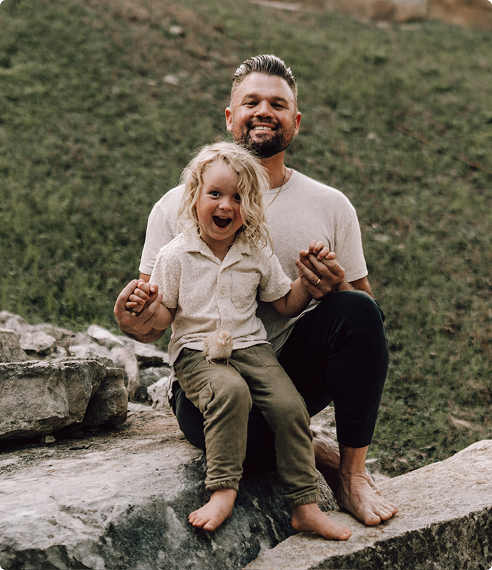
Josh Trent is an Identity Transformation Architect and the award winning host of the Wellness + Wisdom Podcast, with over 15 million downloads since 2015. He is the creator of the L.I.F.E. Method Identity Transformation System and steward of the Emotional Epigenetics and BREATHE: Breath and Wellness systems of self mastery, impacting over 1,000 students worldwide. Josh lives in Austin, Texas with his wife Carrie, daughter Nayah, and son Novah. You can explore all of his work and access free resources at wellnessandwisdom.com/tribe.
Disclosure: We may earn a commission from certain links on this site when you make a purchase, at no extra cost to you. These commissions help support Wellness + Wisdom and do not affect the products or resources we choose to recommend. Full disclosure .