
By Josh Trent | Wellness + Wisdom Podcast Host & Identity Transformation Architect
“The breath is the only system in your body that is both automatic and consciously controlled. That makes it the most powerful tool you own for rewiring your biology in real time.”
— Josh Trent
Table of Contents
- The Breath Bridge: How Breathwork Rewires Your Neural System
- The Dual Control System: Why Breath Is Uniquely Powerful
- Breathwork and the Vagus Nerve: Your Built In Reset Button
- The Science: How Conscious Breathing Changes Your Biology
- Breathwork and Stored Trauma: Accessing What Talk Cannot Reach
- Four Breathwork Techniques That Rewire Your Breathwork Neural System
- Breathwork Neural System Regulation vs. Medication: A Biological Comparison
- Breathwork Across the Five Dimensions of the Wellness Pentagon™
- Building Your Daily Breathwork Practice in 10 Minutes
- Frequently Asked Questions About Breathwork and the Neural System
- Studies and External Resources
- About Josh Trent
The Breath Bridge: How Breathwork Rewires Your Breathwork Neural System
I want to tell you something that changed everything for me. Before I understood the science of breathwork, I was a hostage to my own biology. My neural system was locked in a state of low grade hypervigilance that I thought was just who I was. Anxious. Reactive. Always scanning for the next threat. I had tried meditation, therapy, supplements, and exercise. All helpful. None transformative. Then I discovered that the breath is not just a relaxation tool. It is a direct communication channel to the neural system. And when I learned to use that channel intentionally, my entire biology shifted.
This is why I created the BREATHE™ program and why breathwork is the foundation of everything we teach at Wellness + Wisdom. The breathwork neural system connection is not metaphorical. It is anatomical, neurological, and measurable. When you change how you breathe, you change the signal your body sends to your brain about whether you are safe or in danger. And that signal determines everything: your hormones, your immune function, your gene expression, your emotional regulation, and your capacity to access the higher states of consciousness that the L.I.F.E. Method™ is designed to unlock.
If you have ever let out a long sigh without deciding to, you have already felt this. That involuntary sigh is your body reaching for the exhale it needs to reset itself. Breathwork is simply doing on purpose what your body already does by instinct, and doing it often enough that regulation becomes your default state rather than the rare exception.
The Dual Control System: Why Breath Is Uniquely Powerful
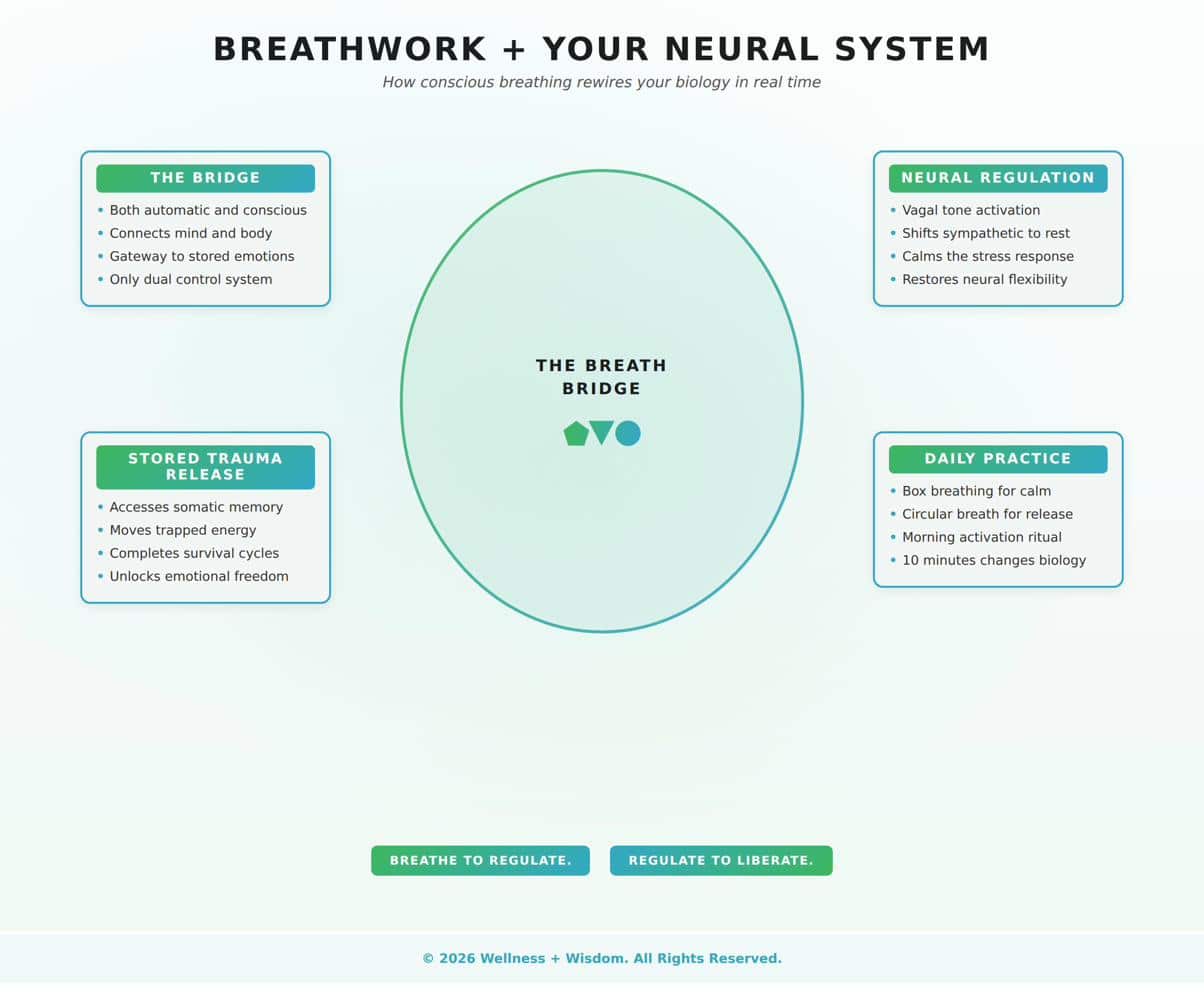
Here is what makes the breath different from every other biological system in your body. Your heart beats automatically. You cannot consciously slow it down. Your digestion runs on autopilot. Your immune system operates without your input. But your breath? Your breath is the only system that is both automatic and consciously controlled. This dual control makes it the most powerful interface between your conscious mind and your autonomic neural system.
When you breathe unconsciously, your neural system runs the show. If you are stressed, your breath becomes shallow and rapid, which signals danger to your brain, which releases more cortisol, which makes you more stressed. This is the stress breathing loop, and most people live inside it 24 hours a day without knowing it. But the moment you take conscious control of your breath, you interrupt that loop. You send a new signal to the brainstem that says: the environment is safe. And within 90 seconds, your entire neurochemistry begins to shift.
This is not a metaphor. Research published in Frontiers in Psychology demonstrates that slow, controlled breathing activates the parasympathetic branch of the neural system through vagal afferent pathways. Your vagus nerve, the longest cranial nerve in the body, runs from your brainstem through your lungs, heart, and gut. When you extend your exhale, you directly stimulate vagal tone, which downregulates cortisol, increases heart rate variability, reduces blood pressure, and shifts your neural system from sympathetic dominance to ventral vagal safety.
Breathwork and the Vagus Nerve: Your Built In Reset Button
The vagus nerve is the master regulator of your breathwork neural system. It is the physical hardware that determines whether your body is in fight or flight, freeze, or safety and connection. Polyvagal theory, developed by Stephen Porges, maps three states of the autonomic neural system. Ventral vagal is safety: social engagement, connection, creativity, rest and digest. Sympathetic is mobilization: fight or flight, cortisol, adrenaline, rapid heartbeat. Dorsal vagal is shutdown: freeze, collapse, dissociation, numbness.
Most people living with chronic stress, trauma, or inherited neural system patterns are oscillating between sympathetic activation and dorsal vagal shutdown. They rarely access ventral vagal safety. Breathwork is the fastest, most reliable way to shift from sympathetic or dorsal vagal into ventral vagal because the breath directly modulates the vagus nerve.
When I teach breathwork on the Wellness + Wisdom Podcast and in the BREATHE™ program, I always emphasize that you are not just learning a relaxation technique. You are learning to manually shift your autonomic state. You are learning to take control of the one system in your body that bridges the gap between involuntary biology and conscious intention. That is profound. That is power.
Here is the practical upshot. Heart rate variability, the tiny beat to beat variation in your pulse, is one of the clearest windows into vagal tone and neural system flexibility. High variability means your body can move fluidly between activation and rest. Low variability is the signature of a neural system stuck in defense. Every time you lengthen an exhale, you nudge that number upward, which is why a few minutes of slow breathing can change how safe your whole body feels. You are not imagining the calm. You are measuring it.
The Science: How Conscious Breathing Changes Your Biology
The scientific evidence for breathwork is extensive and growing. The landmark PNI study by Cohen, Tyrrell, and Smith in the New England Journal of Medicine (PubMed: 1713648) established that psychological stress directly increases disease susceptibility. Breathwork counteracts this by reducing the stress signal at the neural system level, before it cascades into immune suppression.
Research on meditation and breathwork practitioners published in Frontiers in Psychology by Chaix and colleagues demonstrated measurable changes in DNA methylation patterns, meaning conscious breathing practices literally alter gene expression. Your breathwork neural system practice is not just calming you down. It is rewriting your epigenetic code. This is the scientific foundation of the BREATHE™ program and the reason breathwork is central to Emotional Epigenetics™.
A study published in the International Journal of Psychophysiology showed that just 20 minutes of slow breathing significantly increased heart rate variability, a key biomarker of neural system flexibility and resilience. Higher HRV is associated with better emotional regulation, cognitive performance, and cardiovascular health. Lower HRV is associated with chronic stress, anxiety, and increased mortality risk. Breathwork raises HRV directly and measurably.
The most comprehensive look at this comes from Zaccaro and colleagues in Frontiers in Human Neuroscience (PubMed: 30245619). They reviewed decades of research on slow breathing and found a consistent pattern. When you slow your breath to around six cycles per minute, you raise heart rate variability, tilt the autonomic balance toward the parasympathetic branch, and shift activity in the brain regions tied to emotion and attention. In plain terms, slow breathing does not just feel calming. It measurably moves your neural system out of alarm and into regulation.
A 2023 randomized controlled trial from Stanford, led by Balban and colleagues in Cell Reports Medicine (DOI: 10.1016/j.xcrm.2022.100895), put this to the test in daily life. They compared three breathwork patterns against mindfulness meditation over one month, five minutes a day. The exhale focused pattern they call cyclic sighing, a double inhale followed by a long slow exhale, produced the biggest lift in mood and the largest drop in breathing rate. Five minutes. Not an hour on a cushion. Five minutes of the right breath pattern outperformed meditation for calming the body. That is the leverage the breath gives you.
And this is not a one study fluke. A 2023 meta analysis by Fincham and colleagues in Scientific Reports (PubMed: 36624160) pooled twelve randomized controlled trials and found that breathwork significantly lowered self reported stress compared with people who did no breathwork. When many separate trials keep pointing the same direction, you can stop wondering whether it works and start practicing.
Put the three findings together and the picture is hard to argue with. Slow breathing shifts your autonomic balance in the lab. A few minutes of exhale focused breathing beats meditation for calming the body in real life. And across a dozen trials, breathwork reliably lowers stress. This is why I built breathwork into the foundation of everything at Wellness + Wisdom rather than treating it as a nice extra. It is the most researched, most available, and most immediately effective tool we have for changing state on purpose.
Breathwork and Stored Trauma: Accessing What Talk Cannot Reach
Talk therapy has its place. I am not dismissing it. But there is a category of stored experience that words cannot reach because it was encoded before language, or because it lives in the body rather than the mind. Bioenergetic memory, the way your fascia, muscles, organs, and cells store the imprint of overwhelming experiences, does not respond to cognitive processing. It responds to breath, movement, and somatic release.
When you breathe deeply and consciously, you create the conditions for your body to complete survival cycles that were frozen in time. The shaking, the emotional releases, the spontaneous memories that sometimes arise during breathwork are not pathology. They are your neural system finally discharging energy that has been trapped for years or even decades. This is the body healing itself, using the breath as the key.
In the L.I.F.E. Method™, breathwork is not an add on. It is the primary technology of transformation. Liberation happens through the breath. Integration happens through the breath. Frequency shifts through the breath. And Embodiment is anchored by the breath. The breath is the thread that runs through every pillar of identity transformation.
None of this requires you to relive anything. That is the gift of working through the body rather than the story. You do not have to narrate the old event or understand it intellectually for the charge to move. You create safety, lengthen the breath, and let the neural system do what it was always designed to do, which is complete the cycle and return to rest. Many people are surprised that the deepest releases arrive quietly, with a long exhale and a sense of something old finally setting down.
Four Breathwork Techniques That Rewire Your Breathwork Neural System
1. Box Breathing for Calm (4 4 4 4)
Inhale for 4 seconds. Hold for 4 seconds. Exhale for 4 seconds. Hold for 4 seconds. Repeat for 3 to 5 minutes. This technique balances the sympathetic and parasympathetic branches of your neural system and is used by Navy SEALs, first responders, and Wellness + Wisdom practitioners for immediate regulation.
2. Extended Exhale for Neural System Reset
Inhale for 4 seconds. Exhale for 8 seconds. The extended exhale directly stimulates the vagus nerve and activates the parasympathetic response. Practice for 5 minutes before bed to reset your neural system for restorative sleep.
3. Circular Breath for Emotional Release
Breathe in a continuous loop with no pause between inhale and exhale. Inhale through the nose, exhale through the mouth, in a connected rhythm. This technique, used in holotropic and conscious connected breathing traditions, creates the conditions for stored trauma to surface and release. Practice with support and intention.
4. Morning Activation Breath
30 rapid nasal breaths followed by a full exhale and hold. Repeat 3 rounds. This Wim Hof inspired technique floods your system with oxygen, temporarily shifts blood pH, and creates a controlled stress response that strengthens neural system resilience over time. Practice on an empty stomach.
Breathwork Neural System Regulation vs. Medication: A Biological Comparison
Medication for anxiety, depression, and neural system dysregulation works by altering neurochemistry externally. SSRIs increase serotonin availability. Benzodiazepines enhance GABA receptor activity. Beta blockers reduce sympathetic activation. These interventions can be life saving, and I want to be clear that I am not suggesting anyone stop medication without medical guidance.
What I am saying is that breathwork operates on the same biological systems through a different mechanism: internal regulation rather than external intervention. Breathwork increases vagal tone, modulates cortisol, enhances serotonin production, and shifts neural system state, all without introducing an external chemical. For many people, breathwork provides a complementary or foundational practice that supports whatever clinical treatment they are receiving.
The advantage of breathwork is that it builds capacity. Medication manages symptoms. Breathwork teaches your neural system to regulate itself. Over time, this capacity building creates lasting change because you are not dependent on an external agent. You have developed the internal architecture for self regulation.
There is also a dignity in this that matters to me. When you can regulate your own neural system with your own breath, you are not only waiting on a prescription or a practitioner to feel like yourself again. You carry the tool inside you everywhere you go. That does not replace medicine where medicine is needed. It gives you agency alongside it, and agency is its own kind of medicine.
Breathwork Across the Five Dimensions of the Wellness Pentagon™
The Wellness Pentagon™ teaches that true health requires nourishment across physical, mental, emotional, spiritual, and financial dimensions. Breathwork touches every single one. Physically, it optimizes oxygenation, reduces inflammation, and improves cardiovascular function. Mentally, it clears cognitive fog and restores prefrontal cortex function. Emotionally, it releases stored charge and builds emotional regulation capacity. Spiritually, it opens access to states of awe, presence, and connection to something larger than the thinking mind. Financially, it reduces the stress that drives reactive financial behavior and restores the creative bandwidth that generates abundance.
This is why breathwork is not just one practice among many. It is the master practice. It is the one tool that simultaneously nourishes every dimension of the Wellness Pentagon™. And it is available to you right now, for free, using nothing but the body you already have.
When one dimension of the Pentagon is starved, the others feel it, and the reverse is also true. Calm the body with breath and your thinking clears, your relationships soften, your spiritual life opens, and even your relationship with money steadies, because you are no longer deciding from a hijacked neural system. That is the quiet power of a practice that touches all five sides at once.
Common Breathwork Mistakes and How to Avoid Them
Breathwork is simple, but a few common mistakes keep people from the results they are after. The first is forcing the breath. More is not better. Straining to inhale as deeply as possible or pushing the pace turns a calming practice into another stressor. The breath that regulates your neural system is slow, soft, and unforced. Let it be easy.
The second mistake is neglecting the exhale. Most people over focus on the inhale and cut the exhale short. But the exhale is where the vagus nerve is stimulated and the parasympathetic shift happens. If you remember one thing from this article, make your exhale longer than your inhale. That single change does most of the work.
The third mistake is practicing only in crisis. Breathwork is not just a fire extinguisher for panic. Its real power is daily repetition, which slowly rebuilds your baseline so you live in regulation instead of reacting from it. A few minutes every morning does more than an hour during a meltdown.
The fourth mistake is going too intense too soon. Strong activating techniques like rapid breathing can surface a lot of energy fast. If you are new, or if you carry significant stored trauma, begin with box breathing and extended exhale work, and save the intense practices for when you have support and a settled foundation.
The fifth mistake is quitting before the practice compounds. The first few sessions feel pleasant but subtle. The real rewiring shows up in weeks three through twelve, when your resting state itself begins to change. Give it the runway. Biology rewrites through repetition, not through one dramatic session.
Building Your Daily Breathwork Practice in 10 Minutes
You do not need an hour. You do not need a certification. You need 10 minutes and your own lungs. Here is the practice I recommend for anyone beginning their breathwork neural system journey.
Minutes 1 to 3: Box breathing (4 4 4 4). This settles your baseline and signals safety to your neural system.
Minutes 4 to 7: Extended exhale breathing (4 in, 8 out). This deepens the parasympathetic shift and increases vagal tone.
Minutes 8 to 9: Free breathing. Let your breath find its natural rhythm without controlling it. Notice what your body wants to do.
Minute 10: Stillness. Sit with your eyes closed and notice the state of your body. This is the new baseline your neural system just created.
Practice this every morning before you engage with the world. Within 21 days, your neural system will begin to recalibrate. Within 90 days, the change will be measurable. This is how biology rewires. Not through information. Through repetition, breath, and embodied practice.
Consistency beats intensity every time. Five minutes every day will change your baseline faster than a ninety minute session once a month. Anchor the practice to something you already do, like the first moments after you wake or the pause before you start work, so it happens without negotiation. The goal is not a perfect session. The goal is a repeated signal of safety, sent to your neural system, day after day, until calm becomes the place you live from.
If you want to go deeper, the BREATHE™ program provides guided sessions, structured protocols, and community support. Join the Liberated Life Tribe and receive your 10 day Self Liberation Blueprint at liberatedlife.com.
Frequently Asked Questions About Breathwork and the Neural System
How does breathwork rewire the neural system?
Breathwork rewires the neural system by directly stimulating the vagus nerve through controlled breathing patterns. Extended exhales activate parasympathetic response, reducing cortisol and increasing heart rate variability. Over time, this shifts your baseline neural system state from chronic sympathetic activation to ventral vagal safety.
How quickly does breathwork work?
Physiological changes begin within 90 seconds of conscious breathing. Heart rate variability improvements are measurable within a single 20 minute session. Lasting neural system recalibration typically requires 21 to 90 days of consistent daily practice.
Can breathwork replace medication for anxiety?
Breathwork is a complementary practice, not a replacement for prescribed medication. Never discontinue medication without medical guidance. Breathwork builds internal regulation capacity that can support clinical treatment and, in some cases under medical supervision, may reduce dependence on external interventions over time.
What is the best breathwork technique for beginners?
Box breathing (4 seconds inhale, 4 hold, 4 exhale, 4 hold) is the most accessible starting point. It is simple, safe, and immediately effective at shifting neural system state. Practice for 3 to 5 minutes daily and build from there.
What does the BREATHE™ program include?
The BREATHE™ program includes guided breathwork sessions, structured daily protocols, somatic release techniques, and community support through the Liberated Life Tribe. It is designed to build lasting neural system regulation capacity over a structured program period.
How does breathwork relate to Emotional Epigenetics™?
Breathwork is the primary tool for accessing and releasing stored Emotional Epigenetics™ patterns. Because bioenergetic memory is stored in the body rather than the mind, it requires somatic access through breath, movement, and neural system regulation. Breathwork provides that access point.
Studies and External Resources
The science in this article rests on peer reviewed research and authoritative resources. These are the studies and sources referenced throughout.
- Zaccaro A, et al. (2018). How Breath Control Can Change Your Life: A Systematic Review on Psycho Physiological Correlates of Slow Breathing. Frontiers in Human Neuroscience. PubMed: 30245619
- Balban MY, et al. (2023). Brief structured respiration practices enhance mood and reduce physiological arousal. Cell Reports Medicine, 4(1):100895. DOI: 10.1016/j.xcrm.2022.100895
- Fincham GW, et al. (2023). Effect of breathwork on stress and mental health: A meta analysis of randomised controlled trials. Scientific Reports, 13:432. PubMed: 36624160
- Psychological stress and susceptibility to the common cold. N Engl J Med, 1991. PubMed: 1713648
About Josh Trent
Josh Trent is an Identity Transformation Architect and the award winning host of the Wellness + Wisdom Podcast, with over 15 million downloads since 2015. He is the creator of the L.I.F.E. Method™ Identity Transformation System and steward of the Emotional Epigenetics™ and BREATHE: Breath + Wellness™ systems of self mastery, impacting over 1,000 students worldwide. Josh lives in Austin, Texas with his wife Carrie, daughter Nayah, and son Novah. Read his full story here.
Disclosure: We may earn a commission from certain links on this site when you make a purchase, at no extra cost to you. These commissions help support Wellness + Wisdom and do not affect the products or resources we choose to recommend. Full disclosure .