
By Josh Trent, Identity Transformation Architect and host of the Wellness + Wisdom Podcast
Hypervigilance is not a flaw in you. It is a brilliant survival system that learned to keep you safe and never got the message that the danger has passed. You can teach it that it is safe now.
Hypervigilance is a state in which your neural system stays locked in high alert, constantly scanning for threat even when you are objectively safe. It is exhausting, it runs mostly beneath your awareness, and it is one of the most common and least understood ways that stress and old survival patterns shape a life. Here is the reframe that changes everything: hypervigilance is not a defect. It is a survival adaptation that worked so well it forgot to turn off. And what a body learned, a body can gently unlearn.
This article is joy-forward and safety-forward. We are not here to catalog what is wrong with you. We are here to understand a system that has been working overtime to protect you, thank it, and teach it that it is finally safe to rest. That is a homecoming, not a repair job.
Table of Contents
- What hypervigilance actually is
- The signs you might be living in it
- The science of a brain on alert
- Why hypervigilance is often inherited
- The quiet cost of staying on guard
- Teaching your body it is safe
- Hypervigilance and Emotional Epigenetics
- Practices for coming home to safety
- Frequently asked questions
- Studies and External Resources
What hypervigilance actually is
Hypervigilance is a heightened, sustained state of alertness in which your neural system treats ordinary life as if it were a potential emergency. Your threat detection is turned up so high that you are constantly scanning your environment, other people's faces, and your own body for signs that something is about to go wrong. It is the felt sense of never quite being able to relax, even when nothing is happening.
It helps to understand that this is not paranoia and it is not you being dramatic. It is a real physiological state with a real history. At some point, staying on high alert was the smartest thing your system could do. Maybe the environment you grew up in was unpredictable. Maybe there was real danger, or real emotional volatility, or a loss that taught your body the world is not safe. Your neural system adapted brilliantly, and it has kept running that adaptation ever since, long after the original threat.
The most compassionate and accurate way to see hypervigilance is as loyalty. Your system loves you so much that it has been standing guard for years, decades even, refusing to stand down until it is certain you are safe. The work is not to fight that guardian. It is to convince it, slowly and kindly, that the war is over. That reframe is at the heart of the liberation we teach through our mission and the Wellness + Wisdom Podcast.
The signs you might be living in it
The signs of hypervigilance are often so familiar that you may have mistaken them for your personality rather than a state your body is holding. Recognizing them is the first gentle step toward change, because you cannot soften something you have not named.
Common signs include feeling constantly on edge or unable to fully relax, being easily startled, scanning rooms and exits without thinking about it, reading people's moods obsessively for signs of danger, difficulty sleeping or staying asleep because part of you stays on watch, a racing mind that struggles to switch off, physical tension that never quite releases, and exhaustion that rest does not seem to fix. Many people also notice they overreact to small stressors, because a system already at high alert has very little room before it tips over.
If you recognize yourself here, take a breath. None of this means something is wrong with you. It means your body has been working incredibly hard to keep you safe, and it is tired. That recognition, offered with kindness rather than judgment, is the beginning of the path home. This is the kind of honest self awareness we cultivate together inside the Liberated Life Tribe.
The science of a brain on alert
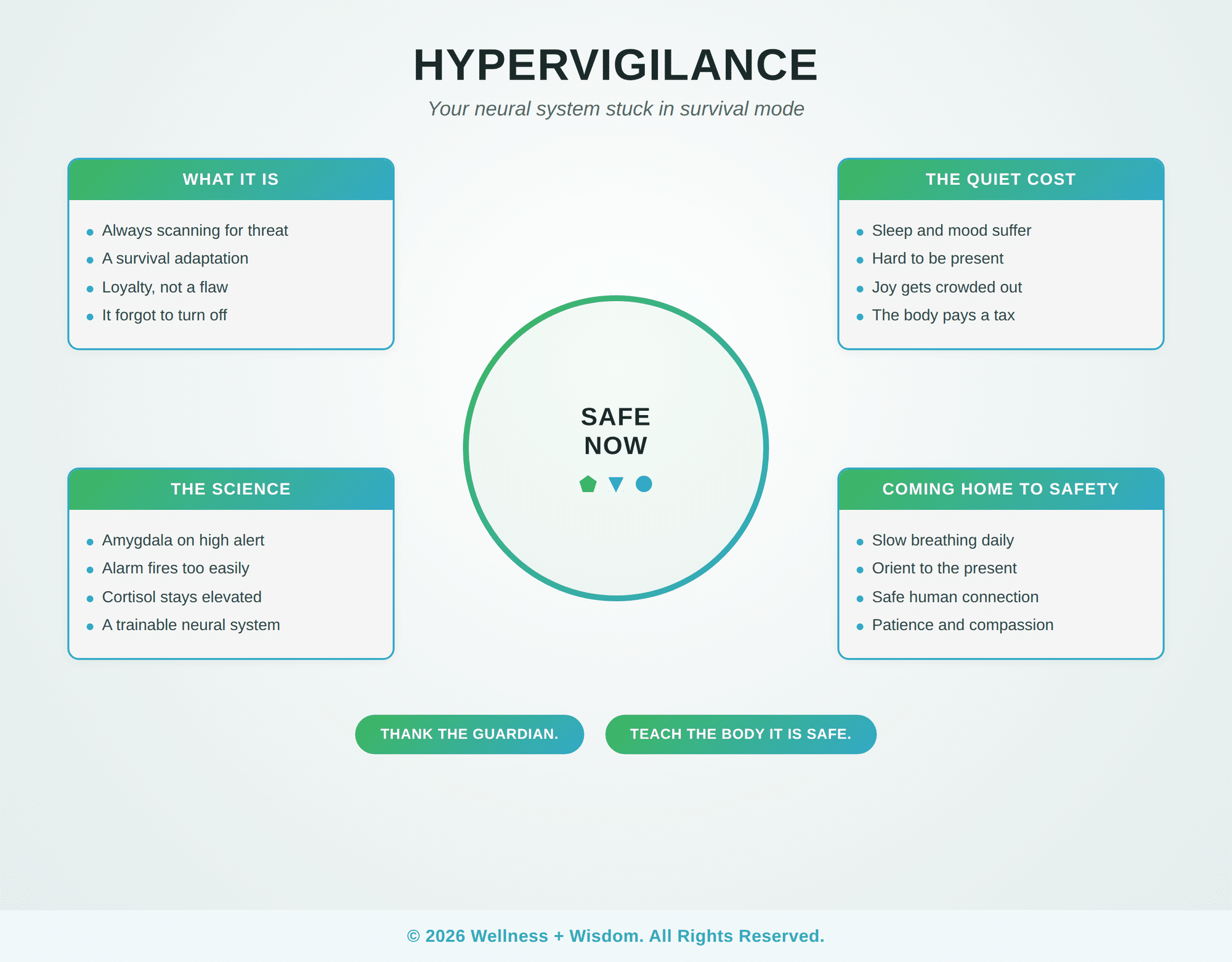
Hypervigilance is driven by a threat detection system centered on the amygdala, the almond-shaped region of the brain that scans for danger and sounds the alarm. When this system becomes overactive, the alarm fires too often and too easily, keeping the whole neural system braced. The science here is well established, and understanding it takes the shame out of the experience.
Research on the neuroscience of trauma, including a detailed review of post-traumatic stress from cells to circuits, shows that hyperactivation of threat salience networks, especially the amygdala, is directly associated with ongoing hypervigilance and heightened threat responses. In a hypervigilant brain, the alarm system is amplified while the calming, top-down influence of the prefrontal cortex is weakened, so the brakes cannot keep up with the accelerator.
Stress hormones play a central role too. A functional MRI study on cortisol and attention describes how, under stress, the brain shifts into a mode of hypervigilant processing that prioritizes the detection of potential threats, with the amygdala activated and vigilance surging. When stress becomes chronic, this vigilant mode can become the default rather than the exception. Additional research on amygdala hyperactivity links this exaggerated fear circuitry directly to symptoms like hypervigilance and hyperarousal.
It also helps to understand why hypervigilance feels so automatic and so hard to think your way out of. Your threat detection system is designed to be faster than conscious thought, because in a real emergency, the fraction of a second it takes to reason would get you killed. So the amygdala fires the alarm before the thinking brain even knows what is happening. This is why telling a hypervigilant person to just relax is useless. The alarm has already gone off long before relaxing was ever an option. The lever is not the thinking mind. The lever is the body and the neural system underneath the thoughts, reached through practices that work faster than words.
Here is the empowering part. Because hypervigilance lives in a trainable neural system, it is not a life sentence. The same neuroplasticity that allowed your brain to learn high alert allows it to learn safety. You are not stuck with the wiring you have now. You can, with practice and care, teach your system a new default. That is not motivational fluff. It is how the brain actually works, and it is the quiet hope woven through everything we teach across the latest episodes.
Why hypervigilance is often inherited
Hypervigilance is frequently not something that started with you, but something you inherited, absorbed from the people who raised you and even carried in patterns passed down across generations. If you grew up with a parent who was themselves always on alert, your developing neural system learned that vigilance was simply how a body is supposed to be. You breathed in their bracing the way you breathed in the air.
This is the territory of Emotional Epigenetics™, the understanding that your emotional patterns and stress responses are shaped by inherited influences as much as by your own direct experiences. A family that lived through danger, scarcity, war, migration, or profound instability can pass a heightened threat response down the line, so that a grandchild braces against a danger they never personally faced. It is not their fault, and it is not yours. It is inheritance.
Understanding this lifts an enormous weight. If your hypervigilance is partly inherited, then it was never a personal failing to begin with. It was a legacy handed to you, and legacies can be transformed. When you do this work, you are not only freeing yourself. You are changing what gets passed forward, which is one of the most beautiful reasons to begin. We explore this generational healing constantly across the latest episodes.
The quiet cost of staying on guard
Living in hypervigilance carries a real cost, not because anything is wrong with you, but because a body was never designed to hold the alarm on indefinitely. When the survival response runs around the clock, the whole system pays a tax, and naming that honestly is part of why finding safety matters so much.
A neural system stuck on high alert keeps stress hormones elevated, which over time affects sleep, digestion, immune function, mood, and the heart. It also narrows your life in quieter ways. It is hard to be fully present with the people you love when part of you is always scanning for threat. It is hard to create, play, rest, or receive joy when your body is braced for impact. Hypervigilance does not just tire you. It slowly crowds out the very experiences that make life feel worth living.
This is precisely why the invitation here is joy-forward rather than fear-based. The point of understanding the cost is not to frighten you into action. It is to help you see how much aliveness is waiting on the other side of safety. Everything that hypervigilance has been crowding out, the presence, the ease, the connection, the joy, is still there, waiting for your system to feel safe enough to let it back in. That is a hopeful truth, and it is the whole reason this work is worth doing.
It is also worth saying that many high-functioning, successful people are quietly hypervigilant, and their alertness may even look like an asset from the outside. They notice everything, anticipate problems, and stay two steps ahead. But underneath the competence, the body is exhausted, and the success is often powered by a fear of what happens if they ever stop. If that describes you, know that you do not have to choose between being capable and being at peace. You can keep your gifts and put down the dread that has been driving them. The sharpness stays. The suffering does not have to.
Teaching your body it is safe
You teach your body it is safe not by arguing with it, but by giving it repeated, direct, physical experiences of safety until it starts to believe them. Hypervigilance did not form through logic, and it will not release through logic. It formed through experience, and it releases through experience. This is the core of the work.
The most direct doorway is the breath, because slow breathing sends an unmistakable safety signal to your neural system. A longer exhale activates the calming, recovery side of your system and gently tells your body that the emergency is over. This is the foundation of the BREATHE™ work, and for a hypervigilant system, a few minutes of slow breathing practiced daily begins to lower the baseline over time. You are not forcing calm. You are offering your body evidence.
Other doorways include gentle movement, time in nature, safe and warm human connection, and the simple practice of pausing to notice, several times a day, that in this actual moment you are okay. Each of these is a small deposit of safety, and they accumulate. Slowly, the guardian begins to relax its watch. This is embodied change, the kind that the L.I.F.E. Method™ is built around, because insight alone does not shift a nervous pattern. Repeated felt experience does.
There is a subtlety worth naming here, because many people trip over it. When you first begin to relax a hypervigilant system, it can feel unsafe, even wrong. Letting your guard down may trigger a wave of anxiety, because on some level your body believes that vigilance is the only thing keeping you alive. This is normal, and it is not a sign that the practice is failing. It is the guardian testing whether it is really allowed to rest. The way through is to go slowly, in small doses, so your system gets to experience that lowering the alert did not lead to catastrophe. Each time you soften a little and remain safe, you gather evidence, and the evidence is what eventually changes the pattern.
Patience with this cannot be overstated. A system that took years or generations to form does not release in a weekend, and trying to force it only signals more urgency, which is the opposite of what safety feels like. The paradox of this work is that the more gently and unhurriedly you approach it, the faster it tends to move, because gentleness itself is the medicine. You are not on a deadline to feel safe. You are simply, day by day, showing your body a new way to be.
One honest and important note. If your hypervigilance stems from trauma, and especially if it is severe or tied to specific traumatic events, this work is most powerful alongside a qualified trauma-informed therapist. Reaching for professional support is not a detour from the path. It is walking the path wisely. The practices here are wonderful companions to real care, never a replacement for it. This is a sensitive area, and if you are struggling, please be gentle with yourself and consider reaching out to a professional or someone you trust.
Hypervigilance and Emotional Epigenetics
Within the framework of Emotional Epigenetics™, hypervigilance is understood as a bioenergetic pattern, a survival response encoded through both your own experiences and your inheritance, and expressed through your neural system and your daily physiology. Seeing it this way matters, because it locates the pattern in something changeable rather than in some fixed truth about who you are.
The framework holds three converging influences: emotional patterns, unconscious beliefs, and environment. Hypervigilance lives in all three. There is the emotional pattern of bracing, often inherited. There is the unconscious belief, usually formed early, that the world is not safe and that you must stay alert to survive. And there is the environment, the ongoing stressors and lifestyle factors that keep the pattern activated. Change is possible at each level, and small shifts in one support shifts in the others.
The liberating implication is that you are not your hypervigilance. It is a pattern moving through you, not the truth of you, and patterns can be met, softened, and rewritten. When you begin to feel safe in your own body, you are not just calming your symptoms. You are changing the code you live from, and the code you pass on. That is the deep promise of this work, and it is available to you. It is the throughline of everything inside the Liberated Life Tribe and our mission.
Practices for coming home to safety
The practices that help with hypervigilance all share one aim: to give your neural system repeated, believable evidence that you are safe now. Start small, be consistent, and let the changes accumulate gently. There is no rushing a guardian into trust, and there is no need to. Choose one or two of the following that feel accessible, rather than trying to do all of them at once, because overwhelm is the opposite of what a hypervigilant system needs. Consistency with one small practice will do far more than an ambitious routine you cannot sustain.
Daily slow breathing. A few minutes of breathing with a longer exhale, practiced when you are already reasonably calm, builds the pathway to safety so it is available when you need it. This is the single highest-return practice, and it costs nothing but a few minutes. Explore the tools in our store to support it.
Orienting to the present. Several times a day, pause and slowly look around the room, letting your eyes rest on what is actually here. Name a few things you see. This simple practice tells your threat system that it can lower its scan, because you are consciously confirming there is no danger right now.
Safe connection. Time with people who feel genuinely safe is medicine for a hypervigilant system, because co-regulation, the calming of one neural system in the presence of another settled one, is one of the deepest ways humans find safety. You were never meant to regulate entirely alone.
Gentle movement and nature. Walking, stretching, and time outside all help discharge stored survival energy and remind the body of ease. Nature in particular has a settling effect on an overactive threat system.
Patience and self compassion. Perhaps the most important practice of all. Your system has been protecting you for a long time. It will not stand down overnight, and it does not need to. Meeting yourself with kindness through the process is itself a profound safety signal, and it changes everything.
Frequently asked questions
What is hypervigilance?
Hypervigilance is a heightened, sustained state of alertness in which your neural system constantly scans for threat even when you are objectively safe. It is driven by an overactive threat detection system centered on the amygdala. Rather than a flaw, it is a survival adaptation that once kept you safe and has continued running long after the original danger passed.
What causes hypervigilance?
Hypervigilance usually develops from experiences that taught the body the world is not safe, such as an unpredictable childhood, trauma, chronic stress, or emotional volatility. It can also be inherited, absorbed from caregivers who were themselves always on alert or passed down across generations. It reflects an amplified threat response and a neural system that stayed braced.
What are the signs of hypervigilance?
Common signs include feeling constantly on edge, being easily startled, scanning rooms and reading people for danger, trouble sleeping because part of you stays on watch, a racing mind, chronic physical tension, and exhaustion that rest does not fix. Many people also overreact to small stressors, because a system already on high alert has little room before it tips over.
Can hypervigilance be healed?
Yes. Because hypervigilance lives in a trainable neural system, the same neuroplasticity that allowed your brain to learn high alert allows it to learn safety. Through repeated, believable experiences of safety, such as slow breathing, orienting to the present, safe connection, and gentle movement, the system can gradually lower its baseline. For trauma-related hypervigilance, working with a trauma-informed therapist is especially powerful.
How do I calm a hypervigilant neural system?
You calm it by giving it direct physical evidence of safety rather than trying to reason with it. Slow breathing with a longer exhale is the most direct tool, along with orienting to your present surroundings, spending time with safe people, gentle movement, and time in nature. Consistency matters more than intensity, and self compassion through the process is itself a powerful safety signal.
Is hypervigilance the same as anxiety?
They overlap but are not identical. Hypervigilance is specifically a state of heightened threat scanning and alertness, while anxiety is a broader experience of worry and unease that can include hypervigilance among its features. Both involve an activated neural system, and both respond to practices that teach the body it is safe. Persistent or severe symptoms are worth discussing with a professional.
Your guardian can finally rest
Hypervigilance was never evidence that something is wrong with you. It was evidence of how hard your body has worked to keep you safe. The path forward is not to shame that guardian into silence, but to thank it, and to give it enough real experiences of safety that it can finally, slowly, lower its watch. On the other side of that vigilance is everything it has been guarding you from feeling: ease, presence, connection, and joy. It is all still there, waiting for you to feel safe enough to come home to it.
Join the Liberated Life Tribe and receive your 10 day Self Liberation Blueprint at liberatedlife.com. It is a free community for people teaching their bodies, gently and together, that it is safe to rest.
Studies and External Resources
Every external source referenced in this article, verified against the original publication:
- Post-traumatic stress disorder: clinical and translational neuroscience from cells to circuits (PMC)
- Time-dependent effects of cortisol on selective attention and hypervigilant processing (PMC)
- Amygdala hyperactivity and hyperarousal in PTSD, veteran group study (PMC)
About Josh Trent
Josh Trent is an Identity Transformation Architect and the award winning host of the Wellness + Wisdom Podcast, with over 15 million downloads since 2015. He is the creator of the L.I.F.E. Method™ Identity Transformation System and steward of the Emotional Epigenetics™ and BREATHE: Breath + Wellness™ systems of self mastery, impacting over 1,000 students worldwide. Explore his story, browse wellness tools in the store, or start with the Liberated Life Tribe. Josh lives in Austin, Texas with his wife Carrie, daughter Nayah, and son Novah.
Peace and power.
Disclosure: We may earn a commission from certain links on this site when you make a purchase, at no extra cost to you. These commissions help support Wellness + Wisdom and do not affect the products or resources we choose to recommend. Full disclosure .