
By Josh Trent, Identity Transformation Architect and host of the Wellness + Wisdom Podcast
You cannot think your way calm. But you can breathe your way there, and your biology will follow.
Here is the simplest truth about your breathwork neural system connection: your breath is the one place where a system that usually runs on autopilot will answer to you directly. Your heartbeat does not take requests. Your digestion does not wait for permission. But your breath is both automatic and voluntary at the same time, and that dual nature makes it the most accessible doorway you have into the way your body regulates stress, energy, and emotion. This is the heart of the BREATHE™ work, and it is grounded in real physiology, not wishful thinking.
In this guide you will learn exactly how conscious breathing changes your state in real time, what the research actually shows about slow breathing and vagal tone, and a handful of practices you can start using today. No mysticism required, though the felt experience often lands as something close to sacred.
Table of Contents
- What the breathwork neural system shift does
- Meet your autonomic neural system
- The science of slow breathing and vagal tone
- Why the shift happens in real time
- The BREATHE framework
- Four breath practices to start today
- Breathwork for anxiety and overwhelm
- Where breath fits in the Wellness Pentagon
- Common mistakes and how to breathe well
- Studies and External Resources
- Frequently asked questions
What the breathwork neural system shift does
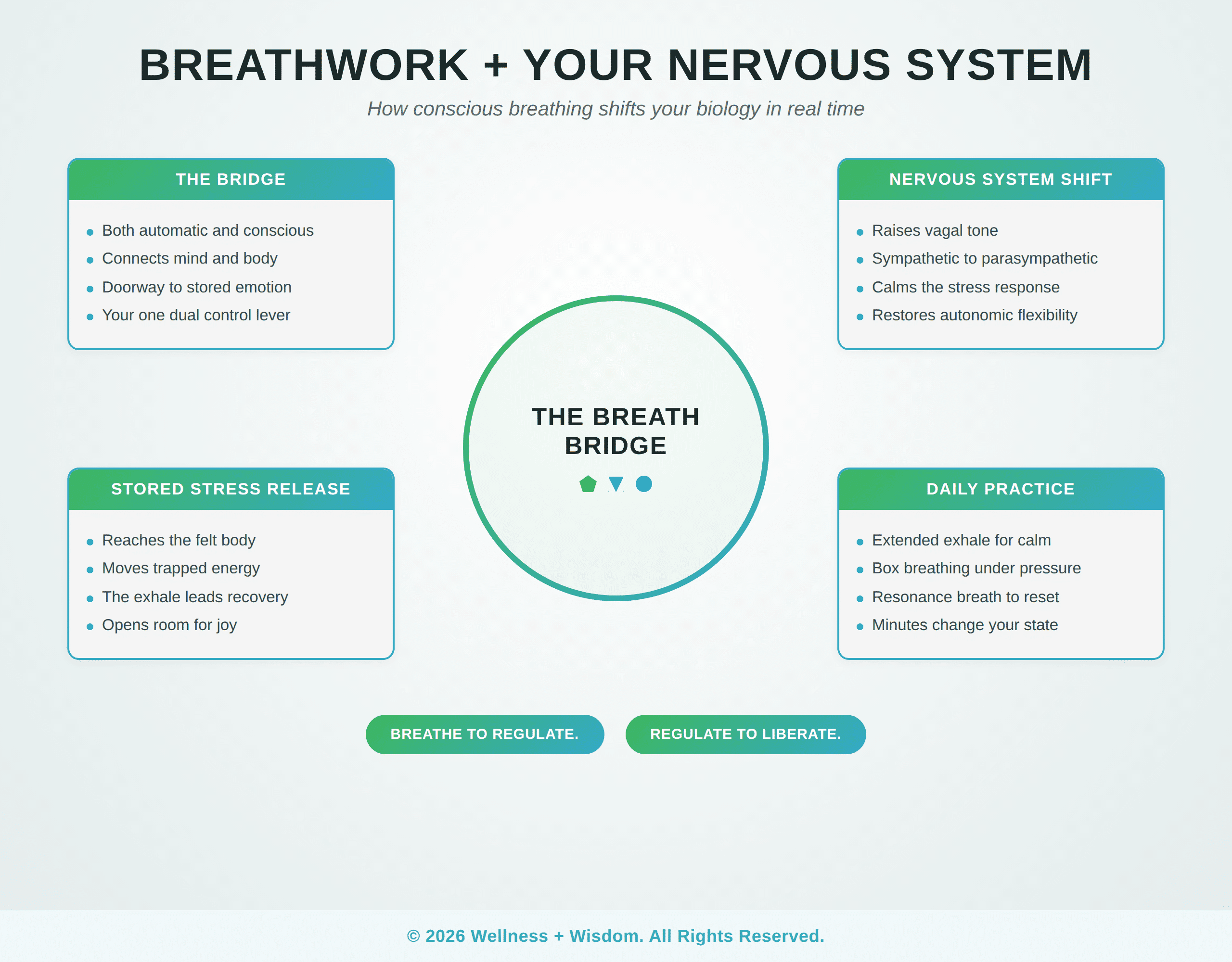
Breathwork shifts your neural system by using the pace and pattern of your breath to move your body out of a stress dominant state and into a rest and recovery state. That is the whole thing in one sentence. When you slow your exhale, lengthen your breath, and settle into a steady rhythm, you are sending a direct physiological signal that the moment is safe, and your body responds by dialing down the alarm and dialing up recovery.
Most people treat breathing as background noise. It runs while you answer emails, sit in traffic, and scroll before bed, and you almost never notice it. That is exactly why it is so powerful when you bring it forward on purpose. You are not learning a new ability. You are reclaiming a lever you have been holding your whole life without knowing it was connected to anything.
The reason this matters for joy, and not just calm, is that a body stuck in chronic stress cannot access presence, creativity, or connection. Those states live on the other side of regulation. When you learn to shift your own physiology, you are not just relaxing. You are opening the door to the version of you that gets to show up fully. That is liberation in the most literal, embodied sense.
Meet your autonomic neural system
Your autonomic neural system is the part of your neural system that runs the functions you do not consciously control: heart rate, digestion, blood pressure, and the stress response. It has two main branches, and understanding them makes everything else click into place.
The sympathetic branch is your accelerator. It handles the classic fight or flight response, releasing energy, sharpening focus on threat, speeding the heart, and preparing you to act. This is not the enemy. You want a responsive sympathetic system. It gets you out of real danger and powers your best performance. The problem is when it never switches off.
The parasympathetic branch is your brake. It governs rest, digestion, repair, and recovery. The primary highway of this branch is the vagus nerve, the long wandering nerve that connects your brainstem to your heart, lungs, and gut. When people talk about vagal tone, they are describing how well this recovery system engages, and higher vagal tone is broadly associated with resilience, emotional flexibility, and cardiovascular health.
Health is not the absence of the accelerator. Health is flexibility, the capacity to rev up when life asks for it and settle back down when the moment passes. A great deal of modern suffering comes from getting stuck with the accelerator floored. Breath is how you find the brake again, and the science on that point is surprisingly solid.
It helps to notice what a stuck accelerator actually feels like from the inside, because most people have normalized it. You wake up already braced. Your jaw is tight before the day has done anything to you. Small inconveniences land like emergencies. Sleep is thin. Digestion is off. None of that is a character flaw, and none of it means something is wrong with you. It usually means your neural system has been running the stress branch for so long that it forgot the recovery branch was an option. The breathwork neural system connection matters here because it hands you a way back that does not depend on your circumstances changing first. You can find the brake in the middle of an ordinary Tuesday, and that is where regulation becomes real. We go deep on this pattern across the Wellness + Wisdom Podcast, and it is the throughline of our mission.
The science of slow breathing and vagal tone
The research on slow breathing and vagal tone is clear enough that it has moved from fringe to physiology textbook. When you breathe slowly, your body measurably shifts toward parasympathetic dominance, and researchers can track it in real time through heart rate variability, the natural beat to beat variation in your heart rhythm that serves as a reliable window into vagal activity.
A large body of work points in the same direction. A 2021 study published in Scientific Reports found that a single session of deep, slow breathing improved vagal tone and reduced anxiety in both younger and older adults. Not a program. One session. That is the real time effect showing up in the data.
The mechanism is elegant. During inhalation, vagal outflow is briefly inhibited and the heart speeds slightly. During exhalation, vagal outflow is restored and the heart slows. This is why a longer, slower exhale is such a reliable calming tool. You are literally spending more time in the phase of the breath where your recovery system leads. A 2017 review in Frontiers in Psychology details how slow paced breathing near what researchers call the resonance frequency, roughly five to seven breaths per minute for most people, is one of the most efficient ways to raise vagal tone.
The effects reach beyond a calmer mind. In a study of people with essential hypertension, slow breathing shifted the balance toward vagal activity and improved baroreflex sensitivity, the reflex that helps regulate blood pressure. A more recent scoping review on PubMed found consistent improvements in heart rate variability and autonomic flexibility across studies, especially when breathing emphasized longer exhalations. The pattern repeats across populations and research groups, which is exactly what you want to see before you build a practice on something.
A word of honesty, because trust is the whole game. Breathwork is a genuine regulation tool with real evidence behind it. It is not a cure for clinical conditions, and it does not replace medical or psychological care. What it offers is a reliable, self directed way to influence your own state, and that is no small thing. It is one of the few interventions that is free, always available, and backed by data.
Why the shift happens in real time
Breathwork works in real time because breathing is the one autonomic function wired for conscious override. Your body did not build a manual control for your heartbeat or your cortisol. It did build one for your breath, because you need to be able to hold it, speed it, and modulate it to talk, swim, sing, and survive. That evolutionary quirk is your leverage.
When you deliberately slow and deepen your breath, several things move together within a few breaths. Your heart rhythm begins to settle. The recovery branch of your neural system gains ground on the stress branch. Blood pressure eases. And crucially, the signal travels upward too, because the vagus nerve carries far more information from body to brain than the other way around. You are not just calming your body. You are sending your brain a steady stream of safety data that it uses to update how threatened it thinks you are.
This is why a person can walk into a hard conversation wound tight and, with sixty seconds of slow breathing beforehand, walk in grounded instead. Nothing about the external situation changed. The internal state did, and the internal state is what you actually act from. This is the bridge between knowing and doing, which is exactly what Embodiment in the L.I.F.E. Method™ is about.
There is a deeper implication worth sitting with. If your breath can update how threatened your brain thinks you are, then you are not stuck with the reactions you inherited or the ones the world trained into you. You have a say. That is not a motivational slogan, it is a physiological fact, and it is the reason breath is the first tool we hand people inside the programs. Change the state, and over time you change the pattern. Change the pattern, and you change the story you live from.
The BREATHE framework
BREATHE™ treats the breath as the bridge between the thinking mind and the feeling body. Most personal growth work lives in the head. You read the book, you understand the concept, you know exactly what you should do, and then in the moment your body does the old thing anyway. That gap is not a willpower failure. It is a regulation gap, and you cannot close it with more thinking. You close it through the body, and breath is the fastest, most portable way in.
The premise is simple. Breath is the only system that is both automatic and consciously controlled, which makes it the natural meeting point between your conscious intentions and your unconscious patterns. When stored stress and old survival responses live in the body, talking about them helps you understand them, but breathing through them helps you move them. The exhale, in particular, becomes a tool for release.
Within the broader L.I.F.E. Method™, breath supports every pillar. It creates the Liberation of a settled system, the Integration of mind and body, the Frequency of a raised baseline state, and the Embodiment that turns insight into lived reality. You are not adding breathwork on top of the transformation. Breath is the engine underneath it.
Four breath practices to start today
The best breath practice is the one you will actually do. Start with one of these, practice it when you are already calm so it is available when you are not, and let it become a reflex. None of these require equipment, an app, or more than a few minutes. If you want to go further after these, the guided journeys inside the Liberated Life Tribe and the tools in our store build directly on this foundation.
Extended exhale breathing
This is the highest return practice for the least effort, and it is where I send almost everyone first. Breathe in gently through your nose for a count of four, then breathe out slowly through your nose or softly pursed lips for a count of six or eight. That is it. The longer exhale leans directly into the vagal, recovery leading phase of the breath. Do this for two to three minutes and most people feel the shift. Use it before sleep, before a hard conversation, or any moment you feel the accelerator stuck down.
Box breathing
Box breathing gives your mind a simple shape to hold, which is part of why it works so well under pressure. Breathe in for four, hold for four, breathe out for four, hold for four. Four equal sides, like a box. This is a favorite for a reason: it is easy to remember when you are rattled, and the even rhythm plus the gentle holds settle the system quickly. If four feels like a strain, start with three. The count is a tool, not a test.
Resonance breathing
Resonance breathing is the practice the research keeps circling back to. You slow all the way down to roughly five to six breaths per minute, which usually lands around a five count inhale and a five count exhale. This is the pace where vagal tone tends to peak for most people. It can feel like a lot of air at first, so keep the breath soft and unforced. Five to ten minutes here is a genuine reset, and with practice your natural resting rhythm often drifts slower on its own.
Morning activation breath
Not every breath practice is about slowing down. Some mornings you want to come online with energy and clarity, and a few rounds of slightly fuller, more rhythmic breathing can help you meet the day awake rather than dragging. Keep this one gentle and brief, sit or stand while you do it, and never practice energizing breathwork while driving or in water. Then transition into a few slow exhales to land in a state that is both alert and calm, which is the sweet spot for creation.
Breathwork for anxiety and overwhelm
Breathwork helps with anxiety because anxiety is not only a thought loop, it is a body state, and the body state is something you can reach directly. When anxiety spikes, the stress branch of your neural system is running the show: shallow fast breathing, racing heart, narrowed attention. Trying to reason your way out rarely works in that moment, because the thinking brain is not the one driving. The breath is a side door into the room.
The move is not to fight the anxiety. It is to change the physiological conditions the anxiety is living in. Slow the breath, lengthen the exhale, and give your system the safety signal it is not currently getting from your thoughts. The Scientific Reports finding that a single session of slow breathing reduced anxiety is exactly this effect, measured in a lab. You are working with your biology instead of against your mind.
Here is the joy forward reframe that matters. The goal is not to become someone who never feels activated. Feeling deeply is part of being fully alive. The goal is to become someone who can meet a big wave of feeling and know, in your body, that you have a way back to center. That confidence changes how you move through everything. When you trust your own capacity to regulate, you stop avoiding the experiences that scare you, and life gets a lot bigger. For a deeper dive into working with the emotions underneath, our latest episodes go there often.
One honest note. If anxiety is frequent, intense, or interfering with your life, breathwork is a wonderful companion to real support, not a substitute for it. Reaching out to a qualified professional is a strength, and the two work beautifully together.
Where breath fits in the Wellness Pentagon
Breath sits at the center of the Wellness Pentagon™, the framework that holds whole person wellness as five connected dimensions: Physical, Mental, Emotional, Spiritual, and Financial. Neglect one side and the others feel it. Breath is unusual because it touches all five at once.
Physically, it regulates your neural system, supports your heart, and improves recovery. Mentally, it clears the fog that chronic stress creates and restores focus. Emotionally, it gives you a way to feel hard feelings without drowning in them. Spiritually, it is one of the oldest doorways into presence and Connection to Creator and God, which is why nearly every wisdom tradition on earth built practices around the breath. And even Financially, a regulated system makes clearer decisions, because scarcity thinking and panic are stress states, and you cannot budget, build, or lead well from fight or flight.
This is what it means to say the frameworks fit together rather than compete. You do not have to choose between working on your body and working on your money and working on your spirit. Learn to regulate your breath and you have touched all of them at the root. That is the kind of leverage worth building a life around.
Common mistakes and how to breathe well
The most common mistake is forcing it. People hear slow breathing and immediately gulp huge, strained breaths that leave them lightheaded and convinced they are doing it wrong. Soft is the whole point. You are inviting the system to settle, not muscling it. If a count feels like a strain, shorten it. Ease is the signal you are looking for.
The second mistake is only reaching for breath in a crisis. If the first time you try to use your brake is during a full blown stress spiral, it will feel clumsy and disappointing. Practice when you are already reasonably calm. Two minutes of extended exhale breathing every morning builds the pathway so it is there, strong and familiar, when you actually need it. You are training a reflex, and reflexes are built in the quiet, not the storm.
The third mistake is treating breathwork as a one time fix rather than a relationship. Regulation is not a destination you arrive at once. It is a practice you return to, the way you return to food and sleep and movement. The good news is that the returns compound. The more you practice, the faster your system responds, and over time your baseline itself shifts toward calm. That drifting baseline is one of the quiet joys of this work.
Finally, some people avoid breathwork because a few slow breaths brought up unexpected emotion, and it scared them. That is not a malfunction. When you settle the body, whatever the busyness was covering sometimes surfaces. If that happens, go gently, and know that support exists. The Liberated Life Tribe is full of people walking this exact path, and doing it together makes it lighter.
Put simply, the breathwork neural system relationship rewards consistency over intensity. You do not need a dramatic hour long session to benefit. You need small, repeatable doses that your body learns to trust. A minute here before a meeting, three minutes there before bed, a few slow exhales in the car before you walk into your home as the person you actually want to be. Those tiny moments are the practice. Stacked over weeks, they become a new baseline, and that new baseline is what freedom feels like in the body. For more on turning practice into lasting change, our latest episodes and my story both circle this territory often.
Studies and External Resources
The science below is why breathwork moves your neural system in real time. Every source is peer reviewed and open to read.
- Deep and slow breathing on vagal tone (2021), Scientific Reports. A single session of slow breathing raised vagal tone and lowered anxiety in young and older adults alike.
- Slow breathing and baroreflex sensitivity (PMC). Slowing the breath improved heart rate variability and baroreflex sensitivity in people with high blood pressure.
- Breathe better, live better (2025), Acta Neurologica Belgica. A current review linking slow breathing to heart rate variability and neural system regulation.
- Cardiac vagal tone framework (2017), Frontiers in Psychology. The reference method for measuring the exact vagal marker that breathwork shifts.
Frequently asked questions
How does breathwork affect the neural system?
Breathwork affects the neural system by shifting the balance between its stress branch and its recovery branch. Slow, steady breathing with a longer exhale increases vagal tone and moves your body toward a parasympathetic, rest and recovery state, which you can measure in real time through heart rate variability. Fast, shallow breathing pushes the other way, toward stress activation.
How long does it take breathwork to work?
Breathwork can shift your state within a few breaths, and research shows measurable changes in vagal tone and anxiety after a single session of slow breathing. Two to three minutes of extended exhale breathing is enough for most people to feel a noticeable difference. The deeper benefits, like a calmer resting baseline, build with regular practice over weeks.
What is the best breathwork for anxiety?
The best breathwork for anxiety is usually the simplest: extended exhale breathing, where you breathe in for four and out for six or eight. The longer exhale leans into the recovery phase of the breath and sends your brain a direct safety signal. Box breathing is another strong choice because its simple, even rhythm is easy to remember under pressure.
Is breathwork backed by science?
Yes. Slow breathing has been shown across multiple studies to increase vagal tone, improve heart rate variability, enhance baroreflex sensitivity, and reduce anxiety. The effects are well documented in peer reviewed journals. Breathwork is a genuine self regulation tool, though it complements rather than replaces medical or psychological care.
Can I do breathwork every day?
Yes, and daily practice is where the real benefit lives. Gentle slow breathing is safe for most people to practice daily and builds the pathway so regulation becomes a reflex. Keep it soft and unforced. If you have a heart or respiratory condition or are pregnant, check with your doctor before starting intensive breathwork practices.
What is the difference between breathwork and meditation?
Breathwork actively uses the pattern of your breath to change your physiological state, while meditation is usually a practice of awareness and attention. They overlap and support each other beautifully. Many people find that a few minutes of breathwork settles the body enough to make meditation feel accessible rather than frustrating.
Your next breath is an invitation
You woke up today already holding the single most accessible tool for regulating your own neural system. You have taken thousands of breaths since, almost all of them unnoticed. Imagine what shifts when even a handful of them become conscious, slow, and intentional. That is not a small promise. That is the beginning of getting your own state back.
Start with one practice. Extended exhale, two minutes, tomorrow morning. Let it be easy. Let it be yours.
Join the Liberated Life Tribe and receive your 10 day Self Liberation Blueprint at liberatedlife.com. It is a free community and a guided on ramp into this work, and it is a joy to walk it alongside you.
About Josh Trent
Josh Trent is an Identity Transformation Architect and the award winning host of the Wellness + Wisdom Podcast, with over 15 million downloads since 2015. He is the creator of the L.I.F.E. Method™ Identity Transformation System and steward of the Emotional Epigenetics™ and BREATHE: Breath + Wellness™ systems of self mastery, impacting over 1,000 students worldwide. Explore his story, browse wellness tools in the store, or start with the Liberated Life Tribe. Josh lives in Austin, Texas with his wife Carrie, daughter Nayah, and son Novah.
Peace and power.
Disclosure: We may earn a commission from certain links on this site when you make a purchase, at no extra cost to you. These commissions help support Wellness + Wisdom and do not affect the products or resources we choose to recommend. Full disclosure .