By Josh Trent | Mental Health
Your brain learned what it needed to learn to keep you safe. The beautiful part is that the same brain that learned survival can learn safety. Nothing about you is permanent except your capacity to change.
Here is something worth celebrating before we go anywhere heavy: the brain you have right now is the most changeable organ in your body. If childhood trauma shaped the way your brain wired itself, that same wiring can be reshaped. This is not wishful thinking. It is one of the most consistent findings in modern neuroscience, and it is the reason I get to do the work I do. Understanding how childhood trauma affects the childhood trauma brain is not about cataloging damage. It is about understanding the instructions your biology received so you can give it new ones.
In this guide we are going to walk through exactly how early adversity shapes the developing brain, what the research actually shows, and the specific, practical ways you rewire those patterns as an adult. This connects directly to Emotional Epigenetics™, the understanding that your experiences, emotions, and environment shape how your biology expresses itself. Let us get into it.
Table of Contents
- What Happens in the Childhood Trauma Brain
- The Science of How Childhood Trauma Rewires the Brain
- Three Brain Regions That Adapt to Early Adversity
- What the ACE Study Revealed About Childhood Adversity
- Adaptation, Not Damage: Reframing the Childhood Trauma Brain
- How the Childhood Trauma Brain Shows Up in Everyday Life
- How to Rewire the Childhood Trauma Brain
- The Window of Tolerance and Why It Widens
- Seven Neuroplasticity Practices That Rewire Survival Patterns
- Frequently Asked Questions
- Studies and External Resources
- About Josh Trent
What Happens in the Childhood Trauma Brain
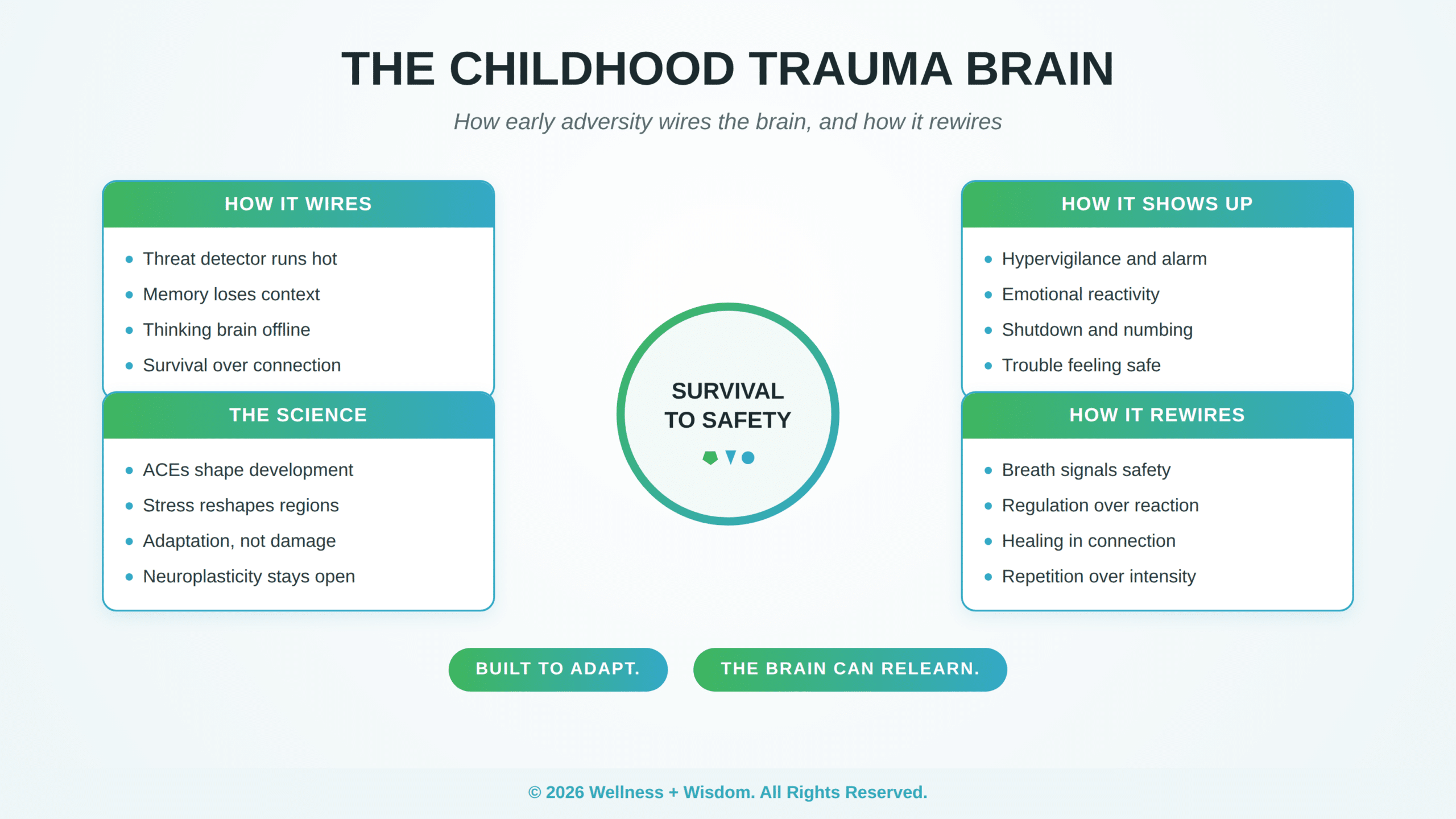
The childhood trauma brain is a brain that learned, early and well, that the world is not reliably safe. When a child grows up around chronic stress, neglect, unpredictability, or fear, the young brain does exactly what it is designed to do: it prioritizes survival over everything else. It tunes itself to detect threat faster, to react sooner, and to expect more danger than the average environment actually contains.
This matters because the brain does most of its foundational wiring in childhood. A young brain is building the scaffolding it will use for the rest of life, and it builds that scaffolding based on the environment it finds itself in. A child in a calm, attuned home wires for connection and exploration. A child in a stressful or frightening home wires for vigilance and protection. Both brains are working correctly. They are simply responding to different instructions.
The result, carried into adulthood, often looks like anxiety, hypervigilance, difficulty trusting, emotional reactivity, or a tendency to shut down under pressure. These are not character flaws. They are the fingerprints of an early environment, written into the architecture of the neural system. And because they were learned, they can be relearned.
The Science of How Childhood Trauma Rewires the Brain
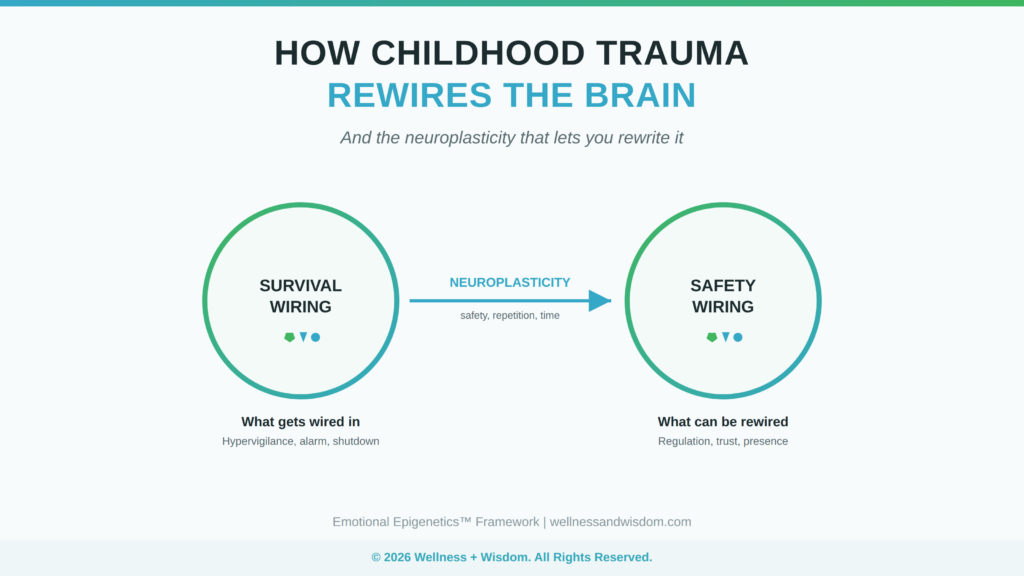
How childhood trauma rewires the brain is no longer a mystery. The mechanism is the developing brain doing its job under difficult conditions. When a child experiences repeated stress, the body floods with cortisol and other stress chemistry. In small, manageable doses this is healthy and adaptive. In chronic, overwhelming doses during the sensitive window of childhood, it begins to shape the structure and function of the brain itself.
A landmark review by Martin Teicher and Jacqueline Samson, published in the Journal of Child Psychology and Psychiatry, synthesized decades of research and concluded that childhood maltreatment is associated with measurable, enduring changes in the structure and connectivity of multiple brain regions. The brain adapts to adversity by reorganizing the very networks responsible for threat detection, emotion regulation, and memory.
This is the same principle at the heart of Emotional Epigenetics™. Your environment does not just affect how you feel. It reaches down into your biology and influences how your systems express themselves. The good news woven into this finding is profound: if experience can shape the brain in one direction, experience can shape it in another. That is the entire premise of healing, and it is the through line of every L.I.F.E. Method™ conversation I have.
Three Brain Regions That Adapt to Early Adversity
To understand the childhood trauma brain, it helps to look at three regions that consistently show up in the research. None of these adaptations are permanent. Each one responds to the right conditions over time.
The Amygdala: Your Threat Detector
The amygdala is the brain's alarm system. In a brain shaped by early adversity, the amygdala often becomes more reactive, firing the alarm faster and more often. This is why someone with a history of childhood trauma may feel intense fear, anger, or panic in situations that seem ordinary to others. The alarm is doing its job. It was simply calibrated for a more dangerous world than the one you live in now.
The Hippocampus: Your Memory and Context
The hippocampus helps you place experiences in time and context, which is part of how you know that a past danger is over. Chronic early stress can affect this region, which is part of why old fears feel present rather than past. Strengthening regulation and safety over time supports this system, which is one reason consistent practices like breathwork and neural system regulation are so valuable.
The Prefrontal Cortex: Your Wise Adult
The prefrontal cortex is the seat of reflection, planning, and emotional regulation. Under chronic early stress, the connection between this thinking brain and the emotional alarm system can be weakened, so reactions arrive before reasoning does. The encouraging news is that this connection is highly trainable. Practices that build the pause between trigger and response literally strengthen this pathway, which is exactly what the 90 second emotion rule trains.
What the ACE Study Revealed About Childhood Adversity
The most influential research on childhood adversity began with a simple, large study. In 1998, Vincent Felitti and Robert Anda published findings in the American Journal of Preventive Medicine from what became known as the Adverse Childhood Experiences study. They found a strong, graded relationship between the number of adverse experiences in childhood and a wide range of health and behavioral outcomes in adulthood.
A follow up synthesis by Anda and colleagues in the European Archives of Psychiatry and Clinical Neuroscience connected those outcomes to the neurobiology of the developing brain. The more adversity a child experiences, the more the brain and body adapt for survival, and those adaptations ripple forward into adult wellbeing.
What I want you to take from this is not fear. It is clarity. The ACE research gives us a map. It explains why so many people feel as though they are running an invisible program they never chose. And a map is the first thing you need before you can choose a new route. This is the same recognition at the heart of inherited trauma work, where patterns that feel like personal failings turn out to be inherited and learned.
Adaptation, Not Damage: Reframing the Childhood Trauma Brain
Here is the reframe that changes everything. The childhood trauma brain is an adapted brain. It did exactly what a developing brain is built to do. Every pattern that feels like a problem today was, at some point, a solution. Hypervigilance kept you ahead of unpredictable adults. Emotional shutdown protected you when feelings were not safe to show. People pleasing earned you safety when conflict was dangerous. These were intelligent responses to a real environment.
This distinction matters enormously, because you cannot heal something you are at war with. When you understand your patterns as old survival strategies rather than personal defects, something softens. You stop fighting yourself. You start working with your biology instead of against it. This is the abundance first, joy forward orientation that runs through everything we teach, and it is the same compassion we bring to self sabotage and to healing the inner child.
It is also why I am careful with language. The patterns are real and they deserve respect, not shame. You are not behind, and you were never the problem. You are a person whose neural wiring learned survival and is now ready to learn something new.
How the Childhood Trauma Brain Shows Up in Everyday Life
One of the most freeing moments in this work is recognizing your patterns in plain daylight, because recognition is where choice begins. These adaptations rarely announce themselves as trauma. They show up disguised as personality, preference, or just the way you are.
In relationships, survival wiring can look like bracing for abandonment, reading tone for hidden threat, or feeling flooded the moment a conversation gets tense. The brain that learned to scan unpredictable caregivers keeps scanning, even with safe partners. This is the same root we explore in trauma bonding and in attachment patterns, where intensity gets confused with closeness.
At work, it can look like overfunctioning, difficulty resting, or a hum of pressure that never quite turns off. The body that learned that calm was dangerous keeps the engine running. In the body itself, it can look like tension you cannot explain, digestive issues, disrupted sleep, or fatigue, because chronic survival activation is expensive to maintain. The gut and emotions are deeply linked, which is why this wiring is felt as much as it is thought.
And in the quiet moments, it can look like a harsh inner voice, a sense of never being enough, or a reflex to numb out when feelings rise. None of these mean something is wrong with you. They mean your brain is running an old program with remarkable loyalty. The moment you can name a reaction as survival wiring rather than identity, you create the smallest gap between trigger and response, and in that gap lives every bit of freedom you are reaching for.
How to Rewire the Childhood Trauma Brain
This is where the science turns from explanation into invitation. The reason you can rewire these patterns is neuroplasticity, the brain's lifelong capacity to form new connections in response to experience. Richard Davidson and Bruce McEwen, writing in Nature Neuroscience, described how both stress and positive interventions shape neuroplasticity, and how targeted practices can promote wellbeing by changing the brain in beneficial directions.
Read that again, because it is the whole point. The same plasticity that allowed adversity to shape your brain is the plasticity that allows safety, repetition, and connection to reshape it. Your brain is not locked. It is listening. And it responds to what you repeatedly give it.
Rewiring is not a single dramatic breakthrough. It is the slow, reliable accumulation of new experiences of safety. Every time you regulate instead of react, every time you stay present instead of shutting down, every time you let yourself be supported instead of bracing alone, you lay down a new path. Do it enough times and the new path becomes the default. This is the physical truth underneath identity change, and it is what makes the L.I.F.E. Method™ work at a cellular level.
The Window of Tolerance and Why It Widens
One of the most useful ideas for understanding this wiring is the window of tolerance. Picture a zone in which you can feel your feelings, think clearly, and stay present all at once. Inside that window, life is workable. You can be stressed and still resourced. The window is the home base of a regulated neural system.
Early adversity tends to narrow that window. When the brain wired for survival, it learned to leave the window quickly, flipping up into anxiety and hypervigilance or down into shutdown and numbness at the first sign of threat. This is why small stressors can feel enormous, and why recovery from a trigger can take longer than the situation seems to warrant. The window is simply narrower than it was designed to be.
Here is the hopeful part, and it is grounded in the same neuroplasticity research we have been discussing. The window of tolerance is not fixed. Every time you stay present with a manageable amount of stress and return to calm, you widen it a little. This is how regulation becomes trainable. You are not forcing yourself to tolerate more. You are teaching your brain, gently and repeatedly, that it is safe to stay. Over months, the window widens, and life that once felt overwhelming starts to feel workable. Practices that build this are the heart of neural system regulation, and they pair naturally with the breath based tools that follow.
Seven Neuroplasticity Practices That Rewire Survival Patterns
These are the practices I return to and teach, each one a way of giving your brain repeated evidence that you are safe now. None of them require you to relive the past. They build the new wiring forward.
1. Breathwork to Signal Safety
Your breath is the fastest, most accessible way to tell your neural system that the danger has passed. Slow, extended exhales shift you out of the stress response and into rest, which is the state in which rewiring happens. A simple practice like box breathing gives your brain a repeatable signal of calm. This is the foundation of the BREATHE™ work because breath is the one system that is both automatic and consciously controllable.
2. Name the Pattern Without Shame
Naming a reaction as an old survival pattern, rather than a personal failing, engages the prefrontal cortex and begins to loosen the automatic grip of the alarm. The simple internal sentence, this is my survival wiring, not my truth, is itself a rewiring act.
3. Ride the Wave Instead of Fleeing It
Emotions move through the body quickly when we let them. Learning to feel an emotion fully without numbing or escaping teaches the brain that feelings are survivable. The 90 second emotion rule is a practical anchor here.
4. Heal in Connection
The brain wires for safety most powerfully in the presence of safe, attuned others. Isolation reinforces survival wiring. Connection reshapes it. This is why community is not a luxury in healing but a biological necessity, and why I built the Liberated Life Tribe as a place to do this work together rather than alone.
5. Work With the Body, Not Just the Story
Stored survival energy lives in the body, not only in thoughts. Somatic practices, movement, and breath give that energy a way to complete and release. Talking is valuable, but the body needs to be invited into the healing too, which is why vagus nerve and somatic tools matter so much.
6. Trust Repetition Over Intensity
Neuroplasticity rewards consistency. Small daily practices done reliably will rewire faster than occasional dramatic efforts. Five regulated minutes every morning teaches your brain more than one heroic weekend. Build a neural system regulation routine you can actually keep.
7. Anchor in Connection to Creator and God
For many people, the deepest sense of safety comes from a spiritual foundation, a felt sense of being held by something larger. This Connection to Creator and God gives the rewiring a stable center to grow around, and it is a core dimension of the Wellness Pentagon™.
A Word on Patience and Proof
If there is one thing I want you to carry out of this, it is patience with the process and trust in the evidence. Rewiring does not feel like a lightning strike. Most days it feels like nothing at all. You take a slow breath when you would have spiraled. You stay in a hard conversation thirty seconds longer than you used to. You let a friend show up for you instead of handling it alone. None of these feel dramatic in the moment, and that is exactly why they work. The brain changes through accumulation, not spectacle.
What you will notice, weeks and months in, is that the baseline has quietly shifted. The thing that used to ruin your whole day costs you twenty minutes instead. The reaction that used to run the show now has a pause in front of it. You did not force that. You earned it, one small repetition at a time. That is the quiet, durable proof that the brain is doing what the science promises it can do, and it is available to you starting with the very next breath you take. This is the heartbeat of every conversation I share, and the reason I keep showing up to this work.
If you want a guided starting point that brings these practices together, the 10 Day Self Liberation Blueprint is the on ramp I built for exactly this. You can also explore deeper conversations on the Wellness + Wisdom Podcast and browse supportive tools in our store.
Frequently Asked Questions
Can the childhood trauma brain actually heal?
Yes. The brain retains neuroplasticity throughout life, which means the patterns shaped by early adversity can be reshaped by new, repeated experiences of safety, regulation, and connection. Healing is gradual and reliable rather than instant, and it builds the new wiring forward rather than requiring you to relive the past.
How does childhood trauma rewire the brain?
Chronic early stress shapes the developing brain to prioritize survival. The threat detection system becomes more reactive, the regulation system can be weakened, and the brain tunes itself to expect danger. These are adaptations to the early environment, written into the neural system, and they can be retrained.
What are ACEs and why do they matter?
ACEs are adverse childhood experiences. Research beginning with the Felitti and Anda study found a graded relationship between the number of adverse experiences in childhood and a range of adult health outcomes, linking early adversity to the developing brain and body. ACEs give us a map of why certain patterns appear in adulthood.
Is the childhood trauma brain damaged?
It is an adapted brain. Every pattern that feels like a problem today was once a protective solution to a real environment. Understanding your patterns as old survival strategies rather than defects is the foundation of healing, because you cannot heal something you are at war with.
How long does it take to rewire trauma patterns?
There is no fixed timeline, because it depends on consistency, support, and the depth of the patterns. What the science is clear on is that repetition matters more than intensity. Small, regular practices of regulation and connection accumulate into lasting change over weeks and months.
Do I need to remember or relive my trauma to heal it?
No. Much of the most effective rewiring happens forward, by building new experiences of safety in the present through breath, regulation, the body, and connection. You do not have to excavate the past to retrain the brain toward calm.
Studies and External Resources
- Felitti VJ, Anda RF, et al. (1998). Relationship of Childhood Abuse and Household Dysfunction to Many of the Leading Causes of Death in Adults. American Journal of Preventive Medicine. PubMed
- Anda RF, et al. (2006). The Enduring Effects of Abuse and Related Adverse Experiences in Childhood. European Archives of Psychiatry and Clinical Neuroscience. PubMed
- Teicher MH, Samson JA (2016). Annual Research Review: Enduring Neurobiological Effects of Childhood Abuse and Neglect. Journal of Child Psychology and Psychiatry. PubMed
- Davidson RJ, McEwen BS (2012). Social Influences on Neuroplasticity: Stress and Interventions to Promote Well Being. Nature Neuroscience. PubMed
About Josh Trent
Josh Trent is an Identity Transformation Architect and the award winning host of the Wellness + Wisdom Podcast, with over 15 million downloads since 2015. He is the creator of the L.I.F.E. Method™ Identity Transformation System and steward of the Emotional Epigenetics™ and BREATHE: Breath + Wellness™ systems of self mastery, impacting over 1,000 students worldwide. Josh lives in Austin, Texas with his wife Carrie, daughter Nayah, and son Novah.
Ready to rewire? Join the Liberated Life Tribe and receive your 10 day Self Liberation Blueprint at liberatedlife.com. Peace and power.
Disclosure: We may earn a commission from certain links on this site when you make a purchase, at no extra cost to you. These commissions help support Wellness + Wisdom and do not affect the products or resources we choose to recommend. Full disclosure .