
Inherited Trauma: The Science of How Your Grandparents' Pain Lives in Your DNA
By Josh Trent | Wellness + Wisdom
There was a moment about six years ago when I was sitting across from my therapist and she said something that stopped me cold. She said: “Josh, some of the fear you are carrying was never yours to begin with.” I did not know what to do with that. I had spent years cataloging my trauma, doing the work, sitting in the fire of my own story. And here she was suggesting that some of the weight I was dragging around had been handed to me before I drew my first breath. It felt like a relief and a gut punch at the same time.
That conversation sent me down a rabbit hole that eventually shaped everything I now teach through Emotional Epigenetics. The science has a name for what my therapist was pointing at: inherited trauma. And in 2025, the research is no longer hypothetical. It is documented, replicated, and it is changing how the world understands human suffering and human healing.
This article is going to walk you through what the latest science actually says, not the watered down wellness version, but the real peer reviewed data about how your grandparents' experiences literally altered the biological code you were born with. More importantly, it is going to show you that the same mechanism that transmits pain can also transmit resilience. And that understanding this science is not a reason to feel hopeless. It is one of the most powerful invitations to healing you will ever receive.
If you have ever wondered why you react to certain situations with an intensity that feels way bigger than the current moment, why certain family patterns keep repeating no matter how hard you work, or why your body holds tension that has no obvious source in your own biography, this article is your answer. And it is also your roadmap forward.
What Is Inherited Trauma?
Inherited trauma, also called intergenerational trauma or transgenerational trauma, refers to the transmission of the biological and psychological effects of traumatic experiences from one generation to the next. This is not metaphor. This is not a poetic way of saying “families pass down bad habits.” This is a documented biological process in which the stress responses, emotional patterns, and even specific neural system dysregulation caused by a traumatic experience in one generation can show up in the bodies and behaviors of their children and grandchildren.
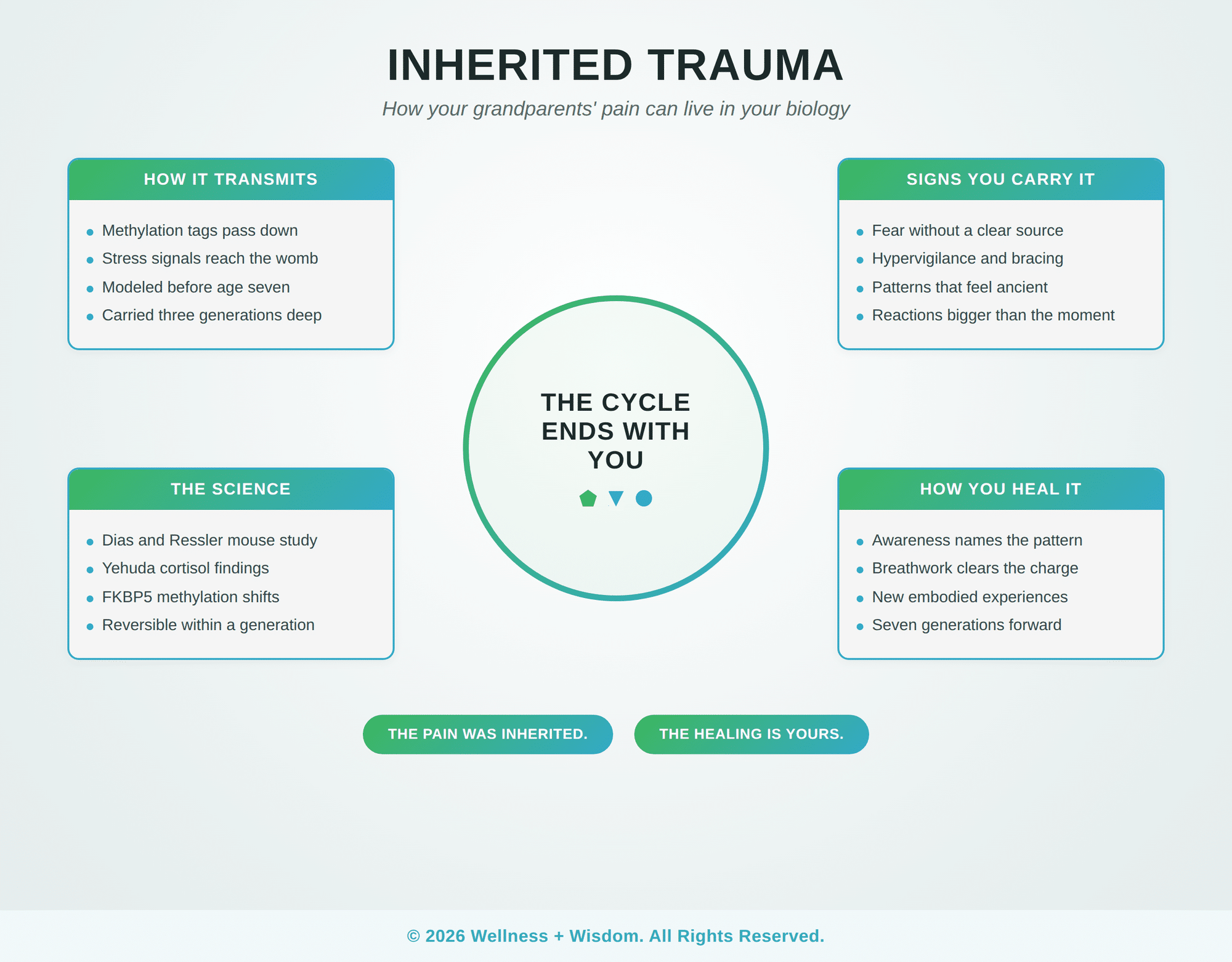
The field gained mainstream scientific traction after researcher Rachel Yehuda at the Icahn School of Medicine at Mount Sinai published landmark studies on Holocaust survivors and their offspring. Her team found that not only did children of survivors show altered cortisol patterns associated with PTSD, but the biological markers were consistent with what you would find in someone who had lived through the trauma themselves. The body had inherited the stress response without having inherited the actual experience.
This is the part that rewires how you understand your own story. When you find yourself in a state of hypervigilance in a situation that is objectively safe, when you struggle with trust in relationships despite evidence that the person in front of you is trustworthy, when your neural system fires an alarm in response to stimuli that do not logically warrant an alarm, you may not be dealing with a personal failure. You may be dealing with inherited biology that was shaped decades before you were born.
The Wellness + Wisdom mission has always been to give people the truth about their biology so they can stop fighting themselves and start understanding themselves. Inherited trauma is one of the most important truths the field of Emotional Epigenetics has uncovered, and the wellness community is only beginning to integrate what it really means.
How Epigenetic Inheritance Works: The Biology Behind the Pain
To understand epigenetic inheritance, you first need to understand what epigenetics actually is. Your DNA is the instruction manual your body runs on. The approximately 3 billion base pairs in your genome contain the code for every protein, enzyme, and cellular function in your body. But here is what most people do not realize: having a gene does not mean that gene is being expressed. Genes get turned on and turned off based on a layer of biological control that sits above the DNA sequence itself. This control layer is called the epigenome.
The two most studied mechanisms of epigenetic control are DNA methylation and histone modification. DNA methylation works like a dimmer switch. When a methyl group attaches to a specific location on your DNA, it typically silences the expression of that gene. Histone modification works by changing the physical structure of how DNA is packaged inside the cell, making certain genes more or less accessible to be read. Together, these mechanisms determine which chapters of your genetic instruction manual are open and which are closed at any given moment.
Here is where generational trauma DNA gets real: these epigenetic marks can be passed from parent to child. When a person experiences severe or chronic stress, it alters their epigenetic marks, particularly around genes that regulate the stress response. And in some cases, these altered marks survive the process of reproduction and appear in the next generation. Sometimes even the generation after that.
The research pioneer in this space, Brian Dias at USC Keck School of Medicine, showed in animal studies that mice trained to fear a specific cherry blossom scent passed that fear response to their offspring and grandoffspring. The descendant mice had never been exposed to the original conditioning. They inherited the fear at the biological level, with measurable epigenetic differences in the olfactory receptors that corresponded to that specific scent. This was not learned behavior. This was inherited biology.
The implications for human beings are profound, and the human data is now following the animal data in compelling ways. The Wellness + Wisdom Podcast has explored this science across dozens of episodes, and every conversation I have with researchers in this space confirms the same message: the body keeps a score that spans generations. Learn more about how this connects to emotional intelligence and your capacity for self awareness as a healing tool.
The Syrian Refugee Study: First Proof Across Three Generations
In early 2025, a landmark study published in Nature Scientific Reports provided what researchers are calling the first report of an intergenerational epigenetic signature of violence in human beings across three generations. This is not a mouse study. This is human families. Three generations of Syrian refugees whose biological samples were analyzed for DNA methylation patterns.
The findings are extraordinary. Researchers identified 14 differentially methylated regions associated with what they called germline exposure to violence, meaning changes in the DNA of people whose mothers had survived war related violence before they were even conceived. They found 21 additional methylation sites associated with direct exposure. And crucially, 32 sites showed the same directional change in DNA methylation across all three types of exposure: germline, prenatal, and direct. The same epigenetic signature of violence was present whether the study participant had personally survived war, been exposed in utero, or was the grandchild of a survivor with zero direct exposure to conflict (Mansour et al., 2025, Scientific Reports).
Let that sink in for a moment. A child in this study, born years after the violence ended, in a body that had never experienced war, carried the biological mark of that violence in their DNA because their grandmother survived it. This is generational trauma DNA made visible at the molecular level.
The study also found epigenetic age acceleration in children with prenatal exposure, meaning the biology of these children was literally aging faster than it should. The trauma was not just shaping their emotional responses. It was accelerating the cellular aging process itself.
This is why the conversation about intergenerational trauma has moved far beyond the realm of psychology and into molecular biology. It is also why the work of healing is not just a personal journey. It is a biological intervention with consequences that extend to generations you have not yet met. Every healing practice you adopt, every pattern you interrupt, every time you choose regulation over reactivity, you are not just healing yourself. You are rewriting the epigenetic instructions for the children who will come after you.
Explore how the science of Emotional Epigenetics translates this research into daily practices on the podcast. And if you want to understand how ancestral patterns show up in the body, this episode on somatic healing is essential listening.
Holocaust Survivors and the Fourth Generation Finding
Rachel Yehuda's research on Holocaust survivors has been foundational to the science of inherited trauma for over two decades. Her team's 2016 paper in Biological Psychiatry showed that children of Holocaust survivors had different methylation patterns on the FKBP5 gene, a critical stress regulator, compared to Jewish adults whose parents did not experience the Holocaust. This was the first human data directly linking parental trauma to epigenetic changes in offspring (Yehuda et al., 2016).
A 2025 study in Scientific Reports extended this work to the third and fourth generation, examining 371 participants including 186 descendants of Holocaust survivors. The findings revealed that these descendants showed DNA methylation patterns associated with stronger activation of the oxytocin system, the biological system linked to bonding, trust, and social regulation. In what researchers interpret as a potential resilience adaptation, descendants also showed lower attachment avoidance than control subjects.
This is the joy forward truth at the heart of this science: the same biological mechanism that transmits the wound can also transmit adaptive responses that increase the capacity for connection. The body is not just a record of injury. It is also a record of survival. And survival, at the epigenetic level, sometimes looks like an enhanced capacity for love.
This finding resonates deeply with what I have seen in the thousands of conversations about emotional intelligence and healing on the Wellness + Wisdom Podcast. The people who have done the most profound work on their inherited patterns are often the most capable of deep connection, not in spite of their lineage, but because of the fierce intention with which they metabolized it.
Which Genes Get Affected? FKBP5, NR3C1, and the HPA Axis
When researchers study epigenetic inheritance related to trauma, they find the same genes showing up repeatedly across different populations and different types of trauma. Understanding these genes gives you a biological map of where inherited stress lives in the body.
FKBP5 is a gene that regulates the sensitivity of the glucocorticoid receptor, which is the primary docking station for cortisol in the body. When FKBP5 is hypomethylated (less methylated than normal), the stress response system becomes more reactive. Cortisol has a harder time doing its job of turning off the alarm, and the neural system stays in a state of heightened alert longer than it should. This is the epigenetic signature found in both Holocaust survivors and their children in Yehuda's research.
NR3C1 is the gene that encodes the glucocorticoid receptor itself. When trauma alters methylation on this gene, it changes the number of cortisol receptors available in the brain, particularly in the hippocampus. Fewer receptors means less efficient stress regulation. The body's natural brake system for the alarm response becomes less effective. Research reviewed in Mammalian Genome in 2025 cataloged DNA methylation variations in NR3C1 alongside FKBP5, BDNF, and SLC6A4 across populations exposed to genocide, combat, and conflict (Mansour et al., 2025).
BDNF (Brain Derived Neurotrophic Factor) is sometimes called Miracle Gro for the brain. It promotes the growth of new neural connections and plays a critical role in learning, memory, and mood regulation. Trauma related epigenetic changes that suppress BDNF expression have been linked to depression, anxiety, and impaired emotional regulation across multiple studies.
The hypothalamic pituitary adrenal (HPA) axis is the central highway of the human stress response. From the moment the hypothalamus fires a stress signal to the pituitary, which signals the adrenals to release cortisol, to the moment cortisol feeds back to the brain to turn the alarm off, every step of this process is regulated by genes that are susceptible to epigenetic modification through trauma. A 2025 review in PubMed specifically examined how traumatic experiences and epigenetic modifications are transmitted across generations through the HPA axis, with a focus on mechanisms for trauma reversal and resilience (Wankerl et al., 2025).
Understanding this biology is not about labeling yourself as damaged. It is about understanding the system so you can work with it. The L.I.F.E. Method I teach is built around exactly this: using the science of epigenetics to inform practical tools for neural system regulation and emotional healing. You can explore more of the biological foundations at Emotional Epigenetics: How Your Feelings Shape Your DNA.
Signs You May Be Carrying Inherited Trauma
Inherited trauma does not always look like a dramatic wound. Sometimes it looks like a quiet, persistent pattern that has always been part of your life, so familiar that you have never thought to question whether it belongs to you or whether it was handed down.
Here are some of the most common indicators, recognizing that this is not a clinical checklist and that working with a qualified therapist is the appropriate next step if you recognize yourself in these patterns:
Disproportionate fear responses. You experience fear or anxiety in situations that are objectively safe. A loud noise, a certain tone of voice, the smell of a specific environment triggers a full body alarm that feels far bigger than the current moment warrants. This is the classic signature of an inherited stress response that was calibrated to a threat that your body never actually experienced.
Patterns that repeat across generations. You can look at your parents, grandparents, or siblings and see the same relational patterns, the same emotional blind spots, the same coping mechanisms. The unconscious repetition of family patterns is one of the most documented signs of intergenerational trauma.
Hypervigilance with no clear origin. A baseline state of alertness that never fully switches off. Difficulty relaxing. Always scanning for what might go wrong. The neural system stuck in a low level threat response even in peaceful circumstances.
Emotional numbness or dissociation. Difficulty accessing your own emotional experience. A quality of being in your life but not fully present in your body. This is a common adaptive response to inherited stress activation that the body learned to suppress in order to function.
Persistent shame or unworthiness with no obvious cause. A felt sense that you are fundamentally flawed or not enough, despite evidence to the contrary and despite sincere effort to work on your self concept. This type of core level shame often has roots in family systems that predate your own personal history.
Difficulty with trust and intimacy. Especially consistent with the FKBP5 and oxytocin system research, difficulty allowing closeness in relationships despite consciously wanting it. The body's alarm response fires in situations of potential vulnerability because vulnerability was epigenetically encoded as dangerous.
If you recognize yourself in several of these patterns, that recognition itself is the beginning of freedom. Understanding that these responses have a biological origin, that they are not character defects but inherited adaptations, is one of the most liberating pieces of knowledge you can hold. More on how to move forward in the healing section below. And you can explore the community support available through the Liberated Life Tribe as a resource for this work.
The Joy Side: Resilience and Strength Are Also Inherited
Here is the part of the inherited trauma conversation that the wellness world has been slow to tell you: the exact same mechanism that transmits suffering also transmits strength. Epigenetic inheritance is not a one way highway of pain. It is a full spectrum transmission of everything your ancestors experienced, including their courage, their adaptation, their survival intelligence, and their capacity for joy.
The 2025 Holocaust descendants study touched on this with its finding of enhanced oxytocin system activation and lower attachment avoidance in third and fourth generation survivors. But the principle extends far beyond any single study. Every population that has survived extreme adversity carries both the wound and the wisdom of that survival in their epigenome. Indigenous communities, diaspora communities, communities who survived slavery, genocide, and war: the research increasingly shows that these communities carry not just inherited stress responses but also inherited resilience adaptations that have biological signatures.
This is why the framework of Emotional Epigenetics refuses to treat the inherited code as purely a liability. It is ancestral information. Some of it needs to be updated, the stress responses that no longer serve you in a world that is safer than the one your grandparents navigated. But some of it is a gift. The heightened sensitivity that makes you an extraordinary empath. The fierce protectiveness that makes you an exceptional parent. The deep knowing that comes from being descended from people who had to read environments at an extremely high level to survive.
The work is not to erase your inheritance. The work is to choose which parts of it you amplify. That is the real promise of intergenerational trauma healing: not the elimination of your ancestral story but the conscious authorship of which chapters you carry forward. Explore the conversation on ancestral gifts and ancestral healing on the podcast for a deeper exploration of this theme.
Intergenerational Trauma Healing: What the Science Actually Supports
The most exciting frontier in the field of generational trauma DNA research is the therapeutics section. A 2026 review in Frontiers in Psychiatry examined studies from 1990 through 2025 on multigenerational trauma epigenetics and notably included a dedicated section on therapeutics, asking the question that everyone in this field wants answered: can epigenetic changes from trauma actually be reversed? The early answer is yes. Not always. Not completely. But meaningfully, measurably, and with implications for future generations.
Somatic practices and neural system regulation. The body is where inherited trauma lives and the body is where it heals. Somatic experiencing, breathwork, and other body based practices are increasingly being framed not just as stress management tools but as epigenetic interventions. Househam's 2023 review confirmed that mindfulness based practices produce measurable changes in DNA methylation and histone modification, partially reversing stress induced epigenetic changes. The mechanism is real: when you change the state of your neural system through body based practice, you change the epigenetic signals your cells are receiving (Househam, 2023). This is explored in depth at Breathwork for Neural System Healing on the podcast.
Trauma focused therapy approaches. The Society of Behavioral Medicine has identified trauma sensitive parenting as a primary intervention for breaking intergenerational cycles, recognizing the parent child attachment relationship as the primary biological interface through which epigenetic stress signals transmit from one generation to the next. Child Parent Psychotherapy (CPP) and Mentalization Based Family Therapy (MBFT) show the strongest evidence for interrupting this transmission at the attachment level, precisely because they intervene in the primary biological relay mechanism. Explore how attachment and conscious parenting connect at Wellness + Wisdom.
Community and cultural healing. The wellness community is increasingly recognizing that the healing modalities most effective for communities with collective trauma histories are not individual therapy. They are ceremony, storytelling, ritual, and communal practice. The Global Wellness Institute named culturally responsive trauma healing as a defining wellness trend for 2025, recognizing that for communities whose trauma is collective, the healing must also be collective. Community as medicine is a theme that runs throughout the latest episodes of the podcast.
Nutritional epigenetics. Certain nutrients directly affect the methylation cycle, the biological process by which epigenetic marks are added and removed from DNA. Folate, B12, SAMe, and choline are methyl donors that support the body's ability to regulate gene expression. This is not a replacement for psychological and somatic healing work, but it is a meaningful supportive layer. The conversation about nutrigenomics and epigenetic health on the podcast goes deeper into this.
Movement and exercise. Multiple studies have shown that consistent aerobic exercise produces epigenetic changes that support BDNF expression, improve HPA axis regulation, and reduce inflammatory gene expression. Movement is not just physical maintenance. At the epigenetic level, it is a direct signal to your genome that the environment is safe and resourced. Your body interprets consistent movement as evidence that you are not in survival mode, and it adjusts gene expression accordingly. Explore this at Movement as Epigenetic Medicine.
A 2025 review in PubMed titled “Epigenetic Echoes: Bridging Nature, Nurture, and Healing Across Generations” frames all of these approaches within a unified model: that healing inherited trauma is essentially the process of providing the body with enough safety, nourishment, and relational repair that the epigenetic marks calibrated to danger can begin to shift (PubMed, 2025).
Emotional Epigenetics: The Framework for Rewriting Your Biology
Everything I teach through Emotional Epigenetics rests on a single foundational truth: your emotional life is not separate from your biology. Every feeling you experience, every emotional pattern you run, every moment of fear or shame or joy or love sends a chemical signal to every cell in your body that changes which genes are being expressed. This is not a metaphor. This is the direct biological mechanism that the epigenetic inheritance research has been documenting for two decades.
The framework I have built around this science has four pillars:
Pillar 1: Recognize what is yours versus what is inherited. Not every fear, every shame response, every relationship pattern began with you. The first act of intergenerational trauma healing is developing the discernment to ask: is this response proportional to what is actually happening right now, or does it feel ancestrally amplified? This is not a blame frame. Your ancestors did the best they could with the information and resources they had. But their calibration was to their world, not yours. You get to update the software.
Pillar 2: Regulate before you cognitively process. The inherited stress response lives in the body, in the subcortical brain structures that process threat before the thinking mind is even involved. This is why talk therapy alone is often insufficient for deeply rooted inherited patterns. You must create safety in the body first. Breathwork, somatic movement, cold exposure, and other neural system regulation tools are the primary interventions at this level.
Pillar 3: Update the story at the cognitive level. Once the body is regulated, the cognitive work of reframing the inherited narrative becomes possible. This is where therapy, journaling, and the L.I.F.E. Method practices come in. Understanding the history that created the pattern allows you to hold it with compassion rather than judgment, and compassion is the emotional signal that most reliably shifts epigenetic expression away from threat activation.
Pillar 4: Create new experiences that encode new biology. Healing is not just the removal of old patterns. It is the building of new ones. Every time you choose repair over rupture in a relationship, every time you feel fear and act with courage anyway, every time you experience genuine safety and allow yourself to fully receive it, you are creating the experiential data that your epigenome uses to update its instructions. This is the profound joy in the science of epigenetic inheritance: your lived experience today is actively rewriting the code.
Explore how these four pillars connect to the broader Wellness + Wisdom programs and how the various pathways into this work are structured for people at different stages of the journey.
Breaking the Cycle: What You Do Now Rewrites the Code for Your Children
Gen Z is leading a cultural conversation that older generations are still catching up to: the conversation about breaking cycles. For the first time in history, a generation is naming inherited trauma, claiming it consciously, and actively working to interrupt its transmission before it passes to another generation. The science validates exactly what this generation intuitively knows: healing now has downstream consequences.
The most powerful intervention point for intergenerational trauma healing is the parent child attachment relationship. This is the primary biological interface through which epigenetic stress signals transmit from one generation to the next. When you are regulated in your body, when you can be a safe, present, attuned caregiver, you are providing your child with the biological experience of safety that literally changes their epigenetic programming. This is not pressure. This is possibility. You do not have to be a perfect parent. You have to be a healing parent.
The research on repair is particularly powerful here. The moments when a rupture in attunement occurs and a parent repairs it, comes back, reconnects, acknowledges, and restores the relational safety, are among the most epigenetically healing experiences a child can have. They encode the belief, at the biological level, that safety is recoverable. That love comes back. That the world is fundamentally reparable. These are the beliefs that inherited trauma erases and that conscious healing restores.
And here is the truth I come back to again and again when I think about my own journey as a father and as someone doing this work: every generation that heals sends ripples backward and forward simultaneously. When you metabolize your inherited pain, you are not just changing your own neural system. You are changing the family field. You are contributing to the healing of ancestors who lived in times when this healing was not possible, and you are decreasing the weight your children will carry. This is the most generous act available to any human being, and it begins with the simple commitment to understand your own biology honestly and compassionately.
If you are ready to begin or deepen this work, the Liberated Life Tribe is a community built specifically for this journey. And the full archive of conversations on healing, consciousness, and human potential is waiting for you on the Wellness + Wisdom Podcast. The latest episodes include conversations with leading researchers and practitioners in the field of trauma and epigenetics.
Join the Liberated Life Tribe
If this article has landed for you, if you recognize the inherited patterns in your own story and you are ready to do something about it, I want to personally invite you to join the Liberated Life Tribe at liberatedlife.com.
When you join, you receive the 10 Day Self Liberation Blueprint, a guided daily journey through the four pillars of Emotional Epigenetics with practical tools for neural system regulation, ancestral pattern recognition, and the creation of new biological experiences that support healing. You also join a community of thousands of people doing exactly this work, breaking cycles, rewriting their biology, and building lives that are genuinely free.
The science is clear. The healing is possible. And you do not have to do it alone. Join the Liberated Life Tribe today.
Frequently Asked Questions About Inherited Trauma
What exactly is inherited trauma and how is it different from learned behavior?
Inherited trauma refers to the biological transmission of stress response patterns through epigenetic changes in DNA, not the conscious or unconscious learning of behavior through observation. While learned behavior involves watching and modeling what caregivers do, inherited trauma involves actual changes to how genes are expressed, changes that can be present in the offspring before the child ever consciously observes or learns anything from the parent. The Syrian refugee study and Holocaust research demonstrate this clearly: children and grandchildren showed altered epigenetic markers even when they had no direct exposure to the original trauma and in some cases were raised in entirely different environments from the affected family members.
Can inherited trauma be healed or is it permanent?
The emerging consensus in the research is that the epigenetic changes associated with intergenerational trauma healing are not permanent. They are dynamic. The same mechanism that allows trauma to be encoded can also allow healing to be encoded. Multiple peer reviewed studies have shown that somatic practices, mindfulness based interventions, trauma focused therapy, and consistent relational safety produce measurable epigenetic changes that move in the direction of regulation and healing. The 2026 Frontiers in Psychiatry review specifically examined the therapeutics of epigenetic trauma reversal, and the early evidence is encouraging. Healing takes time and it requires working at the body level, not just the cognitive level, but it is genuinely possible.
How do I know if what I am experiencing is inherited trauma versus my own personal trauma?
The honest answer is that it is often both, and the distinction matters less than the commitment to heal whatever is present. Some useful questions to ask yourself: Does my reaction feel proportional to what is actually happening in this moment? Have I noticed the same patterns in my parents or grandparents? Does this response feel like it has always been there, part of the furniture of my life, rather than something that developed in response to a specific experience I can identify? These indicators point toward an inherited layer. Working with a trauma informed therapist or somatic practitioner can help you map the difference. Exploring Emotional Epigenetics as a framework is also a powerful starting point.
Does inherited trauma affect some communities more than others?
Yes. The research is consistent: communities with histories of collective trauma, including Indigenous peoples subjected to forced cultural assimilation, descendants of enslaved people, refugee communities, and survivors of genocide, show the most documented evidence of epigenetic transmission across generations. This is not a narrative of victimhood. It is a recognition of biological reality that has been largely ignored in mainstream healthcare. It is also a recognition that healing for these communities must be culturally grounded, collective, and rooted in the specific ancestral traditions that carry their resilience, not just the trauma. The Wellness + Wisdom approach to ancestral healing honors this dimension of the work.
What is the connection between inherited trauma and physical health?
The connection is direct and well documented. The epigenetic changes associated with generational trauma DNA primarily affect the genes that regulate the HPA axis and the immune system. This means that inherited stress responses translate into altered cortisol regulation, elevated inflammatory signaling, and changes in immune function. Over time, these biological states increase risk for conditions including depression, anxiety disorders, cardiovascular disease, autoimmune conditions, and accelerated cellular aging. The Syrian refugee study found that prenatal trauma exposure was associated with epigenetic age acceleration in children. Your ancestors' trauma is not just an emotional inheritance. It is a physiological one. And healing the emotional roots produces measurable physiological benefits throughout the body.
How does the science of inherited trauma connect to conscious parenting?
The parent child attachment relationship is the primary biological interface through which epigenetic stress signals transmit from one generation to the next. When parents do their own healing work, regulate their own neural systems, and provide consistent attunement and repair to their children, they are interrupting the transmission mechanism at its most powerful point. Research supports that children who experience secure attachment with a regulated, emotionally present caregiver show different epigenetic profiles than children of dysregulated or traumatized caregivers. This is the most direct and powerful leverage point for breaking the cycle. The Wellness + Wisdom conscious parenting resources and the full L.I.F.E. Method are designed to support parents in doing exactly this work.
Studies and External Resources
The science in this article rests on peer reviewed research and authoritative resources. These are the studies and sources referenced throughout.
- Epigenetic signatures of intergenerational exposure to violence in three generations of Syrian refugees. Sci Rep, 2025. PubMed: 40016245
- Holocaust Exposure Induced Intergenerational Effects on FKBP5 Methylation. Biol Psychiatry, 2016. PubMed: 26410355
- Genetic heritage of war: exploring transgenerational inheritance of PTSD and its molecular background. Mamm Genome, 2026. PubMed: 41526709
- On the role of epigenetic modifications of HPA axis in posttraumatic stress disorder and resilience. J Neurophysiol, 2025. PubMed: 39842807
- Effects of stress and mindfulness on epigenetics. Vitam Horm, 2023. PubMed: 36863798
- Epigenetic Echoes: Bridging Nature, Nurture, and Healing Across Generations. Int J Mol Sci, 2025. PubMed: 40243774
About Josh Trent
Josh Trent is the founder of Wellness + Wisdom and the creator of Emotional Epigenetics, the L.I.F.E. Method, and the Wellness Pentagon. He has spent over 20 years studying the intersection of physical health, emotional intelligence, and human potential. As host of the Wellness + Wisdom Podcast, Josh has conducted over 600 conversations with the world's leading teachers in health, psychology, neuroscience, and spirituality.
Josh's work blends peer reviewed science with lived experience, delivering practical frameworks that people can use immediately to transform their health, relationships, and sense of purpose. His personal journey through inherited family patterns, addiction, and emotional healing is the foundation of everything he teaches. He is based in Dripping Springs, Texas, where he lives with his family and continues to explore the frontier of emotional epigenetics as both a researcher and a student.
Join the Liberated Life Tribe and receive your 10 Day Self Liberation Blueprint at liberatedlife.com.
References:
- Mansour H, et al. (2025). Epigenetic signatures of intergenerational exposure to violence in Syrian refugee families. Scientific Reports (Nature). PubMed: 40016245
- Yehuda R, et al. (2016). Holocaust Exposure Induced Intergenerational Effects on FKBP5 Methylation. Biological Psychiatry, 80(5):372-380. PubMed: 26410355
- Mansour A, et al. (2025). Genetic Heritage of War: Transgenerational Epigenetic Inheritance and PTSD. Mammalian Genome (Springer Nature). PubMed: 41526709
- Wankerl M, et al. (2025). HPA axis epigenetics, PTSD, and resilience mechanisms. PubMed. PubMed: 39842807
- Epigenetic Echoes: Bridging Nature, Nurture, and Healing Across Generations. (2025). PubMed. PubMed: 40243774
- Househam AM. (2023). Effects of stress and mindfulness on epigenetics. Vitamins and Hormones, 122:283-306. PubMed: 36863798
About Josh Trent
Josh Trent is an Identity Transformation Architect and the award winning host of the Wellness + Wisdom Podcast, with over 15 million downloads since 2015. He is the creator of the L.I.F.E. Method™ Identity Transformation System and steward of the Emotional Epigenetics™ and BREATHE: Breath + Wellness™ systems of self mastery, impacting over 1,000 students worldwide. You can follow Josh Trent and explore the L.I.F.E. Method and the free Liberated Life Tribe. Josh lives in Austin, Texas with his wife Carrie, daughter Nayah, and son Novah.
Disclosure: We may earn a commission from certain links on this site when you make a purchase, at no extra cost to you. These commissions help support Wellness + Wisdom and do not affect the products or resources we choose to recommend. Full disclosure .