
By Josh Trent, Identity Transformation Architect and host of the Wellness + Wisdom Podcast
The vagus nerve is the closest thing you have to a built in brake for stress. You do not need a gadget to use it. You need a longer exhale, and about two minutes.
The vagus nerve is the closest thing you have to a built in off switch for stress, and most people never learn to use it. I spent years revved up and called it ambition. The truth was simpler. My body had forgotten how to come down, and the vagus nerve was the brake I was not pressing. Once I learned to work with it, everything downstream got easier, and the simple reset I am about to share became something I use almost every day.
This is not another wellness hack to add to a pile you will abandon by Friday. It is a return to something your body already knows how to do. When you understand what the vagus nerve is and how to send it the right signal, you get back a sense of control over your own calm that no supplement or device can give you. Let us walk through what the vagus nerve is, the two minute reset I actually use, the science of why it works, and how to make it a habit that sticks.
What this article covers
- What the vagus nerve is
- Why the vagus nerve matters more than another hack
- The night I finally felt the brake work
- Signs your vagal tone is low
- The vagus nerve reset that takes two minutes
- Why the long exhale works
- The vagus nerve and the Wellness Pentagon
- Common mistakes that keep the reset from working
- How to build the habit
- Frequently asked questions
What the vagus nerve is
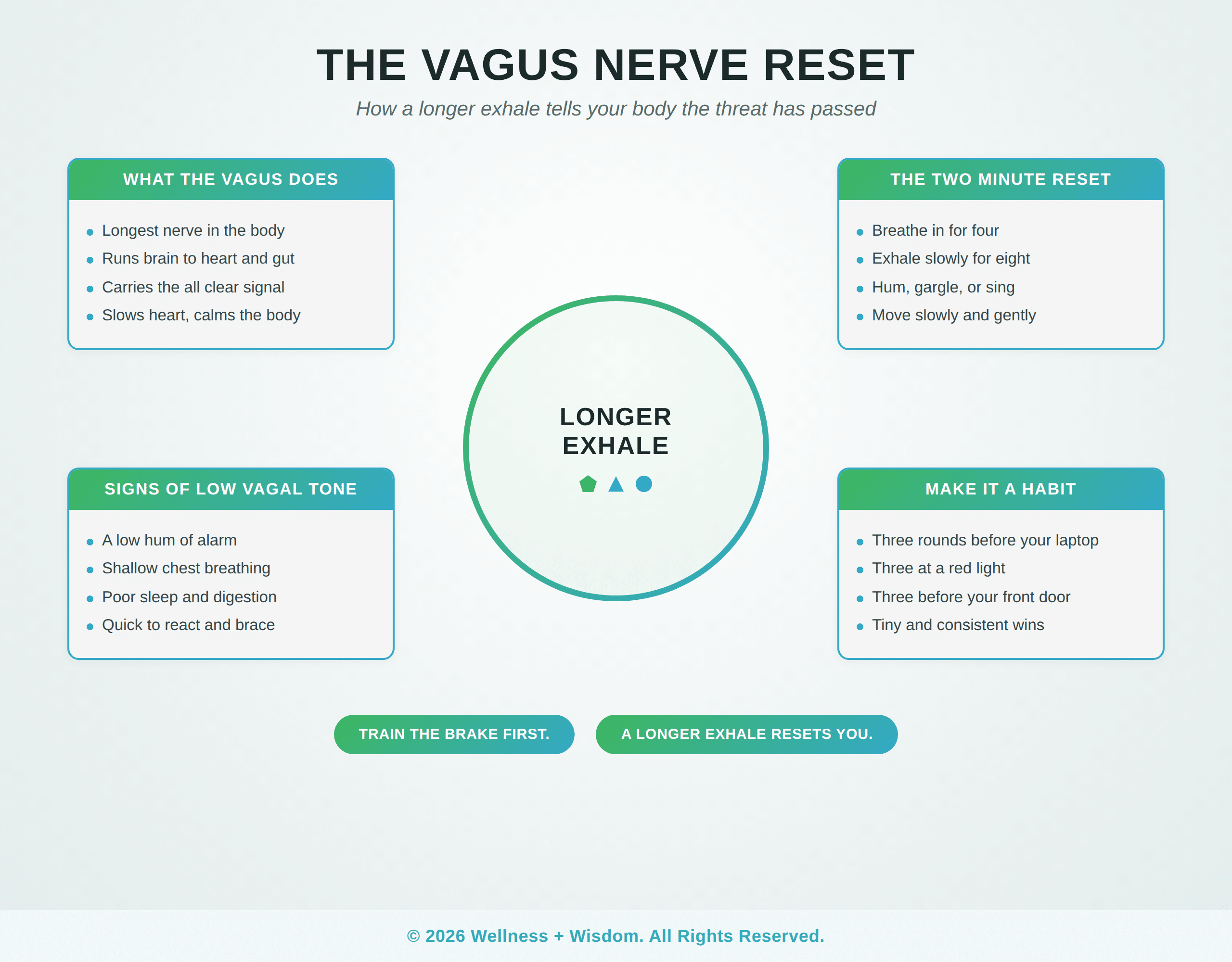
The vagus nerve is the longest cranial nerve in your body and the main wire of your parasympathetic system, the rest and digest branch that brings you back to calm after stress. It runs from your brainstem down through your throat, heart, lungs, and gut, carrying the signal that tells your body the threat has passed. Slow the heart. Deepen digestion. Steady the breath. That is the vagus nerve doing its quiet, essential work.
When this nerve is well toned, you feel calm, present, and resilient. You can meet a stressful moment and then actually come down from it. When its tone is low, you live in a low hum of alarm that you stop noticing because it never fully turns off. Your body stays braced even when nothing is wrong. The good news, and the whole point of this article, is that the vagus nerve responds to training. You are not stuck with the tone you have. You can strengthen it with signals your body was built to receive, and one of the most powerful signals is your own breath.
It helps to picture your body running on a seesaw. On one side is the stress response that revs you up to meet a challenge, and on the other is the calming response the vagus nerve leads, that brings you back down once the challenge passes. In a healthy system the seesaw tips back and forth easily all day long. The problem for most of us is not that we have a stress response. We need that. The problem is that the seesaw gets stuck on the up side and never fully tips back, so we live keyed up without realizing there is another setting. The vagus nerve reset is simply how you tip the seesaw back on purpose until your body remembers it can rest.
Why the vagus nerve matters more than another hack
The vagus nerve matters more than any supplement or gadget because a regulated body is the floor that everything else in your wellness stands on. I will be honest with you. When you learn to settle your own physiology, the changes ripple everywhere. Sleep gets deeper. Cravings quiet down. You stop reacting to the people you love from a braced, defensive body. Regulation is not one more item on the wellness menu. It is the table the whole meal sits on.
Most of what gets sold as wellness skips this entirely and jumps straight to the supplement stack. I am not against tools. I use plenty of them. But if your body cannot find calm, no stack on earth fixes that, because you are pouring water into a bucket with a hole in it. Train the brake first, then add the tools, and watch how much better everything else works. This is exactly why neural system regulation sits at the center of how I teach, and why I keep coming back to it in pieces like the five regulation practices I use. Get the foundation right and the rest of your wellness finally holds.
The night I finally felt the brake work
I remember the exact moment the vagus nerve stopped being a concept and became real for me. It was close to midnight, my chest was tight, my mind was sprinting through tomorrow, and my body was wired in a way I had spent years calling drive. I had read all the theory. I knew the vagus nerve was the brake. What I had never done was actually press it on purpose when it counted.
So I lay there and did the only thing I could think to do. I breathed in for four and out for eight, slow and unforced, again and again. For the first ninety seconds nothing happened, and the cynic in me wanted to quit. Then somewhere around the two minute mark my shoulders dropped without my permission. My jaw unclenched. The sprint in my head slowed to a walk. It was not dramatic. It was quiet, and it was real, and for the first time I felt my own body choose calm instead of waiting for the day to hand it to me.
That is the whole promise of this work. Not a peak experience, but a reliable off ramp you can take any time the alarm gets loud. The vagus nerve had been there my entire life. I had simply never learned to speak its language. Once I did, I had a tool I could use at a red light, in a hard conversation, or at midnight when my body forgot how to come down. That is what I want to hand you here.
Signs your vagal tone is low
Signs of low vagal tone show up as a body that cannot fully relax even when the day is calm. The clearest sign is that low hum of alarm in the background, a sense of being slightly braced or on guard for no clear reason. You might also notice shallow chest breathing, trouble winding down at night, digestion that flares under stress, and a tendency to react quickly and defensively to small things.
None of this means something is wrong with you. It means your body learned to stay activated, often for very good reasons, and simply never got the signal that it is safe to stand down. Sometimes that pattern was set early, a theme I explore in bioenergetic memory and in Emotional Epigenetics™. The cost of staying chronically activated is not only emotional, it is physical, which I unpack in how stress makes you sick. The encouraging truth is that vagal tone is trainable, and the training starts with a single breath.
If you recognize yourself in those signs, you are in very good company. Modern life keeps most of us subtly activated, with a stream of alerts, deadlines, and demands that rarely lets the body fully exhale. Low vagal tone is less a personal flaw than a predictable result of a world that never stops pinging. That reframe matters, because shame keeps you stuck while understanding sets you free to act. Your body adapted to its environment, and it can adapt again toward calm the moment you start giving it the right signal.
The vagus nerve reset that takes two minutes
The vagus nerve reset I actually use is simple. You do not need a gadget. You need a longer exhale. Breathe in gently for four counts, then breathe out slowly for eight. That long exhale is the direct input that tells the vagus nerve to stand the body down. Two minutes of this and your shoulders drop on their own, your heart slows, and the background hum of alarm begins to quiet. This is the core of the reset, and it is the heart of the BREATHE™ work I teach.
A few other signals work through the same nerve. Humming, gargling, and singing gently vibrate the branches of the vagus nerve that pass through your throat, which is why a slow hum on the exhale feels so soothing. Slow rhythmic movement, like an unhurried walk or gentle stretching, sends the same message of safety. These are not party tricks. They are inputs to a nerve that was built to respond to exactly this kind of slow, steady signal. If you want a structured version of the breathing, I walk through box breathing for beginners as a companion practice, and you can find guided breathwork built around the vagus nerve in the Wellness and Wisdom store.
The most important part is the ratio, not the exact count. Make your exhale longer than your inhale, keep the breaths smooth rather than forced, and let the rhythm be gentle. Overbreathing or straining defeats the purpose. The goal is ease, not effort. You are not trying to control your body into calm. You are inviting it.
When the alarm is especially loud, I reach for a gentle variation that works fast. Take a normal breath in through the nose, add a second small sip of air on top to fully expand the lungs, then let a long, slow breath out through the mouth. Repeat that two or three times and the body often drops a gear within seconds. This pattern mirrors the natural reset your body already does when you sigh after a good cry or a wave of relief, which is your built in evidence that the long exhale is the off switch your body has used all along. Keep it gentle and let the out breath lead.
Why the long exhale works
The long exhale works because slowing your breath directly shifts your body toward the parasympathetic, vagal side of the scale. The vagus nerve is the main component of your parasympathetic system, overseeing mood, digestion, immune response, and heart rate, which is why working with it touches so much of how you feel (Breit et al., 2018). When you lengthen the exhale, you are pulling a real physiological lever, not just relaxing by suggestion.
A systematic review of slow breathing techniques found that breathing slower than about ten breaths a minute promotes a predominance of the parasympathetic system, mediated by vagal activity, and is linked with greater heart rate variability, better emotional control, and improved wellbeing (Zaccaro et al., 2018). Researchers have even proposed a model, called respiratory vagal nerve stimulation, describing how slower breathing and longer exhalations both briefly and lastingly stimulate the vagus nerve to produce these calming effects (Gerritsen and Band, 2018). In other words, the science confirms what your grandmother knew. Take a slow, deep breath, and let the out breath be long. Your body does the rest.
There is a simple way to picture vagal tone, and it is called heart rate variability. Your heart does not beat like a metronome. The tiny variations in timing between beats are a window into how flexible and responsive your vagus nerve is, and higher variability generally reflects a body that can move fluidly between effort and rest. Chronic stress tends to flatten that variability, while slow breathing and the long exhale gently restore it. You do not need to measure any of this to benefit from it. The point is that the calm you feel after two minutes of breathing is not your imagination. It is your physiology reorganizing itself around the signal you just sent.
The vagus nerve and the Wellness Pentagon
The vagus nerve sits at the center of the Wellness Pentagon™, not off to the side as some optional extra, because regulation touches all five dimensions of a whole life. A body that can find calm sleeps better physically, thinks more clearly mentally, feels more steadily emotionally, connects more openly with Creator and God spiritually, and even makes wiser decisions financially. When the body is braced, every one of those dimensions suffers. When the body can settle, every one of them improves. That is why I teach regulation first, as the foundation explained in our mission.
This is also where the vagus nerve meets the deeper identity work of the L.I.F.E. Method™. The pillar of Frequency is about the physiological and energetic state you live in, and your vagal tone is one of the most concrete expressions of that state. You cannot think your way into a new identity from a body stuck in alarm. You have to change the state first, then the change becomes embodied. A regulated body makes emotional skill possible, which is why this work pairs so naturally with building emotional intelligence as an adult and with the practice of riding a feeling instead of reacting to it, as in the 90 second emotion rule.
There is a relational gift here too. When your own vagus nerve is toned, you stop passing your dysregulation on to the people around you. You meet your partner, your friends, and your children from a settled body instead of a braced one, which is one of the quiet foundations of conscious parenting. Regulation is not a selfish act. It is one of the most generous things you can offer the people you love.
Common mistakes that keep the reset from working
The vagus nerve reset is simple, but a few common mistakes keep people from feeling it work. The first is forcing the breath. Big, effortful, gulping breaths actually push the body toward the stress side of the scale, the opposite of what you want. The whole practice depends on ease, so keep the breaths smooth, quiet, and unhurried, and let the exhale be long rather than hard.
The second mistake is quitting too early. The shift often does not arrive in the first thirty seconds, and many people give up right before their body would have dropped into calm. Give it the full two minutes. The third mistake is treating the reset as something you only reach for in a crisis. Like any kind of training, the benefit comes from steady repetition when you are already fine, which raises your baseline so that calm is easier to find when things get hard. The last mistake is expecting a dramatic high. This work is quiet by design. A small, reliable drop in tension, repeated daily, will change your life far more than any single intense experience, because you are slowly teaching your body a new default. Approach it with patience and curiosity, and let it be gentle.
How to build the habit
You build the vagus nerve habit by anchoring the breathing to something you already do every day, so it happens without willpower. Three slow rounds before you open your laptop. Three at a red light. Three before you walk in your own front door, so you do not carry the day inside to your family. Tiny and consistent beats long and rare every single time, because vagal tone is built through repetition, not intensity.
Think of it like training any other part of your body. You are not chasing one dramatic session. You are sending your neural system the same gentle signal of safety over and over until calm becomes its new default. Some days the reset will feel like magic and other days like nothing much happened, and both are fine. The benefit accrues underneath your awareness, the way fitness builds long before you notice it in the mirror. Stack the reps, trust the process, and let it compound.
If the pull to skip it shows up, get curious about that resistance instead of forcing your way through, a gentler approach I describe in self sabotage and its epigenetic roots.
Be patient and generous with yourself as the habit forms. There will be days you forget, days you remember and skip it anyway, and days the reset feels like it did nothing at all. None of that is failure. The only thing that matters is that you keep returning to the breath, because the body learns through gentle repetition far more than through pressure or perfection. Treat each round as a small kindness you are offering your own body rather than another task to perform. That posture of care, more than any technique, is what turns a practice into a lasting change.
And as your body learns to settle, you will start to recognize the quiet markers of progress I describe in signs your neural system is healing. Your body has been asking you for this for a long time. Two minutes of breath is how you finally answer. Peace and power.
Frequently asked questions
What is the vagus nerve?
The vagus nerve is the longest cranial nerve in the body and the main wire of the parasympathetic system, the rest and digest branch that calms you after stress. It runs from the brainstem through the throat, heart, lungs, and gut, carrying the signal that the threat has passed so the body can slow the heart, deepen digestion, and steady the breath.
What is a vagus nerve reset?
A vagus nerve reset is a simple practice that sends your body a signal of safety so it can shift out of stress and back into calm. The most effective reset is breathing with a longer exhale than inhale for about two minutes. Humming, singing, gargling, and slow rhythmic movement also stimulate the vagus nerve and support the same calming shift.
How do you stimulate the vagus nerve naturally?
You can stimulate the vagus nerve naturally with slow breathing that emphasizes a long exhale, with humming or singing that vibrates the throat, and with gentle rhythmic movement like walking or stretching. These need no equipment. The key is to keep the breath slow and smooth rather than forced, since straining works against the calming response you are trying to create.
Why does a long exhale calm you down?
A long exhale calms you down because exhalation is when the vagus nerve slows the heart and shifts the body toward its parasympathetic, rest and digest state. Lengthening the out breath strengthens that effect, which is why a four count inhale and an eight count exhale signals safety so quickly. Research links slow breathing of this kind with higher heart rate variability and better emotional control.
How long does it take to improve vagal tone?
Some calming effects of a vagus nerve reset are felt within a single two minute practice, as the shoulders drop and the heart slows. Lasting improvements in vagal tone build over weeks and months of consistent practice, much like physical fitness. The most important factor is repetition, so short daily practice will do far more than an occasional long session.
Can you reset your vagus nerve without any devices?
Yes. The most powerful vagus nerve resets require nothing but your own breath and body. A longer exhale, a gentle hum, and slow movement are all free, always available, and well supported by research. Devices exist, but the foundation of regulation is built with simple daily practices you already carry with you everywhere you go.
Join the Liberated Life Tribe
Learning to regulate your body is the foundation of a free and joyful life. Join the Liberated Life Tribe and receive your 10 day Self Liberation Blueprint at liberatedlife.com. It is a community for people building calm, capable bodies and free lives, with the tools and support to make it stick. You can hear these themes across our latest episodes, and explore how food supports the same calm in how food and emotions intersect. Peace and power.
About Josh Trent
Josh Trent is an Identity Transformation Architect and the award winning host of the Wellness + Wisdom Podcast, with over 15 million downloads since 2015. He is the creator of the L.I.F.E. Method™ Identity Transformation System and steward of the Emotional Epigenetics™ and BREATHE: Breath + Wellness™ systems of self mastery, impacting over 1,000 students worldwide. Josh lives in Austin, Texas with his wife Carrie, daughter Nayah, and son Novah. Read more of my story, or explore the L.I.F.E. Method identity transformation system. Your body has been asking you for this. Two minutes of breath is how you answer.