

By Josh Trent, Identity Transformation Architect and host of the Wellness + Wisdom Podcast
Brain foods are not about restriction. They are about abundance. Every nourishing bite is a signal to your body, your mood, and even your genes that you are safe, supported, and worth taking care of.
Brain foods are the nutrient rich foods that feed your mind as directly as they feed your body, and learning to choose them is one of the most joyful upgrades you can make to your daily life. I am not here to hand you another rigid diet. I am here to show you that food is information. Every meal sends a message to your cells about whether to inflame or to calm, to fog or to focus, to brace or to settle. The best brain foods send the message your whole system has been waiting for. You are nourished, and you are safe.
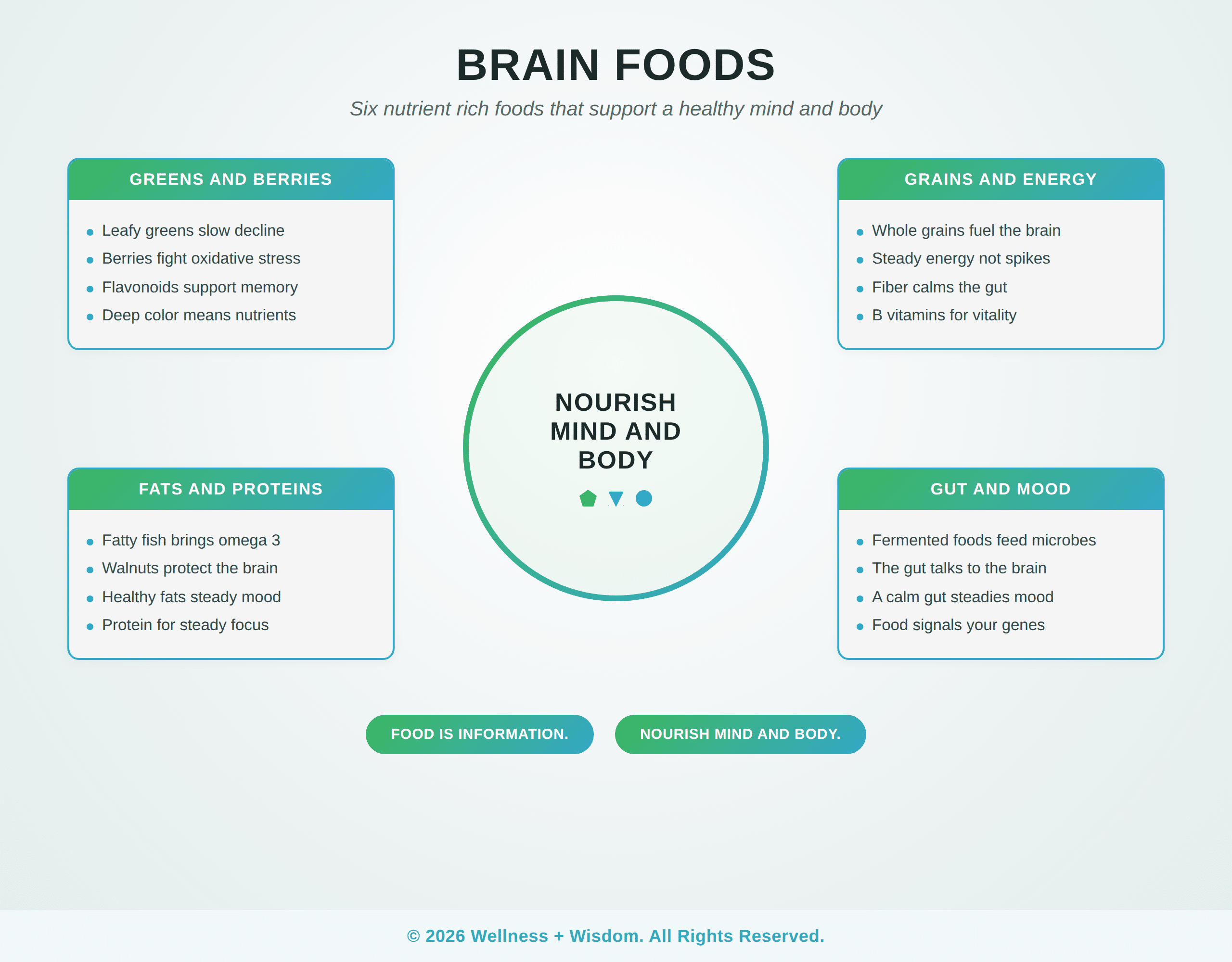
This matters because your mind and body are not two separate projects. They are one living system, and what you eat shapes how you think, feel, and show up. The physical foundation is one of the five sides of the Wellness Pentagon™, and it holds up the other four. When you fuel your body with real brain foods, your mood steadies, your focus sharpens, and your emotional resilience grows. Let us walk through six of the best brain foods, the science underneath them, and the joy forward way to actually eat them.
What this article covers
- Why brain foods matter for your mind and mood
- How brain foods calm the neural system
- Leafy greens
- Nuts and seeds
- Fatty fish
- Berries
- Whole grains
- Fermented foods
- Brain foods as an epigenetic signal
- How to build a plate of brain foods
- Frequently asked questions
- Studies and External Resources
Why brain foods matter for your mind and mood
Brain foods matter because the brain is the most metabolically demanding organ you have, and it builds itself out of what you feed it. Your brain is roughly sixty percent fat, it runs on a steady supply of glucose, and it depends on a constant stream of vitamins, minerals, and antioxidants to protect its delicate wiring. When that supply is rich and steady, you think clearly and feel grounded. When it is poor or erratic, your mood and focus pay the price first.
Here is the part the wellness world often misses. Brain foods do not only protect memory decades from now. They change how you feel today. The same nutrients that guard against long term cognitive decline also calm inflammation, steady blood sugar, and support the chemistry of mood in the present moment. This is the bridge between what you eat and how you feel, a connection I explore in depth in how food and emotions intersect. Food is not just fuel. It is one of the most direct conversations you have with your own biology every single day.
I learned this the slow way. For years I chased the perfect diet, swinging between rigid rules and the rebound that always followed, and it took me a long time to understand that the war with food was never really about food. It was about how I felt about myself. The moment I stopped eating to punish or fix my body and started eating to nourish and support it, everything changed, including my mood and my focus. That shift from restriction to nourishment is emotional work as much as nutritional work, and it is closely tied to the self awareness I teach in building emotional intelligence as an adult. Brain foods land differently when you eat them from a place of care instead of fear.
How brain foods calm the neural system
Brain foods do some of their most important work by calming your neural system and lowering the slow burn of inflammation. Chronic stress keeps the body in a state of high alert, and that state quietly drives the inflammation that wears on both brain and body over time. The omega 3 fats in fatty fish, the antioxidants in berries and greens, and the steady fuel of whole grains all help quiet that fire, which is part of why nourishing food can leave you feeling calmer and clearer within hours of a meal.
There is a feedback loop worth understanding. A dysregulated neural system reaches for quick energy and comfort, which often means the very foods that inflame it further, while a calm neural system finds it easier to choose nourishment. This is why I never separate what you eat from how you feel. Steady nourishment helps settle the body, and a settled body makes the next good choice easier. The cost of staying chronically activated is something I explore in how stress makes you sick, and brain foods are one of the gentlest daily tools for tipping the balance back toward repair and calm.
Leafy greens
Leafy greens are among the most powerful brain foods on the planet, and they earn the top of this list with real evidence behind them. Kale, spinach, arugula, collards, and Swiss chard are loaded with vitamin K, lutein, folate, beta carotene, and antioxidants that protect brain cells from the wear of oxidative stress. The general rule is simple and joyful. The darker and deeper the green, the richer the gift inside it.
The research here is genuinely striking. In a prospective study of nearly a thousand older adults, those who ate about one serving of leafy greens a day showed slower cognitive decline, a difference the lead researcher described as equivalent to being eleven years younger in brain age (Morris et al., 2018). One serving. That is a handful of spinach in a smoothie or a bed of arugula under your lunch. Harvard researchers point to these same greens as a foundation for better brainpower across the lifespan.
A gentle note on variety. Swiss chard is wonderful, and it is also high in oxalates, so if you are prone to kidney stones it is wise to rotate it with other greens rather than leaning on it every day. The spirit here is abundance, not anxiety. Eat a rainbow of greens, enjoy them, and let variety do the work. The easiest way to make greens a daily habit is to hide them in plain sight. A handful of spinach disappears into a morning smoothie, arugula turns any sandwich into a brain supporting meal, and a quick saute of kale in olive oil and garlic takes five minutes. When something is this easy and this powerful, it deserves a place on your plate most days.
Nuts and seeds
Nuts and seeds are dense little packages of brain foods, delivering healthy fats, plant based protein, fiber, vitamins, and minerals in every handful. Walnuts deserve a special mention, because they are rich in a plant form of omega 3 fat and in compounds that help lower the oxidative stress and inflammation that wear on the brain over time. Almonds, pecans, Brazil nuts, and pistachios each bring their own gifts, from vitamin E to magnesium to selenium.
What I love about nuts is how easy they make consistency. A small handful with breakfast, a spoon of nut butter on an apple, or seeds scattered over a salad turns an ordinary meal into a brain supporting one without any effort or counting. Raw or dry roasted are both great. Keep it simple and let it be pleasurable.
One mindful note. Brazil nuts are so rich in selenium that a couple a day is plenty, and more than that over time is not better. And if kidney stones are a concern for you, go easy on cashews. None of this is cause for worry. It is just a gentle reminder that with nutrient dense foods, a little variety beats a lot of any single thing.
Fatty fish
Fatty fish are the classic brain foods, and for good reason. Salmon, sardines, mackerel, and herring are rich in the omega 3 fatty acids your brain is literally built from. About sixty percent of your brain is fat, and the most abundant type is an omega 3 called DHA. When you eat fatty fish, you are giving your brain the raw material it needs to keep its cell membranes flexible, its signaling fast, and its inflammation low.
The mood connection here is real, not hype. Omega 3 fatty acids support the neural connections involved in memory and the chemistry involved in emotional regulation, which is one reason diets rich in these fats are linked with lower rates of low mood. Eating salmon or sardines a couple of times a week is a simple, delicious way to support both your heart and your head. Try baked salmon with herbs and lemon, or fold sardines into a salad. If you do not eat fish, walnuts, flax, and chia offer a plant form of omega 3 to lean on.
One mindful note on choosing fish. The smaller, oilier fish like salmon and sardines tend to be lower in mercury, while large predators like swordfish and certain tuna carry more, so it is wise to enjoy the larger ones less often. Choose well, and let fatty fish be a regular, pleasurable part of how you fuel your mind.
Berries
Berries are the sweetest brain foods on this list, and they pull their weight far beyond their flavor. Blueberries, strawberries, raspberries, and blackberries are packed with anthocyanins and other flavonoids, the plant compounds that give them their deep color and give your brain real protection. These antioxidants combat oxidative stress and support the communication between brain cells that underlies learning and memory.
The evidence is encouraging. In a large long running study, older adults who ate more berries and flavonoids experienced slower rates of cognitive decline than those who ate the fewest (Devore et al., 2012). Wild blueberries, blackberries, and other dark berries tend to carry the highest antioxidant punch. Best of all, berries make healthy eating feel like a treat. Toss them on oatmeal, blend them into a smoothie, or eat them by the handful. Their natural sweetness satisfies a craving while delivering a quiet flood of nutrients, which is exactly the kind of joy forward swap I love. Frozen berries are just as good as fresh, and in some cases freezing actually concentrates their antioxidants, so there is no excuse to skip them in winter. Keep a bag in the freezer and you always have brain foods within reach. Of all the foods on this list, berries are the one that makes eating for your brain feel the least like a chore and the most like a small daily gift.
Whole grains
Whole grains are the steady fuel among brain foods, and they keep your mind running smoothly through the day. Unlike refined grains, whole grains keep their bran, germ, and endosperm, which means they deliver fiber and B vitamins along with their energy. Oats, quinoa, and brown rice release their fuel slowly, giving your brain the steady stream of glucose it prefers instead of the spike and crash that comes from refined carbohydrates.
That steadiness matters more than people realize. When your blood sugar is stable, your mood and focus are stable too, and you are far less likely to ride the emotional roller coaster that erratic eating creates. The fiber in whole grains also feeds your gut, which we are about to see is its own kind of brain support. Harvard nutrition researchers lay out the full case for whole grains as a daily foundation. If you have a specific sensitivity, simply choose the grains that agree with your body, and let them anchor your plate. The practical move is to swap rather than add. Trade white rice for brown or quinoa, choose oats over sugary cereal, and reach for whole grain bread instead of refined. These quiet swaps keep your energy and mood level through the afternoon slump that derails so many good intentions, and they make the rest of your brain foods work better by keeping your blood sugar calm.
Fermented foods
Fermented foods are the most underrated brain foods of all, because they work through your gut to reach your mind. Yogurt, kefir, kimchi, sauerkraut, and miso are rich in probiotics, the beneficial bacteria that help maintain a balanced gut microbiome. That balance is essential not just for digestion, but for mood, because of the remarkable two way line of communication scientists call the gut brain axis.
Your gut produces a large share of your body's serotonin and is in constant conversation with your brain, which is why a healthy microbiome is linked with steadier mood and lower anxiety. Tending your gut with fermented foods is, in a very real sense, tending your emotional resilience. Harvard physicians point to fermented foods as a practical way to support better gut health, and the research keeps confirming what traditional cultures knew for centuries. A gentle note. Some fermented foods are high in sodium, sugar, or histamine, so start small, notice how your body responds, and build from there.
Brain foods as an epigenetic signal
The deepest reason brain foods matter is that food is not just fuel, it is a signal that tells your genes how to behave. This is the heart of Emotional Epigenetics™. Your genetic code is fixed, but which genes get switched on or off is shaped continuously by your environment, and food is one of the most powerful environmental signals there is. Every meal is a vote for the version of you that gets expressed.
This is why I never frame nutrition as punishment. When you eat nutrient rich foods, you are not just avoiding harm. You are actively sending your body the message that it is supported, which calms the stress response and shifts your biology toward repair. The way emotions and environment converge to shape gene expression means your fork is one of the tools you use to rewrite an inherited story. Chronic stress and inflammation push the body toward illness, as I explain in how stress makes you sick, and steady nourishment is one of the gentlest, most consistent ways to push the other direction. Food, like breath, is a daily practice of telling your body it is safe.
This is also where brain foods meet the inner work. The patterns that drive how we eat are often emotional, not logical, which is why willpower alone rarely changes them. Understanding the protective logic behind a craving, a theme I cover in self sabotage and its epigenetic roots, makes lasting change far more possible than another round of restriction ever could. When you pair nourishing food with self compassion, you are working at the level of identity, which is the whole aim of the L.I.F.E. Method™.
How to build a plate of brain foods
You build a plate of brain foods by adding, not subtracting, and by keeping it simple enough to actually repeat. Forget perfection. The goal is a steady rhythm of nourishing choices that you genuinely enjoy, because the diet you can sustain beats the perfect diet you abandon by Thursday. Start with one or two of these foods and let them become habit before you add more.
A simple template helps. Build each plate around a generous base of leafy greens and colorful vegetables, add a serving of quality protein like fatty fish or beans, include a whole grain for steady energy, and finish with a small handful of nuts or a scatter of berries. A spoon of something fermented on the side tends your gut. That is a plate that supports a healthy mind and body without a single number to track. The four pillars of the L.I.F.E. Method™ apply here too. Liberation from food guilt, Integration of body and mind, the Frequency of a calm and grounded state, and the Embodiment of habits that finally stick.
Pair the food with presence. Eating slowly, breathing before a meal, and actually tasting your food helps your body shift into the calm state where digestion and absorption work best. When a craving or a hard emotion shows up, the 90 second emotion rule can help you ride the wave instead of reaching to numb it, and my work on how to balance your emotions supports the steadiness underneath it all. Remember, whether it is a bowl of greens or a fillet of salmon, every nourishing choice adds up. Small, consistent, and completely real.
Most of all, hold this lightly. Brain foods are an invitation, not another rule to fail at, and the pressure to eat perfectly does more harm to your mind than an imperfect meal ever could. Food is one side of the Wellness Pentagon™, woven together with movement, sleep, connection, and a calm inner life. Nourish the whole picture and let your plate be a place of care rather than control. The version of you that eats from self respect will always go further than the version that eats from self criticism, and that gentler relationship with food is itself a kind of healing your body can feel. Start with one brain food this week, enjoy it fully, and let the momentum build from there. That is how real and lasting change begins, one nourishing and unhurried choice at a time.
Frequently asked questions
What are brain foods?
Brain foods are nutrient rich foods that support cognitive function, mood, and long term brain health. They tend to be high in antioxidants, healthy fats, fiber, and key vitamins and minerals. The classic examples include leafy greens, fatty fish, berries, nuts and seeds, whole grains, and fermented foods, all of which nourish both the mind and the body.
What is the single best food for brain health?
There is no single best food, because the brain thrives on variety, but leafy greens and fatty fish are two of the most evidence backed brain foods. Leafy greens are linked with slower cognitive decline, and fatty fish provide the omega 3 fats the brain is largely built from. The most powerful approach is a colorful mix rather than any one superfood.
How do brain foods affect mood?
Brain foods affect mood through several pathways. Omega 3 fats and B vitamins support the chemistry of emotional regulation, stable blood sugar from whole grains keeps mood even, and fermented foods nourish the gut, which produces much of the body's serotonin and communicates with the brain through the gut brain axis. In short, what steadies your body tends to steady your mind.
What is the gut brain axis?
The gut brain axis is the two way communication network between your digestive system and your brain. A healthy, balanced gut microbiome influences mood, stress, and emotional resilience, partly because the gut produces a large share of the body's serotonin. Feeding the gut with fiber and fermented foods is one practical way to support both digestion and emotional wellbeing.
How long does it take for brain foods to make a difference?
Some effects of brain foods are felt quickly, such as steadier energy and mood within a day or two of more balanced eating. Other benefits, like support for long term cognitive health, build over months and years of consistent choices. The key is consistency over intensity, because small nourishing habits repeated daily are what shape your biology over time.
Can changing my diet really support a healthy mind and body?
Yes. Food is one of the most direct daily signals to your body and even your gene expression, so consistent nourishing choices genuinely support a healthy mind and body. Diet works best as one part of a whole person approach that also includes movement, sleep, stress regulation, and connection, which together form the foundation of lasting wellbeing.
Join the Liberated Life Tribe
Nourishing your body is one piece of a much bigger liberation. Join the Liberated Life Tribe and receive your 10 day Self Liberation Blueprint at liberatedlife.com. It is a community for people who want to feel good in their bodies and free in their lives, supported by tools and people walking the same path. You can find more breath and wellness tools in the Wellness and Wisdom store, and hear these themes across our latest episodes. Peace and power.
Studies and External Resources
The science in this article rests on peer reviewed research and authoritative resources. These are the studies and sources referenced throughout.
- Nutrients and bioactives in green leafy vegetables and cognitive decline: Prospective study. Neurology, 2018. PubMed: 29263222
- better brainpower. View source via Harvard Health
- Devore et al., 2012. View source via Wiley
- whole grains. View source via Harvard Nutrition Source
- better gut health. View source via Harvard Health
About Josh Trent
Josh Trent is an Identity Transformation Architect and the award winning host of the Wellness + Wisdom Podcast, with over 15 million downloads since 2015. He is the creator of the L.I.F.E. Method™ Identity Transformation System and steward of the Emotional Epigenetics™ and BREATHE: Breath + Wellness™ systems of self mastery, impacting over 1,000 students worldwide. Josh lives in Austin, Texas with his wife Carrie, daughter Nayah, and son Novah. Read more of my story, explore conscious parenting, or learn how to read the wisdom your body holds in bioenergetic memory. Every nourishing choice is a vote for the person you are becoming.
Disclosure: We may earn a commission from certain links on this site when you make a purchase, at no extra cost to you. These commissions help support Wellness + Wisdom and do not affect the products or resources we choose to recommend. Full disclosure .