By Josh Trent | Holistic Health | April 9, 2026
“Your breath is the only physiological system you can both consciously control and let run on autopilot. That makes it the most accessible portal to freedom your body will ever offer you.”
If you have ever felt the weight of a stressful moment press down on your chest and wondered how to get out from under it in seconds, box breathing is the answer. This deceptively simple box breathing technique is one of the most rigorously studied, instantly accessible, and deeply effective tools in the entire breathwork toolkit. It requires no equipment, no prior experience, no app subscription, and no expensive retreat. Just your breath, a count of four, and thirty seconds of intention.
And right now, in 2026, box breathing is having a moment. Breathwork tutorials are among the most viewed wellness content on every major social platform. A wave of new research from sports science institutions, university labs, and clinical settings around the world is confirming what ancient practitioners knew for centuries: your breath is the fastest lever you have to shift your state. Somatic breathwork of all kinds is surging in mainstream adoption, and box breathing sits at the center of the conversation as the technique that is simple enough for anyone to learn in under two minutes and powerful enough for Navy SEALs to use under live fire.
In this guide, I am going to walk you through everything: the science, the steps, the mistakes people make, the best times to use it, and how to build a practice that transforms your relationship with stress from one of dread to one of mastery. Let us get into it.
What Is Box Breathing and Why Is Everyone Talking About It Right Now
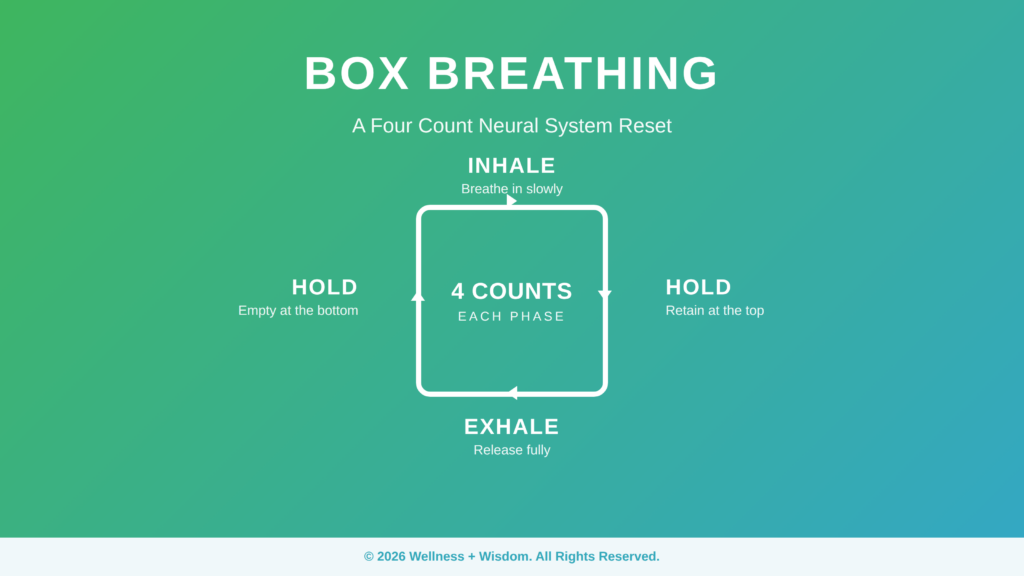
Box breathing, also called four square breathing or tactical breathing, is a structured breathing exercise for stress that divides each breath cycle into four equal phases: inhale, hold at the top, exhale, and hold at the bottom. Each phase lasts the same count, most commonly four seconds, creating a symmetrical breath pattern that your body naturally finds calming and restorative.
The name comes from the simple visual of a square: four equal sides, four equal counts. Inhale up one side. Hold across the top. Exhale down the other side. Hold across the bottom. Repeat. That is the whole technique. There is a reason it is often the first breath practice taught in high stress professions. It is learnable in under two minutes and usable anywhere: in a boardroom, on a yoga mat, or in a car before walking into a conversation you have been dreading.
Why is it trending so powerfully in 2026? Three reasons. First, the science has caught up with the practice. Peer reviewed studies are now producing large effect sizes for the kind of neural system regulation that box breathing delivers, and those findings are filtering into mainstream wellness culture rapidly. Second, mainstream awareness is growing around the limitations of pharmaceutical stress management, and people are hungry for something that works without a prescription or a side effect profile. Third, the breathwork community on social platforms has made this practice accessible to millions of people who never would have found it through a wellness center or a high end retreat.
What I love about box breathing is what I love about all genuinely great tools: its simplicity contains profound power. On the Wellness + Wisdom Podcast, I have talked with hundreds of guests across more than 800 episodes about what actually changes people's lives. The practices that create the biggest shifts are rarely the most complicated ones. Box breathing is proof of that.
This practice is also, if I am being honest with you, one of the places where my own journey began. My path through years of stress, poor health, and emotional suppression led me to breathwork as the single most accessible and immediate tool for getting out of my own head and back into my body. I am going to give you everything I know, because what took me years to figure out does not have to take you that long.
The Science Behind the Box Breathing Technique
Understanding why box breathing works is not just intellectually satisfying. It changes how seriously you take the practice. When you know what is happening inside your body during those four counts, you show up differently. Let me walk you through the core mechanisms.
How Box Breathing Activates the Parasympathetic Response
Your autonomic neural system runs on two competing modes: sympathetic activation (fight, flight, or freeze) and parasympathetic activation (rest, digest, and restore). Modern life keeps the majority of people stuck in low grade sympathetic overdrive. Cortisol stays chronically elevated. Heart rate variability drops. Digestion suffers. Sleep degrades. Relationships feel harder than they should.
Box breathing is a direct intervention into this system. When you slow and regulate your breath, you stimulate the vagus nerve, the longest cranial nerve in your body and the main communication highway of parasympathetic function. The vagus nerve runs from your brainstem down through your heart and lungs and into your digestive organs. When you activate it through deliberate breathing, it sends a cascade of safety signals throughout your entire physiology. Heart rate drops. Blood pressure lowers. Cortisol decreases. Muscles relax. Attention sharpens. The chemical environment of your brain literally changes within minutes.
This is not metaphor. A 2022 comprehensive meta analysis published in Neuroscience and Biobehavioral Reviews reviewed 223 studies on voluntary slow breathing and found consistent increases in vagally mediated heart rate variability both during and after structured breath interventions. The effects were measurable immediately after a single session and persisted and strengthened across multi session practice periods. Your body responds every single time, beginning from your very first session.
Box Breathing and Heart Rate Variability
Heart rate variability (HRV) is one of the most important and most overlooked markers of overall health and resilience. High HRV means your heart is flexible and responsive, able to accelerate and decelerate in response to demand. Low HRV is strongly associated with anxiety, depression, cardiovascular disease, and poor recovery from stress. Elite athletes, peak performers, and long lived populations across the world all tend to have elevated HRV. And structured breath practice is one of the most reliable ways to raise it.
Box breathing works in part by amplifying what researchers call respiratory sinus arrhythmia (RSA): the natural fluctuation of heart rate synchronized with breathing. When you inhale, your heart rate rises slightly. When you exhale, it drops. When you breathe in a slow, deliberate pattern like 4 to 4-4 to 4, you amplify this natural rhythm and give your vagal tone a genuine workout. Over time and with consistent practice, this raises your baseline HRV, meaning you become physiologically more resilient to stress not just during the practice but throughout the rest of your day.
A 2025 narrative review published in PMC confirmed that structured breathwork practices, including box breathing patterns, produce significant autonomic improvements including HRV gains, cortisol reduction, and enhanced mood regulation as consistent outcomes across diverse study populations. The case for this practice in supporting mental and physical health is now robust.
What a 2025 Study Revealed About Box Breathing and Recovery
Here is one of the most compelling recent findings in the box breathing literature. A 2025 study published in PLOS ONE compared box breathing (the 4 to 4-4 to 4 pattern) against six breaths per minute and spontaneous uncontrolled breathing as recovery strategies for athletes following high intensity interval training sessions. The researchers found that both controlled breathing protocols produced large effect sizes for heart rate reduction and perceived exertion compared to the uncontrolled breathing condition. Box breathing produced a substantial and measurable physiological impact even under conditions of acute cardiovascular stress.
What this means for your everyday life: you do not need to be an athlete for this to matter. Every stress response, whether triggered by a difficult workout, a tense conversation, a looming deadline, or a moment of acute overwhelm, activates the same physiological cascade that the athletes in this study experienced. Box breathing interrupts that cascade and accelerates the return to calm. That is an extraordinary tool to have available at any moment of any day, at no cost and zero barrier to access.
How to Do Box Breathing: The Complete 4 to 4-4 to 4 Guide
This is the section that most guides rush through, and rushing through it is exactly why so many people do not get the results they want. The mechanics of the 4 to 4-4 to 4 breathing pattern are genuinely simple, but the subtleties matter. Let me give you the full picture so your first session lands the way it should.
Before You Begin: Setting the Container
Box breathing works in any position, but for your first practice, I recommend sitting upright in a chair with both feet flat on the floor, hands resting loosely on your thighs, and spine long but not rigid. This is not about achieving a perfect posture. It is about giving your diaphragm the room it needs to move fully and freely through each phase.
Close your eyes if you are in a safe place to do so. If you are practicing at your desk in a busy office, soft eyes gazing downward at about a 45 degree angle toward the floor works just as well. Take two completely uncontrolled breaths first. Let your body release whatever tension it is already carrying. Then begin the practice.
The Four Phases of 4 to 4-4 to 4 Breathing
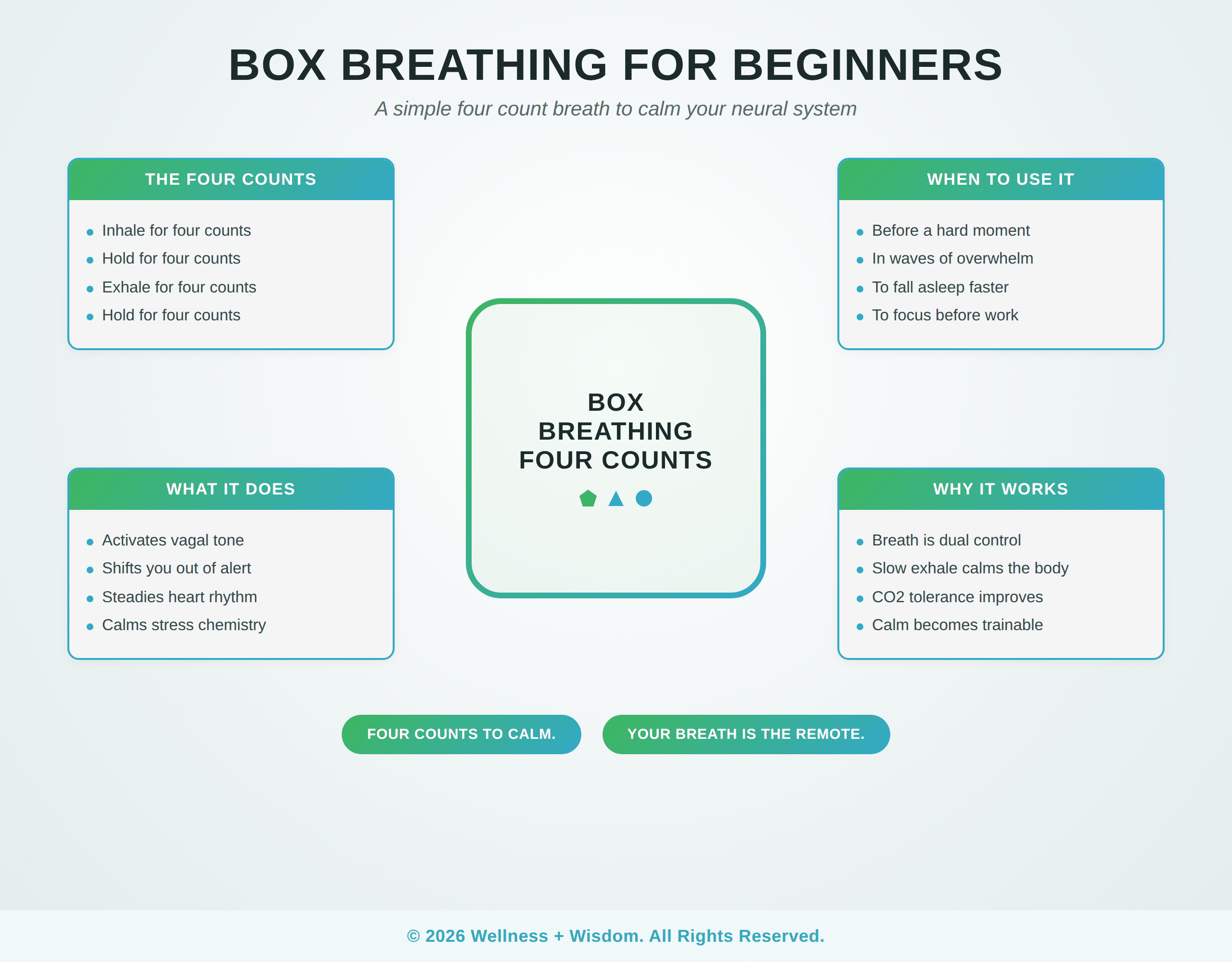
Phase 1: Inhale for 4 counts. Breathe in slowly through your nose. Fill from the bottom of your lungs upward, meaning your belly should expand first and your chest rises last. This is diaphragmatic breathing, and it is the engine that makes the whole technique work. Count slowly and evenly: one, two, three, four. Do not force or strain the breath. Simply invite the air in.
Phase 2: Hold for 4 counts. At the top of your inhale, gently retain the breath. No straining. No clenching your throat or jaw. Just a soft, deliberate pause at full capacity. Count: one, two, three, four. This hold is where something interesting happens physiologically. Your body deepens the process of oxygen and carbon dioxide exchange, and the brief challenge of holding activates the vagal response in a way that a simple inhale alone does not.
Phase 3: Exhale for 4 counts. Release the breath slowly and completely through your nose or mouth, whichever feels more natural for you. The key is the pace. You want a controlled, even exhale across the full four counts. Do not dump all the air out in one second and coast through the remaining three. The slow, deliberate exhale is where the parasympathetic activation is strongest. Count: one, two, three, four.
Phase 4: Hold for 4 counts at the bottom. This is the phase most beginners skip, and it is just as important as the hold at the top. At the bottom of your exhale, retain the empty breath. Count: one, two, three, four. This bottom hold gently allows carbon dioxide to build in a way that signals your neural system that you are safe to remain calm. It is also a form of stillness practice: sitting with the empty, which most people find surprisingly profound. Then breathe in again and begin the next cycle.
Your First Box Breathing Session: A Guided Walkthrough
Start with four complete cycles. That is roughly 64 seconds of practice. This is genuinely enough to notice a measurable shift in your internal state. From there, work toward five to eight minutes (roughly 15 to 20 complete cycles) for a full practice session. Many people find that three to five minutes in the morning and three to five minutes before sleep creates a profound baseline shift within the first seven to ten days of consistent practice.
Here is what to notice during your first session. After your first two or three cycles, you will likely feel a subtle slowing and softening in your body. Your shoulders may drop. Your jaw may unclench. Your thoughts may quiet slightly. This is not placebo. This is your parasympathetic neural system responding in real time. That response is available to you every single time you practice, and it deepens and accelerates as you build consistency.
People who commit to the practice for six months to a year report being able to shift their state in a single breath cycle. The neural system learns. It begins to associate the 4 to 4-4 to 4 pattern with safety, and it starts to meet you halfway every time. That is the compounding benefit of breathwork practice that no single session, no matter how deep, can give you.
The Benefits of the Box Breathing Technique
The research on box breathing and structured breathwork is now substantial enough that I can make specific claims without hedging. Let me walk through what consistent practice actually delivers, both in your immediate experience and over time.
Immediate Benefits You Notice in Your First Session
Reduced heart rate. Lower perceived stress. Improved focus and attention. A sense of mental spaciousness that chronic stress tends to compress. Most people notice these within their first three to four breath cycles.
A 2023 landmark study from Stanford University, published in Cell Reports Medicine, directly compared cyclic sighing, box breathing, and mindfulness meditation for their effects on mood, anxiety, and physiological arousal across nearly 200 participants. All three were effective, but the structured breathing practices produced significantly greater improvements in positive affect and reductions in anxiety compared to the mindfulness only condition. The breath outperformed the meditation app, and it happened in real time during the practices themselves.
This matters because most people who struggle with anxiety or chronic stress feel trapped in the loop of trying to think their way out of a physiological state. But your neural system does not respond well to being reasoned with. It responds to being breathed with. Box breathing gives you a direct physiological intervention that bypasses the thinking mind entirely and speaks directly to the body.
Long Term Benefits With Consistent Practice
When you practice a breathing exercise for stress daily over weeks and months, the benefits compound in ways that genuinely change the quality of your life. Your baseline cortisol levels drop. Your HRV increases. Your sleep quality improves. Your emotional responses to stressors become less reactive and more measured, not because you suppress your feelings but because your neural system has built the capacity to process them.
A 2023 systematic review published in Healthcare via PMC reviewed 50 studies on breathing interventions for stress and anxiety and concluded that slow paced breathing, including structured techniques like box breathing, demonstrates consistent efficacy in promoting parasympathetic activity, reducing anxiety and depressive symptoms, and improving overall stress resilience. These are not marginal effects. These are clinically relevant outcomes comparable to pharmaceutical interventions, without the side effects, without the cost, and available to you anywhere you happen to be.
Beyond the measurable metrics, something else happens with long term practice that is harder to quantify but perhaps even more important: you stop being afraid of your own stress response. When you have practiced moving through activation hundreds of times with grace and ease, the activation itself becomes less threatening. You have proof in your own body that you can regulate. That proof is freedom.
Box Breathing vs. Other Breathing Techniques: Which One Is Right for You
Box breathing is not the only game in town, and it should not be the only tool in your breathwork toolkit. Here is how it compares to other popular techniques so you can make an informed decision about where to start and how to layer practices over time as you build your practice.
Box Breathing vs. 4 to 7-8 Breathing
The 4 to 7-8 technique involves a 4 count inhale, a 7 count hold, and an 8 count exhale. The extended exhale ratio makes it particularly powerful for sleep onset and for managing acute anxiety states. Box breathing is more symmetrical and therefore easier to learn and use in real time situations throughout your day. If you are new to breathwork, start with box breathing. If you have the fundamentals established and want a more potent before sleep tool or a deeper intervention for peak anxiety moments, 4 to 7-8 is worth adding to your repertoire.
Box Breathing vs. Cyclic Sighing
Cyclic sighing involves a double inhale through the nose followed by a long, slow exhale through the mouth. The Stanford study referenced above found cyclic sighing to be the single most effective technique for improving mood in real time in their head to head comparison. It deflates the air sacs in your lungs more completely than a standard exhale and produces a fast parasympathetic shift. Box breathing is more structured and ritualized, which makes it superior for building a daily practice and for high pressure situations where you need a specific anchor pattern rather than a quick one time reset. Both are valuable, and they serve slightly different purposes.
Box Breathing vs. Resonance Breathing
Resonance breathing (also called coherence breathing) involves a slow rhythm of about five to six breath cycles per minute, achieved by breathing in for roughly five seconds and out for five seconds. Research shows this particular pace produces the strongest HRV amplification because it aligns with the natural oscillation of your cardiovascular system at a frequency called the Mayer wave. Box breathing at four counts per phase produces a similar but slightly faster cycle. Resonance breathing is arguably the gold standard for long term HRV training. Box breathing is more accessible and versatile for most people starting out. If you progress past box breathing and want to go deeper on HRV optimization, resonance breathing is the next logical step.
Box Breathing vs. Holotropic and Circular Breathing
Holotropic and circular breathing practices involve continuous connected breath with no pauses, often at a faster pace, and are designed to induce altered states of consciousness, deep emotional release, and somatic processing. These practices are powerful but require guidance, preparation, and often a facilitated container. Box breathing is the everyday practice. Holotropic work is the deep dive. You need the former before the latter, and the neural system regulation you build with box breathing makes the deeper practices safer and more productive when you are ready for them.
If you want to explore deeper somatic breathwork practices, I cover the full spectrum on the Wellness + Wisdom Podcast and in our somatic breathwork guide. The foundations you build with box breathing make every deeper practice more accessible and more effective.
Box Breathing as a Breathing Exercise for Stress: Real World Applications
Theory is useful. Practice is everything. Here is exactly when and how to use box breathing as a breathing exercise for stress in the situations that matter most in everyday life.
Before a High Stakes Moment
Job interview. Difficult conversation. Public speaking engagement. A medical appointment you have been dreading. These are the moments your sympathetic neural system loves to hijack. The cortisol spike is predictable. The racing thoughts are predictable. The shallow, constricted breath is predictable. What you do with that predictability is entirely within your control once you have a tool.
Three to five minutes of box breathing immediately before a high stakes moment does several specific things: it lowers your heart rate, reduces cortisol, improves prefrontal cortex function (the part of your brain that handles nuanced communication, emotional regulation, and clear strategic thinking), and signals to your body that it is safe to perform rather than survive. This is why Navy SEALs, surgeons, professional athletes, and elite performers across every domain use some form of tactical breathing before high demand situations. It is not stress management. It is performance optimization.
During Anxiety or Overwhelm
When anxiety hits mid situation, box breathing is one of the few tools that works in real time without requiring you to leave. If you are in a meeting and your heart is racing. If you are in an argument and you can feel yourself about to say something you will regret. If you are lying awake at 3 AM and your mind is running its greatest hits playlist of worst case scenarios.
In these moments, four to six cycles of box breathing, done subtly with your hands in your lap and eyes soft, will change your biochemistry. The key is to start before the activation has escalated so far that rational thought is offline. If you are already past the window of easy regulation, four cycles will begin to bring you back, but it may take more repetitions than it would earlier in the arousal arc. This is why building a daily practice matters: you get better at catching the wave early, before it breaks over you.
As a Daily Reset Practice
The most profound use of box breathing is not as a crisis intervention. It is as a daily investment in your neural system's baseline resilience. Think of it as currency. Every five minute morning practice deposits physiological resilience into your system. When an unexpected stressor hits, you have reserves to draw from. People who only use breathwork as a rescue technique are always playing catch up. People who use it daily find that they rarely need the rescue in the first place.
I have written extensively on this theme across the Wellness + Wisdom blog and explored it in depth in the Emotional Epigenetics solocast. The way you feel in ordinary moments is a direct reflection of the practices you do on ordinary days. Box breathing is one of those practices.
Common Mistakes Beginners Make With Box Breathing
I have taught breathwork to thousands of people through the BREATHE: Breath + Wellness Program and the broader Wellness + Wisdom programs, and the same mistakes come up consistently. Here are the most common ones and exactly how to correct them so your practice delivers the results it should.
Counting Too Fast
This is the most pervasive mistake. People count at conversational speaking pace and wonder why they do not feel anything. Each count should be approximately one full second, meaning the complete box cycle takes roughly 16 seconds. At that pace, you are breathing at approximately three to four cycles per minute, which is within the range that produces the strongest HRV and vagal activation. Slow down. Count deliberately. One Mississippi per count if that helps you calibrate the pace.
Forcing the Breath
Box breathing should never feel like a battle with your own lungs. If you are straining at the top hold, reduce your count to three seconds. If you struggle to fill completely on the inhale, you may have shallow breath habits that need some dedicated diaphragmatic work before the structured pattern will feel natural. The breath should feel invited, not commanded. The moment it becomes tense, you have flipped the switch back toward sympathetic activation, which is the opposite of the practice's purpose.
Skipping the Bottom Hold
The bottom hold (Phase 4 of 4 to 4-4 to 4) is the most commonly skipped and the most underappreciated element of the entire technique. It is during this empty retention that your body gets to rest in the parasympathetic state without the distraction of an incoming breath. It is also where carbon dioxide builds slightly, and that gentle CO2 accumulation is a key signal in the neural system recalibration process. Do not skip it. It is not an afterthought. It is half of where the medicine lives.
Only Using It When Already in Crisis
If you only practice box breathing when you are already in a dysregulated state, you are asking your body to learn a new skill under maximum stress. That is like trying to learn to swim in the open ocean during a storm. Build the skill on calm days so it is reliably available on the hard ones. The neural pathway you are building requires repetition under low stakes conditions before it becomes accessible under high stakes ones.
Mouth Breathing During the Practice
For box breathing, nasal breathing is strongly preferred for both the inhale and the exhale. Your nasal passages filter, warm, and humidify incoming air in ways that matter physiologically. They also produce nitric oxide during nasal inhalation, a molecule that dilates blood vessels and improves oxygen delivery to your tissues. Nasal breathing produces a meaningfully different neural system response than mouth breathing, particularly in how it modulates vagal tone. Keep it in through the nose whenever possible, both for the inhale and the exhale.
Expecting Too Much Too Fast (or Too Little)
Some beginners are surprised that the practice feels relatively simple and wonder if they are “doing it wrong” when they do not have a dramatic experience. Others are surprised it works as well as it does and think the feeling of calm must be placebo. Both reactions miss the truth. Box breathing produces reliable, measurable, and compounding effects. It is not dramatic. It is foundational. Trust the process and track your results over weeks, not just sessions.
Building Your Daily Box Breathing Practice: The BREATHE Framework
One of the proprietary frameworks at the core of my work is the BREATHE: Breath + Wellness Program, developed after years of studying with some of the most sophisticated breathwork practitioners and researchers in the world. The framework recognizes that breathwork is not a single technique. It is a complete system of self mastery that, practiced consistently, rewires your relationship to your inner experience at a cellular level.
Box breathing is the natural entry point to that system because it is learnable in minutes, usable anywhere, and immediately measurable in its effects. Here is how to build it into a sustainable daily practice structure:
Morning anchor (5 minutes). Before you look at your phone, before you check email, before you engage with anything outside yourself, do five minutes of box breathing. This is your most important practice window. Your cortisol is naturally at its highest in the morning (a phenomenon called the cortisol awakening response), and starting the day with a deliberate parasympathetic signal sets the tone for your entire physiology. Five minutes. That is the investment. Every day.
Midday reset (3 minutes). At noon or early afternoon, do three minutes as a system reboot. By midday, most people have accumulated meaningful sympathetic load from meetings, emails, decisions, and social interactions. A brief reset at this point is genuinely restorative in ways that a coffee or a snack cannot replicate. Set a timer. Do six to eight cycles. Return to your afternoon as a different person than you left it.
Before sleep (5 to 8 minutes). Five to eight minutes of box breathing before sleep significantly improves sleep onset latency and overall sleep quality. A neural system still vibrating with the day's residue takes longer to descend into deep, restorative sleep. Box breathing clears that residue reliably. Many people report that this single practice point alone improved their sleep more than any supplement or sleep hygiene protocol they had tried previously.
Over time, this three session daily structure becomes as automatic as brushing your teeth. It takes approximately 21 to 30 days to establish the habit. After 90 days, people in our Liberated Life Tribe community who commit to this structure consistently report measurable changes in sleep quality, emotional reactivity, cognitive performance, and their overall sense of ease in navigating life. These are the outcomes that matter. This is what the practice is actually for.
To go deeper on building a complete breathwork protocol with advanced practices layered on top of this foundation, I explore this in detail in our full programs and in recent conversations on the best of the 2025 episode collection. The BREATHE framework extends well beyond box breathing into somatic release, coherence breathing, and advanced regulation practices that all build on the foundation you start here.
Box Breathing and the Wellness Pentagon: Five Dimensions of One Practice
Everything I teach connects back to the Wellness Pentagon: the five interconnected dimensions of whole person wellbeing. Physical, mental, emotional, spiritual, and financial wellness are not separate domains. They are faces of the same living geometry, and neglecting any one dimension undermines the others in ways that are often invisible until they are not. Box breathing is one of the few practices I know that genuinely and measurably touches all five dimensions at once.
Physical. The cardiovascular and respiratory benefits are real and measurable. Lower resting heart rate. Higher HRV. Better sleep architecture and quality. Improved immune function through cortisol reduction. These are physical outcomes with downstream consequences for longevity, athletic performance, and daily energy. You cannot separate how you breathe from how you age.
Mental. Regulated breathing improves prefrontal cortex function, working memory, and attentional control. People who practice box breathing consistently report clearer thinking, better decision making under pressure, and greater cognitive flexibility in complex situations. The research on this relationship between breath and cognition is solid and growing rapidly in 2025 and 2026.
Emotional. This may be where box breathing does its most important and least appreciated work. Emotions are physiological events before they are psychological ones. They arise in the body before they surface in the mind. When you regulate your physiology through breath, you build the capacity to process the full spectrum of emotional experience without being overwhelmed or swept away by it. This is not suppression. This is genuine capacity building. You do not feel less. You feel more, with greater grace.
Spiritual. Breath has been a doorway to deeper states of consciousness in virtually every contemplative and spiritual tradition on earth for thousands of years. Box breathing, practiced with presence and intention, is a form of active meditation. It returns you to yourself. It creates the inner quiet in which you can hear what is actually true for you beneath the noise of daily life. I have seen this transformation happen in our community, and I have lived it in my own body. That is spiritual practice, whether you call it that or not.
Financial. This one surprises people every time, but the connection is real. A chronically dysregulated neural system makes systematically poorer financial decisions. Stress impairs impulse control, distorts risk assessment, and creates a scarcity orientation that keeps people in reactive financial patterns. People who regulate their neural system through consistent daily practice negotiate from a calmer place, make better long term financial decisions, and relate to money with more spaciousness and clarity. Box breathing is, among other things, an unlikely but genuine financial wellness intervention.
I explore the Wellness Pentagon in depth across the Wellness + Wisdom Podcast and in my own story of discovering how these five dimensions are entirely inseparable from one another. If you want a structured framework for understanding where you are in each dimension and what practices will create the most leverage for your specific situation, the Wellness Pentagon is the place to begin.
Frequently Asked Questions About Box Breathing
What exactly is the box breathing technique and how does it work?
Box breathing is a structured breath practice that divides each breath cycle into four equal phases of the same count: inhale, hold at the top, exhale, and hold at the bottom. The most common version uses a count of four seconds for each phase, creating a full cycle of 16 seconds. It works by stimulating the vagus nerve and activating the parasympathetic branch of your autonomic neural system, which lowers heart rate, reduces cortisol, improves heart rate variability, and creates a physiological state of calm alertness. The effect is immediate, measurable, and available to anyone regardless of prior experience with breathwork or meditation.
How many times should I do box breathing in a single session?
For a quick reset in a stressful moment, four to six cycles (roughly one to two minutes) is enough to notice a measurable state shift. For a full practice session, 15 to 20 cycles (five to eight minutes) is ideal. For a daily practice structure, aim for two to three sessions per day: morning, midday, and before sleep. Within a few weeks of daily practice, your neural system learns to respond more readily to the pattern, and you will find you can reach a clear, calm state faster and with fewer cycles than when you started. Consistency builds the capacity.
Is box breathing effective for anxiety and panic attacks?
Yes, with one important nuance. For managing ongoing anxiety and lowering your overall stress baseline, box breathing is one of the most evidence supported tools available. Consistent daily practice has been shown across multiple peer reviewed studies to reduce anxiety symptoms and improve stress resilience over time. For acute panic attacks, box breathing is useful but requires the neural pathway to already be established through regular practice. The vagal activation you train during calm daily practice becomes accessible during acute stress, but only if you have built the pathway first. Start now, during calm periods, so the tool is fully available when the storm hits. Do not wait for the storm to start learning.
Can I do box breathing while at work or in public situations?
Absolutely. Box breathing is one of the most discreet wellness practices in existence. Nobody around you will know you are doing it. You can practice subtly at your desk with your hands in your lap and soft downward gaze, in the back of an Uber, in a waiting room, or even standing in a hallway before a presentation. As long as your focus is not required for a safety critical task, four to six cycles of box breathing can be done entirely invisibly. The physiological effects are identical whether you are on a meditation cushion or sitting in a glass walled conference room.
How long does it take to notice real results from daily box breathing practice?
Most people notice an immediate state shift during their very first session: a sense of calm, slowed heart rate, and mental spaciousness within the first three to four breath cycles. Longer term changes such as improved baseline HRV, lower resting cortisol, better sleep quality, and reduced overall anxiety and emotional reactivity typically emerge within two to four weeks of consistent daily practice. The research supports this timeline across multiple study designs. Your results will depend on consistency more than any other variable. Four minutes a day beats 40 minutes on Sunday every single time.
Are there situations in which someone should not practice box breathing?
Box breathing is safe for the vast majority of people and can be modified for almost any starting point. If you have a respiratory condition such as severe asthma or COPD, start with shorter counts (two to three seconds) and consult your doctor before progressing to longer holds. People with certain cardiovascular conditions should also check with a physician before beginning any structured breath hold practice. If at any point during practice you feel dizzy, lightheaded, or uncomfortably short of breath, stop and return to natural uncontrolled breathing. These sensations are uncommon with box breathing (they are more associated with rapid hyperventilation practices) but are worth knowing. When in genuine doubt, a conversation with your healthcare provider before beginning is always a reasonable step.
Your Breath Is the Beginning
Box breathing is the entry point. What you discover about yourself when you go deeper changes everything. Join thousands of people already living from authentic joy. Receive your free 10 day Self Liberation Blueprint and join the Liberated Life Tribe at liberatedlife.com.
Studies and External Resources
The science in this article rests on peer reviewed research and authoritative resources. These are the studies and sources referenced throughout.
- Effects of voluntary slow breathing on heart rate and heart rate variability: A systematic review and a meta analysis. Neurosci Biobehav Rev, 2022. PubMed: 35623448
- The A52 Breath Method: A Narrative Review of Breathwork for Mental Health and Stress Resilience. Stress Health, 2025. PubMed Central: 12341363
- PLOS ONE. View source via PLOS
- Brief structured respiration practices enhance mood and reduce physiological arousal. Cell Rep Med, 2023. PubMed Central: 9873947
- Breathing Practices for Stress and Anxiety Reduction: Conceptual Framework of Implementation Guidelines Based on a Systematic Review of the Published Literature. Brain Sci, 2023. PubMed Central: 10741869
About Josh Trent
Josh Trent is an Identity Transformation Architect and the award winning host of the Wellness + Wisdom Podcast, with over 15 million downloads since 2015. He is the creator of the L.I.F.E. Method™ Identity Transformation System and steward of the Emotional Epigenetics™ and BREATHE: Breath + Wellness™ systems of self mastery, impacting over 1,000 students worldwide. Josh lives in Austin, Texas with his wife Carrie, daughter Nayah, and son Novah.
Explore 800+ conversations on wellness, breathwork, Emotional Epigenetics, conscious parenting, and authentic living in the full episode library. To work directly with Josh and access the complete ecosystem of tools, programs, and community, visit wellnessandwisdom.com/programs or explore the Wellness + Wisdom store. The Liberated Life Tribe is always free to join.
Disclosure: We may earn a commission from certain links on this site when you make a purchase, at no extra cost to you. These commissions help support Wellness + Wisdom and do not affect the products or resources we choose to recommend. Full disclosure .