
By Josh Trent, Identity Transformation Architect and host of the Wellness + Wisdom Podcast
The part of you that keeps sabotaging you is not your enemy. It is a frightened protector doing the only job it ever knew. Befriend it, and the war inside you ends.
Parts work starts with a strange and freeing idea. You are not one unified self fighting your bad habits. You are a system of parts, each one carrying a job it took on long ago. And the part that keeps sabotaging you is not your enemy. It is a frightened protector doing what it believes keeps you safe. Once I really understood that, the whole war inside me changed shape, and parts work became one of the most powerful tools I have ever used on myself.
The part that procrastinates may be shielding you from the shame of failing. The part that picks fights may be guarding against being left first. The part that numbs out with food or scrolling is trying to give you relief the only way it knows how. None of these parts are trying to ruin your life. They are trying, clumsily, to protect it. You cannot beat these parts into submission. They dig in harder when attacked, because that is exactly what protectors are built to do. This is the heart of the practice, and it changes everything about how you relate to yourself.
What this article covers
- What parts work actually is
- Why parts work makes self sabotage make sense
- The parts inside you
- The science behind parts work
- How I actually practice parts work
- Parts work and the L.I.F.E. Method
- Parts work versus willpower
- Where to begin today
- Frequently asked questions
- Studies and External Resources
What parts work actually is
Parts work is a way of relating to your inner world as a system of distinct parts, each with its own feelings, fears, and protective job, all organized around a calm core called the Self. Instead of treating yourself as one mind with a willpower problem, you treat yourself as an inner family. Some parts carry pain. Some parts work overtime to keep that pain hidden. And underneath all of them is a steady, wise presence that already knows how to lead.
The formal name for this model is Internal Family Systems, developed by psychologist Richard Schwartz in the 1980s while he was treating clients who described warring voices inside them. The premise is simple and humbling. We are all multiple. You have a striving part, a resting part, a critical part, a playful part, and many more. Parts work is the practice of getting to know them with curiosity rather than contempt, so they can stop running the show from the shadows.
This view fits everything I teach through Emotional Epigenetics™. The parts that drive your patterns were shaped by your history, your environment, and often the generations before you. Parts work gives you a practical, compassionate way to meet those patterns and finally rewrite them from the inside out.
Why parts work makes self sabotage make sense
Parts work makes self sabotage make sense because it reveals that every self defeating behavior is a protector with a positive intention. Think of the behavior you hate most about yourself. Now ask what it is afraid would happen if it stopped. The answer is almost never laziness or weakness. It is fear, and usually an old one. That single question softens the fight, because curiosity does what criticism never could.
I have used that question on myself more times than I can count, usually at the exact moment I wanted to be hardest on myself. The part that scrolls late at night was protecting me from sitting with loneliness. The part that overworked was guarding a younger part that believed love had to be earned. When I stopped attacking these parts and started listening, they stopped fighting me back. This is the same self protective logic I describe in self sabotage and its epigenetic roots, where the behavior that looks like weakness is actually an old survival strategy still running on a loop.
Self sabotage is not a character flaw. It is a part that learned a job during a hard season and never got the memo that the season is over. Parts work is how you give it that memo, gently. The goal is not to fire the protector. The goal is to thank it, understand it, and give it a new role inside a system that finally feels safe. I go deeper on the identity side of this in why your identity is the real weight you need to lose.
The parts inside you
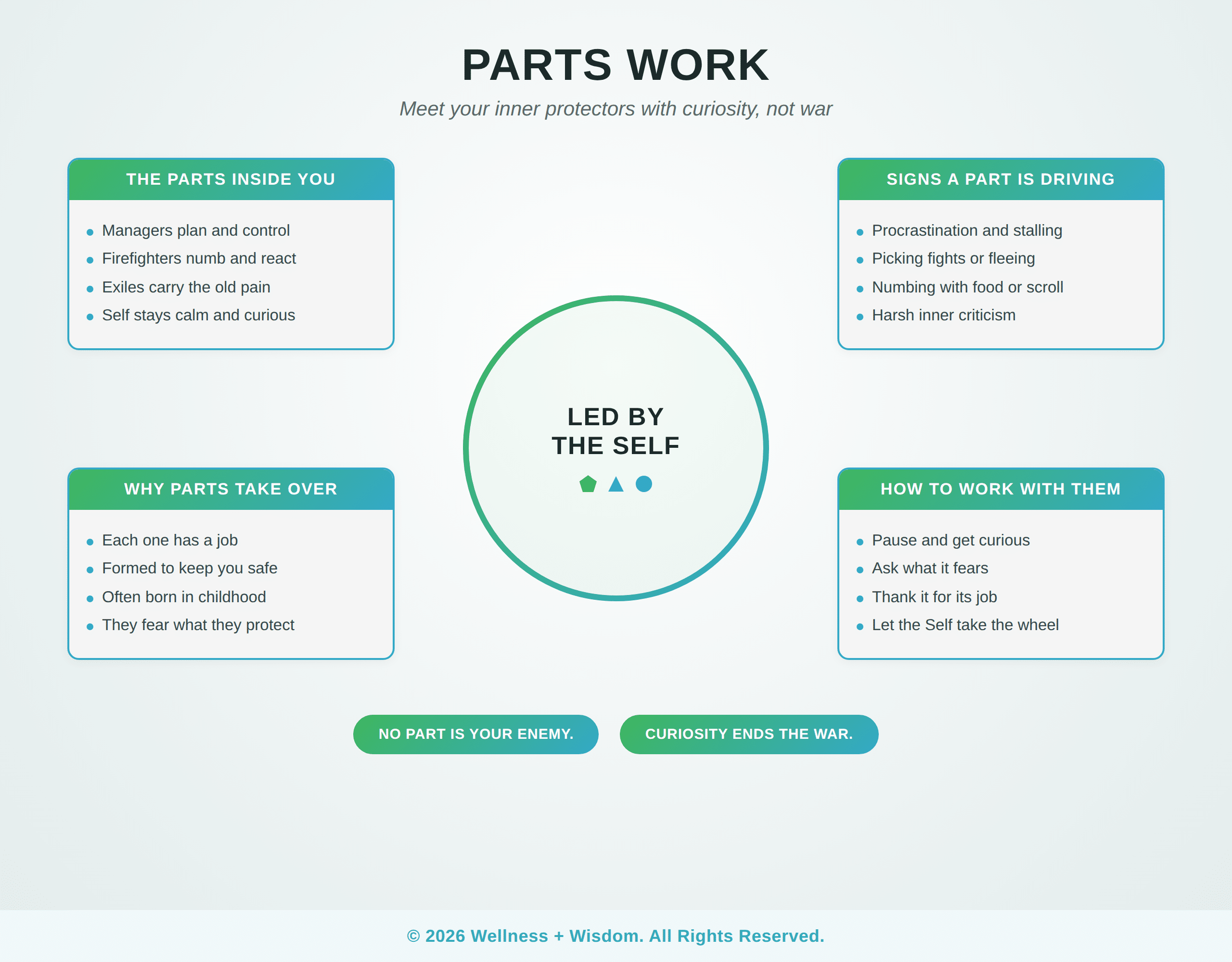
This work organizes your inner world into a few recognizable kinds of parts, and learning the map makes the whole practice click. You do not need to memorize psychology to use it. You only need to recognize these characters when they show up, because naming a part is the first step to leading it instead of being led by it.
Managers
Managers are the proactive protectors that try to keep your life orderly so pain never gets a chance to surface. They show up as the planner, the perfectionist, the people pleaser, and the inner critic. A manager will push you to over prepare for a meeting, criticize your work before anyone else can, or keep you so busy that uncomfortable feelings never get a seat at the table. Managers mean well. They are just exhausted from carrying so much for so long.
Firefighters
Firefighters are the reactive protectors that rush in when pain breaks through anyway. When an old wound gets triggered, the firefighter does whatever it takes to put the fire out fast. That can look like numbing with food, drinking, raging, bingeing a show, or endless scrolling. Firefighters are not weak willed. They are emergency responders, desperate to stop the system from feeling something unbearable. Shaming them only convinces them they are needed more.
Exiles
Exiles are the young, vulnerable parts that carry the original pain, shame, grief, or fear. The managers and firefighters spend enormous energy keeping the exiles locked away, because their feelings once felt like too much. But exiles do not need to stay hidden. They need to be seen and comforted. When an exile finally feels witnessed, the protectors guarding it can finally relax. This is the tender center of the work, and it connects to the way the body stores old experience, which I explore in bioenergetic memory.
The Self
The Self is the calm, curious, compassionate core that is not a part at all. It is who you are underneath the noise. You can recognize Self energy by its qualities, often described as calm, curiosity, compassion, clarity, courage, confidence, creativity, and connectedness. When you are in Self, you are not panicking and you are not numbing. You are simply present, able to listen to your parts the way a good leader listens to a team. The entire aim is to lead your inner system from this place.
The science behind parts work
The science behind this work is younger than the practice itself, but the early evidence is genuinely encouraging. For years this was a clinical model passed between therapists. Now it has started to earn its place in peer reviewed research, and the findings line up with what people feel in their own bodies when they stop fighting themselves.
In a randomized controlled trial of seventy nine people living with rheumatoid arthritis, an Internal Family Systems intervention reduced pain and depressive symptoms while improving physical function and self compassion compared to an education control group (Shadick et al., 2013). That a talking practice could move physical markers of an inflammatory disease tells you how deeply the mind and body are wired together, a theme I unpack in how stress makes you sick. A second randomized study of college women found that parts work reduced depressive symptoms about as effectively as established therapies like cognitive behavioral therapy (Haddock et al., 2017).
The neuroscience of self talk explains why the gentle approach works. Brain imaging research shows that harsh self criticism activates the same threat and error processing circuits the brain uses to brace against danger, while self reassurance lights up the warmer regions tied to soothing and safety (Longe et al., 2010). In plain terms, attacking your parts puts your whole system on alert, and meeting them with warmth tells your biology you are safe. That is the whole practice in a sentence. For the deepest dive into the model itself, the IFS Institute is the source.
Here is why that matters for you in real life. If criticism actually worked, the most self critical people on earth would be the healthiest, and they are not. Shaming a protector into silence costs you energy and trust, and it teaches your system that you are one more voice it has to defend against. Meeting that same protector with curiosity does the opposite. It signals safety, lowers the internal alarm, and invites the part to relax its grip without a fight. The science and the felt experience point in the same direction, which is rare and worth trusting.
How I actually practice parts work
The way I practice parts work is simple enough to do in the middle of a hard moment, which is the only time it really matters. When a part shows up loud, I pause and get curious instead of furious. I ask what it wants for me. I thank it for the job it has carried for so long, often since I was a kid. Then I let the calmer, wiser part of me, the one that is not panicking, take the wheel. Over time the protector relaxes, because it finally trusts that someone steady is driving.
Here is the move broken down. First, notice the part without becoming it. There is a difference between saying I am furious and saying a part of me is furious. That small shift, which parts work calls unblending, gives you just enough room to lead. Second, get curious and ask the part what it is afraid would happen if it stopped. Third, listen without arguing, and thank it sincerely for trying to protect you. Fourth, let your Self stay in the driver seat while the part rides along. You are not exiling the part. You are befriending it.
The breath is my fastest doorway back to Self when a part has hijacked me. A few minutes of slow, extended exhales settles the body enough that the calm center becomes reachable again. This is the bridge between the thinking mind and the feeling body, and it is the foundation of the BREATHE™ work. The grounding and breath practices I use to reach that calm center live in the Wellness and Wisdom store, and if you want a tool for riding the wave of a triggered part, the 90 second emotion rule pairs beautifully with this practice.
A real example from my own life
Let me make this concrete with a part I know well. For years I had a part that would reach for my phone the second the house went quiet at night. The old me called it weakness and tried to white knuckle my way out of it, which only made the nightly battle louder. So one evening I tried something different. Instead of fighting the urge, I paused, put a hand on my chest, and got curious. I asked the part what it was so afraid would happen if it let me sit in the silence.
The answer surprised me. It was not boredom. It was loneliness, an old ache from a much younger version of me who learned that quiet meant nobody was coming. That part had been reaching for the phone to spare me from feeling that ache. It was not sabotaging my sleep. It was guarding a wound. When I thanked it, out loud, for trying so hard to protect me for so long, something in my chest loosened. I did not have to obey the urge or shame it. I could simply let my calmer Self stay present with the lonely part until it settled. The phone lost its pull, not through force, but through understanding.
That is the difference this approach makes. The behavior I had been at war with for years changed in a season, because I finally addressed the fear underneath it instead of attacking the strategy on top of it. None of my parts needed to be defeated. They needed to be heard. And the more I led from Self, the more my system trusted that someone steady was finally home.
Parts work and the L.I.F.E. Method
Parts work is woven directly into the L.I.F.E. Method™, because befriending your parts is how fragmented people become whole. The four pillars of the method give parts work a clear arc, and each one maps onto a stage of the inner work.
Liberation is the moment you stop identifying with a single part and remember you are the Self that can lead them all. Integration is the heart of parts work itself, the patient task of welcoming exiled and protective parts back into one harmonious system instead of waging war on the pieces you dislike. Frequency is the energetic and physiological state you cultivate through breath and presence, the calm baseline from which Self can actually show up. Embodiment is where the change becomes lived rather than understood, as your body collects new evidence that it is safe to lead from the inside. You can explore the full arc in the L.I.F.E. Method and identity transformation.
The parts you are meeting were often shaped long before you had a choice, which is why this work reaches backward and forward at once. Many protectors formed in childhood, and some patterns echo down through families, a truth I cover in understanding generational trauma and in inherited limiting beliefs. When you heal a part today, you change what gets handed down tomorrow. Parts work is not only personal. It is generational, and it is one of the clearest expressions of our mission and the emotional dimension of the Wellness Pentagon™.
Parts work versus willpower
Parts work and willpower are opposite strategies, and only one of them actually ends the inner war. Willpower says crush the bad part. Parts work says understand it, and watch it stand down on its own. One creates an internal war you can never win, because the part you are attacking is a piece of you that fights back harder when threatened. The other ends the war by making peace with the soldier.
Willpower treats the symptom and leaves the fear untouched, which is why white knuckle change so often snaps back. The procrastinator you suppress in January returns in February, because the fear it was protecting you from never got addressed. Parts work goes underneath the behavior to the protective intention, and when that intention is finally heard, the behavior loses its grip naturally. This is the difference between forcing yourself to be different and becoming someone for whom the old behavior is no longer necessary.
This is also why self forgiveness is such a powerful accelerant for parts work. When you stop punishing yourself for having protectors, the whole system softens. I write about the biology of that release in the neuroscience of forgiveness, and about the broader skill of meeting your inner world with maturity in building emotional intelligence as an adult.
Where to begin today
You can begin parts work in the next ten seconds, the moment you catch yourself in a pattern you hate. Do not pile on. Get curious instead. Ask the part what it is afraid of, and actually wait for an answer. That is parts work in miniature, and it is more powerful than any amount of self discipline, because it changes the relationship rather than just the behavior.
Getting to that calm center is the whole game, and the good news is that it is trainable. Every time you meet a part with curiosity instead of war, you strengthen the muscle of Self leadership, and you can practice it in tiny moments all day long. Greet the inner critic over your morning coffee. Soothe the anxious part before a hard conversation. Thank the part that wants to numb out tonight, and ask it what it really needs. If you want help steadying your emotional baseline along the way, my work on how to balance your emotions is a natural companion to this practice.
Start absurdly small, because small is what makes it stick. You do not need an hour of meditation or a perfect morning routine to begin. You need one honest pause in one ordinary moment. The next time you notice yourself bracing, numbing, or spiraling into self criticism, treat it as a tap on the shoulder from a part that needs you. Put a hand on your chest, take one slow breath, and ask the simplest question there is: what are you afraid of, and what do you need from me right now? You will be amazed how often a frightened part settles the instant it feels a steady presence turn toward it instead of away.
You are not a problem to fix. You are a system learning to trust itself again. Every part of you, even the loudest and most frustrating one, is welcome at the table once you sit at the head of it. That is the quiet joy of parts work. The war you have been fighting against yourself was never necessary, and you get to lay the weapons down. Peace and power.
Frequently asked questions
What is parts work?
Parts work is a therapeutic approach that views the mind as a system of distinct parts, each with its own role and good intention, organized around a calm core Self. Rather than trying to eliminate the parts that cause problems, parts work helps you understand them, build trust with them, and lead them from the Self. It is the everyday name for Internal Family Systems, developed by Richard Schwartz.
What are the parts in parts work?
Parts work generally describes three kinds of parts plus the Self. Managers are proactive protectors like the planner, perfectionist, and inner critic. Firefighters are reactive protectors that numb or distract when pain surfaces, through food, scrolling, or other quick relief. Exiles are the young, vulnerable parts that carry old pain. The Self is the calm, curious, compassionate core that leads them all.
How do you do parts work on yourself?
You can practice parts work on yourself by noticing a part without becoming it, getting curious about what it fears, thanking it for trying to protect you, and letting your calm Self lead instead. Slow breathing helps you return to that calm center when a part has taken over. For deeper or trauma related wounds, working with a trained Internal Family Systems therapist is recommended.
Is parts work the same as Internal Family Systems?
Yes. Parts work is the common, everyday name for Internal Family Systems, or IFS, the model created by psychologist Richard Schwartz in the 1980s. Some practitioners use parts work as a broader umbrella term for any approach that engages the different parts of the psyche, but in most modern usage the two terms point to the same practice.
Is parts work evidence based?
Parts work has a growing evidence base. Two randomized controlled trials have shown benefits, one finding reduced pain and depression in people with rheumatoid arthritis, and another finding reduced depressive symptoms in college women comparable to established therapies. The research is still early and more is needed, but the existing studies support its acceptability and effectiveness.
Can parts work help with self sabotage?
Yes, parts work is especially well suited to self sabotage, because it reframes self defeating behavior as a protector with a positive intention rather than a character flaw. When you discover what the sabotaging part is afraid of and meet that fear with curiosity, the behavior tends to lose its grip naturally, without the white knuckle effort that usually fails.
Join the Liberated Life Tribe
You were never meant to do this inner work in isolation. Join the Liberated Life Tribe and receive your 10 day Self Liberation Blueprint at liberatedlife.com. It is a community built for exactly this kind of liberation, where you practice leading your inner system surrounded by people walking the same path home. Every part of you is welcome here. Peace and power.
Studies and External Resources
The science in this article rests on peer reviewed research and authoritative resources. These are the studies and sources referenced throughout.
- Haddock et al., 2017. View source via Wiley
- Having a word with yourself: neural correlates of self criticism and self reassurance. Neuroimage, 2010. PubMed: 19770047
- Shadick et al., 2013. View source via Journal of Rheumatology
- IFS Institute. View source via IFS Institute
About Josh Trent
Josh Trent is an Identity Transformation Architect and the award winning host of the Wellness + Wisdom Podcast, with over 15 million downloads since 2015. He is the creator of the L.I.F.E. Method™ Identity Transformation System and steward of the Emotional Epigenetics™ and BREATHE: Breath + Wellness™ systems of self mastery, impacting over 1,000 students worldwide. Josh lives in Austin, Texas with his wife Carrie, daughter Nayah, and son Novah. Read more of my story, explore conscious parenting, or browse our latest episodes. You are whole, and you are learning to lead the system from the inside.