
By Josh Trent, Identity Transformation Architect and host of the Wellness + Wisdom Podcast
You are not stuck with the genes you were born with. You are in a daily conversation with them, and meditation is one of the most powerful things you can say.
Meditation and DNA are far more connected than most people imagine. For a long time we believed our genes were a fixed sentence handed down at birth, a script we were forced to read until the final page. The science of the last two decades tells a very different and far more hopeful story. The way you live, breathe, and quiet your mind sends real signals to your genes, and a regular meditation practice turns out to be one of the clearest signals you can send.
This is not mysticism dressed up in lab coats. Peer reviewed research from major universities has measured what happens inside human cells before and after meditation, and the results are striking. So let us walk through what the science on meditation and DNA actually shows, what it does not show, and how you can begin a practice that speaks to your biology starting this week.
Table of Contents
- The Connection Between Meditation and DNA
- How Meditation and DNA Actually Interact
- What the Science Shows: Three Landmark Studies
- Meditation Through the Lens of Emotional Epigenetics
- It Is Not About Changing Genes, It Is About Expression
- How to Start a Practice That Speaks to Your DNA
- What Happens in Your Brain When You Meditate
- Why Inherited Stress Shows Up in Your Biology
- Common Obstacles and How to Move Through Them
- Meditation and DNA: Myths vs Reality
- Frequently Asked Questions
- Studies and External Resources
- About Josh Trent
The Connection Between Meditation and DNA
The connection between meditation and DNA is this: meditation changes which of your genes are switched on and which are switched off. It does not rewrite the letters of your genetic code. It changes how that code is read and expressed, and that distinction is everything.
Imagine your DNA as a vast library of books. You are born with all the books already on the shelves. Meditation does not burn any books or write new ones. What it does is decide which books get pulled down and read aloud each day. A stressed life keeps the fear and inflammation books open around the clock. A calm, practiced mind quietly closes those and opens the books of repair, balance, and resilience.
This field has a name. It is called epigenetics, the study of how your environment and behavior influence gene expression without altering the underlying sequence. And the research now shows clearly that meditation is one of the behaviors your genes respond to. This relationship is not a metaphor. It is measurable in a blood sample.
For years I have taught that you are not broken by your biology, only burdened by patterns that can change. This science is some of the most beautiful confirmation of that truth I have ever found. Your daily practice is a daily vote for which version of your genome gets to run your life.
How Meditation and DNA Actually Interact
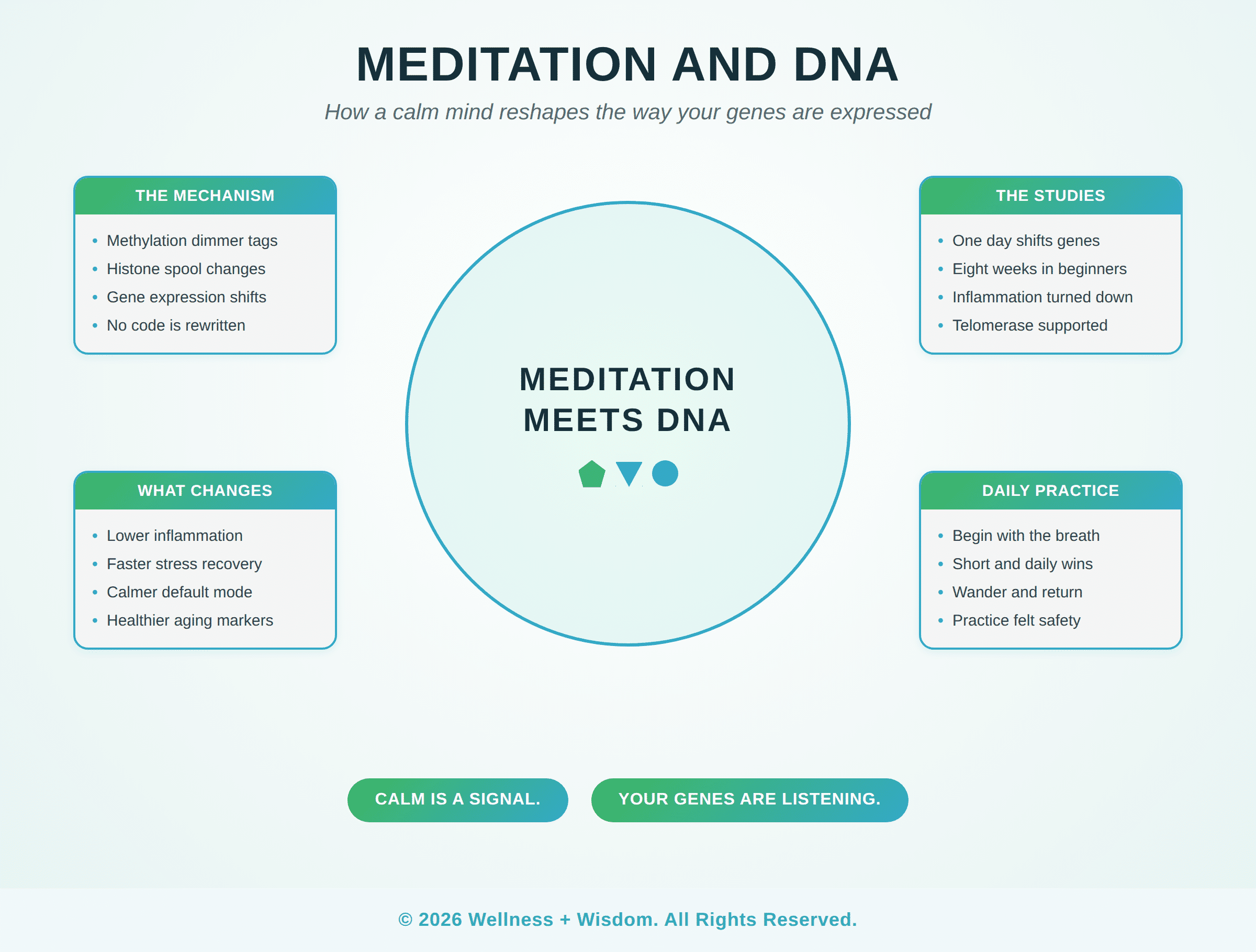
Meditation and DNA interact through the same mechanisms that govern all of epigenetics, mainly through chemical tags that sit on top of your genes and tell them how loudly to speak. Two of the biggest players are DNA methylation and histone modification, and meditation has been shown to influence both.
Think of methylation as a dimmer switch. When a methyl tag lands on a gene, it usually turns that gene down or off. Chronic stress tends to leave inflammatory genes turned up and protective genes turned down. A consistent practice helps shift that balance back toward calm and repair.
Histones are the spools your DNA wraps around, and the chemistry on those spools determines how accessible a gene is for reading. Loosen the spool and a gene becomes easy to express. Tighten it and the gene goes quiet. Meditation has been shown to change the activity of the very enzymes that manage this spooling, which is a direct molecular link between sitting quietly and shifting gene expression.
None of this requires you to understand the biochemistry to benefit from it. Your body already knows how to do this. The point is simply that the calm you cultivate on the cushion does not stay in your head. It travels all the way down to your chromosomes. This is the same mind body conversation we mapped out in psychoneuroimmunology and in how emotions change your gene expression.
What the Science Shows: Three Landmark Studies
The science here rests on real, replicated, peer reviewed studies, not wishful thinking. Three in particular show how deep the effect goes, from same day gene shifts to changes in cellular aging.
1. A single day of meditation shifts gene expression
In a study led by Perla Kaliman and Richard Davidson, published in Psychoneuroendocrinology, experienced meditators spent one intensive day in practice while a comparison group spent the same day in quiet leisure. After just that single day, the meditators showed reduced activity in several inflammatory genes and changes in the enzymes that regulate gene expression. The meditators also recovered faster from a stress test. One day of practice produced measurable molecular change.
2. The relaxation response rewires the transcriptome
In work led by Jeffery Dusek and colleagues at a Harvard affiliated mind body research center, published in PLoS ONE, researchers studied long term practitioners of meditative relaxation. They found that thousands of genes were expressed differently in practitioners compared with people who did not practice, especially genes involved in stress, inflammation, and how cells handle energy. Even newcomers who trained for eight weeks began to show the same shift. The mind learned a new pattern, and the genome followed.
What makes this study so compelling is the sheer size of the effect. We are not talking about one or two genes nudging slightly in one direction. We are talking about thousands of genes shifting their activity in coordinated patterns that point the body toward repair instead of alarm. That is the genome quietly reorganizing itself around a calmer way of living, day after day. And the fact that complete beginners began to catch up to seasoned practitioners after only two months of training is the most encouraging part of all. It means the door is not reserved for monks or mystics. It is open to anyone willing to sit down and practice, regardless of how stressed, scattered, or skeptical they feel when they begin. You do not need talent for this. You need repetition, and your biology takes care of the rest. That is the quiet democracy of this science. It does not ask who you are. It only asks that you show up.
3. Meditation and the biology of aging
One of the most fascinating threads connects meditation to telomeres, the protective caps on the ends of your chromosomes that shorten as you age. In research involving the Nobel honored telomere scientist Elizabeth Blackburn, published in Psychoneuroendocrinology, intensive meditation training was linked with greater activity of telomerase, the enzyme that helps maintain those protective caps. In plain terms, a calmer mind may help protect the cellular machinery of aging itself.
Put these together and the conclusion is hard to argue with. The link is not fringe. It is published in respected journals, measured in human cells, and pointing in one consistent direction.
Meditation Through the Lens of Emotional Epigenetics
Through the lens of Emotional Epigenetics™, meditation is one of the cleanest examples of an environmental signal of safety you can give your body. Emotional Epigenetics™ teaches that three forces converge to shape your gene expression: your emotional patterns, your unconscious beliefs, and your environment. Meditation works on all three at once.
On the level of emotional patterns, meditation teaches your body that it is safe to come down out of constant alertness. On the level of beliefs, it loosens the grip of the inherited stories that keep you braced for threat. On the level of environment, it changes the internal chemistry your cells are bathed in every day. That is a full spectrum signal of safety, and your genes are listening.
This matters across generations, not just within your own life. The patterns we inherit can be quieted, and the calm we cultivate can be passed forward. When you sit to meditate, you are not only helping the person you are today. You are part of how a family breaks a generational pattern and writes a healthier story for the people who come after you.
This is also why I never separate the science from the soul. The data on meditation and DNA is extraordinary, and so is the lived experience of a person who finally feels at home in their own body. Both are true. Both matter. That blend of evidence and depth is the whole spirit of the Wellness Pentagon.
It Is Not About Changing Genes, It Is About Expression
An important clarification keeps people honest here: meditation does not change your genetic code, it changes how your genes are expressed. Anyone who tells you that meditation edits your DNA letters is overselling it. The truth is more elegant and just as powerful.
Your genes are not your destiny. They are more like a piano. The keys are fixed, but the music depends entirely on how they are played. Stress plays a harsh, repetitive tune on the keys of inflammation and fear. A steady practice plays a different song, calling on the keys of repair, balance, and resilience instead. Same instrument, different music.
This distinction protects you from two traps. The first trap is genetic fatalism, the belief that your family history has already decided your fate. The second is magical thinking, the belief that the right practice can make you superhuman. The honest middle is the most empowering place to stand. You cannot change the keys, and you have enormous say over the music. That is the real promise here.
It is the same principle at the heart of identity transformation. You are not rebuilding the raw material of who you are. You are changing which parts of yourself get expressed, amplified, and lived out loud.
How to Start a Practice That Speaks to Your DNA
You start a practice that speaks to your DNA the same way you start anything that matters, small and consistent, every single day. The research did not require people to become monks. It required them to show up. Here is how to begin.
1. Begin with breath
Breath is the simplest doorway into a meditative state and the fastest way to settle your neural system. Even a few minutes of slow, conscious breathing begins to shift you out of stress chemistry. Start with the structure in our guide to box breathing for beginners before you ever try to sit in silence.
2. Keep it short and daily
Ten consistent minutes beats one heroic hour you never repeat. Your genes respond to the pattern, not the performance. Anchor your practice to something you already do, like the first moments after waking, so it becomes automatic. Consistency is the active ingredient.
3. Let the mind wander and come back
A racing mind is not a failed meditation. The practice is the returning, over and over, to the breath or the present moment. Each gentle return is one repetition in the gym of your attention, and it is exactly what quiets the busy default state in the brain.
4. Use stillness, sound, or slow movement
Meditation does not have to mean sitting cross legged in silence. Prayer, slow walking, gentle humming, or simply sitting with your eyes closed all count. The tools in our guide to neural system regulation give you several accessible on ramps if classic meditation feels out of reach.
5. Pair it with felt safety
The deepest gene level benefits come when your body actually feels safe, not just when your mind is busy trying to relax. Cultivating that felt sense of safety is the same somatic work we explore through bioenergetic memory and a daily emotional check in. Safety is the signal your DNA is waiting for.
Meditation and DNA: Myths vs Reality
The conversation around this topic attracts both hype and dismissal, so it helps to separate what is real from what is exaggerated. The reality is more grounded and, honestly, more impressive than the hype.
One common myth is that meditation rewrites your genetic code. Reality: it changes gene expression, not the underlying sequence, and that is plenty. Another myth is that you need years of practice to see any effect. Reality: studies have measured meaningful shifts after a single intensive day and after just eight weeks of training. The door opens faster than most people expect.
On the other side sits the dismissive myth that this is all placebo or wishful thinking. Reality: these findings come from blood samples, gene expression panels, and enzyme assays in peer reviewed journals, not from how people said they felt. The biology is doing something measurable.
The most damaging myth of all is that your genes have already sealed your fate. Reality: your daily choices are in constant dialogue with your biology, and you have far more influence than the old fatalism ever admitted. That is the liberating truth that the science keeps confirming, sit after sit.
What Happens in Your Brain When You Meditate
When you meditate, your brain shifts out of its busy, self focused default and into a calmer, more present state, and that shift is the upstream event that eventually reaches your genes. The brain and the genome are not separate systems. What happens between your ears changes the chemistry that bathes your cells.
One of the most studied changes involves the default mode network, the circuitry that hums along whenever your mind wanders into worry, rumination, and self referential thought. In experienced meditators, this network quiets down. The endless inner commentary softens, and with it goes a great deal of the stress signaling that keeps inflammatory genes switched on.
At the same time, the regions involved in calm and regulation grow stronger with practice, while the brain's alarm center becomes less reactive over time. A less jumpy alarm means fewer floods of stress chemistry, and fewer floods mean a friendlier internal environment for the protective, repair oriented side of your genome.
This is why I always say the cushion and the cell are connected by a single thread. You are not just calming your thoughts when you practice. You are changing the entire chemical weather system your DNA lives inside. The same regulation we build through neural system regulation is what makes the deeper biological shifts possible.
Why Inherited Stress Shows Up in Your Biology
Inherited stress shows up in your biology because the experiences of the generations before you left epigenetic marks that can be passed down, and meditation is one of the tools that can begin to soften them. You did not start from a blank slate. You started with a body already tuned by your lineage.
This is the heart of inherited trauma. When a parent or grandparent lived through prolonged fear, scarcity, or loss, their biology adapted to survive it, and some of those adaptations were handed forward through epigenetic signals rather than through the genetic code itself. A nervousness you never earned can be an inheritance you were handed.
The hopeful side is that what was tuned can be retuned. The same channels that carried stress forward can carry calm forward too. Every time you sit and teach your body that it is safe, you are not only changing your own gene expression. You are interrupting a pattern that might otherwise have continued, which is the quiet power of bioenergetic memory working in reverse.
This is also deeply personal for me. The work I do now is partly the work of giving my children a calmer starting point than I had. That is the generational gift hidden inside a daily practice, and it is one of the most meaningful reasons to begin.
Common Obstacles and How to Move Through Them
The most common obstacle to meditation is the belief that you are bad at it, and the good news is that this belief is based on a misunderstanding of what the practice actually is. You are not failing when your mind wanders. The wandering is the raw material.
Many people quit because they expect a blank, silent mind and instead meet a noisy one. That noisy mind is normal and even healthy. The practice was never about stopping thoughts. It was about noticing when you have drifted and gently coming back. Every return is a repetition, and the repetitions are where the biology changes.
Another common obstacle is time. People imagine they need a long, uninterrupted block, so they never start. The research points the other way. Short and consistent beats long and rare. Five honest minutes every morning will do more for your gene expression than a ninety minute session you attempt once a month and then abandon.
The last obstacle is restlessness in the body. For some people, sitting still feels almost unbearable at first, often because there is stored tension waiting to be felt. If that is you, start with movement or breath rather than stillness, and let the calm arrive gradually. The same principles we teach in the 90 second emotion rule apply here. Let the wave rise, let it move, and let it pass.
Bringing It All Together
Meditation and DNA are in a lifelong conversation, and you get to decide what you say. You were never sentenced to the patterns you inherited. With a few quiet minutes each day, you can shift which genes speak loudly and which fall silent, tilting your whole biology toward calm, repair, and resilience.
Start small. Breathe for five minutes tomorrow morning. Do it again the next day. The science says your cells are listening, and the deeper truth says your spirit is too. This is not about becoming someone new. It is about letting the healthiest version of who you already are finally get expressed.
If you want guidance and a community on this path, this is exactly what we built the Liberated Life Tribe for. Join the Liberated Life Tribe and receive your 10 day Self Liberation Blueprint at liberatedlife.com. You can also deepen your spiritual wellness, explore the full L.I.F.E. Method, hear hundreds of related conversations across our latest episodes, find tools in the store, and learn our full mission and programs.
Frequently Asked Questions
Can meditation really change your DNA?
Meditation does not change the letters of your genetic code, but it does change how your genes are expressed. Peer reviewed studies show that meditation can reduce the activity of inflammatory genes and influence the enzymes that regulate gene expression, which is a real and measurable link between meditation and DNA.
How quickly does meditation affect gene expression?
Faster than most people expect. One study found measurable shifts in gene expression after a single intensive day of practice in experienced meditators, and other research found meaningful changes after just eight weeks of training in beginners.
What is the difference between changing genes and changing expression?
Changing genes would mean editing the actual DNA sequence, which meditation does not do. Changing expression means influencing which genes are switched on or off, like choosing which books in a library get read. Meditation works on expression, not the sequence itself.
Does meditation affect aging?
Research involving telomere scientist Elizabeth Blackburn linked intensive meditation training with greater telomerase activity, the enzyme that helps maintain the protective caps on your chromosomes. This suggests a calmer mind may help protect some of the cellular machinery involved in aging.
How much meditation do I need to see benefits?
Consistency matters more than duration. Ten focused minutes daily tends to outperform occasional long sessions, because your genes respond to a steady pattern rather than a one time effort. Anchoring a short practice to an existing daily habit makes it stick.
Is the link between meditation and DNA scientifically proven?
The link is supported by replicated, peer reviewed studies using gene expression panels and enzyme measurements, not self report alone. The science is still young, but the findings are consistent and come from respected research institutions.
Studies and External Resources
The science showing how meditation changes your DNA rests on peer reviewed research. These are the studies and resources referenced throughout this article.
- Kaliman P, et al. Rapid changes in histone deacetylases and inflammatory gene expression in expert meditators. Psychoneuroendocrinology, 2014. PubMed: 24485481
- Dusek JA, et al. Genomic counter stress changes induced by the relaxation response. PLoS One, 2008. PubMed: 18596974
- Jacobs TL, et al. Intensive meditation training, immune cell telomerase activity, and psychological mediators. Psychoneuroendocrinology, 2011. PubMed: 21035949
About Josh Trent
Josh Trent is an Identity Transformation Architect and the award winning host of the Wellness + Wisdom Podcast, with over 15 million downloads since 2015. He is the creator of the L.I.F.E. Method™ Identity Transformation System and steward of the Emotional Epigenetics™ and BREATHE: Breath + Wellness™ systems of self mastery, impacting over 1,000 students worldwide. Josh lives in Austin, Texas with his wife Carrie, daughter Nayah, and son Novah. Learn more about my story and explore our programs.
Peace and power,
Josh Trent
Disclosure: We may earn a commission from certain links on this site when you make a purchase, at no extra cost to you. These commissions help support Wellness + Wisdom and do not affect the products or resources we choose to recommend. Full disclosure .