Most people who want to change their lives go straight to the behaviors. They overhaul the diet. They sign up for the gym. They download the meditation app. For a while, things seem to shift. Then, somewhere between week three and week eight, something pulls them back. Not the food or the schedule or the habit. Something deeper. Something older. Something that feels, at its core, like who they are.
That pull is your identity. And it is the real weight you need to lose.
Identity transformation is not a trendy concept or a weekend retreat promise. It is the mechanism behind every lasting change you have ever made and every relapse you have ever experienced. The research confirms it completely: when your identity shifts, your behavior follows and tends to stay there. When your identity does not shift, willpower does all the heavy lifting, and willpower is a fragile and exhausting resource.
I have spent over fifteen years exploring the intersection of neuroscience, emotional healing, and authentic living through the Wellness + Wisdom Podcast. In all that time, through hundreds of conversations with the world's leading researchers, therapists, and healers, I keep arriving at the same truth: the most important conversation in personal growth is not about what you do. It is about who you believe you are.
This article is your guide to understanding identity transformation from the inside out: the science, the soul, and the practical steps that make lasting change not just possible but inevitable when you start with the right foundation.
The Weight No Scale Can Measure
Imagine carrying a backpack every single day of your life. The backpack is filled with everything people ever told you about yourself. Your father's disappointment when you failed. Your mother's anxiety about money. Your teacher's dismissal when you asked the wrong question. The cultural message that your body needed to look different. The family rule that expressing emotion was weak or selfish or dangerous.
Over time, that backpack becomes invisible to you. You stop noticing the weight because the weight becomes indistinguishable from who you are. Or so you believe.
The stories in that backpack become your self concept: a composite of all the roles you have played, all the judgments you have absorbed, all the survival strategies you have built over a lifetime. And here is what nobody tells you when you sign up for the next cleanse or challenge or program: changing your behavior without changing your self concept is like trying to run a marathon with that backpack still strapped to your back. You might take a few impressive steps forward, but eventually the weight wins.
This is why the identity question is the wellness question of our generation. The 2026 Global Wellness Summit identified what researchers are calling an “over optimization backlash,” a cultural movement away from self surveillance and data obsession toward meaning, authenticity, and genuine self expression. People are exhausted from tracking everything and transforming nothing that actually matters.
What they are hungry for is genuine identity transformation: a real, cellular level shift in who they believe themselves to be. That shift begins with understanding what identity actually is and how it was built in the first place.
What Identity Actually Is (And Why Most Definitions Sell You Short)
Identity is not your name. It is not your job title or your relationship status or your enneagram type. Those are labels. Identity is something far more primary and far more powerful: it is the story your brain continuously tells about what kind of person you are and what kind of person you are allowed to become.
Your identity operates largely below the level of conscious thought. It is the invisible hand that guides your choices before you are even aware you are making them. When you reach for the third glass of wine even though you said you would stop at one, that is identity. When you shrink in meetings even though your ideas are the best in the room, that is identity. When you sabotage the relationship you actually want because some part of you believes you do not deserve it, that is identity doing exactly what it was designed to do: keeping the story consistent.
Understanding this is not about blaming yourself. It is about getting honest about the architecture of the problem so you can actually address it at the level it lives.
Your Brain's Story Machine: The Default Mode Network
Here is where the science becomes genuinely fascinating. The brain contains a network of regions that activate when you are not focused on a specific external task: when you are daydreaming, reflecting, imagining the future, or making sense of your past. Neuroscientists call this the Default Mode Network, or DMN. And it turns out this network is essentially the headquarters of your sense of self.
Research published in Neuroimage by Davey, Pujol, and Harrison identified the core regions involved in self referential processing within the DMN: the medial prefrontal cortex, the posterior cingulate cortex, and the inferior parietal lobule. Their findings revealed that self related processes are driven primarily through posterior cingulate cortex activity and regulated by the medial prefrontal cortex. [Davey et al., 2016, Neuroimage, PubMed: 26892855]
In plain language: your brain has a dedicated storytelling system that runs a continuous narrative about who you are during every idle moment of your existence. The story it tells is built from memory, from pattern recognition, from the accumulated weight of your experience. And it is remarkably resistant to change, not because you are fundamentally limited, but because the brain values predictability and metabolic efficiency above almost everything else.
The liberating truth is that the same neural plasticity that locked your old identity in place is the very mechanism that makes identity transformation possible. Your brain can write a new story. But it needs more than new information to do it. It needs new embodied experience, repeated over time.
The Inherited Blueprint Nobody Asked You to Accept
Here is something I explore extensively through the lens of Emotional Epigenetics on the Wellness + Wisdom Podcast: a significant portion of your current identity was not chosen by you at all. It was handed down.
Through the science of Emotional Epigenetics, we now understand that emotional patterns, unconscious beliefs, and survival strategies can be transmitted across generations through epigenetic mechanisms, through shared environmental signals, and through the neural system modeling that happens in early childhood. The chronic anxiety that feels like yours may have originated with your grandmother's wartime survival. The shame you carry about your own success might echo a scarcity story running three generations back.
This is not a reason to feel victimized. It is a reason to feel genuinely compassionate toward yourself and simultaneously thrilled that you are the one in your lineage who gets to rewrite the code. Identity transformation, when done with real depth, does not just change you. According to the science of Emotional Epigenetics, it can alter the epigenetic expression being passed forward to the generations that follow you.
You can learn more about how this generational inheritance works through our work on the Wellness Pentagon and the Wellness + Wisdom Podcast.
The Science Behind Identity Transformation
The research on identity and sustainable change is some of the most compelling and underutilized science in the wellness world. Most people have never heard of it. Here is what the evidence actually shows.
Identity Shifts as Turning Points in Your Health
A landmark meta analysis published in the Western Journal of Nursing Research synthesized 14 qualitative studies involving 399 participants across experiences of weight loss, smoking cessation, and recovery from substance use. The researchers Kearney and O'Sullivan identified a consistent and deeply instructive pattern: lasting change did not begin with better information or stronger willpower. It began with a felt value conflict so distressing that the person was compelled to take one small step toward something different. [Kearney and O'Sullivan, 2003, Western Journal of Nursing Research, PubMed: 12666640]
When that first step succeeded, something remarkable and reproducible happened: an identity shift began. The person started to see themselves differently. Not as someone trying to change, but as someone who was actively becoming a new kind of person. With that emerging identity came increased self awareness, greater self confidence, and a momentum that no external motivation or accountability program can sustainably replicate.
This is why asking yourself “who am I really?” is not philosophical self indulgence. It is the most practical wellness question you can ask. Because the answer shapes every single behavior and habit that follows.
Why Willpower Cannot Do What Identity Can
A research framework developed to explain the long term maintenance of health behaviors, published through the National Institutes of Health and known as the Maintain IT model, offers a powerful lens for understanding why most programs ultimately fail. [PMC: 6124500, PubMed: 29402182]
The model argues that the early stages of behavior change require significant executive function: the conscious, effortful mental processing that allows you to override ingrained patterns. But executive function is metabolically expensive. It depletes under stress, fatigue, emotional flooding, and novelty. This is why the gym membership gets abandoned in February, why the diet collapses during a difficult week at work, why the new communication practice disappears under relationship pressure.
What the Maintain IT model shows is that identity transformation fundamentally reduces the burden on executive function over time. When your behavior becomes genuinely consistent with your self concept, when who you are lines up with what you do, you no longer have to fight yourself to act in alignment with your values. The choice begins to feel automatic, not because you suppressed the old self but because you actually became someone new.
This is the essential difference between a diet and a way of life, between a resolution and a genuine revolution. One is behavioral. The other is an identity change that makes the behavior a natural expression of who you are.
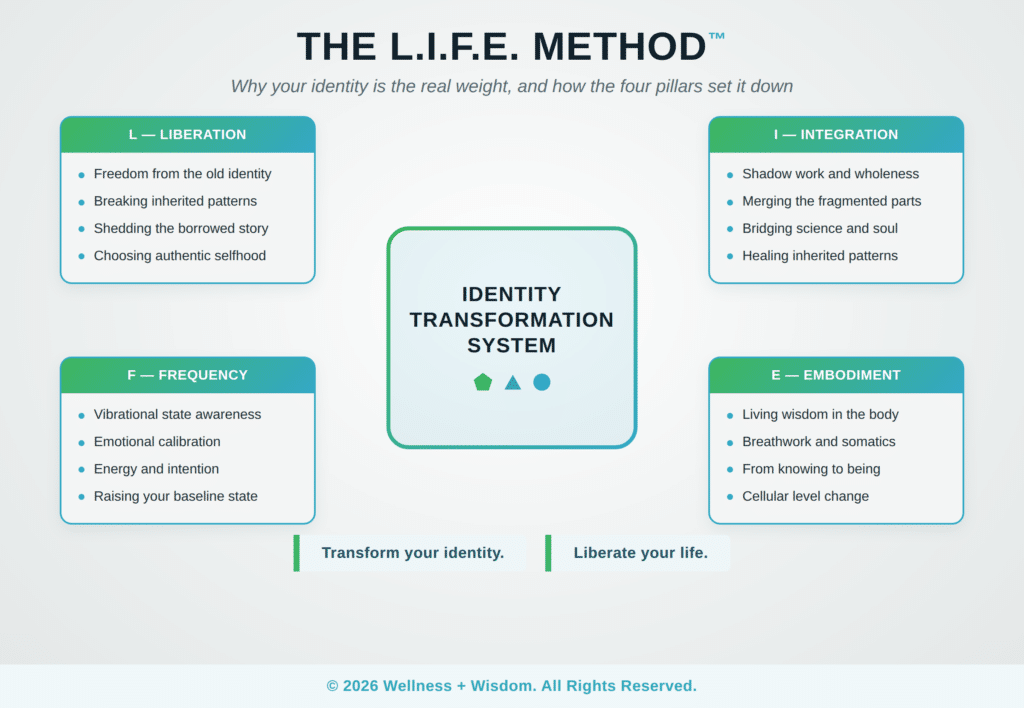
The L.I.F.E. Method was built around exactly this understanding. Every element of the program is designed to create the identity level shift that makes lasting change biologically and psychologically sustainable, not just behaviorally motivated.
The Four Identities Keeping You Stuck
Before you can fully inhabit a new identity, it helps to see clearly which ones you have been wearing. In years of working with people through the L.I.F.E. Method and within the Liberated Life Tribe community, I have found that most persistent stuck patterns trace back to one or more of four core identity structures.
The Performance Identity
This identity is built entirely around doing and producing. Its core operating belief is: “I am what I achieve.” People carrying the Performance Identity are often outwardly functional and even enviably successful, but they experience a chronic low grade terror about stillness, about rest, about the question of who they would be if they stopped producing long enough to find out.
The Performance Identity typically develops in environments where love was conditional on results. The student who received attention only when her grades were perfect. The athlete whose father only showed up when he won. The child who learned early that visible achievement was the price of belonging.
The work of shedding old identity here is not about abandoning ambition or achievement. It is about uncoupling your fundamental worth from your output so that your doing becomes an expression of who you are rather than the proof that you exist.
The Trauma Identity
This identity has fused itself so thoroughly to a painful chapter that the wound and the self become indistinguishable. Its core belief is: “I am what happened to me.” The Trauma Identity can manifest as chronic victimhood, as a profound inability to envision a future that genuinely differs from the past, or as a subtle but powerful unconscious loyalty to suffering because suffering has become familiar, and familiar has become safe.
The Trauma Identity is not a character defect. It is a survival adaptation that once served a real purpose. The problem arrives when a survival strategy becomes a permanent address, because when survival mode is your home, you lose access to the part of yourself that existed before the wound: the authentic self that the L.I.F.E. Method is designed to help you rediscover and inhabit.
The Borrowed Identity
This is perhaps the most common and the least recognized of the four. The Borrowed Identity is composed almost entirely of other people's expectations: the career chosen to satisfy parents, the relationship maintained because leaving would disappoint the family, the values held not because they were genuinely examined and chosen but because they were never questioned at all.
Many people spend entire lifetimes inside a Borrowed Identity. The crisis moment arrives when the gap between who they are performing and who they actually sense themselves to be becomes too painful and too costly to sustain. That moment, as uncomfortable as it is, is the beginning of real identity transformation.
For a deeper exploration of how borrowed beliefs and inherited conditioning shape us, our conversation on the Wellness + Wisdom Podcast goes deep into this territory.
The Scarcity Identity
The Scarcity Identity operates from the core conviction that there is not enough: not enough love, not enough safety, not enough success, not enough worth to go around. This identity drives frantic over accumulation in some areas (money, achievement, validation) and profound self denial in others (rest, pleasure, authentic connection).
The Scarcity Identity is usually rooted in genuine experiences of lack, whether material, emotional, or relational. But the identity itself perpetuates the very scarcity it fears, because a person who believes at their core that they are not enough will unconsciously arrange their life to confirm that belief over and over again. The Wellness Pentagon framework addresses this directly through the dimension of financial wellness, which is never just about money but always about the story we carry about our worthiness of abundance.
Shedding Old Identity With the L.I.F.E. Method
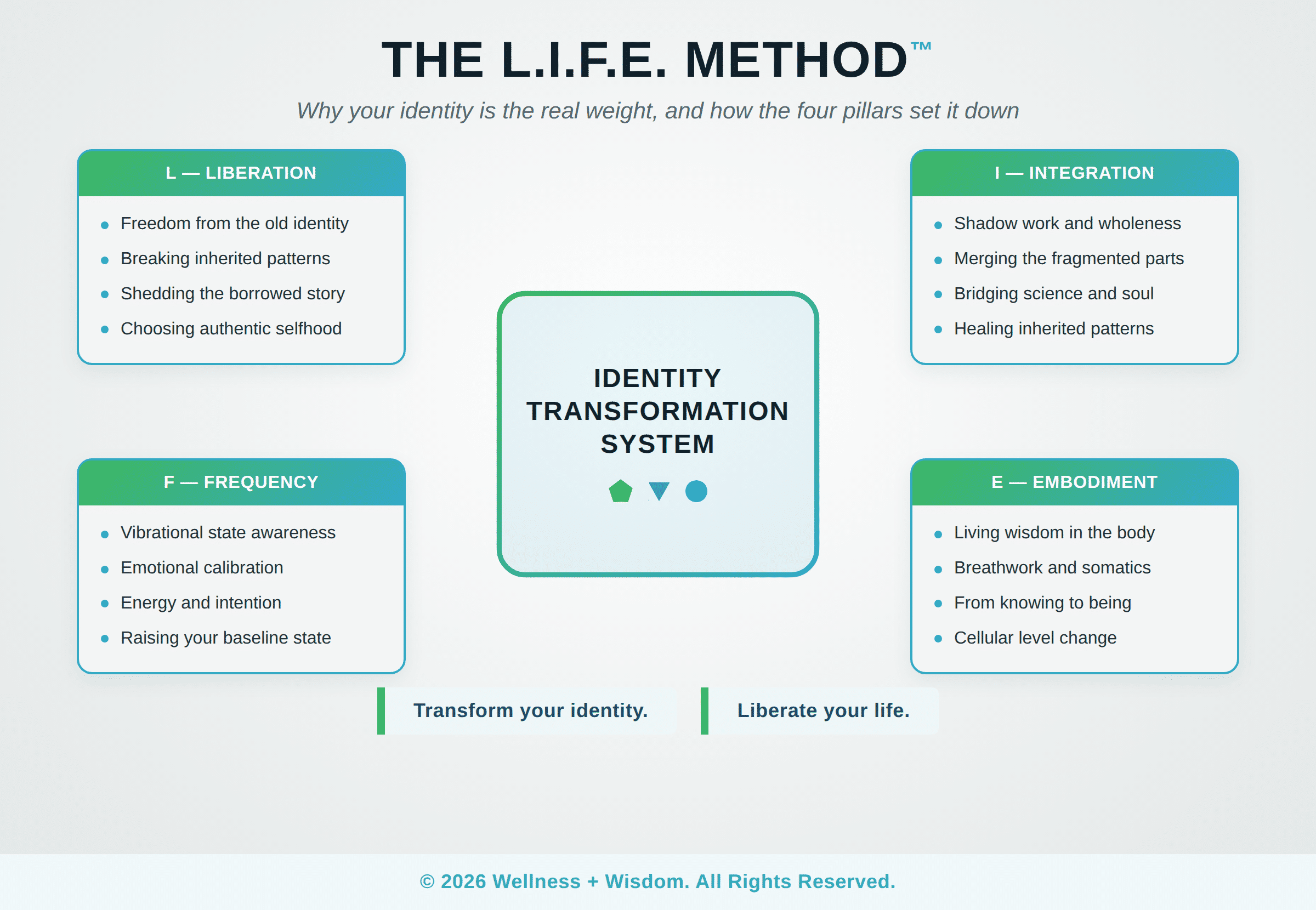
The L.I.F.E. Method is the framework I built through years of teaching Emotional Epigenetics, breathwork, trauma integration, and identity work. L.I.F.E. stands for Love, Integration, Forgiveness, and Embodiment, and each letter is a distinct doorway into shedding old identity and inhabiting something truer. You can explore the full six week program on our pricing and enrollment page. Here is the essence of each pillar.
L: Love the Version of You That Had to Survive
The first movement of identity transformation is not rejecting the old self, it is loving it. The Performance, Trauma, Borrowed, and Scarcity identities were not mistakes. They were brilliant adaptations a younger you made to survive a world that felt unsafe. Love here means turning to that younger self like a wise parent and saying, you did what you had to do, and now we get to choose something different. Healing cannot begin from self contempt.
I: Integration of All That You Are
Integration is where most identity work falls short. We try to delete the old self and exile the shameful parts, but the shadow does not vanish when you stop looking. It goes underground and runs your life from below. True change means holding the wounded parts and the whole parts in the same arms, with radical honesty and radical compassion. This is also why the Liberated Life Tribe exists, because identity change done in isolation reinforces the very loneliness that keeps the old self in place.
F: Forgiveness as a Release of Weight
If identity is a weight, unforgiveness is a chain, and the person you most need to forgive is often yourself. Chronic resentment and self judgment fire the same stress systems in the neural system that respond to physical danger. Forgiving yourself for who you were before you knew better is not making excuses. It is releasing the biochemical weight of self punishment so your neural system can rest long enough to support a new way of being. This is one of the most profound practices in the complete L.I.F.E. Method program.
E: Embodiment as the New Identity in Action
This is where identity transformation stops being a concept and becomes lived reality. You can think a new thought and set a powerful goal, but until the new identity lives in your body, your breath, and your neural system reflexes, the old self stays the operating system. Through breathwork and conscious movement you build new neural pathways that support the identity you are choosing. The body is the subconscious mind native language, and when the body shifts, the mind follows. We explore these practices across the latest episodes of the Wellness + Wisdom Podcast.
Who Am I Really? Seven Practices to Find Your Authentic Self
The authentic self is not a destination you reach once. It is a direction you keep choosing, the orientation you return to when you live from your actual values rather than your conditioned ones. Here are seven practices that support that return.
1. The Identity Audit: Write the five roles you play most. For each, ask which feel like authentic expression and which are performances you maintain out of fear or obligation. The gap is your invitation.
2. The Energy Inventory: Notice where you feel energized and where you feel drained. Authentic identity aligns with life force, so chronic depletion in a whole area is information about fit.
3. The Borrowed Belief Investigation: Name three limiting beliefs about yourself and ask whose voice each sounds like. Did you choose it, or inherit it? Explore this through our work on Emotional Epigenetics.
4. Breathwork as Identity Space: Conscious breathing creates space between stimulus and response, and in that space you get to choose who you are rather than default to the pattern. Even five minutes each morning shifts your neural system from reactive to responsive.
5. Community Accountability: Share your identity transformation with someone who can name the difference between your old and emerging patterns. We cannot see ourselves clearly alone, which is a core gift of the Liberated Life Tribe.
6. The Physical Signal Practice: Choose one small physical anchor for the new identity, like standing tall when you enter a room or one long exhale before a hard response. The body is the fastest pathway to the subconscious.
7. Evidence Collection: Each night, write one moment you acted from the new identity rather than the old one. The brain follows evidence, and the more you gather, the truer the new self feels. For more, explore the blog and the store.
Frequently Asked Questions About Identity Transformation
What is identity transformation and why does it matter for lasting health change?
Identity transformation is the process of shifting your core self concept from a conditioned, inherited, or trauma based story to one that more accurately reflects your authentic values, desires, and genuine capacities. It matters for lasting health change because research consistently shows that sustainable behavior change is driven primarily by identity, not willpower or motivation. When who you believe you are shifts, your choices and habits follow naturally and tend to remain in place without the exhausting force of conscious effort. The Kearney and O'Sullivan meta analysis found that lasting change across weight loss, smoking cessation, and recovery all began with an identity shift, not a behavior change. The identity shift made the behavior change sustainable. [PubMed: 12666640]
How long does genuine identity transformation take?
There is no universal timeline, and anyone who promises you one in a specific number of days is selling something simpler than what identity work actually involves. That said, research on the Maintain IT model and neuroplasticity suggests that meaningful identity level shifts begin within weeks of consistent practice and deepen substantially over six to twelve months of engaged work. The L.I.F.E. Method is structured as a six week immersive precisely because that timeframe represents a minimum effective dose for beginning the neurological rewiring that supports genuine identity change. The work continues well beyond that initial phase, and the depth of shift tends to increase with time, practice, and community.
Can identity actually change after significant trauma?
Not only can it: genuine healing from trauma almost always involves some form of identity transformation. Trauma creates what I call the Trauma Identity: a self concept organized around the wound, where the event and the person become fused. Healing means learning to separate who you are from what happened to you, not by denying the experience or its impact, but by expanding your self concept to hold both the wound and the wisdom, both the past and the possible. Research in somatic healing, neuroplasticity, and emotional epigenetics confirms that the brain and body remain genuinely capable of significant restructuring and reorientation throughout adulthood. Your history shaped you. It does not define you permanently unless you allow it to.
What does shedding old identity feel like in the body?
Honestly? It often feels genuinely uncomfortable at first, and this is important to understand so you do not mistake the discomfort for a sign that you are doing something wrong. The neural system is wired for predictability and pattern consistency. When you begin to release an old identity, even a limiting or painful one, the brain and body register it as unfamiliarity, and unfamiliarity initially reads as threat. You might experience resistance, a grief for the old self that feels surprisingly real, heightened anxiety or restlessness, or even physical sensations as the neural system adjusts to new patterns. These responses are not signs that something has gone wrong. They are signs that something is actually changing. The breathwork and somatic practices embedded in the L.I.F.E. Method are specifically designed to support the neural system through exactly these transitions.
Is the authentic self something I create or something I discover?
In my experience, supported by decades of philosophical inquiry and emerging somatic research, the authentic self is far more discovered than created. The work of identity transformation is largely a process of removal: stripping away the conditioning, the survival strategies, the borrowed beliefs, the inherited shame and fear. What is left when those layers are genuinely released is not a blank slate waiting to be filled in. It is something that has been present all along, waiting patiently beneath the weight you have been carrying. The authentic self does not need to be built. It needs to be uncovered, welcomed, and given the space and safety to emerge.
How do I know if I am ready to begin this kind of work?
You are ready when the gap between who you are performing and who you actually sense yourself to be becomes more painful than the discomfort of genuine change. That threshold moment is different for everyone, but it is unmistakable when it arrives. It tends to show up as a felt exhaustion with the old story, a quiet but persistent inner knowing that something needs to shift at a level deeper than behavior or circumstance. If you have read this far in this article, it is very likely that you have already crossed that threshold. The next step is not another year of research or preparation. It is a simple, real first move toward something new. The Liberated Life Tribe and the ten day Self Liberation Blueprint are designed to be exactly that first move.
Ready to Lose the Weight That Actually Matters?
Join the Liberated Life Tribe and receive your free ten day Self Liberation Blueprint. A guided journey into the core practices of authentic identity, designed to give you immediate, embodied tools for the shift you are ready to make.
Join the Liberated Life Tribe at liberatedlife.com
This is where the cycle ends and your authentic joy begins.
Studies and External Resources
The science in this article rests on peer reviewed research and authoritative resources. These are the studies and sources referenced throughout.
- Mapping the self in the brain's default mode network. Neuroimage, 2016. PubMed: 26892855
- Identity shifts as turning points in health behavior change. West J Nurs Res, 2003. PubMed: 12666640
- Harnessing centred identity transformation to reduce executive function burden for maintenance of health behaviour change: the Maintain IT model. Health Psychol Rev, 2018. PubMed Central: 6124500
About Josh Trent
Josh Trent is the founder of Wellness + Wisdom and the creator of the L.I.F.E. Method, a six week identity transformation program grounded in the science of Emotional Epigenetics, breathwork, and somatic healing. He is the host of the Wellness + Wisdom Podcast, one of the longest running wellness podcasts in the world, with over 700 episodes exploring the intersection of neuroscience, emotional healing, and authentic living. Josh is based in Dripping Springs, Texas and has spent over fifteen years studying and teaching the practical pathways from self sabotage to genuine, embodied joy. He is also the founder of the Liberated Life Tribe, a global community dedicated to the work of authentic self liberation.
Follow Josh: Podcast | Blog | Josh's Story
Scientific References
- Davey CG, Pujol J, Harrison BJ. Mapping the self in the brain's default mode network. Neuroimage. 2016;132:390 to 397. PubMed: 26892855
- Kearney MH, O'Sullivan J. Identity shifts as turning points in health behavior change. West J Nurs Res. 2003;25(2):134 to 52. PubMed: 12666640
- Berger BG, Pargman D, Weinberg RS. Harnessing centered identity transformation to reduce executive function burden for maintenance of health behavior change: The Maintain IT Model. Health Psychology Review. 2018. PMC: 6124500
Disclosure: We may earn a commission from certain links on this site when you make a purchase, at no extra cost to you. These commissions help support Wellness + Wisdom and do not affect the products or resources we choose to recommend. Full disclosure .