
By Josh Trent | Emotional Intelligence | April 9, 2026
“Forgiveness is not something you do for the person who hurt you. It is something you do for the version of yourself that is still living in that moment, waiting to be set free.”
Let me tell you something that might rearrange everything you think you know about forgiveness.
Most people believe forgiveness is something you extend outward, a gift you give to the person who wronged you. They think it means releasing someone from accountability, pretending the wound never happened, or being the bigger person in some moral performance that mostly benefits them. And because forgiveness feels like that, because it feels like losing, like condoning, like weakness, most people never actually do it.
They carry the weight instead. They replay the betrayal at 2 a.m. They feel the old anger flare when they see a name on their phone. They build their identity, quietly and slowly, around the injury itself. And they wonder why they feel stuck, exhausted, inflamed, and never quite free.
Here is what I want you to know today, as someone who has lived through this and spent years studying it: the neuroscience of forgiveness has completely rewritten what we thought we understood about letting go. This is not a spiritual platitude. This is measurable, peer reviewed biology. Forgiveness changes your brain. It lowers your cortisol. It reduces your blood pressure. It shifts your immune function. It alters your genetic expression over time.
And it does all of that not because you gave the other person anything. But because you gave yourself back your own neural system.
On the Wellness + Wisdom Podcast, we have had hundreds of conversations about the tools that genuinely move the needle on human suffering and liberation. Forgiveness keeps coming up not as a nice idea, but as a biological necessity for anyone who wants to live in authentic joy. Today I want to go deep on the science, the mechanism, and the practice, because you deserve more than a meme about letting go. You deserve the actual truth about what is happening inside your brain and body when you hold a grudge, and what becomes available when you finally release it.
What Forgiveness Actually Is (And What It Is Absolutely Not)
Before we talk about the neuroscience, we have to clear up a misconception that blocks most people from ever accessing forgiveness at all.
Forgiveness is not excusing someone's behavior. It is not saying what happened was okay. It is not forgetting the event or erasing the memory. It is not offering trust that has not been earned back. It is not reconciliation, and it is not a relationship restored.
Forgiveness, at its core, is a decision you make inside your own body and your own neural system to stop carrying the physiological and psychological weight of someone else's actions. It is releasing the story of victimhood, not because you are not a victim of what happened, but because the ongoing reenactment of that victimhood is what is keeping you trapped.
The pioneering psychologist Everett Worthington, whose work underpins much of modern forgiveness science, describes forgiveness as an emotional replacement: you replace the unforgiving emotions of resentment, bitterness, hostility, and fear with positive other oriented emotions like empathy, compassion, or even just neutral acceptance. Notice that definition does not require you to feel warmly toward the person who hurt you. It simply requires that you stop letting their actions live rent free in your body.
When I went through the darkest chapter of my own life, learning to forgive the people I felt had betrayed me most was not something I did for them. I did it because continuing to carry that weight was literally making me sick. The insomnia, the chronic tension in my chest, the way I would see something innocuous and feel a flash of rage, these were not moral failures on my part. They were my neural system trying to protect me from a perceived threat that no longer existed in the room but was fully alive in my body.
The science confirms what I experienced. The L.I.F.E. Method I created, which stands for Love, Integration, Forgiveness, and Embodiment, places forgiveness at the exact center of identity transformation for a reason: you cannot become who you truly are while your biology is still defending against who hurt you. You can read more about this in my personal story of transformation.
The Neuroscience of Forgiveness: What Brain Scans Actually Reveal
Researchers have now used functional MRI imaging to watch what happens inside the brain when a person chooses to forgive. The results are remarkable and should be taught in every school in the world.
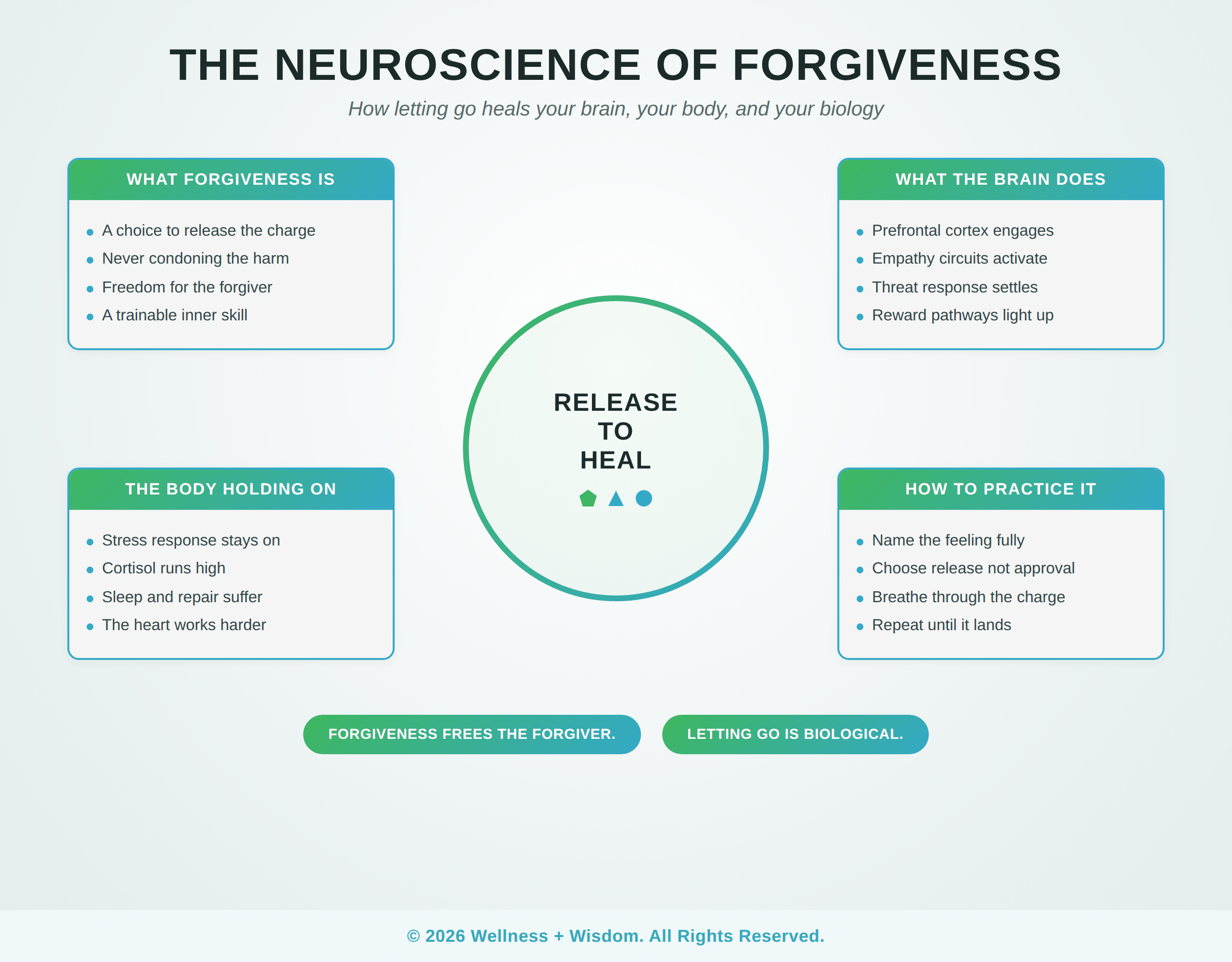
A landmark study published in Frontiers in Human Neuroscience identified what the researchers called “the functional neuroanatomy of forgiveness.” When participants were guided to genuinely forgive a past transgressor, specific brain regions lit up in a coherent and predictable pattern. The key areas activated included the precuneus, the right inferior parietal regions, and the dorsolateral prefrontal cortex. These are not random areas. They are the exact zones involved in perspective taking, cognitive reappraisal, and the regulation of emotion through conscious thought. In other words, your brain is doing sophisticated, compassionate, executive work when you forgive. This is not a soft feeling. This is high level neurological labor.
A subsequent analysis published in Neuroscience and Biobehavioral Reviews and indexed at PubMed (PMID 32088347) parsed the forgiveness process into three distinct components with corresponding neural mechanisms. The study confirmed that forgiveness requires the coordinated activation of cognitive control, perspective taking, and what researchers called social valuation, which is the brain's capacity to weigh the ongoing worth of a relationship and the conditions under which reconnection or release makes sense. This study changed the conversation: forgiveness is not a single event that happens to you, it is a multi network neurological process that your brain executes with remarkable precision.
And here is the news that should stop you in your tracks: structural brain research has found that people with a larger middle frontal gyrus, a region in the prefrontal cortex, show significantly higher forgiveness scores and lower symptoms of depression and anxiety. This was documented in a study from PMC (PMCID 8918469) examining adolescents, and it revealed something profound: forgiveness mediates the relationship between brain anatomy and clinical mental health symptoms. Your capacity for forgiveness is literally wired into your brain, and the more you practice it, the more you strengthen the very structures that make it possible.
This is neuroplasticity in action. Every time you choose to forgive, you are not just making a moral choice. You are performing a brain workout that builds the neural architecture of emotional freedom. This is why the Wellness Pentagon, which guides everything we do at Wellness + Wisdom, holds emotional health as one of five non negotiable dimensions of whole person wellbeing.
The Three Brain Networks the Neuroscience of Forgiveness Activates
Understanding the specific systems your brain recruits when you forgive helps demystify why it feels so hard and why, once you push through, it feels so undeniably right. Based on the convergent research in this field, here are the three primary networks involved.
Network One: Empathy and Perspective Taking
The first system your brain activates when forgiveness begins is the empathy network. This includes regions associated with theory of mind, which is the brain's ability to model the internal states of other people. When you start to genuinely consider why someone acted the way they did, when you wonder what wound in them produced the wound they gave you, this network fires. The precuneus and the temporoparietal junction are key players here, and their activity correlates directly with the degree of forgiveness offered.
This is why every great spiritual tradition across human history has pointed to compassion as the pathway through resentment. They were not guessing. They were describing what the brain actually does. Empathy does not mean agreement. It means your brain is sophisticated enough to hold another human being's complexity, even when that complexity caused you pain.
On the Wellness + Wisdom Podcast, I have spoken with therapists, neuroscientists, and trauma healers who all return to this same truth: the person who hurt you was almost certainly operating from their own unhealed wounds. That does not make what happened acceptable. It makes it understandable. And understanding is the first door to freedom.
Network Two: Cognitive Reappraisal
The second network is what researchers call cognitive reappraisal, and it is one of the most powerful tools the human brain possesses. This is the prefrontal cortex stepping in to literally reframe the emotional meaning of an event. When you shift from “this person destroyed my life” to “this experience, as painful as it was, showed me what I needed to see about myself and others,” your brain physically changes how it tags that memory.
Reappraisal does not require that you pretend the event did not hurt. It simply means you choose a framework for understanding it that reduces the ongoing physiological cost. And the research is clear that this shift is biological, not just philosophical. When the prefrontal cortex engages in reappraisal, activity in the amygdala decreases. You literally feel less threat from the memory. The emotional charge of the wound is measurably reduced.
The Emotional Epigenetics framework I teach recognizes this reappraisal process as one of the core mechanisms through which we change not just our psychology but our actual gene expression. When you stop interpreting a past event as an ongoing threat, you are sending a fundamentally different signal to your biology. We cover this in depth on the Wellness + Wisdom Podcast with leading researchers in epigenetics and trauma healing.
Network Three: Social Valuation and Regulatory Mechanisms
The third network involves the brain's ability to regulate emotional responses through social context. Your brain is constantly running calculations about the people in your life: who is safe, who is threatening, and what the ongoing cost of a relationship is relative to its benefit. When you choose forgiveness, you are not necessarily re categorizing a person as safe. You are removing them from the active threat category so that your neural system can stop spending energy defending against them.
The reward pathways in the brain are also involved here. Resentment, frustratingly, can be neurologically reinforcing. The rumination loop, the replaying of grievances, can trigger small dopamine releases of righteous indignation. Your brain can actually become attached to the story of being wronged because that story gives you a sense of identity, of being the one who was unjustly treated. Forgiveness disrupts that loop at the neurological level and creates space for reward pathways to be activated by something far more nourishing: connection, purpose, and joy.
Why Forgiveness Is Hard: The Biology of Resentment
If forgiveness is so good for us, why is it so extraordinarily difficult? The answer is not a character flaw. The answer is evolution.
Your brain evolved over hundreds of thousands of years in an environment where social betrayal could be a death sentence. Being cast out from the tribe, being deceived by a competitor, being harmed by someone you trusted: these were survival level catastrophes for your ancestors. So your brain developed a very efficient system for tagging interpersonal harm as high priority, threat level information that should never be forgotten.
The amygdala, your brain's threat detection center, plays a central role here. When you experience betrayal, rejection, or injustice, the amygdala fires and floods your body with cortisol and adrenaline. This is the same physiological response as being chased by a predator. And critically, the amygdala stores these memories with a priority tag: remember this, do not let your guard down, this happened and it could happen again.
Research has shown that recalling personal betrayals triggers significantly stronger amygdala activation than recalling other negative memories. The brain treats the memory of being wronged as more dangerous than many physical threats. And while the original harm may have occurred years or even decades ago, the amygdala does not apply a timestamp. Every time you encounter a trigger related to the wound, whether it is a name, a smell, a tone of voice, or even a vaguely similar situation, your brain fires as if the danger is present right now.
This is why forgiveness is hard. It is not weakness. It is not failure. It is your neural system doing exactly what it was designed to do. The challenge is that in the modern world, this brilliant survival mechanism is now creating chronic low grade stress responses that are slowly and quietly degrading your health. The threat is no longer in the room. But your biology does not know that.
There is also the identity piece, and I think this is the one most people never talk about. When something terrible happens to us, we sometimes build our identity around the injury. The grievance becomes a part of how we understand who we are. “I am the person who was betrayed by my business partner.” “I am someone whose parent abandoned them.” “I am the one who was treated unfairly.” These are real experiences. They shaped you. But when the story of what happened to you becomes the story of who you are, forgiveness feels like losing yourself, not just releasing an old pain. That is a biological attachment, and it is the hardest layer of this work.
The Wellness Pentagon framework I teach holds emotional wellness as one of five indispensable pillars, and this identity wound sits at the very center of emotional health. True emotional wellness is not the absence of pain. It is the capacity to move through pain without becoming defined by it.
How Forgiveness Heals the Body: Cortisol, Sleep, and the Immune System
The research on how forgiveness heals the body has expanded dramatically in the past several years, and what it shows goes far beyond the emotional. Forgiveness is a physiological intervention with measurable outcomes across multiple organ systems.
Cortisol and the Stress Response
A meta analysis published in Annals of Behavioral Medicine and available at PubMed (PMID 30632797) synthesized decades of forgiveness research and found a reliable, statistically robust association between forgiveness and health outcomes. The associations were strongest for psychological wellbeing but also significant for cardiovascular indicators including heart rate and blood pressure. Critically, high forgivers showed greater reduction in cortisol levels from baseline than low forgivers under identical stress conditions.
Cortisol is not just a stress hormone. At chronically elevated levels, it is a biological wrecking ball. It suppresses immune function, promotes inflammation, disrupts sleep architecture, impairs memory consolidation, accelerates cellular aging, and increases the risk of cardiovascular disease. When you hold resentment, you are not just feeling bad. You are bathing your cells in a chemical environment that breaks the body down over time. Forgiveness interrupts that process at the hormonal level.
Blood Pressure and Heart Health
Research from Johns Hopkins Medicine has documented that the act of forgiveness can lower blood pressure and reduce the physical markers of the stress response. Studies examining racially and socioeconomically diverse populations have found that forgiveness is linked to lower resting diastolic blood pressure and lower cortisol, with effect sizes described as moderate to large. This is not a trivial outcome. High blood pressure is a major risk factor for heart attack and stroke. Forgiveness is, among many other things, a heart health intervention.
Offering forgiveness is also known to lower adrenaline, the hormone that, when chronically elevated, can damage the coronary endothelium and increase the likelihood of developing metabolic conditions including type 2 diabetes. The body keeps score, as researchers have long noted. But the body also heals. And forgiveness is one of the most direct ways you can give it permission to do so. This is why forgiveness and health cannot be separated in any honest conversation about whole person wellness.
Sleep Quality and Restoration
A study published and accessible at PMC (PMCID 6992518) examined the relationship between forgiveness and sleep quality. The findings were striking: both forgiveness of others and self forgiveness were associated with significantly better sleep, less daytime dysfunction, and improved neurological and physiological health outcomes. The proposed mechanism is intuitive once you understand the neuroscience: forgiveness reduces the rumination, anger, and regret that activate the stress response at bedtime and fragment sleep architecture throughout the night. When you are not replaying grievances at 2 a.m., your brain can actually do the repair work that sleep is designed for.
And the sleep benefits compound everything else. Deep, restorative sleep is when your body processes emotional memories, consolidates learning, clears inflammatory waste from the brain via the glymphatic system, and repairs cellular damage. Every good night of sleep that forgiveness enables is another round of healing you would not otherwise receive.
Immune Function and Inflammation
Unforgiveness is now understood by researchers to fuel a chronic low grade state of social threat, and chronic social threat dysregulates immune and inflammatory systems. Elevated inflammatory markers, impaired antiviral defenses, and disrupted immune signaling are all associated with sustained psychological stress. Forgiveness, by reducing that stress, directly supports immune competence. Studies focusing on stress reduction interventions that include forgiveness elements consistently find improvements in immune related outcomes. Your ability to fight off bacteria, viruses, and even your own damaged cells is tied, in part, to whether or not you have released the grudges that are holding your neural system hostage.
The L.I.F.E. Method addresses all of these biological layers, not just the cognitive ones. True transformation happens at the cellular level, and forgiveness is the biological gateway to that depth of change. Explore the full program details and what students experience at wellnessandwisdom.com/pricing.
Forgiveness and Emotional Epigenetics: Healing Beyond This Lifetime
Here is where I want to take this conversation somewhere most wellness content never goes, and it is the part that genuinely moves me most deeply.
We now know from the science of Emotional Epigenetics that the emotional states we carry over time, the patterns of stress, resentment, fear, and reactivity that we live in, influence how our genes are expressed. Your biography becomes your biology. The research by Michael Meaney at McGill University showed that maternal emotional behavior directly influences gene expression in offspring. The landmark work of Dias and Ressler published in Nature Neuroscience demonstrated that conditioned fear responses can be transmitted across generations through epigenetic mechanisms.
What this means in practical terms is sobering and liberating at the same time: the forgiveness work you do, or do not do, is not just about your life. It is about the lives of the people who come after you. Children who grow up with a chronically stressed, resentful parent are receiving a different epigenetic environment than children raised by a parent who has done the deep work of releasing inherited and personal wounds. The patterns transmit. The healing transmits too.
When I talk about the Emotional Epigenetics framework and the idea that your healing today can change things for seven or more generations forward, forgiveness is at the center of that math. Every layer of resentment you release, every old wound you stop feeding, every story of victimhood you are willing to rework into a story of wisdom and growth, is a different signal you are sending to your biology. And that biology is the very same biology your children and grandchildren will inherit.
This is the long game of forgiveness. Not just feeling better tomorrow. Changing the code for generations. For more on conscious parenting and how your emotional healing directly shapes the biology and wellbeing of your children, explore the Conscious Parenting conversations in the Wellness + Wisdom Podcast library.
The F in the L.I.F.E. Method: Forgiveness as Identity Work
The L.I.F.E. Method I created is a six week identity transformation system built on four pillars: Love, Integration, Forgiveness, and Embodiment. Forgiveness sits at the exact center of that sequence for a reason that the neuroscience now validates completely.
Before forgiveness, the work is internal: you learn to love yourself, to begin the process of integration, to bring the parts of yourself you have rejected or suppressed back into wholeness. But you cannot fully integrate yourself while you are still at war with the people and experiences that shaped your wound. The unforgiven wound is like a hook in your body that keeps pulling your attention backward. Integration requires that you unhook it.
In the L.I.F.E. Method, we approach forgiveness not as a single dramatic event but as a process of identity renegotiation. The question is never “can you forgive them?” The question is “who do you become when you are no longer defined by what they did?” That is an identity question, not just an emotional one. And identity transformation is the deepest layer of lasting change.
The breathwork practices embedded in the L.I.F.E. Method are particularly relevant here. The breath is the only function of the neural system that is both automatic and consciously controlled. When you use conscious, rhythmic breathwork to access and release stored emotional charge, you are working directly with the biology of resentment. You are giving the amygdala a signal that it is safe to stand down. You are allowing the prefrontal cortex, the seat of reappraisal and empathy, to come back online. The body releases what the mind cannot yet reach.
Many of the students who have gone through the L.I.F.E. Method describe the forgiveness module not as a gentle meditation but as a profound reckoning. There are tears, yes. There is grief. But what follows is consistently described as a physical lightness, an actual sensation in the body of something being set down that has been carried for years. That is not metaphor. That is your neural system recalibrating. That is cortisol dropping. That is the amygdala threat tag on that memory being de prioritized. That is your immune system getting a little more bandwidth to do its actual job.
You can explore the full L.I.F.E. Method and see the program details at wellnessandwisdom.com/pricing. If you want to begin with the free pathway, the Liberated Life Tribe is the on ramp, with the 10 day Self Liberation Blueprint included at no cost. And you can explore the wellness tools in our store to support your practice.
A Practical Forgiveness Practice That Actually Works
Understanding the science is one thing. Doing the actual work is another. Here is a practical approach to forgiveness that is grounded in what the research shows about how the brain actually moves through this process. This is not a shortcut. Real forgiveness takes real work. But it is work that pays off in your body, your relationships, and your freedom.
Step One: Name the Weight
Get specific. Write down exactly what you have not forgiven, not in a vague “I am angry at X” way but in precise, honest detail. What happened? What did it cost you? What did you lose? The brain processes emotion more effectively when it is given clear, concrete language to work with. Specificity is the beginning of reappraisal. You cannot cognitively reframe what you have not first clearly seen.
Step Two: Validate the Injury Without Feeding It
Before the brain can begin the work of forgiveness, it needs acknowledgment that the wound was real. Skip this step and the amygdala stays on guard. Speak to yourself, in writing or out loud, with the same compassion you would offer a close friend: “This genuinely hurt me. What happened was not okay. My body has been carrying the weight of this.” Validation is not victimhood. It is the prerequisite for release.
Step Three: Use Breathwork to Access the Body Layer
The mind can want to forgive while the body holds on. This is why talk therapy alone often moves slowly through deep wounds: we are working at the level of narrative while the wound is stored somatically, in the body's tissues and neural patterns. Conscious breathwork, practiced with intention, moves the work deeper. Try four counts in through the nose, four counts hold, eight counts out through the mouth. Do this for three to five minutes while focusing on the specific wound. Notice what arises in the body. This is the stored charge beginning to surface.
For a deeper dive into using the breath as a forgiveness tool, explore the breathwork resources in the L.I.F.E. Method program and the wellness tools available in the W+W store.
Step Four: Practice Empathy Without Excusing
Ask yourself: what was happening in the life of the person who hurt me? What wounds might they have been carrying that produced the wound they gave to me? You do not have to answer this with warmth. You can answer it with neutrality. The goal is not to feel good about what they did. The goal is to move that person from the “active threat” category in your brain's file system to the “complex human who caused harm and whom I no longer need to defend against” category. This is a cognitive operation, and it works even when it feels incomplete at first.
Step Five: Make a Choice, Not Just a Feeling
Forgiveness is ultimately a decision, not a feeling. The feeling of peace, of lightness, of release often comes after the decision, not before it. Many people wait to feel forgiving before they choose to forgive. That is waiting for the destination before you are willing to start the journey. Declare forgiveness as a commitment, even if every cell of your body is still holding on. Then repeat that commitment every time the old resentment resurfaces, not as a performance but as a signal you are sending to your neural system that the war is over.
Step Six: Forgive Yourself First and Last
The research on self forgiveness consistently shows that it is as physiologically impactful as forgiving others, and often harder. The ways you have failed yourself, the choices you regret, the version of you that participated in your own suffering: that person also needs to be released. The same neural systems, the same cortisol reduction, the same sleep improvement, all of these apply to self forgiveness with equal force. The Liberated Life Tribe community exists in part to make this work less lonely. You do not have to do this in isolation.
Forgiveness vs. Reconciliation: The Distinction That Changes Everything
One of the most important things I want you to take from this article is the difference between forgiveness and reconciliation, because conflating the two is one of the primary reasons people resist forgiving.
Forgiveness is an internal process. It happens inside you, in your neural system, in your body, in your relationship with your own story. You can fully and completely forgive someone and never speak to them again. You can forgive someone and still maintain firm boundaries about the relationship. You can forgive someone who has died, who is not sorry, who has never acknowledged the harm they caused. Forgiveness does not require the other person's participation at all.
Reconciliation is an interpersonal process. It requires both parties, honesty, demonstrated change, rebuilt trust, and a mutual commitment to a different way of being in relationship. Reconciliation is sometimes possible and sometimes not. It requires safety. It requires accountability from the person who caused harm. And sometimes, the wisest and most loving thing you can do for yourself is to forgive completely and reconcile not at all.
The science supports this distinction completely. The health benefits of forgiveness, the cortisol reduction, the improved sleep, the cardiovascular protection, these do not depend on reconciliation. They depend on internal release. Your body does not need the other person to change in order for you to heal. It needs you to make the choice, inside your own neural system, to stop interpreting their past actions as a present threat.
This is what I mean when I say forgiveness is the most radical act of self love available to you. It has nothing to do with them. It has everything to do with you choosing your own freedom over the righteousness of your resentment.
For more conversations about this kind of radical emotional work, the Wellness + Wisdom Podcast has produced over 800 episodes exploring exactly these themes. Search the archive for episodes on forgiveness, trauma, identity, and liberation. The W+W blog also houses a growing library of evidence based articles to support you on this path.
What the Latest Research Says: A 2026 Global Study on Forgiveness and Wellbeing
A remarkable study covered by the Harvard Gazette in April 2026 analyzed data from more than 200,000 participants across 22 countries. The findings confirm what the neuroscience has been pointing toward for years: regular acts of forgiveness are associated with a meaningful rise in psychological wellbeing that persists across time. Crucially, the study found that forgiveness also predicted positive changes in character, including increased gratitude, greater orientation toward doing good in the world, and stronger prosocial behavior.
In other words, forgiveness does not just heal you. It expands you. The people who learn to forgive well do not just feel better. They become more of who they were designed to be. They develop more generosity, more gratitude, more capacity to contribute to the people around them. The act of releasing resentment, it turns out, opens the very space in which authentic joy grows.
This is the 2026 wellness conversation worth having. At a moment when the world is saturated with optimization protocols and performance metrics, the research is pointing us back to something ancient and deeply human: the act of letting go is one of the most sophisticated health interventions available. And it does not require a supplement, a device, or a prescription. It requires only the willingness to set down what you have been carrying.
In the Wellness + Wisdom Podcast community and the Liberated Life Tribe, we talk about this regularly because we have all seen it: the people who do the forgiveness work change in ways that no external intervention could produce. They show up differently in their marriages, their parenting, their work, and their bodies. They are lighter. They are more present. They laugh more easily. They sleep better. They get sick less often. The science now tells us exactly why.
Check out the best of the Wellness + Wisdom Podcast for some of our most impactful conversations on healing, identity, and liberation. And explore the full range of W+W resources to support your journey.
Frequently Asked Questions About the Neuroscience of Forgiveness
What does the neuroscience of forgiveness show about what happens in the brain?
The neuroscience of forgiveness shows that when we genuinely forgive, the brain activates specific networks including the prefrontal cortex, the precuneus, and the temporoparietal junction. These are areas associated with empathy, perspective taking, and the conscious regulation of emotion. Functional MRI studies have documented that forgiveness reduces amygdala activity, meaning the brain literally calms its threat response to the painful memory. Research also shows that people with greater prefrontal cortex volume demonstrate higher forgiveness capacity and lower symptoms of depression and anxiety, suggesting that forgiveness practice builds the very brain structures that support emotional freedom. Every act of forgiveness is also a neural investment: you are growing the brain tissue that makes it easier to forgive in the future.
Why is forgiveness so hard from a biological standpoint?
Forgiveness is biologically hard because the brain evolved to treat interpersonal betrayal as a survival level threat. The amygdala tags memories of being wronged as high priority danger signals, triggering ongoing cortisol and adrenaline responses even long after the original event. Resentment can also become neurologically reinforcing: the rumination loop activates small dopamine releases from the sense of righteous indignation, making the brain reluctant to give up the grievance. Additionally, many people unconsciously build their identity around their wounds, so forgiveness feels like self erasure rather than self liberation. Understanding these biological roots helps depersonalize the difficulty: it is not weakness to find forgiveness hard. It is evolution doing exactly what it was designed to do in an environment that no longer exists.
How does forgiveness heal the body physically?
Forgiveness heals the body through several measurable pathways. It lowers cortisol, the chronic stress hormone that suppresses immune function, promotes inflammation, and disrupts sleep. It reduces blood pressure and resting heart rate. It improves sleep quality by quieting the rumination and anger that activate stress responses at night. It supports immune function by reducing the chronic social threat state that dysregulates immune and inflammatory signaling. A meta analysis synthesizing decades of research found robust associations between forgiveness and both psychological and cardiovascular health outcomes. Forgiveness and health are inseparable: what the mind releases, the body recovers. The research makes clear that holding resentment is not a psychological indulgence. It is a physical risk.
Is forgiveness the same as reconciliation?
No, and this distinction is critical. Forgiveness is an internal process that happens entirely within your own neural system and body. You can fully forgive someone without ever speaking to them again, without condoning their actions, and without restoring the relationship. Reconciliation is an interpersonal process that requires both parties, demonstrated accountability, rebuilt trust, and mutual commitment to a different kind of relationship. The health benefits of forgiveness do not require reconciliation. They require only the internal decision to stop interpreting the past harm as an active present threat. You can forgive completely and maintain firm boundaries at the same time. This is not contradiction. This is wisdom.
How does forgiveness connect to the L.I.F.E. Method?
Forgiveness is the third pillar of the L.I.F.E. Method, sitting between Integration and Embodiment. In the L.I.F.E. Method framework, forgiveness is understood as identity work rather than emotional work alone. The question is not just “can you forgive them?” but “who do you become when you are no longer defined by what they did?” This approach uses breathwork practices to access the somatic layer of stored resentment, allowing the body to release what the mind cannot yet reach. The method recognizes that full identity transformation requires releasing the hooks of unforgiven wounds that pull attention backward into the past rather than forward into authentic expression and joy. Forgiveness is where the biology of the past finally meets the possibility of a different future.
Can forgiveness change my genetic expression over time?
The science of Emotional Epigenetics strongly suggests yes. The emotional environment we live in over time, including chronic states of resentment, anger, and perceived social threat, influences gene expression through epigenetic mechanisms. Research has shown that emotional patterns and stress responses can transmit across generations epigenetically. Conversely, shifting to a state of greater psychological safety and emotional regulation, which forgiveness enables, sends a fundamentally different signal to the biology. What you feel chronically, your body expresses biologically. Forgiveness, practiced over time, changes what your body is expressing and potentially what future generations inherit from you. This is the deepest reason to do the work: not just for yourself, but for everyone who comes after you.
Ready to do the real work of forgiveness alongside a community that gets it?
The Liberated Life Tribe is a free community built for exactly this kind of deep, embodied transformation. When you join, you receive instant access to the 10 day Self Liberation Blueprint, a guided journey through the very practices that make forgiveness, integration, and authentic joy not just concepts but lived realities in your body.
Join the Liberated Life Tribe and receive your 10 day Self Liberation Blueprint at liberatedlife.com
Free to join. Grounded in science. Built for the real work of liberation.
Scientific References
- Marazziti, D. et al. (2013). How the brain heals emotional wounds: the functional neuroanatomy of forgiveness. Frontiers in Human Neuroscience. PMC3856773.
- Chester, D.S. & DeWall, C.N. (2020). Parsing the components of forgiveness: Psychological and neural mechanisms. Neuroscience and Biobehavioral Reviews. PMID 32088347.
- Toussaint, L. et al. (2020). Let it Rest: Sleep and Health as Positive Correlates of Forgiveness of Others and Self Forgiveness. The Journal of Positive Psychology. PMC6992518.
- Balliet, D. et al. (2019). Meta analytic connections between forgiveness and health: the moderating effects of forgiveness related distinctions. Annals of Behavioral Medicine. PMID 30632797.
- Harvard Gazette (2026). How forgiving can improve well being: 22 country, 200,000 participant global study. Harvard University.
About Josh Trent
Josh Trent is an Identity Transformation Architect and the award winning host of the Wellness + Wisdom Podcast, with over 15 million downloads since 2015. He is the creator of the L.I.F.E. Method Identity Transformation System and steward of the Emotional Epigenetics and BREATHE: Breath + Wellness systems of self mastery, impacting over 1,000 students worldwide. Josh lives in Austin, Texas with his wife Carrie, daughter Nayah, and son Novah. Explore his latest podcast episodes, wellness tools, and our mission at wellnessandwisdom.com. To begin your own liberation journey, join the Liberated Life Tribe and receive your free 10 day Self Liberation Blueprint at liberatedlife.com.
Studies and External Resources
The science in this article rests on peer reviewed research and authoritative resources. These are the studies and sources referenced throughout.
- Parsing the components of forgiveness: Psychological and neural mechanisms. Neurosci Biobehav Rev, 2020. PubMed: 32088347
- Forgiveness Mediates the Relationship Between Middle Frontal Gyrus Volume and Clinical Symptoms in Adolescents. Front Hum Neurosci, 2022. PubMed Central: 8918469
- Meta analytic connections between forgiveness and health: the moderating effects of forgiveness related distinctions. Psychol Health, 2019. PubMed: 30632797
- Editor choice: Let it rest: Sleep and health as positive correlates of forgiveness of others and self forgiveness. Psychol Health, 2020. PubMed Central: 6992518
- Harvard Gazette in April 2026. View source via Harvard Gazette
- How the brain heals emotional wounds: the functional neuroanatomy of forgiveness. Front Hum Neurosci, 2013. PubMed Central: 3856773
Disclosure: We may earn a commission from certain links on this site when you make a purchase, at no extra cost to you. These commissions help support Wellness + Wisdom and do not affect the products or resources we choose to recommend. Full disclosure .