
By Josh Trent, Identity Transformation Architect and host of the Wellness + Wisdom Podcast
Gratitude is not a Hallmark card. It is a biological instruction. Every time you give sincere thanks, you are quietly editing how your genes behave.
Gratitude epigenetics is the science of how a sincere practice of thankfulness changes the way your genes are expressed. For most of us, gratitude was sold as a nice attitude, a polite habit your grandmother recommended. The research of the last decade tells a far bigger story. Gratitude is not just a feeling. It is a force that reaches down into your biology and shifts which genes speak loudly and which fall quiet.
That reframe matters, because a nice attitude is easy to skip on a hard day, but a biological intervention is something you protect. Once you understand this, the morning gratitude practice stops being a chore and becomes a daily act of self repair. So let us walk through what this really means, what the science shows, and how to practice it in a way that actually reaches your cells.
Table of Contents
- What Gratitude Epigenetics Really Means
- Gratitude Is Not Just a Positive Attitude
- How Gratitude Epigenetics Works in the Body
- What the Science Shows
- Gratitude Epigenetics and Emotional Epigenetics
- Why Your Brain Defaults to the Negative
- Gratitude in the Hardest Seasons
- Signs Gratitude Is Rewiring You
- How to Practice Gratitude Epigenetics Daily
- Gratitude Epigenetics: Myths vs Reality
- Frequently Asked Questions
- Studies and External Resources
- About Josh Trent
What Gratitude Epigenetics Really Means
Gratitude epigenetics means that the regular practice of thankfulness acts as an environmental signal that influences your gene expression, turning down stress related genes and supporting genes tied to calm and repair. It does not change your genetic code. It changes how that code is read.
Epigenetics is the study of how your environment and behavior shape which of your genes are switched on or off, without altering the underlying sequence. Your thoughts and emotions are part of that environment. When gratitude becomes a steady inner climate rather than an occasional mood, it becomes one of the signals your cells respond to, day after day.
This is why I call gratitude an intervention rather than an attitude. An attitude is something you have. An intervention is something you do, on purpose, because it works. Understanding this science moves thankfulness from the category of nice to the category of necessary, right alongside sleep, movement, and breath.
I have taught for years that you are not broken by your biology, only burdened by patterns that can change. Gratitude epigenetics is one of the gentlest and most available ways to begin changing those patterns. You do not need a prescription or a clinic. You need a few honest minutes and a willingness to notice what is already good.
Gratitude Is Not Just a Positive Attitude
Real gratitude is not forced positivity or pretending everything is fine. It is the honest practice of noticing genuine good, even while life is hard, and that honesty is what gives it biological power. Toxic positivity papers over pain. True gratitude holds both the difficulty and the gift in the same hand.
This distinction is everything. When people try fake gratitude, slapping a smile on top of unprocessed pain, it does not work and it often backfires. The body is not fooled by performance. What moves the needle is sincere appreciation, the kind that can coexist with grief, fear, and frustration without denying any of them.
This is the same reason we never teach gratitude as a way to bypass hard feelings. You can be grateful and still be allowed to hurt. In fact, the deepest gratitude often grows right in the middle of struggle, which is why it pairs so naturally with the honest emotional work in our guide to the 90 second emotion rule and the courage we explore in the neuroscience of forgiveness.
So when we talk about this, we are not talking about wishful thinking. We are talking about a sincere, repeatable practice that the body recognizes as a signal of safety. That signal is what reaches your genes, and only the real thing carries it.
How Gratitude Epigenetics Works in the Body
Gratitude epigenetics works in the body by shifting you out of chronic threat chemistry and into a state of safety that your cells read as a signal to lower inflammation and support repair. The pathway runs from your mind, through your neural system, and down to the genes inside your cells.
When you live in chronic stress, your body runs a defensive genetic program, ramping up inflammatory genes as if bracing for injury or attack. This makes sense in a true emergency. The problem is that modern life keeps that program running long after any real threat has passed, and chronic inflammation quietly underlies much of modern disease.
Gratitude interrupts that loop. A sincere moment of thankfulness tells your body, at a deep physiological level, that you are safe enough to appreciate what you have. That felt safety calms the stress response, tones the vagus nerve, and over time helps shift your genetic program away from constant defense and toward balance and repair. This is the same mind body bridge we mapped in psychoneuroimmunology.
The beautiful part is how accessible this lever is. You cannot easily command your genes, but you can choose where you place your attention, and gratitude is simply attention aimed at the good. That small choice, repeated, becomes a steady biological signal. This is the same principle behind how meditation reshapes gene expression, applied to the simple act of giving thanks.
What the Science Shows
The science behind gratitude epigenetics rests on real, peer reviewed research linking thankfulness and wellbeing to measurable changes in mood, biology, and gene expression. Three lines of work show how deep it goes.
1. Gratitude measurably raises wellbeing
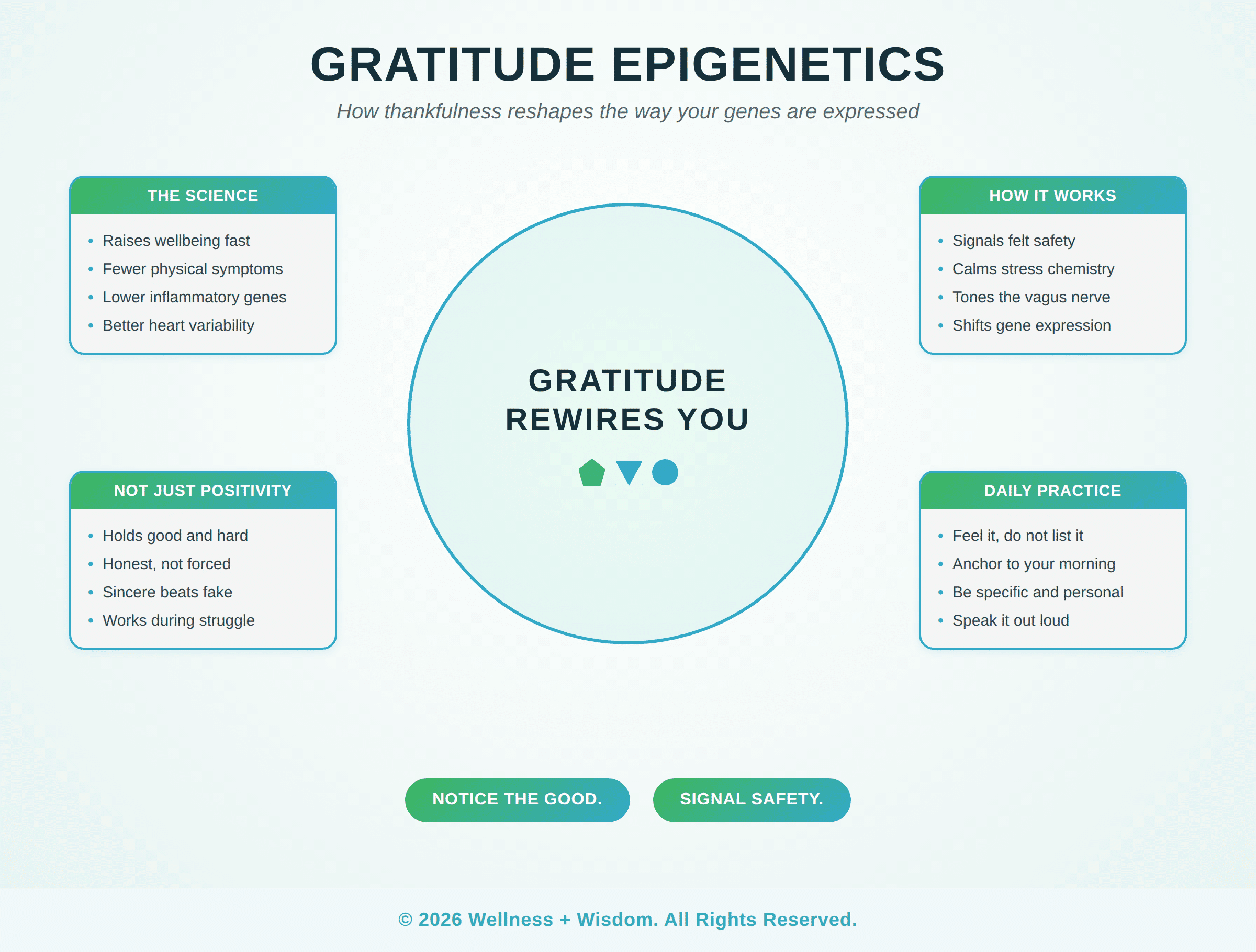
In a landmark set of experiments published in the Journal of Personality and Social Psychology, researchers Robert Emmons and Michael McCullough had people keep regular records of either things they were grateful for or daily hassles. The gratitude group showed greater wellbeing and reported fewer physical complaints than the others. A simple shift in attention produced real changes in how people felt and functioned.
2. Wellbeing shows up in your gene expression
In a striking study published in the Proceedings of the National Academy of Sciences, a team led by Barbara Fredrickson and Steven Cole analyzed gene expression in adults with different kinds of wellbeing. They found that a deep, meaning based sense of wellbeing was linked with lower expression of the body's stress driven inflammatory gene program. Your inner state was visible in your cells. This is the molecular doorway that gratitude walks through.
3. Gratitude touches the heart and the immune system
In research on patients with early stage heart conditions, summarized in work led by Paul Mills and colleagues and available through the National Library of Medicine, higher gratitude was associated with better heart rate variability and a healthier profile of inflammatory biomarkers. A gratitude journaling practice was studied as a way to support those same measures. Thankfulness was reaching the heart and the immune system, not just the mood.
Put these together and the conclusion is clear. The path from a grateful mind to a healthier body is real and measurable, and that path is what this science describes.
Gratitude Epigenetics and Emotional Epigenetics
Gratitude epigenetics is one of the clearest applications of Emotional Epigenetics™, the understanding that your emotional patterns, your beliefs, and your environment converge to shape your gene expression. Gratitude works on all three of those forces at once.
On the level of emotional patterns, a gratitude practice slowly retrains a mind that learned to scan for threat into one that also notices the good. On the level of beliefs, it gently challenges inherited stories of scarcity and replaces them with a felt sense of enough. On the level of environment, it changes the internal chemistry your cells live inside every day. That is a full spectrum signal, which is exactly why it reaches so deep.
This also means gratitude is not only personal. The emotional climate you cultivate becomes part of the environment your children grow up in. A home soaked in scarcity and complaint teaches one pattern. A home where genuine thanks is spoken out loud teaches another. In this way, a simple gratitude practice becomes one of the ways a family begins to break a generational pattern and pass something better forward.
It connects to the bigger picture too. Gratitude steadies the emotional dimension of the Wellness Pentagon and feeds your spiritual wellness at the same time. Few practices give back so much for so little effort.
Why Your Brain Defaults to the Negative
Your brain defaults to scanning for problems because that bias once kept your ancestors alive, and gratitude is the deliberate practice of correcting it. Understanding this removes any shame about why thankfulness can feel like work at first. You are not negative by character. You are negative by inheritance.
For most of human history, the people who survived were the ones who noticed the rustle in the grass, remembered the danger, and stayed alert for the next threat. Missing a real danger could be fatal, while missing a sunset cost nothing. So our brains evolved a strong negativity bias, weighting bad news far more heavily than good. The result is a mind that grips problems tightly and lets blessings slide right off.
That ancient wiring served our survival, but in a modern life that is mostly safe, it leaves us anxious, restless, and half blind to the good that is already here. We have a threat detection system running at full volume in a world that, for most of us most of the time, is not actually trying to kill us. The alarm never quite gets the memo that the danger has passed.
Gratitude is how you retrain that system on purpose. Every time you deliberately notice something good and let yourself feel it, you build a new pathway that competes with the old threat scanning default. You are not lying to yourself about reality. You are correcting a measurement error your biology was born with. Over time, the good becomes easier to see, not because life changed, but because your attention did. This is the same rewiring at the heart of bioenergetic memory and lasting change.
This also explains why a gratitude practice has to be deliberate and repeated rather than occasional. You are not adding a pleasant habit to a neutral mind. You are gently outvoting a very old survival program. A single grateful moment will not undo the bias, but a daily one, sustained over weeks and months, slowly shifts your baseline toward noticing the good first. That shift is the whole goal, and it is entirely within reach for anyone willing to keep showing up.
Gratitude in the Hardest Seasons
Gratitude is not only for good days, and in fact it does its deepest work in the hardest seasons, when it is least automatic and most powerful. This is the part that separates a shallow practice from one that genuinely changes you.
It would be cruel and false to tell someone in real pain to simply be grateful, and that is not what this is. The invitation is gentler and more honest. Even in grief, even in fear, even in loss, there are usually small mercies that can be acknowledged without denying the pain, a warm cup of coffee, a friend who answered the phone, a body that is still breathing. Naming those does not erase the hardship. It keeps you connected to life while you move through it.
There is real wisdom here. The seasons that break us open are often the ones that teach us the most, and learning to honor a struggle for what it forged in you is some of the most advanced and most healing work there is. This is not the same as being glad it happened. It is finding meaning inside it anyway, which is exactly what the science suggests helps protect the body during stress.
I have walked through my own dark seasons, and what I have found is that gratitude in those times is less about the big picture and more about the next small thing. You do not have to be thankful for the whole storm. You only have to find one true thing to appreciate today, and then again tomorrow. That thread of small thanks is often what carries a person through, the same steadiness we explore in the dark night of the soul.
If you are in a hard season right now, let this be permission rather than pressure. You do not owe anyone forced positivity, and you do not have to manufacture feelings you do not have. Start impossibly small. One breath. One thing. One quiet thank you for something real, however tiny it seems. The practice meets you exactly where you are, and on the days when you can find nothing else, gratitude for simply making it through the day counts completely.
Signs Gratitude Is Rewiring You
You know gratitude is rewiring you when your default reactions start to soften and you notice the good before you notice the lack. This shift is subtle at first and then unmistakable.
Early signs include catching yourself appreciating small things you used to rush past, recovering more quickly after setbacks, feeling less gripped by comparison, and sleeping a little easier because your mind has somewhere kinder to land at night. None of these are dramatic. All of them are the quiet evidence of a nervous and genetic pattern slowly changing.
Another sign is that hard days hurt a little less, not because the difficulty shrinks, but because your capacity to hold it grows. Gratitude does not erase pain. It widens the container around it. That widening is the same expansion we teach throughout emotional intelligence for adults, and it is a reliable marker that the practice is taking root.
If you notice these shifts, take them seriously as progress. They mean the signal is getting through. The genes do not announce themselves, but your softening reactions are the felt echo of a deeper change underway.
How to Practice Gratitude Epigenetics Daily
You practice gratitude epigenetics by making sincere thankfulness a small daily ritual that your body can feel, not just a list your mind recites. The feeling is the active ingredient. Here is how to make it land.
1. Feel it, do not just list it
The research suggests that depth matters more than length. Rather than rushing through ten items, choose two or three and actually let yourself feel the appreciation in your body for a few breaths. A felt thank you sends a stronger signal than a long, hollow list.
2. Anchor it to your morning
The first minutes of your day set the tone for your chemistry. A short gratitude practice before you reach for your phone helps you begin in safety rather than scarcity. Pair it with a few slow breaths from our guide to box breathing to deepen the effect.
3. Be specific and personal
Generic gratitude fades fast. Specific gratitude lands. Instead of being thankful for family in the abstract, picture one real moment, the sound of your child laughing, the warmth of a friend's text. Specificity is what makes the body believe it.
4. Include the hard things when you can
Some of the most powerful gratitude is finding the hidden gift inside a struggle. This is advanced practice and it cannot be forced, but over time, learning to thank even your difficulties for what they taught you is deeply rewiring. It connects to the work of identity transformation, where old wounds become the soil of a new self.
5. Speak it out loud to others
Gratitude grows when it is shared. Telling someone specifically why you appreciate them strengthens your bond and doubles the benefit, for them and for you. Spoken gratitude turns a private practice into a relationship and a culture, the same warmth we try to cultivate inside the Liberated Life Tribe.
Gratitude Epigenetics: Myths vs Reality
Gratitude epigenetics attracts both eye rolls and overhype, so it helps to separate the grounded truth from the noise. The reality is more modest and more powerful than either extreme.
One myth says gratitude means ignoring your problems. Reality: real gratitude holds the good and the hard at the same time and never requires you to deny your pain. Another myth says you have to feel grateful to practice it. Reality: the practice often comes first and the feeling follows, the way movement can precede motivation.
On the skeptical side, some dismiss all of this as feel good fluff. Reality: the link between positive states and lower inflammatory gene expression has been measured in peer reviewed journals, and gratitude has been studied in real clinical populations. This is not magic. It is biology responding to attention.
The most limiting myth of all is that your wiring is fixed and a little thankfulness cannot change anything. Reality: your gene expression is in constant dialogue with how you live, and few daily inputs are as cheap, safe, and available as gratitude. That is the quiet promise behind gratitude epigenetics. A small practice, repeated, genuinely changes you.
Bringing It All Together
Gratitude epigenetics turns one of the oldest pieces of wisdom into one of the most practical tools you have. Thankfulness was never just good manners. It is a daily biological instruction, a way of telling your cells that you are safe enough to notice what is good and to heal.
Start small and start sincere. Choose two things tomorrow morning and actually feel them for a few breaths before the day grabs you. Do it again the next day. Your mood will shift first, your reactions will soften next, and underneath it all, quietly, your biology will be listening and responding. This is healing through abundance, exactly the way it was meant to be. And the best part is that you already have everything you need for it. No equipment, no cost, no waiting room. Just your attention and one honest thank you.
If you want guidance and a community on this path, this is exactly what we built the Liberated Life Tribe for. Join the Liberated Life Tribe and receive your 10 day Self Liberation Blueprint at liberatedlife.com. You can also explore the gut and emotion connection, dive into the full L.I.F.E. Method, hear hundreds of related conversations across our latest episodes, find tools in the store, and learn our full mission and programs.
Frequently Asked Questions
What is gratitude epigenetics?
Gratitude epigenetics is the science of how a regular practice of thankfulness influences gene expression. It does not change your genetic code, but it acts as an environmental signal that can turn down stress related inflammatory genes and support genes tied to calm and repair.
Can gratitude really change your genes?
Gratitude does not edit your DNA sequence, but it can influence which genes are expressed. Research links positive, meaning based wellbeing with lower activity in the body's stress driven inflammatory gene program, which is the pathway gratitude epigenetics describes.
Is gratitude just positive thinking?
No. Real gratitude is the honest practice of noticing genuine good even while life is hard, not forced positivity or denial of pain. The body responds to sincere appreciation, not performance, which is why authentic gratitude carries biological power that fake positivity does not.
How long until gratitude has an effect?
Mood benefits can appear within a couple of weeks of consistent practice, as shown in gratitude journaling research. Deeper changes build gradually with repetition, because gene expression responds to a steady pattern of signals rather than a single effort.
What is the best way to practice gratitude?
Choose two or three specific things and actually feel the appreciation in your body for a few breaths, rather than rushing through a long list. Anchor it to your morning, be specific and personal, and speak it out loud to others when you can.
Does gratitude help with stress and health?
Yes. Gratitude is associated with greater wellbeing, fewer physical complaints, better heart rate variability, and a healthier inflammatory profile in studies. By signaling safety to the body, it helps calm the chronic stress response that drives much of modern disease.
Studies and External Resources
The science behind gratitude epigenetics rests on peer reviewed research. These are the studies and resources referenced throughout this article.
- Emmons RA, et al. Counting blessings versus burdens: an experimental investigation of gratitude and subjective wellbeing in daily life. Journal of Personality and Social Psychology, 2003. PubMed: 12585811
- Fredrickson BL, et al. A functional genomic perspective on human wellbeing. Proceedings of the National Academy of Sciences, 2013. PubMed: 23898182
- Redwine LS, et al. A pilot randomized study of a gratitude journaling intervention on heart rate variability and inflammatory biomarkers in Stage B heart failure patients. Psychosomatic Medicine, 2016. National Library of Medicine: PMC4927423
About Josh Trent
Josh Trent is an Identity Transformation Architect and the award winning host of the Wellness + Wisdom Podcast, with over 15 million downloads since 2015. He is the creator of the L.I.F.E. Method™ Identity Transformation System and steward of the Emotional Epigenetics™ and BREATHE: Breath + Wellness™ systems of self mastery, impacting over 1,000 students worldwide. Josh lives in Austin, Texas with his wife Carrie, daughter Nayah, and son Novah. Learn more about my story and explore our programs.
Peace and power,
Josh Trent
Disclosure: We may earn a commission from certain links on this site when you make a purchase, at no extra cost to you. These commissions help support Wellness + Wisdom and do not affect the products or resources we choose to recommend. Full disclosure .