
By Josh Trent, Identity Transformation Architect and host of the Wellness + Wisdom Podcast
That feeling in your gut is not a metaphor. It is a second brain, and it has been trying to talk to you your whole life.
Gut health emotions are far more entangled than most of us were ever taught. You already know this in your body. You have felt butterflies before a big moment, a pit in your stomach during dread, and a heaviness in your belly during grief. That is not poetry. That is biology. Your gut and your feelings are wired together through a real, physical highway, and what happens in one constantly shapes the other.
For most of medical history we treated digestion and emotion as two separate departments. The science of the last fifteen years has demolished that wall. Understanding this axis as one connected system is one of the most practical and hopeful shifts you can make for your wellbeing. So let us walk through how this axis works, what the research shows, and how you can support both your gut and your emotional life from a place of abundance rather than restriction.
Table of Contents
- The Gut Health Emotions Connection
- Meet Your Second Brain
- How Gut Health Emotions Travel the Vagus Highway
- What the Science Shows
- Gut Health Emotions Through Emotional Epigenetics
- Stress Hits Your Gut First
- Your Gut Is Where You Feel Safety
- Signs Your Gut and Emotions Are Out of Sync
- How to Support Gut Health Emotions Naturally
- Gut Health Emotions: Myths vs Reality
- Frequently Asked Questions
- Studies and External Resources
- About Josh Trent
The Gut Health Emotions Connection
The gut health emotions connection is this: your digestive tract and your brain are in constant two way communication, so the state of your gut shapes your mood and the state of your mood shapes your gut. It is a loop, not a one way street.
Inside your gut lives a vast community of trillions of microbes, collectively called the microbiome. These tiny residents are not passive passengers. They help produce and regulate many of the same chemical messengers your brain uses for mood, including a large share of your body's serotonin. When that inner community is thriving, it sends signals of calm and balance upward. When it is struggling, it can send signals of unease.
This is why a person can do everything right on the surface, eat reasonably and exercise, and still feel anxious or flat for reasons no one can explain. Often the missing piece is the gut. Honoring this connection opens a door that talk and willpower alone could never open.
I have taught for years that you are not broken by your biology, only burdened by patterns that can shift. The gut is one of the most overlooked places those patterns live, and one of the most responsive places to begin healing them. This is the same mind body unity at the heart of the Wellness Pentagon, where the physical and emotional dimensions are never truly separate.
Meet Your Second Brain
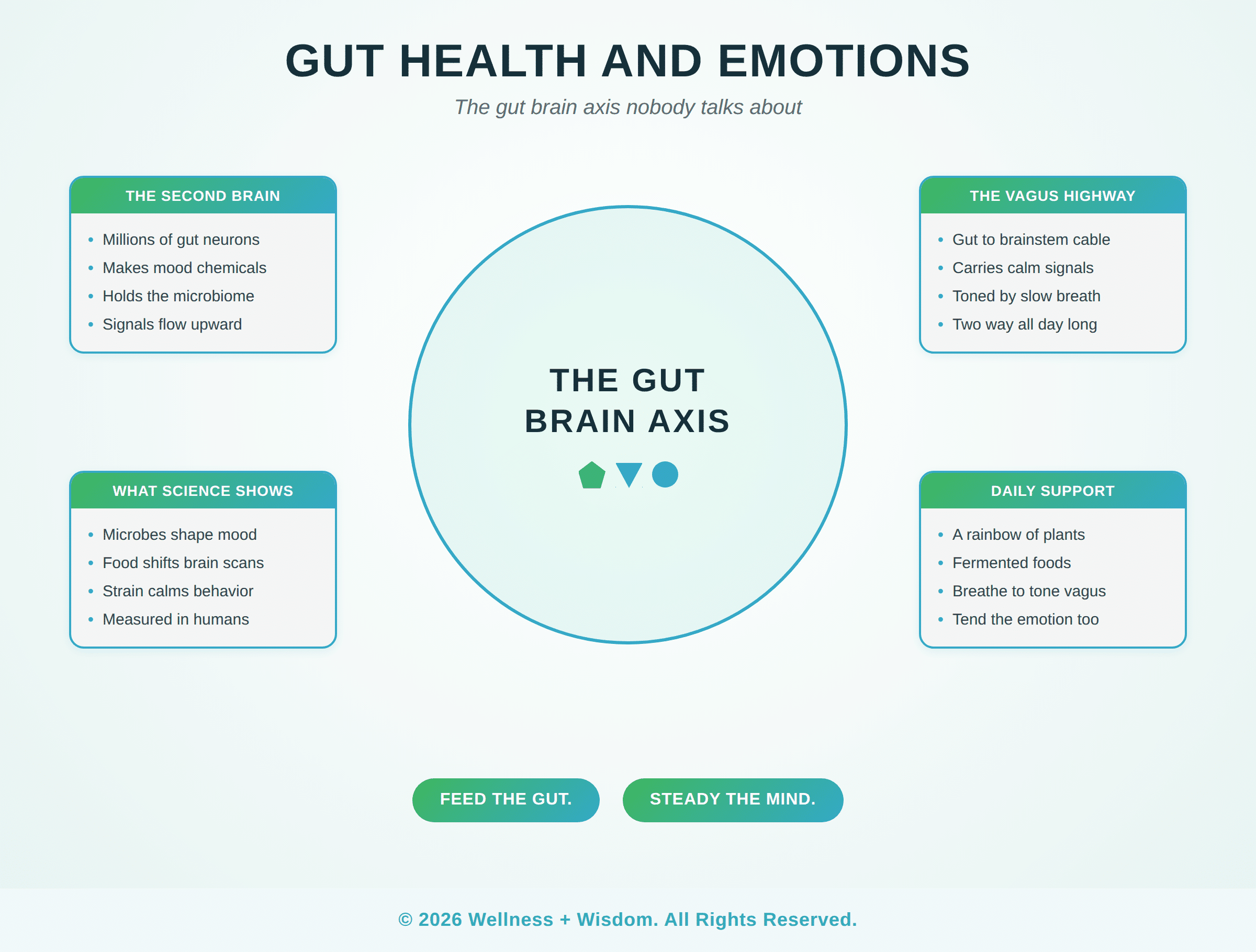
Your gut contains its own dedicated network of neurons, often called the second brain, that can operate and react independently of the brain in your head. This enteric neural system contains hundreds of millions of nerve cells lining your digestive tract, which is why your gut can have what feels like a mind of its own.
This second brain does far more than move food along. It senses, it reacts, and it sends a steady stream of information up to the brain in your skull. In fact, the majority of the signals traveling between the gut and the brain flow upward, from gut to head, not the other way around. Your belly is reporting to your mind far more than your mind is dictating to your belly.
That single fact reframes everything. The old assumption was that thinking controls feeling and the body simply obeys. The reality is that your gut is one of the loudest voices shaping how you feel before a single conscious thought arrives. When you learn to listen to it, you gain access to information your thinking mind cannot reach on its own.
This is also why the body keeps a kind of record that the mind cannot always retrieve, a theme we explore in depth in bioenergetic memory. Your gut is part of how your body remembers, holds, and signals your emotional state.
How Gut Health Emotions Travel the Vagus Highway
Gut health emotions travel mainly along the vagus nerve, the long wandering nerve that connects your gut directly to your brainstem and serves as the primary cable of the gut brain axis. Think of it as the fiber optic line carrying messages in both directions all day long.
When your vagus nerve is toned and active, it sends calming signals that downshift your whole system into rest and repair. When it is underactive, often because of chronic stress, that calming signal weakens and both digestion and mood can suffer. This is why practices that tone the vagus nerve tend to improve gut comfort and emotional steadiness at the same time. You are strengthening the cable that carries both.
The good news is that the vagus nerve responds beautifully to simple daily practices. Slow breathing, humming, gentle movement, and time in calm settings all increase vagal tone. These are the exact tools in our guide to neural system regulation and the vagus nerve reset I rely on myself when my body needs to come back to center.
This is the elegant secret of the whole system. You do not have to choose between healing your gut and healing your emotions. Because they share the same highway, the practices that help one almost always help the other. That is leverage, and it is available to you every day through your breath.
What the Science Shows
The science connecting the gut and emotions is real, growing fast, and increasingly hard to ignore. Three lines of research show just how deep the link goes, from the microbes themselves to measurable changes in the human brain.
1. The microbes influence mood and behavior
In a landmark review in Nature Reviews Neuroscience, researchers John Cryan and Timothy Dinan gathered the emerging evidence that the gut microbiota communicate with the brain and may play a role in anxiety, mood, and cognition. They described a true microbiota gut brain axis, a communication network linking the bugs in your belly to the feelings in your mind.
2. Changing the gut changes the brain in humans
A study from a UCLA team led by Kirsten Tillisch, published in Gastroenterology, took healthy women and had one group consume a fermented product with beneficial bacteria for four weeks. Brain scans showed measurable changes in the regions that process emotion and attention compared with the groups that did not. Altering the gut visibly altered the brain. This was real evidence in humans, not just rodents.
3. A single strain can shift emotional behavior through the vagus
In research published in the Proceedings of the National Academy of Sciences, a team led by Javier Bravo found that feeding a specific beneficial bacterium changed emotional behavior and calming brain chemistry, and that the effect traveled through the vagus nerve. When they cut the vagus connection, the benefit disappeared. The highway was essential to the message.
Put these together and the picture is clear. The link is measurable, mechanistic, and modifiable. What you tend in your gut reaches all the way up to how you feel.
Gut Health Emotions Through Emotional Epigenetics
Through the lens of Emotional Epigenetics™, the gut is one of the main places where your environment, your emotions, and your gene expression meet. The microbes in your belly are exquisitely sensitive to your inner state, and they help translate that state into chemical signals your cells respond to.
Chronic stress changes the makeup of your microbiome, which in turn changes the signals your gut sends to your brain and your genes. A calm, well tended inner ecosystem becomes a signal of safety. A stressed, depleted one becomes a signal of threat. This is the same convergence of emotional patterns, beliefs, and environment that shapes how your genes are expressed, a process we explore in how emotions change your gene expression.
What makes this so hopeful is how responsive the gut is. Unlike the genes you were born with, your microbiome can shift in a matter of days when you change what you feed it and how you live. That makes the gut one of the fastest and most forgiving places to begin rewriting an inherited pattern of stress.
And like everything in this work, it reaches beyond you. The patterns of stress and calm you carry can influence the environment your children grow up in, including the microbial and emotional climate of your home. Tending your own gut and emotions is one quiet way a family begins to break a generational pattern.
Stress Hits Your Gut First
When you feel stressed, your gut is often the very first place it lands, long before your conscious mind catches up. This is by ancient design. In a moment of perceived threat, the body pulls resources away from digestion to prepare for action, which is why anxiety so often arrives as a churning, clenching, or sinking feeling in the belly. Your gut reacts before you have even named what is wrong.
A short burst of this is harmless and even useful. The problem is chronic stress, where the alarm never fully switches off. Over time, ongoing stress can disturb the balance of your microbiome, irritate the gut lining, and weaken the calming signals your gut normally sends upward. The result is a painful loop where stress harms the gut and the unhappy gut feeds more unease back to the brain.
This is the same loop we mapped in psychoneuroimmunology, and it is why you cannot out supplement a stressed life. No amount of probiotics will fully heal a gut that is marinating in constant alarm. The deepest gut support is often emotional and nervous, not only nutritional, which surprises a lot of people who expected the answer to live entirely on their plate.
The hopeful flip side is that calming the system breaks the loop in both directions. Every time you signal safety to your body through breath, rest, or genuine connection, you are also tending your gut. Your belly relaxes when you do. That is the same loop, finally working for you instead of against you, and you can start tilting it toward calm today.
Your Gut Is Where You Feel Safety
Your gut is one of the primary places your body decides whether you are safe, and that felt sense of safety is the foundation of both good digestion and emotional steadiness. Long before you can talk yourself into calm, your body has already taken a vote, and the gut casts a loud ballot in that election.
This is why forcing yourself to relax rarely works. Safety is not a thought you think. It is a state your body enters, and the gut is deeply involved in reaching it. When your belly is tense and your breath is shallow, your whole system stays braced, no matter what your mind insists. When your belly softens, permission to rest quietly spreads through the rest of you.
Cultivating this felt safety is some of the most important work there is, and it is far gentler than it sounds. Slow meals eaten without screens, unhurried breath, warmth, and real connection all tell the gut it is safe to digest and safe to settle. The same somatic skill we build through neural system regulation is what finally lets the gut exhale.
When you make your body a safe place to be, your gut and your emotions both begin to trust again. That trust is the quiet ground that all the food and supplements in the world are meant to stand on. Build the safety first, and everything else you do for your gut lands deeper and lasts longer.
Signs Your Gut and Emotions Are Out of Sync
Your gut and emotions are out of sync when digestive discomfort and mood struggles keep showing up together, because they are usually two ends of the same disturbed axis. Learning to read these signs gives you a powerful early warning system.
Common signs include ongoing digestive trouble that flares during stressful seasons, anxiety or low mood that seems to track with how your stomach feels, intense cravings that arrive with difficult emotions, and a foggy, heavy feeling that lifts when your digestion settles. None of these mean something is wrong with you. They mean the axis is asking for attention.
The cravings piece deserves a gentle word. When hard emotions show up, the body often reaches for quick comfort, and that is a human and understandable response, not a moral failing. The work is never to shame the craving. It is to get curious about the feeling underneath it and to tend the gut and the emotion together. This is the same compassionate approach we bring to the 90 second emotion rule.
If you notice these patterns, take it as good news in disguise. It means you have found a lever. Supporting one end of the axis tends to lift the other, and the path forward is gentler than most people fear.
How to Support Gut Health Emotions Naturally
You support this whole axis naturally by feeding your inner ecosystem well, calming your neural system, and tending your feelings, all at once. This is an invitation to abundance, not a list of restrictions. Here is where to begin.
1. Welcome a rainbow of plants
The friendly microbes in your gut thrive on variety and fiber from whole plant foods. Rather than counting or cutting anything, simply invite more colors and more kinds of vegetables, fruits, legumes, nuts, and seeds onto your plate. Diversity on the plate becomes diversity in the gut, and a diverse gut tends to be a resilient, mood supporting gut.
2. Enjoy fermented foods
Traditional fermented foods such as yogurt, kefir, sauerkraut, kimchi, and miso deliver living beneficial bacteria straight to your inner community. The human research on fermented products and brain activity makes these a simple, time honored ally for both digestion and mood. Add them as a delicious habit, not a chore.
3. Breathe to tone the vagus
Because the vagus nerve is the main cable of this axis, daily breathing is one of the most direct ways to support both ends at once. A few minutes of slow breathing settles digestion and steadies mood together. Start with the simple structure in our guide to box breathing for beginners.
4. Protect your sleep and your calm
Your microbiome follows your daily rhythms, so consistent rest and lower chronic stress are powerful gut allies. Stress is one of the fastest ways to disturb the inner ecosystem, which is exactly the connection we mapped in psychoneuroimmunology. Calm is not a luxury for your gut. It is a nutrient.
5. Tend the emotion, not just the food
Because this is a two way street, emotional care is gut care. Naming your feelings, processing stress, and deepening your spiritual wellness all send calming signals down into your belly. You are never only working on one end of the axis. You are always tending the whole loop.
One last reminder before you begin. None of this has to be perfect, and none of it has to happen all at once. The gut rewards gentle consistency far more than heroic overhauls that burn out within a week. Pick one practice that feels genuinely good, the extra handful of vegetables, the few minutes of breath, or the slower meal eaten in peace, and let it become a quiet habit. Then add another when you are ready. Your inner ecosystem is patient and forgiving, and it responds to kindness repeated over time. Small and steady is not the slow path here. It is the fast one. Trust the direction, not the speed.
Gut Health Emotions: Myths vs Reality
The conversation around this topic collects a lot of hype, so it helps to separate the grounded truth from the exaggeration. The reality is more nuanced and more empowering than either the hype or the dismissal.
One myth says a single supplement will fix your mood overnight. Reality: the gut responds best to a whole way of living, not one magic pill, and the changes build gradually as your inner ecosystem shifts. Another myth says it is all in your head. Reality: the link is measurable in brain scans, microbiome samples, and controlled studies, and it is very much in your gut as well as your head.
On the dismissive side, some insist that mood is purely psychological and the gut is irrelevant. Reality: the majority of communication on this axis flows from gut to brain, so ignoring the gut means ignoring a major source of how you feel. Both directions are real, and both deserve care.
The most limiting myth of all is that you are simply stuck with the way you feel. Reality: the gut is one of the most responsive systems in your body, capable of meaningful change within days. That responsiveness is the quiet promise behind every conversation about the gut and mood. You have more influence than you were told.
Bringing It All Together
Gut health emotions are two voices in a single ongoing conversation, and you get to help shape the tone of it. That feeling in your belly was never random. It is your second brain reporting in, and when you tend it with good food, deep breath, and emotional honesty, it begins to report a steadier, calmer story.
Start small and start kind. Add one more color to your plate. Breathe for five minutes. Notice the feeling underneath the craving instead of fighting it. Your gut is listening, your emotions are listening, and the same gentle practices nourish them both. This is healing through abundance, exactly the way it was meant to be.
If you want guidance and a community on this path, this is exactly what we built the Liberated Life Tribe for. Join the Liberated Life Tribe and receive your 10 day Self Liberation Blueprint at liberatedlife.com. You can also explore how meditation reshapes your biology, dive into the full L.I.F.E. Method, hear hundreds of related conversations across our latest episodes, find supportive tools in the store, and learn our full mission and programs.
Frequently Asked Questions
How are gut health and emotions connected?
Gut health emotions are connected through the gut brain axis, a two way communication network linking your digestive tract and your brain, largely through the vagus nerve and the microbiome. The state of your gut shapes your mood, and your mood shapes your gut, in a continuous loop.
Can improving my gut really improve my mood?
Research suggests yes. A controlled human study found that consuming a fermented product with beneficial bacteria for four weeks changed activity in brain regions that process emotion. Supporting the gut tends to support the emotional end of the axis as well.
What is the gut brain axis?
The gut brain axis is the communication system connecting your digestive tract and your brain through neural, hormonal, and immune pathways. The vagus nerve is its main cable, and most of the signals travel upward from gut to brain, which is why your gut strongly influences how you feel.
What foods support gut health emotions?
A colorful variety of whole plant foods that provide fiber, along with traditional fermented foods like yogurt, kefir, sauerkraut, and kimchi, support a diverse and resilient microbiome. The approach is abundance and variety rather than restriction.
Why do I crave comfort food when I am stressed?
Stress travels along the gut brain axis and can drive cravings as the body reaches for quick comfort. This is a human response, not a failing. The gentle path is to tend the feeling underneath the craving while also supporting the gut, rather than relying on shame.
How fast can gut health changes affect emotions?
The gut is highly responsive. The microbiome can begin shifting within days of changes in food, rest, and stress, and human studies have shown brain changes after a few weeks of consistent support. This makes the gut one of the fastest places to begin.
Studies and External Resources
The science woven through this article comes from peer reviewed research in tier one journals. Here are the studies referenced, with direct links so you can read the source for yourself.
- Cryan and Dinan (2012). Nature Reviews Neuroscience: how the community of microbes in the gut shapes brain activity and behavior.
- Tillisch and colleagues (2013). Gastroenterology: a fermented milk product with probiotics measurably changed activity in brain regions tied to emotion.
- Bravo and colleagues (2011). Proceedings of the National Academy of Sciences: a single probiotic strain shifted emotional behavior through the vagus nerve.
- Valles Colomer and colleagues (2019). Nature Microbiology: specific gut bacteria carry neuroactive potential linked to quality of life and depression.
- Foster and McVey Neufeld (2013). Trends in Neurosciences: how the gut and brain talk to each other and influence anxiety and mood.
About Josh Trent
Josh Trent is an Identity Transformation Architect and the award winning host of the Wellness + Wisdom Podcast, with over 15 million downloads since 2015. He is the creator of the L.I.F.E. Method™ Identity Transformation System and steward of the Emotional Epigenetics™ and BREATHE: Breath + Wellness™ systems of self mastery, impacting over 1,000 students worldwide. Josh lives in Austin, Texas with his wife Carrie, daughter Nayah, and son Novah. Learn more about my story and explore our programs.
Peace and power,
Josh Trent
Disclosure: We may earn a commission from certain links on this site when you make a purchase, at no extra cost to you. These commissions help support Wellness + Wisdom and do not affect the products or resources we choose to recommend. Full disclosure .