
By Josh Trent, Identity Transformation Architect and host of the Wellness + Wisdom Podcast
Trauma bonding is what happens when your body confuses a stress response for a love story. The good news is that the same body can learn a new story, and calm can become the most magnetic thing you have ever felt.
Trauma bonding is the emotional attachment that forms when affection and harm come from the same person on an unpredictable schedule. I lived it before I had a name for it. The highs felt euphoric. The lows felt like withdrawal. And the swing between them felt, wrongly, like the deepest connection I had ever known. It was not love. It was my neural system hooked on the cycle. If you have ever sat across from someone steady and felt almost nothing, then ached for the one who kept you guessing, you already understand trauma bonding in your body, even if your mind has not caught up yet.
Here is the part nobody told me, and the reason I am writing this instead of another fear soaked warning. You are not weak for getting caught in a trauma bond. You are human, running ancient wiring that confused intensity for safety. Once you see the loop clearly, you get your choice back. That is the whole invitation of this article. Not shame. Freedom. Let us walk through what trauma bonding really is, the science underneath it, why calm starts to feel boring, and the joy forward path out that I came back to again and again.
What this article covers
- What trauma bonding actually is
- Why trauma bonding feels like the deepest love
- The science of trauma bonding
- Why trauma bonding makes calm feel boring
- How your early home wired the pattern
- The stages people describe in a trauma bond
- Trauma bonding versus real love
- How to break a trauma bond the joy forward way
- A word on safety and support
- Frequently asked questions
What trauma bonding actually is
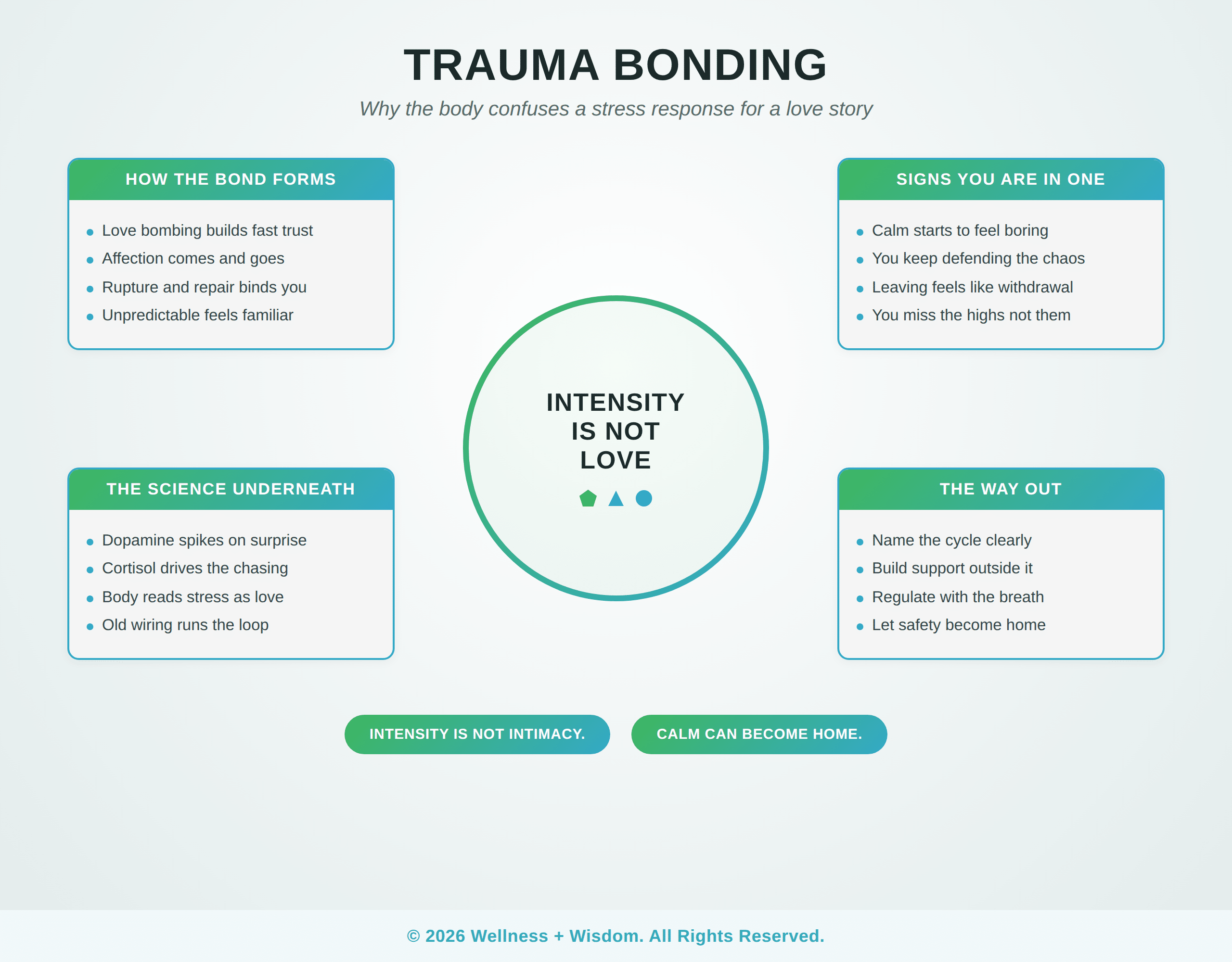
Trauma bonding is a powerful emotional attachment that forms inside a repeating cycle of harm followed by relief, where the same person who hurts you is also the one who soothes you. That is the clean definition, and it matters, because the phrase gets used loosely. Bonding with a friend over a shared hard season is not trauma bonding. Real trauma bonding is darker and more specific. It is the glue that keeps you tethered to a relationship that your gut already knows is costing you.
The bond does not form despite the chaos. It forms because of the chaos. When kindness and cruelty alternate without warning, your body starts to organize its entire world around the next moment of relief. The fight, the silence, the grand reconciliation, the promises. Each loop deepens the attachment, not because the relationship is good, but because the chemistry of unpredictability is overwhelming. Trauma bonding can happen in romance, in families, in friendships, even at work. Anywhere there is a power imbalance and an on again off again pattern of reward, the bond can take root.
This is the same theme I explore through Emotional Epigenetics™. The patterns we live are rarely random. They are coded, inherited, and reinforced. Trauma bonding is one of the most painful expressions of that coding, and one of the most liberating to finally rewrite.
Why trauma bonding feels like the deepest love
Trauma bonding feels like love because your brain releases its biggest chemical rewards in response to unpredictability, not consistency. This is not a character flaw. It is biology doing exactly what it evolved to do. When affection is reliable, your body relaxes and the fireworks fade. When affection is uncertain, your body lights up and pays attention, because survival once depended on tracking the source of safety that kept moving.
That is why a steady partner can feel flat while a chaotic one feels like destiny. The chaos is not proof of depth. It is proof of activation. Trauma bonding hijacks the part of you that was built to chase, and it dresses that chasing up as romance. I spent years mistaking my racing heart for a soulmate signal. My heart was not reading love. It was reading threat, and the relief that followed the threat felt like coming home.
Understanding this changed everything for me, because it moved the conversation out of my worth and into my wiring. I was not too needy or too much. My neural system had simply learned that love and danger arrive together, and it had gotten very good at staying hooked. You can read more about how the body stores these patterns in my piece on bioenergetic memory.
The science of trauma bonding
The science of trauma bonding rests on two pillars: intermittent reinforcement and the dopamine response to unpredictable reward. Put those together and you get the most addictive emotional pattern a human can experience. Let me make the research land in plain language, because once you feel it in your bones, the spell starts to break.
Traumatic bonding theory
The term traces back to research on traumatic bonding theory, the idea that strong emotional attachments are forged precisely by intermittent abuse rather than in spite of it. In a study of seventy five women who had recently left abusive relationships, researchers found that the extremity of intermittent mistreatment and the power imbalance in the relationship predicted how strongly a woman stayed attached to a former partner, even six months after leaving (Dutton and Painter, 1993). Read that again. The worse the unpredictability, the stronger the pull. That is trauma bonding in a sentence, and it is why willpower alone almost never works.
The unpredictable reward loop
Now add the neuroscience of reward. Dopamine, the chemical we usually blame for pleasure, is really the chemical of anticipation and surprise. Landmark research showed that dopamine neurons fire hardest when a reward is unexpected, and go quiet when the same reward becomes predictable (Schultz, Dayan and Montague, 1997). Apply that to a relationship. When love arrives on a random schedule, every crumb of affection triggers a flood of dopamine, because your body never saw it coming. When love is steady and certain, the dopamine flattens out. Your body misreads that calm as boredom, when it is actually safety. This is the engine of trauma bonding, and it is running underneath your conscious choices.
None of this means you are broken or doomed. It means the pattern has a mechanism, and a mechanism can be interrupted. The same neural system that learned to chase can learn to settle. I go deeper on the stress side of this loop in Psychoneuroimmunology: How Stress Makes You Sick, because the cost of staying activated is not only emotional. It is physical.
Why trauma bonding makes calm feel boring
Trauma bonding makes calm feel boring because a regulated relationship gives your body none of the spikes it learned to crave. Here is the cruel twist nobody warns you about. When you finally meet someone steady, your body can read the calm as flat. No fights, no withdrawal, no rush of relief. You might even sabotage something genuinely good while you go hunting for the intensity you mistook for love. That is the loop talking, not your heart.
A regulated relationship feels quiet because nothing in it is threatening you. That is the entire point, even when it feels strange at first. The flatness you feel is not a lack of love. It is the absence of fear, and your body has simply never tasted love without fear riding shotgun. This is exactly the kind of self protective reflex I describe in self sabotage and its epigenetic roots, where the very thing that could heal you feels the most threatening.
If you want a faster way to ride the wave when calm feels unbearable, the 90 second emotion rule is one of the most useful tools I know. The discomfort of choosing calm is real, but it is temporary, and on the other side of it is a kind of peace that the chaos could never give you.
How your early home wired the pattern
Your early home taught your body what love is supposed to feel like, long before you could choose. If the house you grew up in ran on unpredictability, where warmth and tension traded places without warning, then trauma bonding will feel familiar in a way that steadiness never does. Familiar is not the same as healthy. It is just known. And the known, even when it hurts, feels safer to the body than the unknown.
This is where the science gets humbling. Stress patterns can be passed down across generations, not only through what we are taught, but through the way our biology is shaped. Research on the children of Holocaust survivors found measurable epigenetic changes on a stress regulating gene called FKBP5 in both the survivors and their adult offspring, the first demonstration that severe parental trauma can leave a biological fingerprint on the next generation (Yehuda et al., 2016). You may be carrying a sensitivity to chaos that did not start with you.
That is not a sentence. It is an explanation, and it lifts an enormous weight. As I always say, it is not your fault, but it is your responsibility. The pattern you inherited can be rewritten, and your healing reaches forward just as far as the wound reached. I unpack this fully in understanding generational trauma and in my work on inherited limiting beliefs. When you break a trauma bond, you are not only freeing yourself. You are changing the code for everyone who comes after you.
The stages people describe in a trauma bond
Most people describe a trauma bond moving through recognizable stages, beginning with intense affection and ending with emotional dependency on the cycle itself. The pattern is not identical for everyone, but the shape repeats often enough to name. Seeing the stages laid out is one of the first cracks in the spell, because you stop blaming yourself and start recognizing a structure.
The cycle usually opens with a flood of attention and affection so intense it sweeps you off your feet. Trust and dependency follow, often as your world quietly narrows around this one person. Then comes the first criticism or rupture, followed by confusion as the person who adored you suddenly turns cold. Reconciliation arrives like rain after drought, and the relief is so sweet it papers over the harm. Over time, you may find yourself making excuses, doubting your own memory, and shrinking your needs to keep the peace. The final stage is the hardest to spot from inside it, where the bond itself becomes the thing you are addicted to, not the person.
If you read that and felt your stomach drop, breathe. Recognition is not a verdict. It is the doorway. Naming the stage you are in gives you something to stand on, and standing is the first move toward walking out. Building the emotional skill to track your own patterns is its own practice, one I cover in building emotional intelligence as an adult.
Trauma bonding versus real love
The simplest way to tell trauma bonding from real love is this: trauma bonding lives on a roller coaster, and real love lives on solid ground. One is defined by intensity, the other by safety. Both can feel powerful, but only one leaves you more yourself over time. Here is the contrast I wish someone had drawn for me years ago.
Trauma bonding runs on uncertainty. You feel anxious between contact, you scan for moods, you brace for the next swing, and the highs are addictive because the lows are so steep. Your sense of self shrinks. Your world narrows. You confuse relief for joy. Real love runs on consistency. You feel calmer after time together, not more activated. You can predict the person without dread. You stay connected to your friends, your purpose, and your own voice. Your world expands. The excitement is steadier and quieter, and it grows rather than burning out.
Notice the word I keep coming back to. Calmer. After time with someone who truly loves you, your body settles. After time inside a trauma bond, your body winds tighter. That single felt difference is more honest than any story your mind can write. This is the kind of discernment that the Wellness Pentagon™ trains, because emotional and relational health are two of the five sides of a whole life, and you can read more about that framework in our mission.
How to break a trauma bond the joy forward way
You break a trauma bond by giving your body enough repeated safety that calm slowly stops feeling foreign and starts feeling like home. This is not about willpower or going cold overnight. It is neural system work, the same somatic and breath practices I come back to again and again. Your body learned to brace for the next swing, and it needs new evidence that closeness can be steady. That evidence is built in small moments, not grand gestures. I map this through the four pillars of the L.I.F.E. Method™: Liberation, Integration, Frequency, and Embodiment.
Liberation: name the loop and reclaim your choice
Liberation begins the moment you name the trauma bond out loud. Naming it was the first crack in the spell for me. I tracked the cycle on paper so I could see the pattern instead of living blind inside it. Writing down what happens each day turns a fog into a map. You stop arguing with your memory and start trusting the evidence. Liberation is not a dramatic exit. It is the quiet decision to stop pretending the loop is love.
Integration: build support outside the bond
Integration means you stop getting all of your regulation from the one person who is dysregulating you. I built support outside the relationship so that I was not depending on the source of the chaos to also be the source of my calm. Call a friend. Tell the truth to someone safe. Rejoin the parts of your life that quietly shrank. Trauma bonding thrives in isolation and loses its grip in connection. The opposite of the loop is community, which is exactly why I built the Liberated Life Tribe.
Frequency: regulate the body with the breath
Frequency is about changing the energetic and physiological state your body lives in, and the fastest doorway is your breath. Breath is the only system that is both automatic and consciously controlled, which makes it the bridge between your thinking mind and your feeling body. When the pull to chase the high tightens its grip, a few minutes of slow, extended exhales tells your neural system that you are safe right now. This is the heart of the BREATHE™ work, and you can find the breath and somatic tools I use in the Wellness and Wisdom store.
Embodiment: let safety become the new home
Embodiment is where the change becomes permanent, because it moves from something you understand to something you live. You give your body real, repeated safety until calm stops feeling like absence and starts feeling like belonging. This is slow on purpose. Every time you choose the steady thing and survive the discomfort, you lay down new wiring. Forgiveness, including forgiving yourself for staying as long as you did, is part of the release, which I write about in the neuroscience of forgiveness. Over time, the pull fades. That fading is not a sign you cared less. It is a sign your neural system is finally learning that safety and love are allowed to live in the same place.
One honest question can guide the whole journey. Ask yourself this. Do I feel calmer after time with this person, or more activated? Not more excited. Calmer. Your body already knows the answer, even when your mind is busy writing a romance. If you want to keep practicing the felt sense of steadiness, my work on how to balance your emotions and the identity work in the L.I.F.E. Method™ and identity transformation are the next steps I would point you toward.
A word on safety and support
If your relationship involves any form of physical danger, your safety comes before every other step in this article. Trauma bonding often coexists with abuse, and leaving can be the most dangerous moment, so please do not do it alone. Reach out to people you trust, and consider professional support from a trauma informed therapist who can walk with you. In the United States, the National Domestic Violence Hotline offers free, confidential support any hour of the day, and they can help you think through a safety plan.
You are not weak for getting caught in a trauma bond. You are human. The pull was real, the chemistry was real, and walking out is one of the bravest things a person can do. You can listen to more of these conversations across our latest episodes, where guests and I keep returning to the same truth. Healing is possible, and it is closer than the loop wants you to believe.
Frequently asked questions
What is trauma bonding?
Trauma bonding is a strong emotional attachment that forms when affection and harm come from the same person on an unpredictable schedule. The cycle of rupture and reconciliation, driven by intermittent reward, creates a bond that can feel like love but is rooted in a stress response. It can happen in romantic relationships, families, friendships, and even workplaces.
What are the signs of trauma bonding?
Common signs of trauma bonding include defending or making excuses for someone who hurts you, feeling unable to leave even when you know you should, missing the highs of the relationship more than the person, and feeling anxious or activated rather than calm. A telling sign is that steady, kind people start to feel boring while chaotic ones feel magnetic.
Is trauma bonding the same as love?
No. Trauma bonding is defined by intensity and uncertainty, while real love is defined by safety and consistency. The simplest test is how your body feels. Real love leaves you calmer and more yourself over time, while a trauma bond leaves you more activated and smaller. Intensity is not intimacy, and a racing heart is not proof of connection.
How do you break a trauma bond?
You break a trauma bond by naming the cycle clearly, building support outside the relationship, regulating your body with breath and somatic practices, and giving yourself enough repeated safety that calm begins to feel like home. It is rarely one clean decision and more often a series of small choices to stay regulated when the pull to chase the high is strongest. Professional and community support make it far more doable.
Why does calm feel boring after a trauma bond?
Calm feels boring after a trauma bond because your body learned to associate love with the spikes of unpredictability. A regulated relationship gives none of those spikes, so the body can misread safety as flatness. This is the loop talking, not a lack of love. With time and repeated experiences of steady connection, calm stops feeling boring and starts feeling like peace.
How long does it take to break a trauma bond?
There is no fixed timeline, because breaking a trauma bond depends on the depth of the pattern, your history, and the support around you. Many people feel the pull lessen over weeks and months as their body collects new evidence that safety is real. The fading of the pull is not a sign you cared less. It is a sign your neural system is healing.
Join the Liberated Life Tribe
The opposite of a trauma bond is a community that wants you free. Join the Liberated Life Tribe and receive your 10 day Self Liberation Blueprint at liberatedlife.com. It is the starting point for choosing calm on purpose, surrounded by people walking the same path home. You are not weak for getting caught in the loop. You are human, and you can walk out. Peace and power.
About Josh Trent
Josh Trent is an Identity Transformation Architect and the award winning host of the Wellness + Wisdom Podcast, with over 15 million downloads since 2015. He is the creator of the L.I.F.E. Method™ Identity Transformation System and steward of the Emotional Epigenetics™ and BREATHE: Breath + Wellness™ systems of self mastery, impacting over 1,000 students worldwide. Josh lives in Austin, Texas with his wife Carrie, daughter Nayah, and son Novah. Read more of my story, explore conscious parenting, or discover why your identity is the real weight you need to lose. Wherever you are in the cycle right now, know that the loop is not the end of your story. The very fact that you read this far means part of you is already reaching for the steady ground on the other side. Trust that reach. It is your real self, calling you home, and it has been right all along.