
By Josh Trent, Identity Transformation Architect and host of the Wellness + Wisdom Podcast
You will not parent from your values under pressure. You will parent from your wiring. The good news is that wiring can be rewritten.
Almost every loving parent has had the same terrifying moment. Your child does something small, the pressure rises, and out of your mouth comes a tone, a phrase, or a reaction that is not yours at all. It is your mother's. It is your father's. The very thing you swore you would never do, you just did. If you want to change that, the moment is not a failure. It is the doorway.
Here is the truth that changes everything. The patterns you inherited are real and powerful, but they are not your destiny. Decades of research show that generational patterns pass down through families, and that same research shows they can be interrupted by a parent willing to do the inner work. So let us walk through why we repeat what we hated, what the science actually shows, and the practical path to break the cycle with love rather than shame.
Table of Contents
- What It Means to Break the Parenting Cycle
- Why We Repeat What We Swore We Never Would
- The Science of Generational Patterns
- The Hope in the Research: You Can Change This
- Generational Patterns and Emotional Epigenetics
- Generational Patterns Are Quieter Than You Think
- The Inner Work Comes First
- How to Break the Parenting Cycle in Daily Life
- Generational Patterns: Myths vs Reality
- Frequently Asked Questions
- Studies and External Resources
- About Josh Trent
What It Means to Break the Parenting Cycle
To break the parenting cycle means to stop automatically passing down the wounds, reactions, and patterns you inherited, and to consciously choose a healthier way of relating to your child instead. It does not mean becoming a perfect parent. It means becoming a conscious one.
Every family hands something down. Some of it is beautiful, like humor, faith, and resilience. Some of it is painful, like criticism, emotional absence, or explosive anger. The patterns travel quietly from generation to generation, usually without anyone choosing them on purpose. Breaking the cycle is simply the act of waking up to what is being handed down and deciding, on purpose, what stays and what stops with you.
This is some of the most important work a person can do, because it does not only change your life. It changes the trajectory of every generation that follows. When you break this cycle, you become what some call a transitional character, the one person in a lineage who absorbs the pain and refuses to pass it on. That is a quiet kind of heroism.
I want to be clear from the start. This work is not about blaming your parents. Most parents did the best they could with the wiring and wounds they were handed. Understanding that lets you hold compassion for them and still choose differently for your own children. Both can be true, and the same spirit of grace runs through our work on inherited trauma.
Why We Repeat What We Swore We Never Would
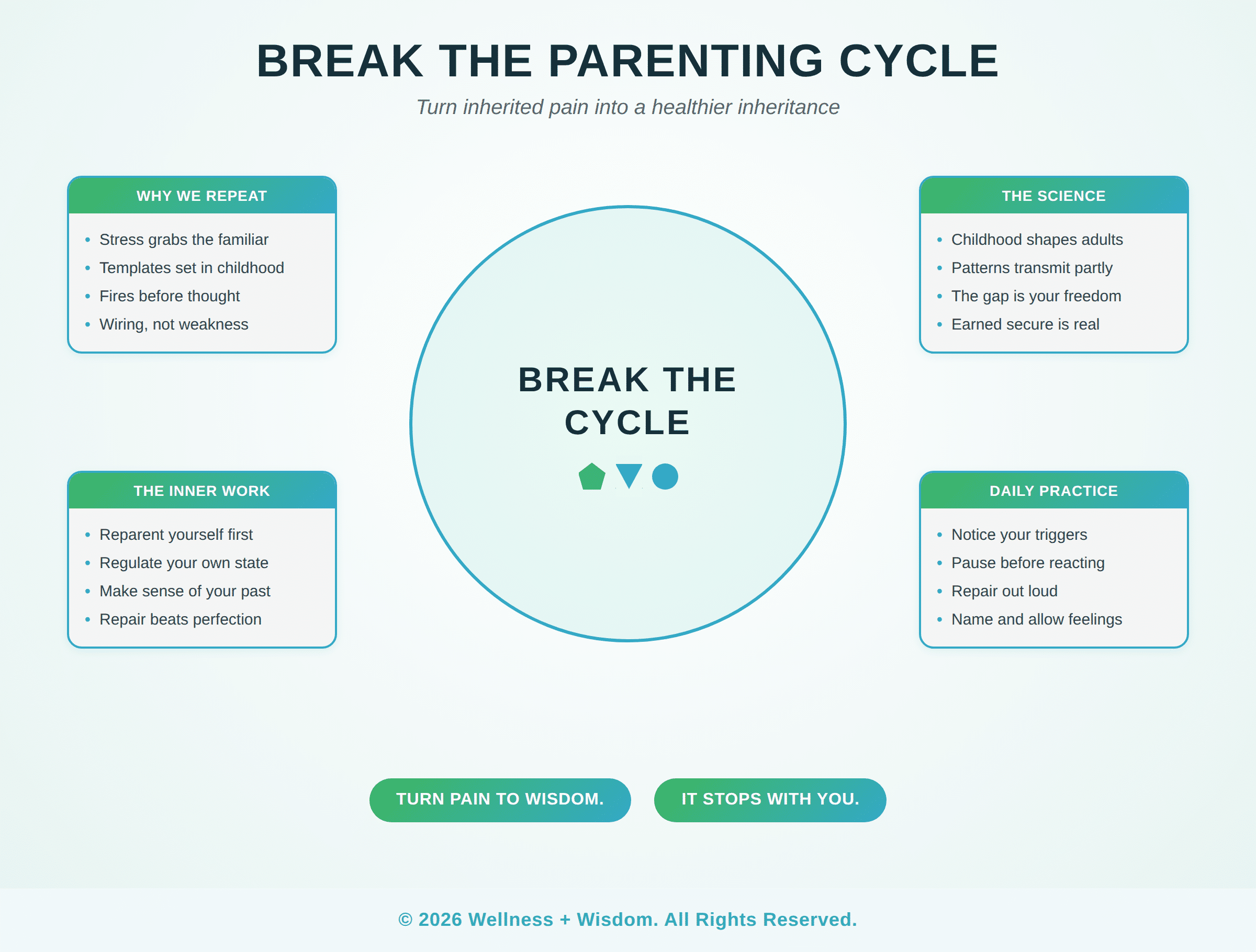
We repeat the very patterns we hated because under stress the brain reaches for what is familiar, not what is healthy, and the familiar was installed in childhood long before we could consent to it. This is wiring, not weakness.
When you were small, your developing brain recorded how the adults around you handled anger, closeness, fear, and repair. Those early templates became your default operating system, stored deep in the body below conscious thought. In calm moments you can choose your values. Under real pressure, when a child is screaming and you are exhausted, the old template fires faster than your intentions can.
This is why willpower alone fails. You cannot simply decide to be different and expect it to hold when you are triggered, because the reaction lives below the level of decision. The pattern is stored in your neural system, in the body, in the automatic response that happens before you have time to think. That is humbling, and it is also the key to a real solution.
Once you understand that these reactions are stored patterns rather than character flaws, everything shifts. You stop fighting yourself with shame and start working with your biology instead. The reaction you hate is not who you are. It is an old recording, and recordings can be changed, the same way we describe in healing your inner child as an adult.
The Science of Generational Patterns
The science behind generational patterns is sobering and hopeful at the same time. It confirms that what happens in childhood echoes for decades, and it also reveals exactly where the cycle can be broken.
1. Childhood shapes a lifetime
The landmark Adverse Childhood Experiences study, led by Vincent Felitti and published in the American Journal of Preventive Medicine, surveyed thousands of adults and found that difficult childhood experiences strongly predicted adult physical and mental health outcomes decades later. The childhood emotional environment is not something we simply outgrow. It leaves a long signature, which is exactly why interrupting harmful patterns matters so much.
2. Patterns transmit, but not completely
In an influential meta analysis published in Psychological Bulletin, Marinus van IJzendoorn examined how attachment patterns pass from parent to child. The link was real, yet a large share of the transmission could not be explained by sensitivity alone. Researchers call this the transmission gap, and within that gap lives your freedom. The cycle leans on you, but it does not fully decide you.
3. The cycle can genuinely be broken
This is the finding that gives me hope. In a 23 year longitudinal study published in Child Development, Glenn Roisman and colleagues studied people who had difficult childhoods but who came to understand their stories coherently as adults. These earned secure individuals went on to parent as effectively as people who had warm childhoods. Making sense of your past changed how you showed up as a parent. Healing was not only possible. It was measurable.
Taken together, the research tells a single clear story. Childhood matters enormously, the past exerts real pull, and a parent who does the inner work can still break the cycle and change the inheritance.
The Hope in the Research: You Can Change This
You can break the parenting cycle, and the research proves it is not wishful thinking. The earned secure finding is one of the most encouraging discoveries in all of developmental psychology, because it shows that a hard start does not have to become a hard legacy.
The key, it turns out, is not having had a perfect childhood. The key is making sense of the one you had. People who could look back honestly at their difficult experiences, feel them, and understand them, broke free of the automatic repetition. They did not deny the pain and they did not drown in it. They integrated it, and that integration set their children free.
This is why I always say the path forward runs through, not around. You do not break the cycle by pretending your childhood was fine or by white knuckling better behavior. You break it by turning toward your own story with honesty and compassion until it no longer runs you from the shadows. That is the deep meaning of identity transformation.
So if you carry a heavy history, take heart. Your past is not a sentence passed on to your children. It is raw material you can work with, and the very wounds you heal become the wisdom you pass down instead. That is the abundance hidden inside this work.
Generational Patterns and Emotional Epigenetics
Through the lens of Emotional Epigenetics™, to break this cycle is to change the emotional environment your child develops inside, which shapes how their genes are expressed. Your calm or your chaos is not just a mood. It is part of the climate your child grows in.
Emotional Epigenetics™ teaches that emotional patterns, beliefs, and environment converge to influence gene expression across generations. A child raised in chronic stress develops a biology braced for threat. A child raised in felt safety develops a biology tuned for connection and growth. When you regulate yourself and create safety in your home, you are quite literally helping shape your child's developing biology in a healthier direction.
This is the same convergence we explore in breaking a generational curse and across the dimensions of the Wellness Pentagon. Your inner state becomes your child's outer world, and their outer world becomes part of their inner wiring. The cycle is biological as well as behavioral, which is exactly why your own healing is the most powerful parenting tool you own.
This reframes the whole task. You do not have to be a flawless parent to give your child a healthier inheritance. You mostly have to become a more regulated, more conscious human, and let that regulation ripple outward into the home. The work on yourself is the work for your children.
Generational Patterns Are Quieter Than You Think
Generational patterns are usually quieter than dramatic trauma, living in the small daily moments of tone, touch, and repair that a child absorbs thousands of times before they can speak. This is why so many people insist their childhood was fine and still find old reactions running their parenting. The cycle is not only made of big events. It is made of repetition.
Think about how affection was shown in your home, or whether it was. Think about what happened after a conflict, whether anyone ever circled back to repair it or whether the silence simply hardened. Think about how mistakes were handled, how feelings were greeted, how stress moved through the rooms of your house. None of these may rise to the level of a story you would tell a therapist, yet all of them became templates you carry.
This matters because you cannot change what you cannot see. The patterns that run deepest are often the ones that feel most like simply how life is, rather than choices someone made. Bringing them into the light is the work. When you can name the quiet inheritance, you can finally decide whether to keep it or release it, the same way we describe the body holding old patterns in bioenergetic memory.
So do not wait for a dramatic wound to justify this work. The everyday climate you grew up in shaped you just as surely, and the everyday climate you create now is shaping your children right now. That ordinary, repeated atmosphere is exactly where the cycle either continues or quietly ends with you.
Your Children Learn From Who You Are, Not What You Say
Children learn far more from who you are than from what you tell them, which means your own regulation, self talk, and relationships are the real curriculum. You can deliver the perfect lecture about staying calm and still teach the opposite the moment you lose your temper over a spilled cup. Kids read the neural system in the room, not the words.
This can feel daunting, but it is actually liberating. It means you do not have to script the perfect things to say. You mostly have to keep becoming a steadier, kinder, more whole person, because that is what your children are quietly studying every day. They watch how you treat yourself when you fail. They watch how you speak to their other parent. They watch whether your words and your behavior match.
It also means that your own healing is never wasted on them. Every bit of calm you build, every wound you tend, every moment of self compassion you practice becomes part of the example they absorb. The work you do on your own wellbeing, including your daily gratitude practice and your own steadiness, is being recorded by the smallest, most attentive students you will ever have.
So model what you most want them to learn. Let them see you breathe through frustration, apologize sincerely, rest without guilt, and treat yourself with kindness. Those lived demonstrations will outlast every instruction, and they are how the healthiest patterns get handed forward instead of the painful ones.
The Inner Work Comes First
The inner work comes first because you cannot give your child a regulation you do not have, so reparenting yourself is the foundation of reparenting them. You are the thermostat of your home, not the thermometer. Your state sets the temperature.
Reparenting yourself means becoming the steady, compassionate inner parent you may not have had. It means learning to soothe your own activation, to speak to yourself with kindness, and to meet your own feelings with the patience you want to offer your child. As you build that capacity inside, it naturally becomes available to your kids. You cannot pour calm from an empty cup.
This is why your healing is not selfish. Every hour you spend regulating your own neural system, processing your own history, and softening your own inner critic directly raises your ceiling as a parent. The tools we teach in neural system regulation and the 90 second emotion rule are parenting tools precisely because they are self regulation tools first.
Start where you are. You do not need years of therapy before you can begin, although support helps enormously. You simply need to commit to meeting your own reactions with curiosity instead of shame, and to repairing with your child when you fall short. Repair, not perfection, is what teaches a child that love survives mistakes.
How to Break the Parenting Cycle in Daily Life
You break this cycle in daily life through small, repeatable practices that interrupt the old pattern and install a new one, one moment at a time. This is not a one time decision. It is a daily practice. Here is where to begin.
1. Notice your triggers
The behaviors in your child that enrage you most are often clues to your own unhealed places. When you feel a reaction that is too big for the moment, pause and get curious. That oversized response is usually the old pattern surfacing, and noticing it is the first and most important step toward changing it.
2. Build a pause between trigger and reaction
The entire cycle hinges on the gap between stimulus and response. A single slow breath before you react can be enough to let your conscious values catch up with your automatic wiring. Practices like box breathing train that pause so it is available when you need it most.
3. Repair quickly and out loud
You will still mess up, and that is fine. What changes your child is what you do next. Going back and saying that you were wrong, that it was not their fault, and that you love them, teaches repair and breaks the silence that often surrounded conflict in your own childhood. Repair is where the cycle actually breaks.
4. Name and allow feelings
Many of us grew up in homes where big feelings were punished or ignored. You change that by letting your child have their emotions while you stay calm beside them. Helping them name what they feel builds the emotional intelligence you may have had to learn late, a skill we explore in emotional intelligence for adults.
5. Tend yourself daily
Because your regulation is the foundation, daily self care is not a luxury here. Sleep, breath, connection, and stillness keep your own system steady enough to parent from your values. Your spiritual wellness and steadiness are what your child borrows when their own world feels too big.
Generational Patterns: Myths vs Reality
The idea of breaking generational patterns collects a lot of confusion, so it helps to separate the myths from the reality. The truth is gentler and more freeing than the myths suggest.
One myth says you have to blame and cut off your parents to heal. Reality: the work is about understanding and integration, and many people break the cycle while keeping compassion, and sometimes connection, with the parents who raised them. Another myth says you must be a perfect parent or you have failed. Reality: research points to repair, not perfection, as what actually protects a child.
On the discouraged side, some believe that because they were hurt, they are doomed to hurt their own kids. Reality: the earned secure findings show clearly that a difficult past, once understood, does not have to repeat. Your awareness is already evidence that you are different from the unconscious pattern.
The most limiting myth of all is that it is too late, that the damage is done. Reality: children are remarkably responsive to a parent who starts showing up differently, and repair can happen at any age. It is never too late to break the parenting cycle, because the next conscious moment is always available to you.
Bringing It All Together
To break the parenting cycle is to become the person in your family who turns pain into wisdom instead of passing it forward. You did not choose the wiring you were handed, but you get to choose what happens next, and that choice ripples for generations.
Start with yourself, start with grace, and start today. Notice one trigger. Take one breath before you react. Repair one moment you wish had gone differently. None of it has to be perfect. Each small, conscious choice rewrites the inheritance a little more, and your children will feel the difference long before they understand it. What feels like a small act in a single moment becomes, stretched across years, an entirely different childhood. This is healing through love, exactly the way it was meant to be. And you will not have to do it flawlessly for it to work. The research is clear that children do not need perfect parents. They need present ones who keep coming back, keep repairing, and keep growing. Every time you choose awareness over autopilot, you hand your children a lighter load than the one you were given, and that lighter load is the truest inheritance you can leave.
If you want guidance and a community on this path, this is exactly what we built the Liberated Life Tribe for. Join the Liberated Life Tribe and receive your 10 day Self Liberation Blueprint at liberatedlife.com. You can also explore conscious parenting, dive into the full L.I.F.E. Method, hear hundreds of related conversations across our latest episodes, find tools in the store, and learn our full mission and programs.
Frequently Asked Questions
What does it mean to break the parenting cycle?
To break the parenting cycle means to stop automatically passing down the wounds, reactions, and patterns you inherited, and to consciously choose a healthier way of relating to your child. It is about becoming a conscious parent, not a perfect one.
Why do I parent like my parents even though I swore I would not?
Under stress, the brain reaches for the familiar templates installed in childhood, which fire faster than your conscious intentions. These reactions are stored patterns in the body, not character flaws, which is why willpower alone is not enough and inner work is needed.
Can you really break a generational pattern?
Yes. A 23 year longitudinal study found that people who had difficult childhoods but came to understand their stories coherently as adults, called earned secures, parented as effectively as those with warm childhoods. Making sense of your past measurably changes how you parent.
Do I have to blame or cut off my parents to heal?
No. The work centers on understanding and integration, not blame. Many people break the cycle while holding compassion, and sometimes connection, for the parents who raised them, recognizing that most did the best they could with their own wiring.
Where do I start if I want to break the parenting cycle?
Start with yourself. Reparenting your own neural system through breath, self compassion, and processing your history raises your capacity as a parent. Then practice noticing triggers, pausing before reacting, and repairing quickly when you fall short.
Is it ever too late to change how I parent?
No. Children are remarkably responsive to a parent who begins showing up differently, and repair can happen at any age. The next conscious moment is always available, which means it is never too late to begin changing the pattern.
Studies and External Resources
The science in this article rests on peer reviewed research and authoritative resources. These are the studies and sources referenced throughout.
- Relationship of childhood abuse and household dysfunction to many of the leading causes of death in adults. The Adverse Childhood Experiences (ACE) Study. Am J Prev Med, 1998. PubMed: 9635069
- Adult attachment representations, parental responsiveness, and infant attachment: a meta analysis on the predictive validity of the Adult Attachment Interview. Psychol Bull, 1995. PubMed: 7777645
- Earned secure attachment status in retrospect and prospect. Child Dev, 2002. PubMed: 12146743
About Josh Trent
Josh Trent is an Identity Transformation Architect and the award winning host of the Wellness + Wisdom Podcast, with over 15 million downloads since 2015. He is the creator of the L.I.F.E. Method™ Identity Transformation System and steward of the Emotional Epigenetics™ and BREATHE: Breath + Wellness™ systems of self mastery, impacting over 1,000 students worldwide. Josh lives in Austin, Texas with his wife Carrie, daughter Nayah, and son Novah. Learn more about my story and explore our programs.
Peace and power,
Josh Trent
Disclosure: We may earn a commission from certain links on this site when you make a purchase, at no extra cost to you. These commissions help support Wellness + Wisdom and do not affect the products or resources we choose to recommend. Full disclosure .