
By Josh Trent, Identity Transformation Architect and host of the Wellness + Wisdom Podcast
The strongest men I know are not the ones who feel nothing. They are the ones who can feel everything and still stay standing.
Masculine emotional leadership is the capacity to feel your emotions fully, stay present with them, and lead yourself and the people you love from a grounded heart instead of a clenched jaw. It is not softness pretending to be strength. It is the rare and powerful combination of depth and steadiness that most men were never taught and most relationships are starving for.
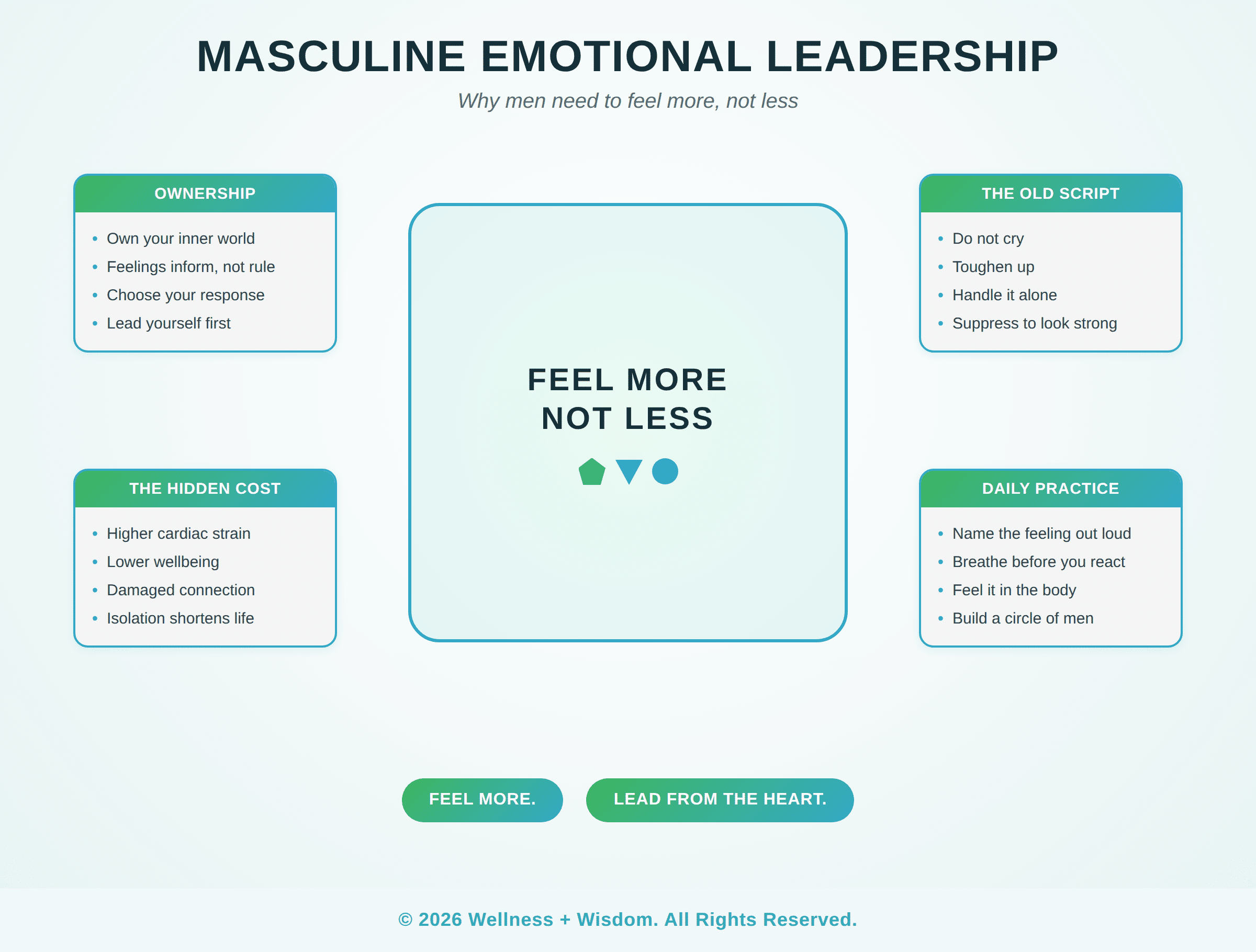
For generations, boys heard the same message in a hundred different ways. Do not cry. Toughen up. Stop being so sensitive. We took that message and built whole identities on top of it, and then we wondered why we felt numb, distant, and alone inside our own lives. The truth is simpler and far more hopeful. Men do not need to feel less. We need to feel more, and we need the skill to carry what we feel. That skill is masculine emotional leadership, and it can be learned at any age.
Table of Contents
- What Masculine Emotional Leadership Actually Means
- Why Men Were Taught to Feel Less
- The Hidden Cost of Bottling It Up
- Masculine Emotional Leadership Is Strength, Not Softness
- What It Looks Like in Your Relationships
- How to Build Masculine Emotional Leadership
- Emotional Leadership vs Toxic Stoicism
- Frequently Asked Questions
- Studies and External Resources
- About Josh Trent
What Masculine Emotional Leadership Actually Means
Masculine emotional leadership means taking full ownership of your inner world so that your emotions inform you instead of running you. It is the difference between a man who explodes, a man who goes cold, and a man who can name what he feels, stay regulated, and choose his response. That third man is the leader, and leadership here starts with yourself before it ever touches anyone else.
Most men were handed two options for their emotions. Bottle them up or blow them out. That third path is the one almost nobody modeled for us. You feel the anger, the grief, the fear, or the love completely, you let it move through your body, and you stay at the wheel the entire time. The feeling is honored. The reaction is chosen.
This is the same integration we teach as the I in the L.I.F.E. Method™. The four pillars are Liberation, Integration, Frequency, and Embodiment, and emotional leadership lives right at the heart of Integration. You stop splitting off the parts of yourself you were told were unmanly and you bring them home. A man who has integrated his anger does not become passive. He becomes precise.
Here is the core reframe. Emotional leadership is not about being emotional. It is about being in relationship with your emotions instead of being hijacked by them or hiding from them. That relationship is the foundation of every other kind of leadership you will ever exercise, at home, at work, and in your own body.
Why Men Were Taught to Feel Less
Men were taught to feel less because emotional suppression was mistaken for strength for a very long time. Boys learned early that vulnerability got punished and stoicism got rewarded, so they did the rational thing. They shut the door on their inner lives and called it being a man.
Think about the scripts. The boy who falls and scrapes his knee is told to walk it off. The teenager who feels heartbroken is told to man up. The grown man who feels overwhelmed is told that real men handle it alone. None of these messages were delivered with malice. Most came from fathers and coaches who were handed the exact same script and never questioned it.
This is inheritance in action, and it is the territory of Emotional Epigenetics™. The emotional patterns of the men who raised us shaped the men we became, sometimes through what they said and just as often through what they could never say. A father who could not feel his own grief rarely teaches his son how to feel his. The pattern passes down quietly, generation after generation, until someone decides to break it.
The cruel irony is that the suppression was never strength at all. It was a survival strategy dressed up as a virtue. And like every survival strategy, it kept us alive while slowly making us numb. Reclaiming the right to feel is not a betrayal of masculinity. It is the recovery of it.
The Hidden Cost of Bottling It Up
Bottling up emotion does not make it disappear. It drives it underground, where it raises your physiological stress and quietly damages your body. The science on this is clear and a little startling once you see it.
Researchers James Gross and Robert Levenson ran a now classic study, published in the Journal of Personality and Social Psychology, where people watched an emotional film while either expressing or suppressing what they felt. The suppressors looked calmer on the outside. Inside, their bodies told a different story, showing increased sympathetic activation of the cardiovascular system. In plain terms, hiding the feeling made the body work harder, not less.
A later body of work led by Gross and Oliver John, also in the Journal of Personality and Social Psychology, found that people who habitually rely on suppression tend to report lower wellbeing and worse relationships than those who process emotion in healthier ways. The very strategy men were taught to protect themselves turns out to cost them connection and peace.
Then there is the loneliness piece, and it may be the most sobering of all. A landmark meta analysis of 148 studies and more than 300,000 people, published in PLoS Medicine found that people with strong social relationships had a fifty percent greater likelihood of survival, an effect comparable to quitting smoking. Suppression isolates. Isolation shortens lives. The emotional armor men were told to wear is not free. It charges interest in the currency of health and years.
This is the same mind body conversation we explored in psychoneuroimmunology. What you refuse to feel does not vanish. It settles into your tissues, your sleep, and your neural system, and it asks to be paid eventually. Masculine emotional leadership is, among other things, simple preventive medicine.
The anger that has nowhere to go
For a lot of men, anger is the only emotion that was ever allowed, so every other feeling gets funneled through it. Grief comes out as rage. Fear comes out as control. The work is not to kill the anger. It is to widen the channel so the feeling underneath can finally surface. When a man can feel his sadness directly, his anger stops having to carry the whole load.
Masculine Emotional Leadership Is Strength, Not Softness
Masculine emotional leadership is strength because it takes far more courage to feel than to numb. Any man can slam a door or go silent. It takes a developed nervous capacity to stay open in the exact moment everything in your conditioning screams at you to shut down.
We have confused softness and weakness for too long. A man who can sit with his crying child without trying to fix it, who can hear hard feedback from his partner without going defensive, who can admit he was wrong without collapsing into shame, is not soft. He is strong in the way that actually holds a family together. That kind of strength is built, not born.
This is why emotional leadership pairs so naturally with identity transformation. The old identity said strength means never flinching. The new identity says strength means staying present through the flinch. Same man, deeper power. The muscles you build here are the muscles of a leader other people instinctively trust.
There is also a frequency to it, which connects to the F in L.I.F.E.™. A grounded man changes the emotional weather of every room he enters. His regulated state becomes a kind of permission for everyone around him to settle. That is leadership you can feel before a single word is spoken.
What It Looks Like in Your Relationships
In relationships, emotional leadership looks like a man who can stay present during conflict instead of stonewalling or exploding. He becomes the steady ground his partner can push against and trust will not crumble. That steadiness is one of the most attractive and stabilizing forces in any partnership.
Most relationship ruptures are not caused by the disagreement itself. They are caused by what happens to the man's regulation during the disagreement. When he floods and goes cold, his partner feels abandoned. When he floods and erupts, she feels unsafe. When he can feel the heat rising and stay in the conversation anyway, everything changes. The same skill we teach through the 90 second emotion rule becomes a relationship superpower.
Emotional leadership also means going first. It means being the one willing to say I felt hurt, or I was scared, or I am sorry, before anyone forces it out of you. This is the same courage we explore in the neuroscience of forgiveness. Going first is not losing. It is leading.
And it extends to your children. A father who models emotional leadership raises kids who do not have to spend their thirties unlearning what he never had to teach them. This is the heart of conscious parenting, and it is how you break a generational pattern in real time. Your regulated presence is the inheritance you actually want to leave.
How to Build Masculine Emotional Leadership
You build masculine emotional leadership through deliberate daily practice, the same way you would build any other kind of strength. Nobody walks into the gym and lifts heavy on day one. You start light, you stay consistent, and the capacity grows. Here are the practices I lean on and teach men.
1. Name the feeling out loud
The simplest starting point is to name what you feel, in plain language, the moment you notice it. Research on affect labeling shows that putting a feeling into words takes some of the charge out of it. You are not journaling a novel. You are saying, quietly, I am angry, or I am scared, or I am sad. Naming is the first act of leadership.
2. Breathe before you respond
Breath is the fastest tool a man has for staying at the wheel when emotion spikes. A few slow breaths settle the neural system and buy you the half second between the trigger and the reaction where all your power lives. This is the foundation of our BREATHE™ work, and you can start with the simple structure in our guide to box breathing and the tools in neural system regulation.
3. Feel it in the body
Emotions are not just thoughts. They are physical events. Learning to locate a feeling in your body, the tight chest, the hot face, the heavy gut, and breathe into it rather than around it is the core of true regulation. This somatic skill connects directly to the work on bioenergetic memory and the vagus nerve reset I rely on myself.
4. Reparent the boy inside
A lot of a man's emotional reactivity is the unhealed boy still running the show. Learning to meet that younger part with compassion instead of contempt is some of the deepest work available. This is exactly what we mean by healing your inner child as an adult, and it is not soft. It is the hardest and most rewarding strength training there is.
5. Build a circle of real men
This kind of leadership cannot be built in isolation. Men need other men who will tell the truth, hold them accountable, and let them be human. The data on connection and longevity makes this non negotiable. Find or build a circle where you do not have to perform. This is one reason we created the Liberated Life Tribe.
Emotional Leadership vs Toxic Stoicism
Emotional leadership and toxic stoicism can look similar from the outside, but they are opposites underneath. Both can appear calm. The difference is what is happening inside the man and what becomes possible because of it.
Toxic stoicism is calm because the man has gone numb. He has cut the wire to his own feelings, so nothing reaches him, including joy, including his children, including his own aliveness. He pays for that flat calm with disconnection and, over time, with his health. The peace is the peace of a frozen lake.
Emotional leadership is calm because the man has built the capacity to feel intensely and stay grounded anyway. His calm is not the absence of feeling. It is the presence of a strong container. He can be moved to tears by his daughter's wedding and still be the steady one everyone leans on an hour later. The peace is the peace of deep water, not frozen water.
The test is simple. Ask whether the calm includes the full range of feeling or excludes it. Real emotional leadership widens you. Toxic stoicism shrinks you. One is a man fully alive and in command of himself. The other is a man slowly disappearing inside his own armor. Choosing the first is available to you starting today.
The Masks Men Learn to Wear
Most men do not feel nothing. They feel everything and hide it behind a mask, and the mask becomes so familiar they forget it is there. Recognizing your own mask is the first real step out from behind it, and almost every man wears at least one of these three.
The first mask is the Protector who never rests. He carries everyone and lets no one carry him. His love is real, but over the years it hardened into duty, and underneath all that competence is a man nobody has asked how he is doing in a very long time. He does not need to drop the strength. He needs to let one trusted person see the cost of it.
The second mask is the Achiever who never feels. He converts every emotion into a task and every ache into a goal. As long as he is producing, he never has to sit still long enough to notice what is moving underneath. The drive is real, and it is also a beautifully disguised way to stay one step ahead of his own heart. The grind becomes the hiding place.
The third mask is the Agreeable Man who never says no. He keeps the peace by abandoning himself, swallowing his truth to dodge conflict, then quietly resenting the very people he could never be honest with. His kindness is genuine, but it is missing a spine, and a man without a real no cannot offer a trustworthy yes.
None of these masks make a man bad. They made sense once. They were the best a boy could do with the tools he was handed. The invitation now is not to attack the mask but to outgrow the need for it, which is the quiet beginning of real change.
What Changes When a Man Leads Himself
When a man begins to lead himself emotionally, the change radiates outward into every part of his life, usually faster than he expects. The first thing that shifts is his body. The chronic tension he had completely normalized starts to release, his sleep deepens, and the low background hum of stress in his neural system finally begins to quiet.
The second thing that shifts is his presence. People feel safer around a regulated man. His kids stop bracing when he walks in. His partner stops managing his moods. His team stops walking on eggshells. He becomes, without trying, the calmest and most trustworthy person in the room, and that steady presence is its own quiet form of leadership.
The third thing that shifts is his joy, and this is the part nobody warns men about. When you stop spending energy holding feelings down, that energy comes back to you as aliveness. Color returns to ordinary days. Laughter comes easier. The same openness that lets grief move through also lets joy move in. A man who can feel his sadness fully is finally a man who can feel his happiness fully too.
This is the abundance waiting on the other side of the work, and it touches every dimension of the Wellness Pentagon. A man who leads himself does not merely survive his life. He inhabits it. That is the whole point, and it is far closer than most men dare to believe. The door was never locked. It was only waiting for you to try the handle.
If you are not sure which mask is yours, watch what happens the next time you feel something inconvenient. Notice whether you reach for control, for productivity, or for keeping everyone around you comfortable. That reflex is the mask showing itself in real time. You do not have to fight it or shame it. You only have to see it clearly, because what a man can finally see, he can finally choose to set down.
Bringing It All Together
Emotional leadership is the strength to feel everything and still stay standing, and it is the single most underrated skill a man can build. You were not made to go numb. You were made to feel deeply, love fiercely, and lead from a grounded heart, and every part of that can be reclaimed no matter how long the door has been shut.
Start small. Name one feeling today. Breathe before one reaction. Tell one person the truth about how you actually feel. The man who feels more, not less, is not the weaker man in the room. He is the one everyone else quietly wishes they could be. You can become him, one honest breath at a time.
If you want a brotherhood walking this same path, this is exactly what we built the Liberated Life Tribe for. Join the Liberated Life Tribe and receive your 10 day Self Liberation Blueprint at liberatedlife.com. You can also explore the five dimensions of whole person health in the Wellness Pentagon, deepen your spiritual wellness, hear hundreds of related conversations across our latest episodes, and find supportive tools in the store. Explore our full mission and the L.I.F.E. Method when you are ready to go deeper.
Frequently Asked Questions
What is masculine emotional leadership?
Masculine emotional leadership is the capacity to feel your emotions fully, stay present and regulated with them, and lead yourself and your loved ones from a grounded heart. It is not about feeling less. It is about being in relationship with your feelings instead of being hijacked by them or hiding from them.
Does showing emotion make a man weak?
No. It takes more courage and capacity to feel an emotion and stay present than to numb out or explode. Strength here means staying open and regulated in the exact moment your conditioning tells you to shut down. That is a skill that can be built at any age.
What does suppressing emotions do to the body?
Research by Gross and Levenson found that suppressing emotion increases sympathetic activation of the cardiovascular system, meaning the body works harder even when a man looks calm. Habitual suppression is also linked to lower wellbeing, worse relationships, and the isolation that research connects to shorter lives.
How is emotional leadership different from being stoic?
Toxic stoicism is calm because a man has gone numb and cut the wire to his feelings. Masculine emotional leadership is calm because he has built the capacity to feel intensely and stay grounded anyway. One shrinks a man over time. The other widens him.
How do I start building masculine emotional leadership?
Start by naming what you feel out loud, breathing before you react, and learning to feel emotions in your body rather than around them. Reparent the younger part of you that learned to suppress, and build a circle of men where you do not have to perform.
Can emotional leadership improve my relationship?
Yes. Most relationship ruptures come from what happens to a man's regulation during conflict, not the disagreement itself. A man who can stay present and grounded under pressure becomes the steady ground his partner can trust, which is one of the most stabilizing forces in any partnership.
Studies and External Resources
The science in this article rests on peer reviewed research and authoritative resources. These are the studies and sources referenced throughout.
- Journal of Personality and Social Psychology. View source via DOI
- Journal of Personality and Social Psychology. View source via DOI
- Social relationships and mortality risk: a meta analytic review. PLoS Med, 2010. PubMed: 20668659
About Josh Trent
Josh Trent is an Identity Transformation Architect and the award winning host of the Wellness + Wisdom Podcast, with over 15 million downloads since 2015. He is the creator of the L.I.F.E. Method™ Identity Transformation System and steward of the Emotional Epigenetics™ and BREATHE: Breath + Wellness™ systems of self mastery, impacting over 1,000 students worldwide. Josh lives in Austin, Texas with his wife Carrie, daughter Nayah, and son Novah. Learn more about my story and explore our programs.
Peace and power,
Josh Trent
Disclosure: We may earn a commission from certain links on this site when you make a purchase, at no extra cost to you. These commissions help support Wellness + Wisdom and do not affect the products or resources we choose to recommend. Full disclosure .