
By Josh Trent | Mental Health
We were never meant to heal alone. The deepest medicine for the human heart is not found in a pill or a program. It is found in the simple, radical experience of being seen, known, and held by other people.
There is a sentence that has reshaped how an entire field thinks about recovery: the opposite of addiction is not sobriety, it is connection. When you understand the real relationship between addiction and connection, everything about healing starts to make more sense. The behaviors we label as willpower problems are very often connection problems wearing a disguise. And that is wonderful news, because connection is something every one of us can build, starting today.
In this guide we are going to explore what the science actually says about addiction and connection, why isolation fuels compulsive patterns, and how belonging becomes one of the most powerful forces for healing a human being can experience. This is the heart of the Wellness Pentagon™, where social and emotional connection are treated as essential dimensions of health, not optional extras.
Table of Contents
- The Big Idea: Addiction and Connection
- What Rat Park Taught Us About Addiction and Connection
- Why Isolation Fuels Addiction
- Social Pain Is Real Pain
- How Connection Heals the Brain and Body
- Building Your Liberation Tribe
- The Three Layers of Connection That Heal
- Seven Ways to Build Real Connection
- Reframing Recovery Around Belonging
- Frequently Asked Questions
- Studies and External Resources
- About Josh Trent
The Big Idea: Addiction and Connection
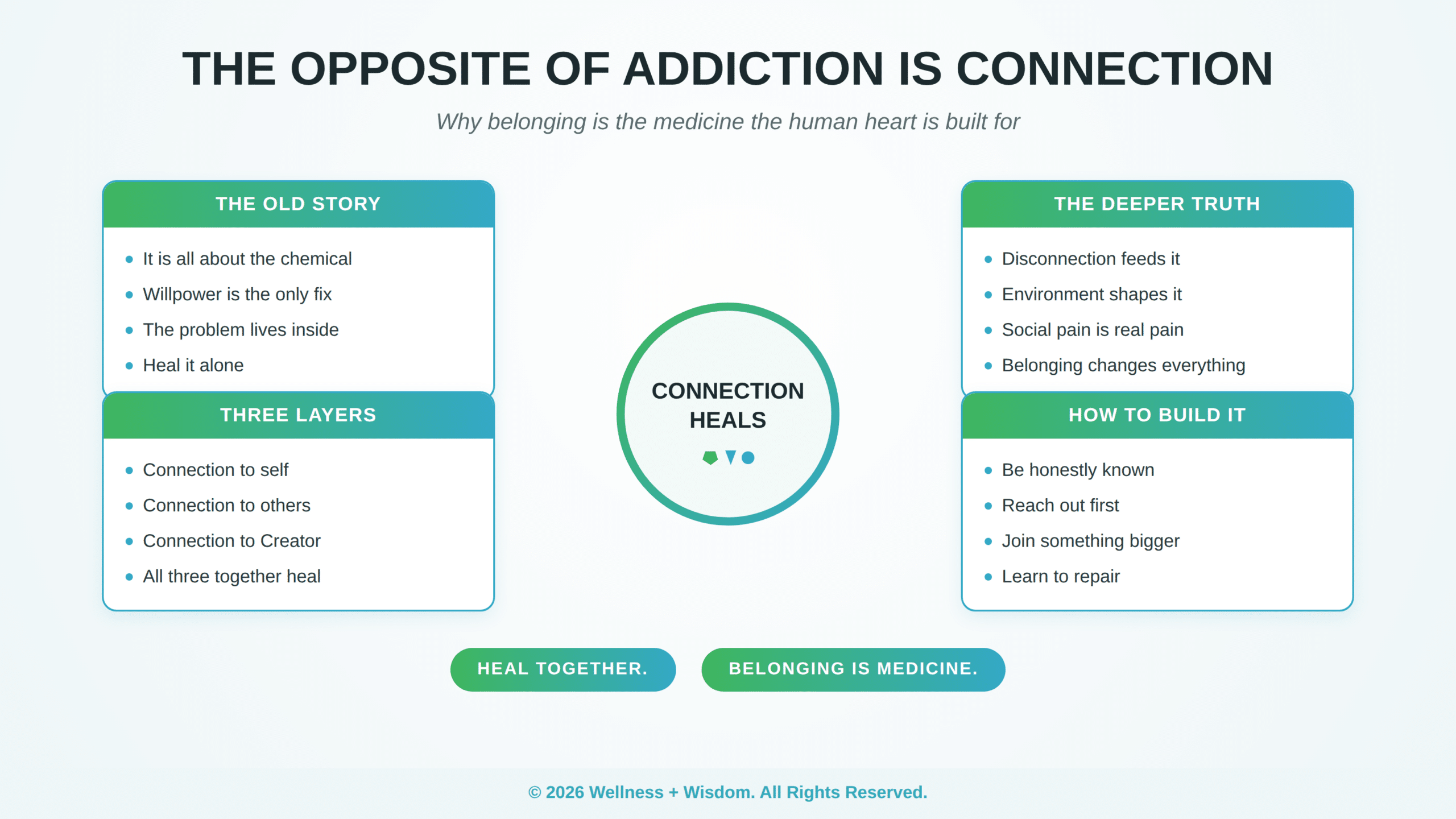
For most of the last century, we told one story about addiction. The story said that certain substances or behaviors hijack the brain, that the problem lives inside the chemical, and that the solution is to remove the chemical and hold the line with willpower. That story is not entirely wrong, but it is dramatically incomplete. It leaves out the single most important variable in the human experience: relationship.
The deeper truth about addiction and connection is that compulsive patterns very often grow in the soil of disconnection. When a person feels chronically alone, unseen, or unsafe, the brain looks for relief wherever it can find it. A substance, a screen, a behavior, anything that takes the edge off the ache of separation. The pattern is not a moral failing. It is an attempt to meet a real need through the only door that seems open. Understanding this changes how we approach recovery, and it aligns with the whole person approach to recovery that treats the human being rather than just the symptom.
When we reframe the conversation around addiction and connection, the path forward opens up. The goal is not simply to take something away. It is to give something back. Belonging. Purpose. The felt sense that you matter to someone and someone matters to you. That is not soft. That is the most evidence backed medicine we have.
What Rat Park Taught Us About Addiction and Connection
One of the most famous experiments in the study of addiction and connection came from a researcher named Bruce Alexander. Earlier studies had placed rats alone in bare cages with two water bottles, one plain and one laced with a drug, and observed the isolated animals consuming the drug compulsively. The conclusion seemed obvious: the drug was irresistible.
Alexander asked a different question. What if the cage, not just the chemical, was driving the behavior? He built a richer environment, sometimes called Rat Park, with space, play, and other rats to connect with. In work published in Pharmacology Biochemistry and Behavior, his group examined how housing conditions influenced morphine consumption in rats, highlighting the powerful role of environment in drug taking behavior.
The takeaway that captured the world's imagination is simple and humane. Environment matters enormously. A creature with connection, stimulation, and a life worth living relates to substances very differently than a creature in isolation. We are not so different. When our lives are rich with relationship and meaning, the pull toward escape loosens its grip. This is why I never reduce recovery to a single number on a sobriety counter. It is about building a life worth staying present for, which is the same spirit behind debunking common recovery misconceptions.
Why Isolation Fuels Addiction
If connection is medicine, isolation is the wound that medicine is meant to treat. The link between loneliness and poor health is not a metaphor. It is measurable, and the numbers are striking.
In a landmark meta analysis published in PLoS Medicine, Julianne Holt Lunstad and colleagues reviewed data on hundreds of thousands of people and found that strong social relationships were associated with a significantly greater likelihood of survival. A follow up review in Perspectives on Psychological Science examined loneliness and social isolation specifically and identified them as meaningful risk factors for mortality. In plain terms, disconnection is hazardous to your health on the scale of other major risk factors we take very seriously.
When you hold this next to what we know about addiction and connection, the picture sharpens. Isolation does not just feel bad. It puts the whole system under chronic stress, and a stressed, disconnected neural system reaches for relief. This is also why people in early recovery are so vulnerable when they try to do it alone, and why combating loneliness is not a side project. It is central to healing.
Social Pain Is Real Pain
Here is a finding that still moves me every time I sit with it. The brain processes the pain of social rejection in some of the same regions it uses to process physical pain. In a study published in Science, Naomi Eisenberger and colleagues used brain imaging to show that the experience of social exclusion activated neural regions associated with the distress of physical pain.
Read that slowly. When you feel left out, abandoned, or unseen, your brain is not being dramatic. It is registering a genuine injury. Rejection hurts because, to a deeply social species, belonging is a survival need, not a luxury. This is the biological root of so much human suffering, and it is why the patterns we form to soothe that pain, including the patterns we call addiction, make so much sense once we stop judging them.
Understanding that social pain is real pain invites a different kind of compassion, the same compassion we bring to healing the inner child and to the patterns explored in trauma bonding. The reach for relief was always a reach for relief from real pain.
How Connection Heals the Brain and Body
If disconnection wounds, connection mends, and it does so through real physiology. When you feel safely connected to another person, your body shifts out of threat and into a state of calm and openness. Heart rate steadies. Stress chemistry settles. The neural system reads the signal that you are safe, and in that safety, healing becomes possible. This is the same regulation we build deliberately through neural system regulation.
Connection also gives the brain new experiences to learn from. Every moment of being truly seen and accepted lays down evidence that contradicts the old story of being alone or unworthy. Over time, those moments rewire expectations. This is why community is not a nice addition to recovery. It is a core mechanism of it. The relationship between addiction and connection runs in both directions: disconnection feeds the pattern, and connection dissolves it.
There is a spiritual dimension here too. For many people, the deepest belonging includes a Connection to Creator and God, a sense of being held by something larger than the self. That vertical connection and the horizontal connection of community reinforce each other, and together they form a foundation strong enough to build a whole new life on. This is the abundance first orientation at the center of the L.I.F.E. Method™, which stands for Liberation, Integration, Frequency, and Embodiment.
Building Your Liberation Tribe
So if the answer to so much of our struggle is connection, the practical question becomes: how do you build it on purpose? Most of us were never taught this. We assume connection should happen naturally, and when it does not, we conclude something is wrong with us. Nothing is wrong with you. Connection is a skill and a practice, and like any practice, it can be learned and strengthened.
I call the kind of community that heals a Liberation Tribe. It is a group of people committed to growth, honesty, and mutual support, where you can show up as you actually are and be met with acceptance rather than judgment. A real tribe is not about fixing each other. It is about witnessing each other, which is often the very thing that makes change possible. This is exactly why I built the Liberated Life Tribe, a place to do the inner work alongside others instead of in isolation.
Building your tribe does not require dozens of people. Research on addiction and connection suggests that even a handful of genuine, attuned relationships can transform a person's resilience. Quality matters far more than quantity. A few people who truly know you are worth more than a thousand surface level contacts.
The Three Layers of Connection That Heal
When we talk about connection as the answer, it helps to get specific, because connection is not one thing. It moves through three layers, and a whole human being needs all three. When any layer is missing, the ache of disconnection finds a way in, and the patterns we call addiction often follow.
The first layer is connection to self. This is the felt sense of being at home in your own skin, able to feel your emotions without fleeing from them and to meet your own inner world with kindness. So much compulsive behavior is an attempt to escape an uneasy relationship with the self, which is why work like healing the inner child and parts work is so foundational. You cannot connect outward from a self you are constantly running from.
The second layer is connection to others, the horizontal web of friends, family, and community that reminds you that you are not alone. This is the layer the research on belonging speaks to most directly, and it is the one most damaged by modern life. Many of the patterns we inherit here were shaped early, which is why understanding how childhood trauma rewires the brain matters so much for adult relationships.
The third layer is connection to Creator and God, the vertical sense of being held by something larger than yourself. For many people this is the most stabilizing connection of all, a ground that does not waver even when human relationships are still being rebuilt. When all three layers are tended, the soil that addiction grows in simply dries up, and a life rooted in belonging takes its place.
Seven Ways to Build Real Connection
These are practices I return to and teach, each one a way of building the kind of belonging that heals. None of them require you to be a different person. They simply ask you to take small, brave steps toward each other.
1. Practice Being Honestly Known
Connection deepens in proportion to honesty. Letting one safe person see a real, unpolished part of you is worth more than years of pleasant small talk. Start small, and let yourself be known a little more than feels comfortable.
2. Reach First
The ache of disconnection makes us wait for others to reach toward us, which keeps everyone waiting. Be the one who texts first, invites first, says I have been thinking of you first. Most people are starving for exactly the connection they are afraid to initiate.
3. Offer Real Presence
Put the phone down and give someone your full attention. Presence is the rarest and most healing gift in a distracted world. When you truly listen, you give another person the experience of mattering, and you receive it in return.
4. Join Something Bigger Than You
Belonging grows fastest inside shared purpose. A group, a class, a service project, a recovery community, a tribe. Shared purpose gives connection a structure to grow within and a reason to keep showing up.
5. Regulate So You Can Relate
It is hard to connect when your system is in survival mode. Simple practices like breathwork and neural system regulation bring you into the calm, open state where real connection becomes possible. Heal the body, and relating gets easier.
6. Learn to Repair
All relationships rupture sometimes. What separates lasting connection from fragile connection is the willingness to repair, to return after conflict and reconnect. Repair, not perfection, is what builds trust over time.
7. Anchor in Connection to Creator and God
The most stable belonging often begins with the felt sense of being held by something larger. This Connection to Creator and God can steady you when human relationships are still being rebuilt, and it gives every other connection a deeper ground to stand on.
A Closing Word on Belonging
If you take one thing from all of this, let it be this: the loneliness you may feel is not proof that something is wrong with you. It is proof that you are human, wired across millions of years to need each other. The reach for relief, whatever form it took, was always a reach toward belonging. And belonging is available. Not perfectly, not all at once, but truly and steadily, one honest conversation and one brave hello at a time.
I have watched this transformation more times than I can count. A person walks in convinced they are too far gone, beyond reach, fundamentally alone, and within a community that simply refuses to give up on them, something thaws. They are met not with a fix, but with a steady, patient presence that asks for nothing except their willingness to keep showing up. They begin to believe they matter. They start to stay present for their own life. The substance or behavior that once felt essential quietly loses its hold, not because they white knuckled it away, but because they finally have something better. That something better is each other. It always was. You are closer to it than you think, and the very next step is smaller and kinder than you imagine. The door is open, and someone on the other side is genuinely glad you came.
If you want a guided way to begin building this kind of belonging, the 10 Day Self Liberation Blueprint is the on ramp I built for exactly this. You can also explore deeper conversations on the Wellness + Wisdom Podcast and browse our latest episodes on healing in community.
Reframing Recovery Around Belonging
When you place addiction and connection at the center of recovery, the whole journey changes shape. Recovery stops being a grim exercise in deprivation, a daily white knuckle battle against a craving, and becomes something far more sustainable and even beautiful: the building of a life so connected and meaningful that the old escape loses its appeal.
This reframe matters because shame is one of the great accelerants of compulsive behavior. When a person believes they are weak, beyond help, or alone in their struggle, that belief drives them deeper into isolation, and isolation drives the pattern in a loop that feels impossible to break from the inside. But when recovery is understood as a return to connection rather than a verdict on character, shame loses its grip. The person is not a problem to be fixed. They are a human being reaching for belonging, and that reach can be honored and met. This is the compassionate lens we bring to self sabotage as well, where the behavior makes sense once you see the need underneath it.
Belonging based recovery also tends to last, because it builds the very thing that protects against relapse. A person surrounded by genuine relationships has people to call in hard moments, witnesses to their growth, and a reason beyond themselves to keep going. The data here consistently points the same direction: people heal better together. This is the entire reason community sits at the heart of everything we build, from the Liberated Life Tribe to the conversations we share in our resources. No one was meant to do this alone, and the good news is that no one has to.
Frequently Asked Questions
What does it mean that the opposite of addiction is connection?
It means that compulsive patterns often grow out of disconnection, and that building genuine relationship and belonging is one of the most powerful forces for healing. The phrase reframes recovery from simply removing a substance to building a life rich with connection and meaning.
What did the Rat Park study show about addiction and connection?
The Rat Park research examined how the environment, including connection and stimulation, influenced drug consumption in rats. It highlighted that environment plays a powerful role in drug taking behavior, suggesting that isolation, not just the chemical, drives compulsive use.
Why does isolation make addiction worse?
Isolation places the body under chronic stress and removes the natural regulation that connection provides. Research links loneliness and social isolation to serious health risks, and a stressed, disconnected system is more likely to reach for relief through compulsive patterns.
Is social pain really comparable to physical pain?
Research using brain imaging has shown that the experience of social rejection activates some of the same neural regions involved in physical pain. For a deeply social species, belonging is a survival need, so rejection registers as a genuine injury.
How do I build connection if I feel alone right now?
Start small and reach first. Let one safe person know you a little more honestly, offer real presence, and join a group with shared purpose such as a supportive community or tribe. Even a few genuine relationships can transform resilience, and connection is a skill that strengthens with practice.
Does connection replace professional treatment for addiction?
Connection is a powerful part of healing, but it works best alongside appropriate support and care rather than as a replacement for it. A whole person approach combines community and belonging with the other dimensions of wellbeing and professional help where it is needed.
Studies and External Resources
- Holt Lunstad J, Smith TB, Layton JB (2010). Social Relationships and Mortality Risk: A Meta Analytic Review. PLoS Medicine. PubMed
- Holt Lunstad J, et al. (2015). Loneliness and Social Isolation as Risk Factors for Mortality: A Meta Analytic Review. Perspectives on Psychological Science. PubMed
- Alexander BK, et al. (1981). Effect of Early and Later Colony Housing on Oral Ingestion of Morphine in Rats. Pharmacology Biochemistry and Behavior. PubMed
- Eisenberger NI, Lieberman MD, Williams KD (2003). Does Rejection Hurt? An fMRI Study of Social Exclusion. Science. PubMed
About Josh Trent
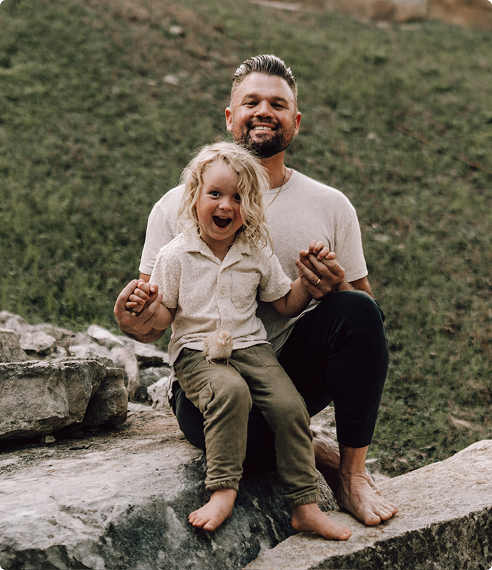
Josh Trent is an Identity Transformation Architect and the award winning host of the Wellness + Wisdom Podcast, with over 15 million downloads since 2015. He is the creator of the L.I.F.E. Method™ Identity Transformation System and steward of the Emotional Epigenetics™ and BREATHE: Breath + Wellness™ systems of self mastery, impacting over 1,000 students worldwide. Josh lives in Austin, Texas with his wife Carrie, daughter Nayah, and son Novah.
Ready to build your tribe? Join the Liberated Life Tribe and receive your 10 day Self Liberation Blueprint at liberatedlife.com. Peace and power.
Disclosure: We may earn a commission from certain links on this site when you make a purchase, at no extra cost to you. These commissions help support Wellness + Wisdom and do not affect the products or resources we choose to recommend. Full disclosure .