

By Josh Trent | Wellness + Wisdom Podcast Host & Identity Transformation Architect
“Your bank account is not separate from your biology. The stress you carry about money is rewriting your body every single day.”
— Josh Trent
Table of Contents
- Financial Wellness Stress Lives in Your Body, Not Just Your Budget
- How Financial Wellness Stress Rewires Your Neural System
- The Cortisol Tax: What Money Worry Does to Your Biology
- Financial Wellness Stress Across the Five Dimensions of the Wellness Pentagon™
- Inherited Money Wounds: The Epigenetic Layer You Cannot Budget Away
- Financial Wellness Stress vs. Financial Hardship: Why They Are Not the Same
- The Science: Three Studies That Changed How We Understand Money and Health
- Five Practices to Heal Financial Wellness Stress at the Biological Level
- Financial Wellness Stress on the Trading Floor: What Cortisol Research Reveals
- From Scarcity to Liberation: Rewriting the Financial Code
- Frequently Asked Questions About Financial Wellness Stress
- Studies and External Resources
- About Josh Trent
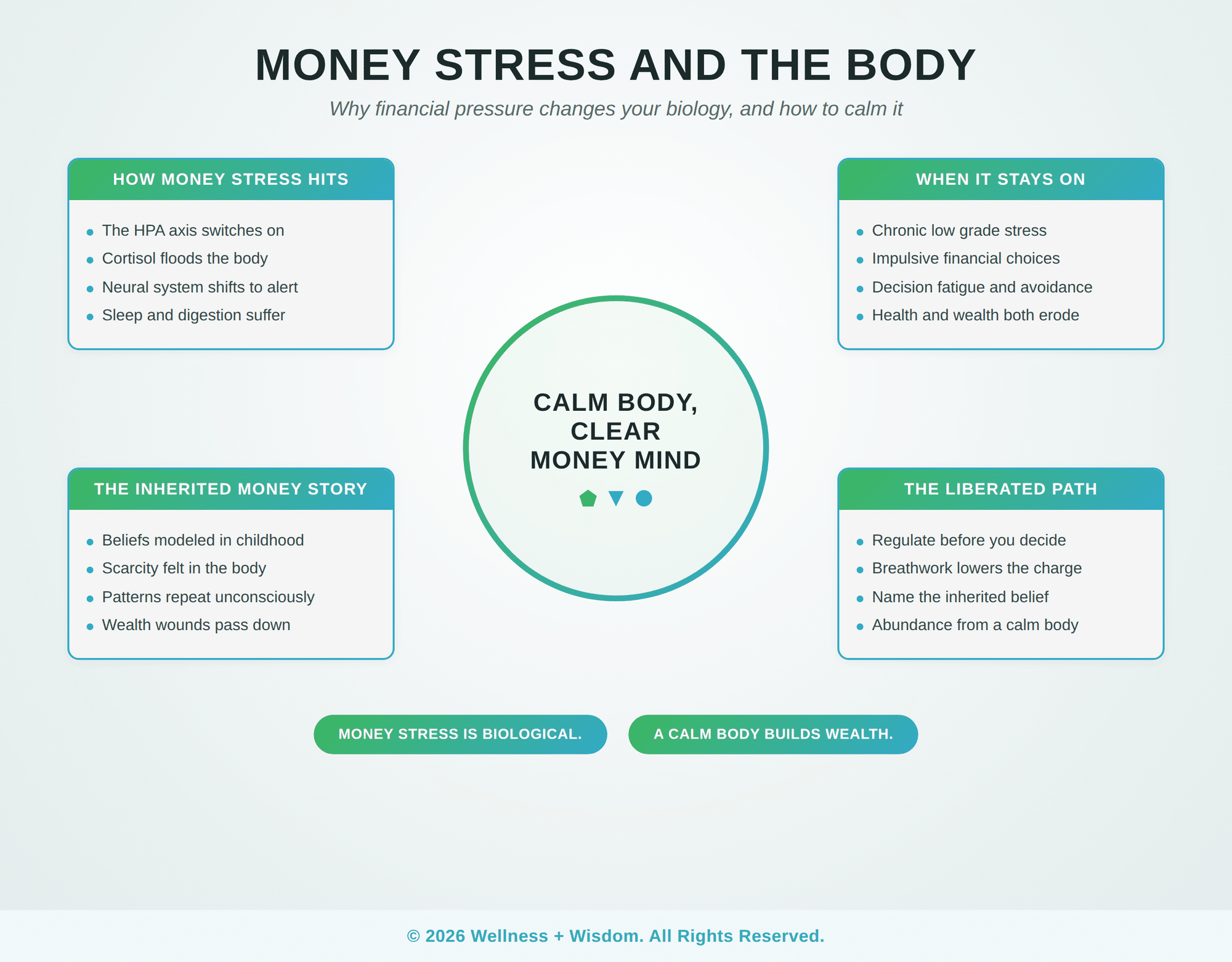
Financial Wellness Stress Lives in Your Body, Not Just Your Budget
Here is something most financial advisors will never tell you: the stress you feel about money is not a mindset problem. It is a biological event. Financial wellness stress is one of the most underestimated forces acting on your physical health, your relationships, your sleep, and your capacity to show up as the person you actually want to be. And if you have been white knuckling your way through financial anxiety thinking that a better spreadsheet or a bigger paycheck will fix it, I need to be honest with you. It will not. Not until you understand what is actually happening inside your body.
When I started the Wellness + Wisdom Podcast over a decade ago, I was broke. Not figuratively. Literally. I was sleeping on a friend's couch, eating peanut butter out of the jar, and carrying so much shame about my financial situation that my body was in a constant state of low grade emergency. My digestion was wrecked. My sleep was fractured. My ability to think clearly about my future felt like trying to read a book through fog. I did not know it at the time, but financial wellness stress was running my biology like a silent operating system, and it was running the show far more effectively than any budget app ever could.
What I have learned since then, through hundreds of conversations with researchers, clinicians, and healers on the podcast, through my own healing journey, and through the development of the Wellness Pentagon™ framework, is that financial stress is a whole body event. It changes your hormones. It alters your immune function. It shifts your gene expression. And it does all of this whether you are making $30,000 or $300,000 a year because financial wellness stress is not about how much money you have. It is about how your neural system processes the relationship between safety and resources.
How Financial Wellness Stress Rewires Your Neural System
Let me walk you through what actually happens inside your body when you open a bill you were not expecting, or when you check your bank account and see a number that makes your stomach drop. Your hypothalamus, the command center of your neural system, perceives financial threat the same way it would perceive a physical threat. It does not distinguish between a bear charging at you and a credit card statement that says you owe more than you thought. The response is identical.
Your hypothalamus releases corticotropin releasing hormone, which tells your pituitary gland to release adrenocorticotropic hormone, which tells your adrenal glands to flood your system with cortisol. This is the HPA axis in action, and it was designed to save your life in acute danger. The problem is that financial stress is not acute. It is chronic. It does not last 90 seconds like a bear encounter. It lasts months. Years. Decades. And when your HPA axis is activated chronically, the downstream effects are devastating.
Research published in Brain, Behavior and Immunity found that people experiencing financial strain were 59% more likely to belong to a high risk biological group four years later, with measurable disruption in the communication between their immune and neuroendocrine systems. The lead researcher noted that financial stress may be uniquely harmful because it can invade many aspects of life, from family conflict to social exclusion to basic survival needs. This is not a metaphor. Financial wellness stress literally changes the conversation between your immune cells and your hormones.
When I teach about the neural system on the podcast and in the L.I.F.E. Method™, I always come back to this: your neural system does not care about your intentions. It cares about your felt sense of safety. And for millions of people, money is the single biggest source of felt unsafety in their lives. Not because they are bad with money, but because their neural system has been conditioned, often from childhood, to equate financial uncertainty with survival threat.
The Cortisol Tax: What Money Worry Does to Your Biology
Think of chronic cortisol elevation as a tax your body pays for every hour you spend worrying about money. And unlike the IRS, this tax does not come with a refund. Here is what the research shows happens when financial wellness stress keeps your cortisol elevated over time:
Your immune system weakens. The landmark study by Cohen, Tyrrell, and Smith published in the New England Journal of Medicine (PubMed: 1713648) demonstrated that psychological stress directly increases susceptibility to infection. They found a dose response relationship: the more stress, the more likely participants were to develop illness when exposed to a common cold virus. Financial stress is one of the most persistent forms of psychological stress, which means it is quietly eroding your immune defenses every single day.
Your cardiovascular system takes a hit. Research by Steptoe and colleagues published in Psychosomatic Medicine (PubMed: 15784795) showed that stress exposure significantly impacts cortisol output and cardiovascular reactivity. When your body is in a chronic state of financial hypervigilance, your heart rate variability decreases, your blood pressure trends upward, and your vagal tone drops. Your body literally loses its capacity to rest.
Your brain structure changes. Chronic cortisol exposure causes hippocampal atrophy, which means the part of your brain responsible for memory, learning, and emotional regulation physically shrinks. This is why people under severe financial stress often describe brain fog, difficulty making decisions, and an inability to imagine a positive future. It is not laziness. It is neurobiology. Your brain is being reshaped by the stress hormone that was only meant to help you for 90 seconds at a time.
Your metabolism shifts. Elevated cortisol promotes visceral fat storage, insulin resistance, and inflammatory cascades that set the stage for metabolic syndrome. Research shows that under stress conditions, cortisol secretion can increase 10 to 12 fold from baseline levels. When that stress is financial and therefore constant, you are metabolically swimming upstream no matter how clean your diet is.
Financial Wellness Stress Across the Five Dimensions of the Wellness Pentagon™
This is exactly why I created the Wellness Pentagon™. You cannot look at financial stress in isolation because it is not isolated. It bleeds into every dimension of your health. Let me break this down.
Physical Dimension
Financial wellness stress floods your body with cortisol daily, disrupts your sleep architecture, compromises your immune function, and drives chronic inflammation. Your body does not know the difference between being chased and being in debt. The physiological cascade is the same.
Mental Dimension
Money worry creates decision fatigue, cognitive bandwidth shrinkage, and hypervigilance. Research shows that financial strain consumes so much cognitive bandwidth that it effectively lowers IQ equivalent performance. You are not stupid with money. Your brain is literally operating with reduced capacity because the stress is eating your processing power.
Emotional Dimension
Shame. Unworthiness. Anxiety spirals. Inherited money beliefs that were modeled for you before age seven. Emotional Epigenetics™ teaches us that the emotional patterns around money are not always yours. Many of them were inherited from your parents and grandparents through both behavioral modeling and epigenetic transmission.
Spiritual Dimension
When financial wellness stress takes over, your connection to purpose collapses. Survival mode replaces flow. Creative energy disappears. You stop asking “what is my calling?” and start asking “how do I make it through this month?” That is not a spiritual failure. That is your neural system prioritizing survival over meaning, and it is completely predictable biology.
Financial Dimension
And yes, the financial dimension itself becomes a self reinforcing loop. Debt compounds biology. Stress makes you less capable of making good financial decisions. Poor financial decisions create more stress. The loop tightens until the only way out is to address the biology first, not the budget. This is the insight most financial advice completely misses, and it is the reason the Wellness Pentagon™ treats financial wellness as a health issue, not just a math issue.
Inherited Money Wounds: The Epigenetic Layer You Cannot Budget Away
Here is where it gets deeper. Many of the financial stress patterns you carry are not yours. They were inherited. Through Emotional Epigenetics™, we understand that the emotional climate of your childhood, the beliefs your family held about money, the stress your parents carried about resources, all of this gets encoded into your biology before you ever earn your first dollar.
The groundbreaking study by Dias and Ressler published in Nature Neuroscience (PubMed: 24292232) showed that traumatic experiences in one generation altered the gene expression and neural structure of subsequent generations. They conditioned mice to associate a specific scent with danger, and the offspring, who had never been exposed to the conditioning, still showed fear responses to that same scent. The mechanism? Epigenetic changes in sperm cells that altered DNA methylation patterns around the relevant olfactory receptor gene.
Now apply that principle to money. If your grandmother grew up during the Great Depression, her neural system encoded scarcity as a biological reality. That encoding passed to your parent, and from your parent to you. You may have grown up hearing phrases like “money does not grow on trees,” “we cannot afford that,” or “rich people are greedy.” Those are not just words. They are epigenetic signals that shaped your relationship with wealth before you could even spell it.
Yehuda and colleagues at Mount Sinai demonstrated this same intergenerational transmission in Holocaust survivors and their children (PubMed: 26410355). The offspring of survivors showed altered cortisol metabolism and FKBP5 gene methylation patterns, meaning their stress response systems were literally configured differently at the genetic level because of what their parents experienced. Financial trauma, while not identical to genocide, operates through the same biological pathways. Scarcity stress gets encoded. It gets passed down. And it runs your financial behavior from the unconscious until you bring it into awareness.
Financial Wellness Stress vs. Financial Hardship: Why They Are Not the Same
This is a distinction that almost nobody makes, and it matters enormously. Financial hardship is an objective condition. You do not have enough money to cover your basic needs. Financial wellness stress is a subjective experience. It is the felt sense of financial threat, and it can exist at any income level.
Research from the Journal of Family and Economic Issues found that subjective financial stress, meaning how people perceive and feel about their financial situation, is a stronger predictor of psychological distress than objective financial indicators like income or debt levels. People with identical incomes can have wildly different levels of financial wellness stress depending on their consumption values, spending habits, and crucially their inherited beliefs about money.
This is why high income earners can be just as biologically stressed as someone living paycheck to paycheck. The neural system does not read your bank balance. It reads your felt sense of safety. And if your felt sense of safety around money was programmed in childhood by parents who were terrified of scarcity, no amount of income will reprogram that response. Not without doing the deeper work.
I have interviewed billionaires on the Wellness + Wisdom Podcast who were still running scarcity programming. I have talked to people with modest incomes who had completely liberated their neural systems from financial fear. The difference was not the number in their accounts. The difference was whether they had done the L.I.F.E. Method™ work of Liberation, Integration, Frequency, and Embodiment around their relationship with money.
The Science: Three Studies That Changed How We Understand Money and Health
Study 1: Financial Stress and Immune Neuroendocrine Disruption
The UCL study published in Brain, Behavior and Immunity tracked participants over four years and found that financial strain was the most biologically damaging form of stress measured. People reporting financial strain were 59% more likely to show disrupted immune neuroendocrine communication, which is the body's fundamental system for maintaining health. The researchers noted that financial stress may be uniquely toxic because it pervades every aspect of daily life.
Study 2: Financial Stress and Inflammation
A study published in the Annals of Behavioral Medicine (PMC: PMC4738080) examined financial stress, social status, and inflammatory markers including interleukin 6 and C reactive protein in a community sample of 688 adults. They found complex relationships between financial stress and systemic inflammation, with psychological wellbeing and perceived social standing acting as mediators. In other words, it is not just the money. It is how the money stress makes you feel about yourself and your place in the world. That feeling drives inflammation.
Study 3: The Physiological Impact of Financial Stress Interventions
A 2024 review published in PMC (PMC11588778) examined the physiological effects of financial stress interventions and found measurable biological improvements when people received support for financial stress, not just financial planning but stress specific support. This confirms what the Wellness Pentagon™ has always taught: you cannot separate financial wellness from biological wellness. They are the same system.
Five Practices to Heal Financial Wellness Stress at the Biological Level
Practice 1: Breathwork Before Budgeting
Before you open your bank app, do 3 minutes of box breathing. Four seconds in, four seconds hold, four seconds out, four seconds hold. This activates your vagus nerve, shifts your neural system from sympathetic dominance to ventral vagal safety, and gives your prefrontal cortex the oxygen it needs to make rational financial decisions. The BREATHE™ system was built for exactly this kind of moment. You cannot think clearly about money while your body is in survival mode.
Practice 2: Name the Inherited Belief
Write down the top three messages you received about money before age 10. “We cannot afford that.” “Money is the root of all evil.” “You have to work hard to make money.” Then ask yourself: is this actually true, or is this an inherited epigenetic pattern? Awareness is the first step in Emotional Epigenetics™. You cannot change what you cannot see.
Practice 3: Somatic Financial Inventory
Where do you feel money stress in your body? Your jaw? Your chest? Your gut? Your shoulders? Locate the sensation, breathe into it, and allow it to move. Financial stress stores somatically the same way trauma does. Your body is literally holding financial fear in its tissues. Breathwork, movement, and somatic practices release this stored charge.
Practice 4: Regulate Before You Earn
Most people try to earn their way out of financial stress. That is like trying to run a marathon while your body is in anaphylaxis. Regulate first. Earn second. When your neural system is regulated, you make better financial decisions, you communicate more effectively about money in your relationships, and you have access to the creative bandwidth that generates abundance. Dysregulation generates scarcity. Regulation generates possibility.
Practice 5: Join a Tribe
Financial shame thrives in isolation. When you bring your money fears into a safe community, the shame dissolves. This is why the Liberated Life Tribe exists. Connection is the antidote to the isolation that financial stress creates. When your neural system detects that you are not alone, the cortisol starts to drop and the healing begins.
Financial Wellness Stress on the Trading Floor: What Cortisol Research Reveals
One of the most striking demonstrations of financial wellness stress changing biology comes from the work of Coates and Herbert, published in the Proceedings of the National Academy of Sciences (PubMed: 24550472). They studied traders on the London trading floor and found that cortisol levels rose 68% during periods of market volatility. More importantly, elevated cortisol directly predicted risk aversion, meaning that the biological stress response was changing financial decision making in real time.
This is not just a Wall Street phenomenon. The same dynamic plays out in your kitchen when you sit down to pay bills. Financial wellness stress changes how you process risk, how you evaluate opportunity, and how you communicate about money with your partner. When cortisol is elevated, your brain shifts toward threat detection and away from creative problem solving. You see danger everywhere and opportunity nowhere. That is not a character flaw. That is neurobiology responding to chronic financial wellness stress.
The Coates and Herbert findings also showed that the relationship between cortisol and risk aversion was nonlinear. Small amounts of cortisol enhanced performance. But sustained elevation, the kind that comes from weeks or months of financial wellness stress, degraded performance dramatically. Your neural system has a sweet spot for stress, and chronic financial worry pushes you far past it into territory where every financial decision becomes harder, slower, and more fear based.
What this means for your daily life is profound. If you are making financial decisions from a place of chronic stress, you are neurobiologically incapable of seeing the full picture. Your brain is literally filtering out possibility in favor of threat. The solution is not more information about investing or budgeting. The solution is neural system regulation first. Breathe. Regulate. Then decide.
From Scarcity to Liberation: Rewriting the Financial Code
Financial wellness stress is not a personal failure. It is a biological pattern, often inherited, always reinforced by a culture that equates your net worth with your self worth. But here is the good news: biology is not destiny. Emotional Epigenetics™ shows us that the same mechanisms that encode stress can encode healing. Methylation patterns can change. Gene expression can shift. Neural pathways can be rewired. And the financial dimension of the Wellness Pentagon™ can be restored.
The path is not more information about money. It is deeper regulation of your neural system. It is awareness of the inherited patterns that drive your financial behavior. It is breathwork before budgeting, somatic release before spreadsheets, and community before conquest. When you heal the biology, the behavior follows. When you liberate the neural system, the financial freedom becomes possible.
This is not theory. This is what I have lived. From sleeping on a couch to building Wellness + Wisdom into a platform that reaches millions. The money changed when my biology changed. The income grew when my neural system learned that it was safe to receive. And that is available to you too.
Join the Liberated Life Tribe and receive your 10 day Self Liberation Blueprint at liberatedlife.com. It is the starting point for rewriting the code, not just financially, but across every dimension of your Wellness Pentagon™.
Frequently Asked Questions About Financial Wellness Stress
What is financial wellness stress?
Financial wellness stress is the biological and psychological response your body generates when it perceives financial threat or uncertainty. It involves activation of the HPA axis, cortisol elevation, immune suppression, and neural system dysregulation. It is distinct from financial hardship in that it is a subjective felt experience that can occur at any income level.
How does money stress affect the neural system?
Money stress activates your neural system's threat detection centers, triggering the same fight, flight, or freeze response you would experience in physical danger. Chronic activation keeps your neural system locked in sympathetic dominance, reducing your capacity for rest, creative thinking, and emotional regulation.
Can financial stress actually make you sick?
Yes. Research published in Brain, Behavior and Immunity found that financial strain was 59% more likely to produce measurable immune neuroendocrine disruption over a four year period. Chronic financial stress is associated with increased inflammation, cardiovascular risk, metabolic dysfunction, and hippocampal atrophy.
Is financial stress inherited?
Yes, through both behavioral modeling and epigenetic transmission. Studies in Nature Neuroscience have demonstrated that traumatic experiences alter gene expression in subsequent generations. The financial beliefs and stress patterns of your parents and grandparents can be biologically encoded in your neural system before you are born.
What is the Wellness Pentagon™ approach to financial wellness?
The Wellness Pentagon™ treats financial wellness as one of five interconnected dimensions of whole person health: physical, mental, emotional, spiritual, and financial. When any one dimension is neglected, the others suffer. Financial wellness stress cannot be solved with financial advice alone because it is a biological pattern that requires somatic, emotional, and neural system level healing.
How can breathwork help with financial anxiety?
Breathwork activates the vagus nerve, which shifts your neural system from sympathetic dominance (fight or flight) to ventral vagal safety (rest and connect). When you breathe before engaging with your finances, you give your prefrontal cortex access to the oxygen and blood flow it needs to make rational decisions rather than reactive ones. The BREATHE™ program provides specific protocols for this kind of regulation.
Studies and External Resources
The science in this article rests on peer reviewed research and authoritative resources. These are the studies and sources referenced throughout.
- Psychological stress and susceptibility to the common cold. N Engl J Med, 1991. PubMed: 1713648
- Changes in financial strain over three years, ambulatory blood pressure, and cortisol responses to awakening. Psychosom Med, 2005. PubMed: 15784795
- Parental olfactory experience influences behavior and neural structure in subsequent generations. Nat Neurosci, 2014. PubMed: 24292232
- Holocaust Exposure Induced Intergenerational Effects on FKBP5 Methylation. Biol Psychiatry, 2016. PubMed: 26410355
- The Psychosocial Context of Financial Stress: Implications for Inflammation and Psychological Health. Psychosom Med, 2016. PubMed Central: 4738080
- Physiological Effects of Psychological Interventions Among Persons with Financial Stress: A Systematic Review, Meta analysis, and Introduction to Psychophysiological Economics. Appl Psychophysiol Biofeedback, 2024. PubMed Central: 11588778
- Cortisol shifts financial risk preferences. Proc Natl Acad Sci U S A, 2014. PubMed: 24550472
About Josh Trent
Josh Trent is an Identity Transformation Architect and the award winning host of the Wellness + Wisdom Podcast, with over 15 million downloads since 2015. He is the creator of the L.I.F.E. Method™ Identity Transformation System and steward of the Emotional Epigenetics™ and BREATHE: Breath + Wellness™ systems of self mastery, impacting over 1,000 students worldwide. Josh lives in Austin, Texas with his wife Carrie, daughter Nayah, and son Novah. Read his full story here.
Disclosure: We may earn a commission from certain links on this site when you make a purchase, at no extra cost to you. These commissions help support Wellness + Wisdom and do not affect the products or resources we choose to recommend. Full disclosure .