By Josh Trent, Identity Transformation Architect and host of the Wellness + Wisdom Podcast
What feels like the end is often the ground being cleared. The dark night is not the collapse of your life. It is the collapse of who you thought you had to be.
The dark night of the soul is a period of profound spiritual and emotional disorientation when the meaning, identity, and certainty you once leaned on stop working, and you are left in the dark with no clear map. It can feel like everything is falling apart. Here is the reframe that changes everything: in most cases, it is not falling apart, it is falling open. What looks like a breakdown is very often the early stage of a breakthrough, and there is real science that backs this up.
This is one of the most misunderstood experiences a person can go through. Our culture treats it as a malfunction to be medicated away as fast as possible. Sometimes support and treatment are exactly right, and I will be clear about that. But the dark night itself is not always a disorder. Often it is a doorway. In this guide you will learn what the dark night of the soul actually is, why it happens, what the research on human transformation reveals, and how to move through it with more grace and less fear.
Table of Contents
- What the dark night of the soul actually is
- Dark night versus clinical depression
- Why the dark night happens
- The science of growth through adversity
- The stages of moving through it
- The L.I.F.E. Method and the dark night
- Practices for the dark night
- What waits on the other side
- Frequently asked questions
- Studies and External Resources
What the dark night of the soul actually is
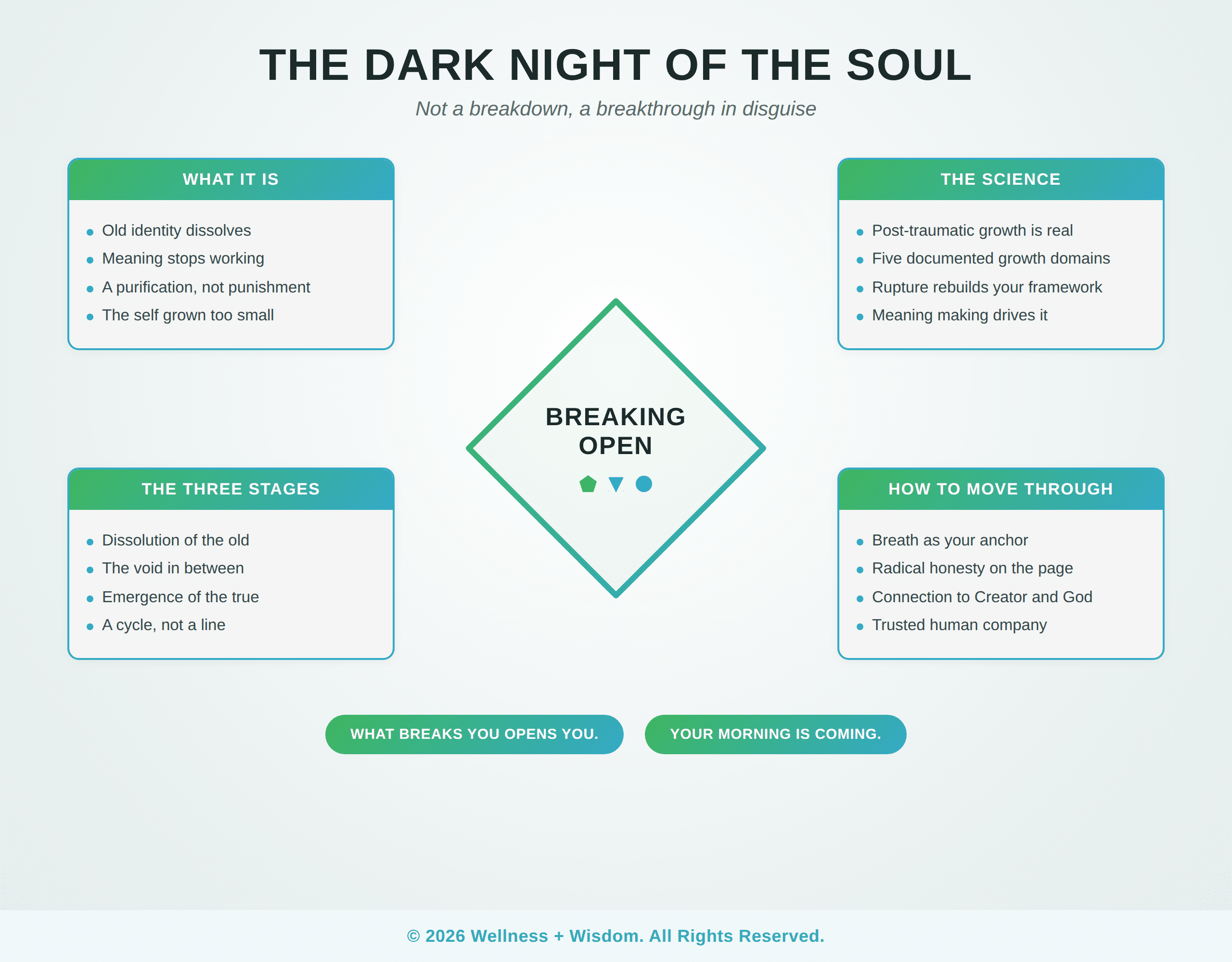
The dark night of the soul is a stage of spiritual transformation in which your old sources of meaning, identity, and security dissolve, leaving you in a disorienting darkness before a new and truer self takes shape. The phrase comes from the sixteenth century Spanish mystic Saint John of the Cross, who described it not as a punishment but as a purification, a necessary passage on the way to deeper union with the divine.
In plain and modern terms, it is what happens when the identity you built can no longer hold you. The career that used to define you goes hollow. The beliefs that used to comfort you stop landing. The version of yourself you performed for years suddenly feels like a costume you cannot stand to wear one more day. Nothing external may even be wrong, and yet everything internal is coming undone.
That undoing is terrifying precisely because it is real. You are not imagining the loss. Something genuinely is ending. But endings and deaths are not the same thing. A caterpillar dissolving in the cocoon is not dying, though from the inside it must feel exactly like it. This is the heart of what we teach as Liberation in the L.I.F.E. Method™. Freedom almost always begins with the loss of a self that was too small.
Dark night versus clinical depression
The dark night of the soul and clinical depression can look similar from the outside, but they are not the same, and knowing the difference matters for how you care for yourself. Both can involve deep sadness, loss of motivation, and a sense that the old life has drained of color. Where they differ is in texture and trajectory.
A dark night usually carries a strange thread of meaning inside the pain, a felt sense that something is being worked out, that you are being taken somewhere even if you cannot see where. It tends to be tied to questions of identity, purpose, and spirit. Clinical depression, by contrast, often flattens meaning entirely and can arrive with physical markers, persistent hopelessness, and thoughts of not wanting to be here.
Here is the honest and important part. These two can overlap, and one can become the other. This is not a competition between soul and science, and you do not have to choose a side. If you are struggling with persistent hopelessness, or you are having thoughts of harming yourself, please reach out to a qualified professional or a crisis line right away. Getting support is not a failure of the spiritual path. It is wisdom, and it is part of walking the path well. The frameworks here are companions to real care, never a replacement for it.
Why the dark night happens
The dark night happens because a self that was built for survival eventually collides with a soul that wants to actually live. For most of us, the identity we carry into adulthood was assembled under pressure. We became who we needed to be to earn love, to stay safe, to belong, to avoid pain. That self is not bad. It got you here. But it was optimized for protection, not for aliveness, and at some point the gap between the two becomes impossible to ignore.
Sometimes a specific event kicks the door open. A loss, a diagnosis, a divorce, a betrayal, a career ending, a moment where the story you were living simply cannot continue. Other times there is no single trigger at all. Life is objectively fine on paper, and yet a quiet voice underneath everything keeps whispering that this cannot be all there is. Both are valid entrances to the same passage.
What is really happening is that your inherited constructs are being challenged, the beliefs and roles and patterns you absorbed long before you had any say in them. This is closely related to the work of Emotional Epigenetics™, the understanding that so much of what we carry was handed to us, not chosen by us. The dark night is often the moment those handed down patterns finally break their grip, which is exactly why it feels like an earthquake. The ground that is shaking was never truly solid. It only felt that way because you had never questioned it.
There is a particular loneliness to this that deserves naming. In the middle of a dark night, you can be surrounded by people who love you and still feel utterly unreachable, because what is dissolving is invisible to everyone but you. Friends may tell you to cheer up, to be grateful, to snap out of it, and every well meaning word can land like proof that nobody understands. This is not a sign that something is wrong with you. It is the nature of the passage. The old self spoke a language everyone around you recognized. The new one has not learned to speak yet. That silent stretch between languages is part of the work, and it is one reason a Liberated Life Tribe of people who have walked it matters so much. Being witnessed by someone who has been in the dark changes everything.
It also helps to understand that the dark night is not a modern invention or a wellness trend. Every serious wisdom tradition has mapped this territory, from the mystics to the great teachers explored across the Wellness + Wisdom Podcast. Human beings have always known that transformation runs through darkness. What our culture forgot, and what this work remembers, is that the darkness is not the enemy of the light. It is the soil.
The science of growth through adversity
Modern psychology has a name for the transformation that can emerge from profound struggle, and it is called post-traumatic growth. Coined by researchers Richard Tedeschi and Lawrence Calhoun in the 1990s, post-traumatic growth describes the genuine positive change that many people experience not in spite of their darkest passages, but through them. This is not wishful thinking. It is a well documented area of study.
In their research, published and expanded across decades including in a 2023 paper in World Psychiatry, Tedeschi and Calhoun identified five domains where people commonly report growth after a crisis: a deeper appreciation for life, closer relationships, a greater sense of personal strength, recognition of new possibilities and paths, and spiritual or existential development. That last domain matters here. The dark night lands squarely in the territory where people report the most spiritual growth.
The numbers are striking. As reported by the American Psychological Association, a large majority of trauma survivors report at least one dimension of post-traumatic growth, such as renewed appreciation for their lives. The mechanism the researchers describe is illuminating. Growth does not come from the event being pleasant. It comes from what they call a rupture in your assumptive world, the shattering of your old framework, which forces a cognitive rebuilding into something more spacious and resilient than what came before.
A recent meta-analysis on post-traumatic stress and post-traumatic growth reinforces the pattern, finding that the distress and the growth are often intertwined threads of the same process rather than opposites.
Read that again, because it is the whole point. The breaking is not the opposite of the growth. The breaking is the beginning of the growth. Your old structure has to come apart for a truer one to be built. And here is the honest caveat that keeps this real: growth is not guaranteed, and it is not a reason to rush anyone through their pain. The research is equally clear that post-traumatic growth can coexist with ongoing distress. You do not have to feel grateful for the dark night while you are in it. You only have to keep walking.
There is one more piece of the science worth holding onto. The researchers found that growth is not primarily a function of how bad the event was. It is a function of the meaning making that happens afterward, the willingness to engage with the questions the crisis raised rather than numb them away. That is genuinely good news, because meaning making is something you can participate in. You cannot always choose what breaks you open. You can choose whether to sit with the pieces honestly, and that choice is where the transformation lives. This is precisely why practices like breathwork, honest reflection, and conscious community are not soft extras during a dark night. They are the very tools that tilt a rupture toward growth instead of toward getting stuck, which is the heart of everything inside the L.I.F.E. Method™ programs.
The stages of moving through it
Moving through the dark night of the soul tends to follow a rough arc, and knowing the arc helps because it reminds you that where you are is a stage, not a permanent address. These stages are not rigid or linear, and you may cycle through some more than once, but the shape is recognizable to almost anyone who has walked it.
The dissolution
First comes the falling apart. The old identity, beliefs, or life structure stop working, and you feel the ground go out from under you. This stage is marked by confusion, grief, and often a frightening sense that you no longer know who you are. The instinct here is to grab for anything that will make it stop. The invitation, hard as it is, is to let the dissolution do its work.
The void
Then comes the in between, the space where the old is gone and the new has not yet arrived. This is the loneliest part of the passage, the wilderness with no landmarks. Nothing feels certain and nothing feels finished. The void is deeply uncomfortable, and it is also sacred ground, because it is the only place where something genuinely new can be born rather than just rearranged. Most people try to skip this stage by rushing into a new job, a new relationship, a new belief system, anything to escape the emptiness. That rushing is exactly what short circuits the transformation. The void has its own intelligence. If you can stay in it without collapsing and without fleeing, it does something no amount of striving can do. It clears the space for a self you could not have manufactured on purpose.
The emergence
Slowly, often so slowly you barely notice at first, something begins to reform. A new sense of self, quieter and truer than the last. Small returns of energy, curiosity, and even joy. This is where the growth the research describes starts to become visible. You are not returning to who you were. You are becoming someone the old you could not have imagined.
The L.I.F.E. Method and the dark night
The L.I.F.E. Method™ maps almost perfectly onto the journey of the dark night, which is no accident, because it was built from lived passages exactly like this one. Its four pillars are Liberation, Integration, Frequency, and Embodiment, and each one meets a specific need of the person moving through the dark.
Liberation is the dissolution itself, the freeing of yourself from an identity that was never fully yours. Integration is the work of the void, where you make sense of what is surfacing and begin weaving the fragments into something whole. Frequency is the gradual raising of your baseline state as the heaviness lifts and lighter states become available again. And Embodiment is the emergence made real, the new self brought all the way down into how you live, move, and relate, not just how you think.
This is why we say the dark night is not something to escape but something to move through consciously. Handled with awareness, it becomes the most powerful identity transformation available to a human being. This is the same terrain we explore constantly across the latest episodes and inside the Liberated Life Tribe, because almost no one navigates it well alone.
Practices for the dark night
The practices that help in the dark night are not about forcing your way back to the light. They are about staying present and resourced while the deeper work unfolds. Think of them as ways to keep your feet under you, not ways to rush the passage. Many of them draw on the same tools we gather in the store and teach across our latest episodes, adapted for the particular tenderness of this season.
Breath as an anchor. When the disorientation peaks, your breath is the one steady thing you always have. Slow, long exhales settle the neural system and remind your body it is safe even when your mind is in freefall. This is the foundation of our BREATHE™ work, and it is never more useful than here.
Radical honesty on the page. Write without editing. Let the confusion, grief, and questions pour out. Naming what is moving through you takes it out of the shadows and gives the reforming self something to work with.
Connection to Creator and God. The dark night is, at its root, a spiritual passage. Whatever your practice, this is the season to lean into it. Prayer, silence, time in nature, surrender. You do not have to have the words. Presence is enough.
Trusted human company. You were never meant to walk the wilderness alone. A wise friend, a guide, a therapist, a community that understands. Isolation is the one thing that turns a hard passage into a dangerous one, so let yourself be witnessed.
Gentleness with the body. Sleep, movement, food, water, sunlight. When the soul is doing heavy lifting, the body needs more care, not less. Small acts of physical kindness keep you steady enough to do the inner work.
What waits on the other side
What waits on the other side of the dark night is not the old life restored, it is a truer life begun. People who move consciously through this passage almost universally describe the same thing on the far side: a life that is simpler, realer, and more their own. Less performance. Less fear of what others think. A steadier joy that does not depend on everything going right.
This is the deep promise hidden inside the hardest passage. You do not come out the same, and you would not want to. The self that could not survive the dark was the self that was keeping you small. What emerges is closer to who you actually are underneath everything you were told to be. That is liberation in the fullest sense, and it is the whole reason this work exists. You can explore the frameworks that support it through our mission and the wellness tools we have gathered for exactly these seasons.
What does the new self actually look like in ordinary life? Usually nothing dramatic and everything different. You stop saying yes when your body means no. You feel your feelings instead of managing them. You care less about being impressive and more about being real. Choices that used to take weeks of agonizing become clear, because you finally know what is actually yours to carry and what never was. Relationships sort themselves out, some deepening and some falling away, as you stop performing a version of yourself that was never sustainable. None of this arrives all at once. It arrives the way dawn does, so gradually that one day you simply notice there is light again, and you realize you have been walking in it for a while without naming it. That quiet, steady aliveness is the gift on the far side, and it is why we hold the dark night as sacred rather than something to merely survive.
If you are in the dark right now, hear this clearly. You are whole even here, and you are being carried toward something truer, even though it feels like the opposite. You are in the most sacred and transformative passage a human life offers. Keep breathing. Keep reaching out. The morning is closer than you think.
Frequently asked questions
What is the dark night of the soul?
The dark night of the soul is a period of deep spiritual and emotional disorientation when your old sources of meaning, identity, and certainty stop working. The term comes from Saint John of the Cross, who described it as a purification rather than a punishment. It often feels like a breakdown but is frequently the early stage of a profound transformation.
How long does the dark night of the soul last?
There is no fixed timeline for the dark night of the soul. Some people move through it in weeks, others over months or longer, often in cycles rather than a straight line. The passage tends to ease as a new and truer sense of self begins to form. Gentleness and support help you move through it with more grace.
Is the dark night of the soul the same as depression?
Not exactly, though they can look similar and can overlap. A dark night usually carries a thread of meaning and is tied to questions of identity and spirit, while clinical depression often flattens meaning and can bring persistent hopelessness. If you are experiencing ongoing hopelessness or thoughts of self harm, reach out to a qualified professional right away.
Is there science behind growth after a spiritual crisis?
Yes. Psychologists Richard Tedeschi and Lawrence Calhoun documented post-traumatic growth, the genuine positive change many people experience through profound struggle, across five domains including spiritual and existential development. A large majority of trauma survivors report at least one dimension of growth, though the research is clear that growth can coexist with ongoing distress.
What should I do during a dark night of the soul?
Stay present and resourced rather than forcing your way back to the light. Anchor in slow breathing, write honestly, lean into your spiritual practice and Connection to Creator and God, stay connected to trusted people, and care gently for your body. If distress becomes severe, seek professional support. Moving through it consciously, rather than escaping it, is what allows the transformation.
Can the dark night of the soul be a good thing?
For many people, yes, though it rarely feels that way while inside it. The dark night dissolves an identity that had become too small and clears the ground for a truer self to emerge. People who move through it consciously often describe a simpler, realer, more joyful life on the other side. The pain is real, and the growth is often just as real.
Your morning is coming
If this passage found you, it found you for a reason. The dark night of the soul is not evidence that something has gone wrong. It is evidence that something in you refuses to keep living small. Trust the process, protect your body, keep good people close, and let the old self go. What is being born is worth the dark.
Join the Liberated Life Tribe and receive your 10 day Self Liberation Blueprint at liberatedlife.com. It is a free community of people walking exactly this kind of passage, and no one should walk it alone.
Studies and External Resources
Every external source referenced in this article, verified against the original publication:
- Tedeschi and Calhoun, The post-traumatic growth approach to psychological trauma (World Psychiatry)
- American Psychological Association, Growth after trauma
- Meta-analysis on post-traumatic stress and post-traumatic growth (ScienceDirect)
About Josh Trent
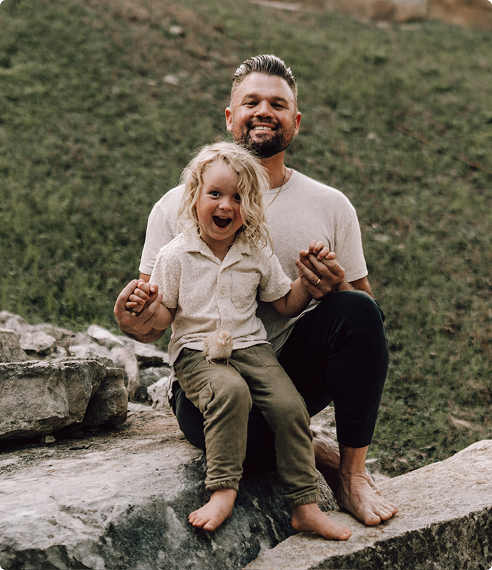
Josh Trent is an Identity Transformation Architect and the award winning host of the Wellness + Wisdom Podcast, with over 15 million downloads since 2015. He is the creator of the L.I.F.E. Method™ Identity Transformation System and steward of the Emotional Epigenetics™ and BREATHE: Breath + Wellness™ systems of self mastery, impacting over 1,000 students worldwide. Explore his story, browse wellness tools in the store, or start with the Liberated Life Tribe. Josh lives in Austin, Texas with his wife Carrie, daughter Nayah, and son Novah.
Peace and power.
Disclosure: We may earn a commission from certain links on this site when you make a purchase, at no extra cost to you. These commissions help support Wellness + Wisdom and do not affect the products or resources we choose to recommend. Full disclosure .