By Josh Trent | Mental Health
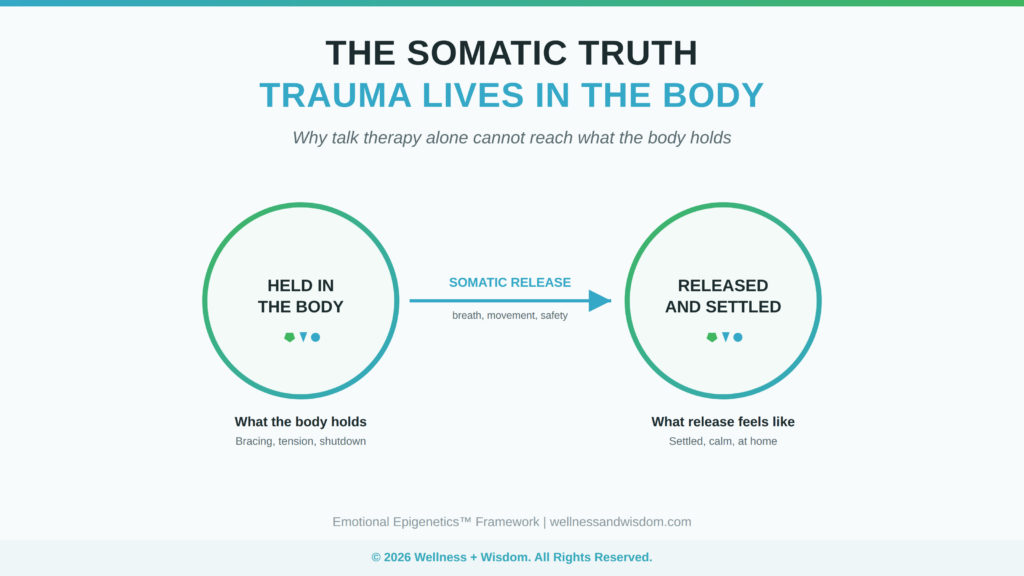
You can understand exactly why you feel the way you feel and still feel it in your body every single day. Insight is the beginning of healing, not the end. The body has its own language, and it deserves to be heard.
Here is something that sets so many thoughtful people free: if you have done years of talk therapy and still feel the old patterns living in your body, you are not failing at healing. You are bumping into one of the most important truths in trauma science. Somatic healing exists because some of what we carry was never stored as a story in the first place. It was stored in the body, and the body is where it asks to be met. Understanding this work is one of the most hopeful turns you can take, because it opens a door that words alone could never quite reach.
In this guide we will explore why trauma lives in the body, what the research actually shows about body based healing, and the specific practices that help release what talking cannot. This connects directly to the BREATHE™ work and to Emotional Epigenetics™, where the body is honored as a full participant in healing, not just a vehicle for the mind.
Table of Contents
- What Somatic Healing Actually Means
- Why the Body Keeps the Score
- Where Talk Therapy Reaches Its Limit
- The Science of Somatic Healing
- How Somatic Healing Works in the Body
- What Stored Trauma Feels Like in the Body
- Seven Somatic Healing Practices
- Going Slow on Purpose: The Art of Titration
- Why It Is Both, Not Either Or
- Frequently Asked Questions
- Studies and External Resources
- About Josh Trent
What Somatic Healing Actually Means
Somatic healing is the practice of working with the body, its sensations, movements, and breath, to release and resolve the imprints of stress and trauma that live below the level of words. The term somatic comes from the Greek soma, meaning the living body. So somatic work simply means body based work, healing that includes the felt experience rather than only the thinking mind.
This matters because so much of what we carry is not a memory we can narrate. It is a bracing in the shoulders, a tightness in the chest, a habit of holding the breath, a body that goes on alert before the mind even registers a reason. These are real and they are physical, and they respond to a physical kind of attention. This is the same body wisdom we explore through bioenergetic memory, the idea that experience leaves an imprint in the tissues, not only the thoughts.
None of this replaces the mind. It completes it. The most whole healing engages both the story you can tell and the sensation you can feel. Somatic healing is how we welcome the second half of that equation home.
Why the Body Keeps the Score
The phrase the body keeps the score has entered the cultural conversation for good reason, and it traces back to real science. In an influential paper in the Harvard Review of Psychiatry, Bessel van der Kolk described how traumatic memory and the psychobiology of stress are held in the body and the neural system, shaping physiology long after an event is over.
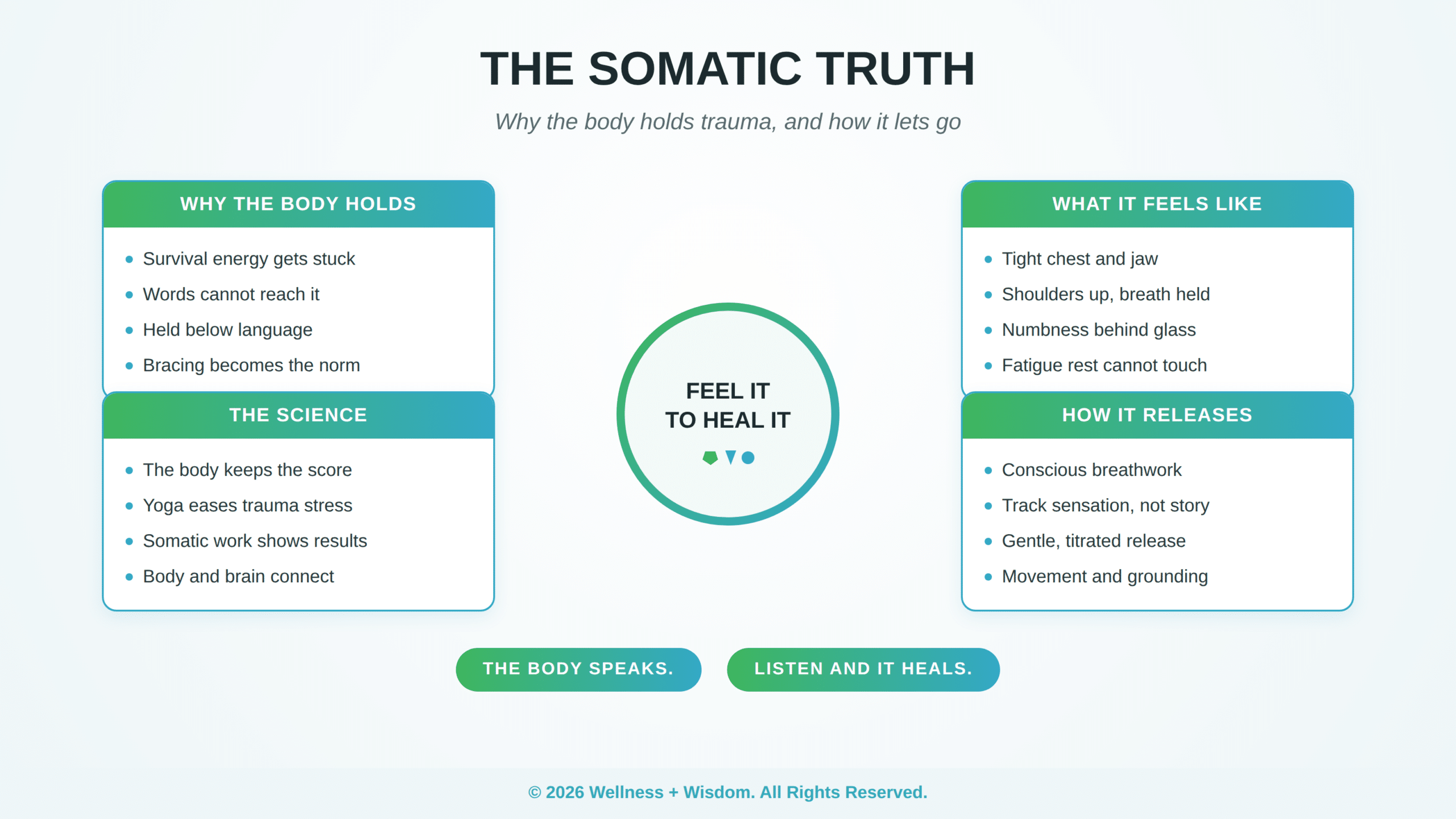
When something overwhelming happens, the body mobilizes enormous survival energy. If that energy cannot complete its natural cycle, it does not simply vanish. It can stay held in the system as chronic tension, hypervigilance, or shutdown. This is why a person can know intellectually that they are safe now and still feel braced for danger. The knowing lives in one part of the system. The bracing lives in another. The connection between body and brain runs deep here, which is the same territory we map in how childhood trauma rewires the brain.
Understanding that the body keeps the score is liberating rather than discouraging. It means the persistent symptoms are not a sign of weakness or failure to think correctly. They are stored survival energy waiting for a safe way to move and complete. This work gives that energy the doorway it has been looking for.
Where Talk Therapy Reaches Its Limit
Let me be clear and fair, because this is important: talk therapy is genuinely valuable. Insight matters. Being witnessed matters. Making meaning of your story matters enormously, and for many people, talking is where healing begins. This is not a case against therapy. It is an invitation to add something to it.
Here is where talk alone reaches its edge. The parts of the brain that hold survival activation are not primarily verbal. You cannot always reason your way into a regulated body, because the body does not speak in sentences. It speaks in sensation, tension, breath, and movement. A person can have brilliant insight into their patterns and still feel them firing in the body, because insight and regulation live in different systems. This is the same gap we feel when we know better and still react, the gap that practices like the 90 second emotion rule help close.
So the limit is not that talking fails. The limit is that talking addresses one layer, and there is another layer that needs a different language. Body based work speaks that second language. When you pair the two, the story and the sensation finally meet, and that meeting is where deep change becomes possible.
The Science of Somatic Healing
The evidence for body based approaches has grown substantially, and it is encouraging. In a randomized controlled trial published in the Journal of Clinical Psychiatry, van der Kolk and colleagues studied yoga as an adjunctive treatment for post traumatic stress and found meaningful benefits, supporting the idea that a body based practice can reach what talk alone may not. A long term follow up in the Journal of Alternative and Complementary Medicine continued to explore these effects in women with chronic post traumatic stress.
Beyond yoga, a randomized controlled outcome study published in the Journal of Traumatic Stress examined Somatic Experiencing, a specific body oriented approach, and reported positive outcomes for people with post traumatic stress. Taken together, these studies point in the same hopeful direction: when we include the body in the healing process, people often get relief that purely cognitive approaches struggle to deliver on their own.
This is exactly why this work sits at the heart of what I teach. The science and the lived experience agree. The body is not a problem to manage. It is a partner in healing, and it has been waiting to be invited in. This is the embodied dimension of the L.I.F.E. Method™, which stands for Liberation, Integration, Frequency, and Embodiment.
How Somatic Healing Works in the Body
Somatic healing works by helping stored survival energy complete and discharge in a safe, titrated way, so the body can return to a baseline of calm. Rather than reliving an overwhelming event, the focus is on gently tracking sensation in the present moment and allowing the body to do what it could not do before: finish the cycle and settle.
One of the central tools here is the breath, because breath is the one system that is both automatic and consciously controllable. By slowing and deepening the breath, you send a direct signal of safety to the neural system, which is the foundation of neural system regulation. From that regulated place, the body becomes able to release what it has been holding, layer by layer, at a pace it can handle.
Movement matters too. Gentle, intentional movement gives stored energy a pathway to move through and out. So does safe touch, sound, and the felt sense of being supported by another person. The vagus nerve plays a key role in this shift toward calm, which is why so many somatic practices work with it directly. None of this requires force. It requires safety, patience, and a willingness to listen to what the body is saying.
What Stored Trauma Feels Like in the Body
Before we go further into release, it helps to recognize what we are actually talking about, because stored trauma rarely shows up wearing a name tag. It shows up as the texture of daily life, so woven into your experience that it can feel like simply who you are.
It might be a chest that tightens the moment a conversation gets tense, a jaw that clenches in sleep, or shoulders that live up around the ears no matter how many times you tell them to drop. It might be a startle response that fires too fast, a stomach that knots before you understand why, or a deep fatigue that rest never quite touches. The gut and emotions are tightly linked, which is why so much of this is felt in the belly.
It can also show up as the opposite of activation: numbness, disconnection, a sense of watching your life from behind glass. When survival energy has nowhere to go, the body sometimes powers down instead of powering up. Both the bracing and the numbing are intelligent. They are the body protecting you the only way it knew how.
Naming these as held energy rather than personal flaws is the first gift of body based work. The tight shoulders are not a character defect. They are a held breath from a moment that never felt safe to exhale. Once you see your symptoms this way, you stop fighting your body and start listening to it, and listening is where the release begins.
Seven Somatic Healing Practices
These are practices I return to and teach, each one a gentle way of inviting the body back into the conversation. Start slow, stay within what feels manageable, and let the body lead.
1. Conscious Breathwork
Slow, extended exhales tell the body that the danger has passed. A simple practice like box breathing is the most accessible entry point into body based work, and it is the doorway most of my students begin with.
2. Track Sensation Without Story
Place your attention on a physical sensation, the warmth of your hands, the weight of your feet, the rise of your chest, without analyzing it. This trains the body to be felt rather than fled from, which is the core skill of all somatic work.
3. Intentional Movement
Shaking, stretching, dancing, or yoga gives stored energy a way to move and complete. The body holds tension in patterns, and movement is how those patterns finally loosen and release.
4. Grounding Through the Senses
Feeling your feet on the floor, naming what you see and hear, holding something textured, all bring the body into the present, where safety actually lives. Grounding is how you remind the body that now is not then.
5. Work With the Vagus Nerve
Humming, gentle gargling, slow exhales, and cold water on the face all stimulate the pathways that shift the body toward calm. These small practices build the capacity for neural system regulation over time.
6. Safe, Supportive Connection
The body co regulates with other safe bodies. A trusted presence, a supportive community, a steady hand can help the system settle in ways solitude cannot. This is why healing in community accelerates somatic work.
7. Anchor in Connection to Creator and God
For many, the deepest sense of safety is spiritual, a felt sense of being held by something larger. This Connection to Creator and God gives the body a stable center to release around, and it is a core dimension of the Wellness Pentagon™.
What It Feels Like to Come Home to Your Body
I want to give you a picture of where this leads, because the destination is worth every patient step. People who do this work describe a quiet, almost ordinary kind of miracle. The shoulders that lived around the ears for decades finally come down. The breath that was always a little held finally drops into the belly. The startle that fired at every sound begins to soften. None of it is dramatic. It is just a body slowly remembering that it is allowed to rest.
What changes most is the relationship you have with yourself. Instead of treating your body as a malfunctioning machine to be fixed or overridden, you begin to treat it as a wise, loyal companion that has been carrying you all along. The tension was never the enemy. It was a faithful guard that stayed at its post long after the threat was gone, and now it gets to stand down. That tenderness toward yourself changes everything downstream, from your relationships to your sleep to the simple experience of being awake in your own life.
This is the heart of why I keep teaching this, and why I keep coming back to it in my own life and across hundreds of conversations. We were not built to live braced. We were built to feel, to settle, to connect, and to move freely through this one wild life. Your body has been waiting patiently for permission to come home. The door is open, the pace is yours, and the very next breath is a beautiful place to start. There is no version of you that is too far along to begin, and no holding so old that the body cannot, in time and in safety, learn to let it go.
If you want a guided way to begin this body based work, the 10 Day Self Liberation Blueprint brings these practices together. You can also explore deeper conversations on the Wellness + Wisdom Podcast and browse supportive tools in our store.
Going Slow on Purpose: The Art of Titration
One of the most important and counterintuitive principles of body based work is this: faster is not better, and more is not deeper. The body releases what it has held only when it feels safe enough to do so, and safety is built slowly. Pushing hard, forcing a catharsis, or trying to blast through years of holding in a single session tends to overwhelm the very system you are trying to heal.
Skilled body based work uses something called titration, a fancy word for a simple idea: take it in small, manageable doses. You touch the edge of a sensation, then return to something neutral and calm. You let the body discharge a little, then settle. You move between activation and safety in gentle waves, so the system learns it can feel difficult things and still come back to center. Each cycle widens what the body can hold without flooding, which is the same widening of the window of tolerance we build through neural system regulation.
This is why patience is not a delay in the work. It is the work. The body is not a problem to be solved quickly. It is a living system that heals at the pace of safety. When you honor that pace, the body rewards you by opening doors it kept locked when you tried to force them. Going slow, it turns out, is the fastest way through, and it is one of the kindest things you will ever learn to do for yourself. Your body has waited a long time to be treated gently, and it will meet that gentleness with a trust that opens everything else.
Why It Is Both, Not Either Or
I want to leave you with the most important reframe of all. This is not somatic versus talk. It is somatic and talk, the body and the mind, sensation and story, working together. The richest healing honors the whole person, which is the entire premise of the Wellness Pentagon™: physical, mental, emotional, spiritual, and financial wellbeing, all nourished together.
When you bring insight and embodiment into the same room, something beautiful happens. The understanding you gained in conversation finally lands in the body. The sensations you released in the body finally make sense in the story. The two halves of you, the one that knows and the one that feels, stop working at cross purposes and start moving in the same direction. That is what integrated healing feels like, and it is the same wholeness we pursue in connection based recovery and in healing the inner child.
You were never meant to think your way to peace while your body stayed at war. Somatic healing is how you finally bring the whole of you home, and the invitation is open to you starting with your very next breath.
Frequently Asked Questions
What is somatic healing?
Somatic healing is body based work that uses sensation, breath, and movement to release the imprints of stress and trauma that live below the level of words. It complements talk therapy by addressing the physical layer of what we carry, helping the body return to a baseline of calm.
Why can't talk therapy alone heal stored trauma?
Talk therapy is valuable for insight and meaning, but the parts of the brain that hold survival activation are not primarily verbal. A person can understand their patterns and still feel them firing in the body, because insight and regulation live in different systems. Somatic work speaks the body's language.
What does the science say about somatic healing?
Randomized controlled trials have found benefits for body based approaches such as yoga and Somatic Experiencing in people with post traumatic stress, supporting the idea that including the body can reach what cognitive approaches alone may not.
Do I need to relive my trauma to do somatic work?
No. Somatic healing focuses on gently tracking sensation in the present and allowing stored energy to complete in a safe, titrated way, rather than reliving an overwhelming event. Safety and pacing are central to the approach.
Can I practice somatic healing on my own?
You can begin with gentle self practices like conscious breathwork, grounding, and intentional movement. For deeper trauma, working with a trained practitioner and a supportive community provides the safety and co regulation that make release possible.
Should I stop talk therapy and switch to somatic work?
Not necessarily. The most complete healing is usually both, not either or. Talk therapy and somatic healing address different layers, and together the story and the sensation can finally meet, which is where deep change happens.
Studies and External Resources
- van der Kolk BA (1994). The Body Keeps the Score: Memory and the Evolving Psychobiology of Posttraumatic Stress. Harvard Review of Psychiatry. PubMed
- van der Kolk BA, et al. (2014). Yoga as an Adjunctive Treatment for Posttraumatic Stress Disorder: A Randomized Controlled Trial. Journal of Clinical Psychiatry. PubMed
- Rhodes A, Spinazzola J, van der Kolk B (2016). Yoga for Adult Women with Chronic PTSD: A Long Term Follow Up Study. Journal of Alternative and Complementary Medicine. PubMed
- Brom D, et al. (2017). Somatic Experiencing for Posttraumatic Stress Disorder: A Randomized Controlled Outcome Study. Journal of Traumatic Stress. PubMed
About Josh Trent
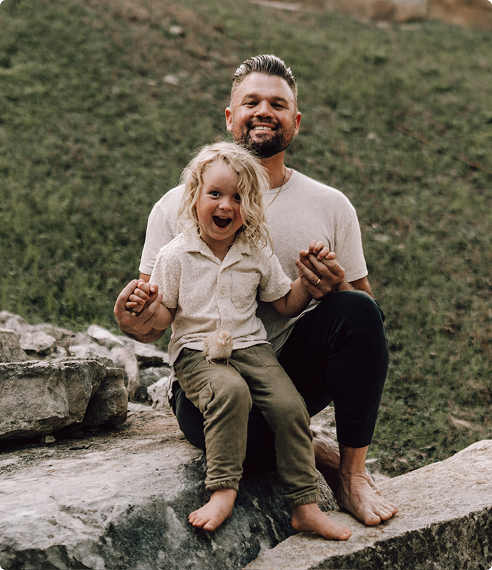
Josh Trent is an Identity Transformation Architect and the award winning host of the Wellness + Wisdom Podcast, with over 15 million downloads since 2015. He is the creator of the L.I.F.E. Method™ Identity Transformation System and steward of the Emotional Epigenetics™ and BREATHE: Breath + Wellness™ systems of self mastery, impacting over 1,000 students worldwide. Josh lives in Austin, Texas with his wife Carrie, daughter Nayah, and son Novah.
Ready to feel it heal? Join the Liberated Life Tribe and receive your 10 day Self Liberation Blueprint at liberatedlife.com. Peace and power.
Disclosure: We may earn a commission from certain links on this site when you make a purchase, at no extra cost to you. These commissions help support Wellness + Wisdom and do not affect the products or resources we choose to recommend. Full disclosure .