
By Josh Trent | Emotional Intelligence
You can feel deeply for the world and still keep your own center. Empathy was never meant to mean drowning in everyone else's weather. The most loving thing you can do is stay whole enough to actually help.
Have you ever walked into a room feeling good and walked out carrying a heaviness that was not yours? Or sat with a stressed friend and left wired and anxious yourself? That is emotional contagion, and once you understand it, you gain one of the most practical gifts in all of emotional intelligence: the ability to stay open hearted and connected without losing yourself in the process. Understanding this is not about building walls. It is about learning to feel with people while staying rooted in your own center.
In this guide we will explore what emotional contagion actually is, what the science shows about how we catch each other's feelings, and the practices that let you protect your energy while keeping your heart wide open. This connects directly to the work of building emotional intelligence as an adult and to the Wellness Pentagon™, where emotional wellbeing is a dimension worth tending with real skill.
Table of Contents
- What Is Emotional Contagion
- The Science of Emotional Contagion
- Why Some People Absorb More Than Others
- The Hidden Cost of Absorbing Everyone's Feelings
- Where Emotional Contagion Shows Up in Daily Life
- How to Protect Your Energy Without Closing Your Heart
- Seven Practices to Protect Your Energy
- Are You an Empath? Understanding Deep Sensitivity
- What Changes When You Master This
- Empathy Without Drowning
- Frequently Asked Questions
- Studies and External Resources
- About Josh Trent
What Is Emotional Contagion
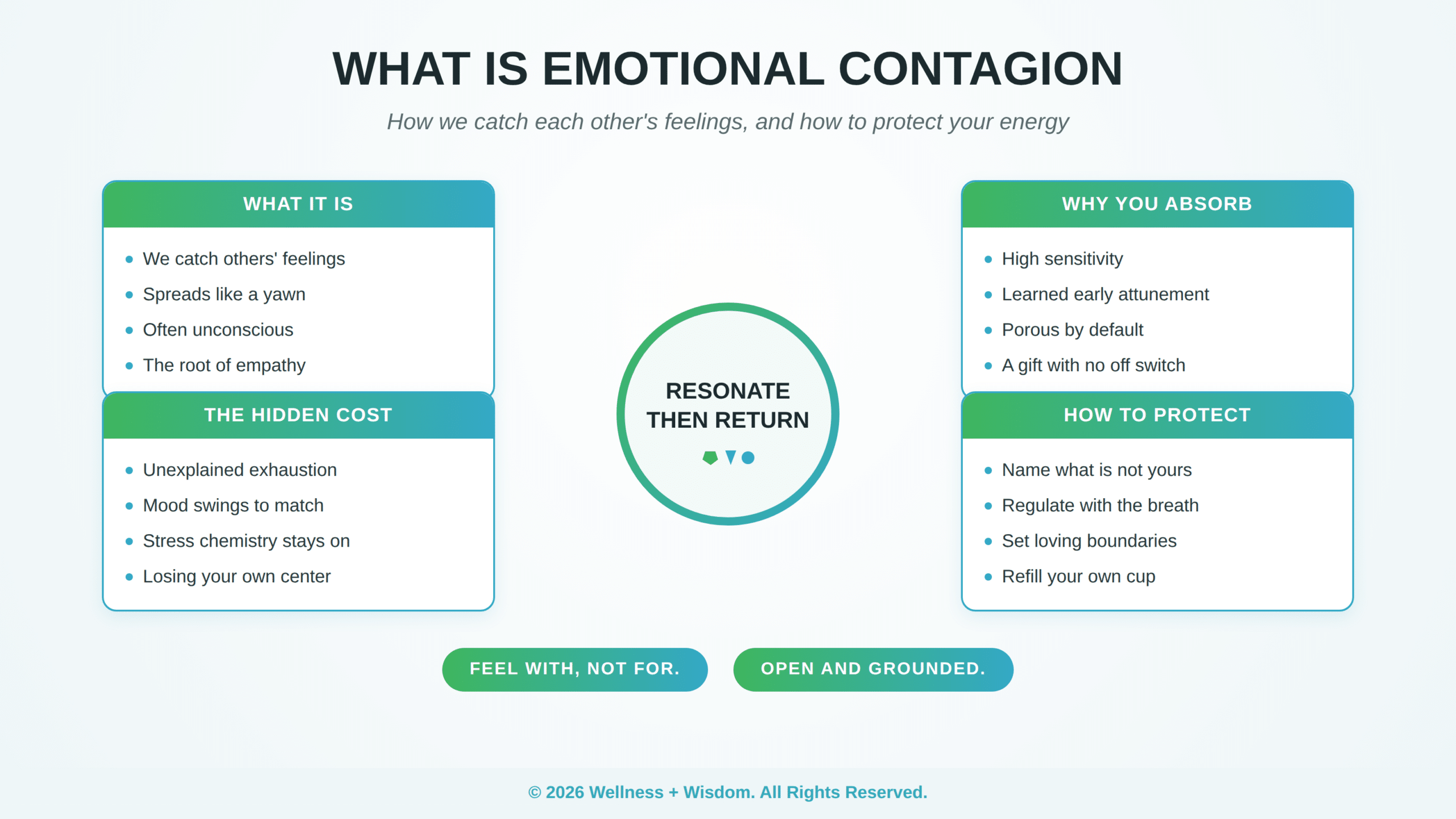
Emotional contagion is the natural tendency to catch and feel the emotions of the people around us, often without realizing it is happening. Just as a yawn can spread across a room, so can calm, joy, anxiety, anger, and grief. We are wired to resonate with each other, and that resonance moves between us faster than thought.
This is not a flaw in your design. It is one of the most beautiful features of being human. This resonance is part of how we bond, how we feel understood, how a mother soothes a baby, how a crowd lifts as one. The capacity to catch each other's feelings is the root of empathy and connection itself, which is why it sits so close to the heart of connection and belonging.
The challenge is simply that this gift has no off switch by default. The same openness that lets you feel another person's joy also lets you absorb their stress, and without a little skill, you can end up carrying emotions that were never yours to hold. The good news is that this skill is entirely learnable.
The Science of Emotional Contagion
The research here is rich and fascinating. One striking demonstration came from a large study published in the Proceedings of the National Academy of Sciences, which found evidence that emotions can spread between people through social networks, even through text on a screen, without direct in person contact. Feelings, it turns out, are genuinely transmissible.
At a more intimate level, research by Ulf Dimberg and colleagues published in Psychological Science showed that people unconsciously mirror the facial expressions of others, reacting to happy and angry faces with tiny matching muscle movements they were not even aware of. We literally rehearse each other's emotions in our own bodies. A broader review in Neuroscience and Biobehavioral Reviews continues to explore how this mimicry serves connection and affiliation between people.
It even reaches our stress chemistry. A study in Hormones and Behavior examined empathic stress, the way one person's stress response can ripple into an observer, and how that transfer is shaped by experience. In other words, this is not just a feeling. It is physiology moving between bodies, which is part of why it can affect your whole neural system, and why neural system regulation is such a useful counterbalance.
Why Some People Absorb More Than Others
If you have always felt like a sponge for other people's emotions, there is a real reason, and it is not weakness. Some people are simply more sensitive to it, and that sensitivity often has roots worth understanding with compassion.
Highly empathic and sensitive people tend to pick up on subtle emotional cues that others miss. This is a genuine gift in connection, caregiving, and creativity. The same wiring that makes someone a deeply attuned friend or a gifted healer also makes them more porous to the emotional atmosphere around them.
For many, this heightened absorption was also shaped early. A child who grew up scanning a caregiver's mood for signs of safety learns to track emotions with exquisite precision, because reading the room was once a survival skill. This is the same early attunement we explore in how childhood trauma rewires the brain and in healing the inner child. If you absorb a lot, it likely means you learned to, and what was learned can be gently rebalanced.
The Hidden Cost of Absorbing Everyone's Feelings
When this runs unmanaged, it quietly drains you. With unmanaged absorption, you may end days exhausted without knowing why, feel anxious in crowds, or notice your mood swinging to match whoever you were last with. You might dread certain people not because you dislike them, but because being near them leaves you depleted.
Over time, carrying emotions that are not yours takes a real toll on the body. Chronic absorption keeps your stress chemistry activated, which affects sleep, digestion, and energy. The gut and emotions are closely linked, so a system constantly braced against the emotional weather often speaks up through the body first.
There is an emotional cost too. When you are always tuned to everyone else's state, you can lose touch with your own. You stop knowing what you feel, want, or need, because your inner radar is permanently pointed outward. Reclaiming your center is not selfish. It is the foundation that makes sustainable compassion possible, and it is a core practice in balancing your emotions.
Where Emotional Contagion Shows Up in Daily Life
Once you know what to look for, you start to see this dynamic everywhere, because it is woven into every space where humans gather. Recognizing it in the moment is the first step toward staying centered within it.
At work, one stressed leader can flood an entire team with tension, while one calm, grounded presence can settle a whole room. In families, moods move through the house like weather, and children are especially porous to the emotional climate the adults create. This is part of why the work of conscious parenting begins with the parent's own regulation. The calmest person in the room often sets the tone for everyone.
In friendships and intimate relationships, two people can amplify each other's states in a loop, anxiety feeding anxiety, or calm deepening calm. Understanding this gives you real choice about which loops you feed. And in crowds, concerts, sporting events, or even a tense waiting room, you can feel the collective mood wash over you in seconds. None of this means you are doing anything wrong. It means you are human and connected, and with a little awareness, you get to decide how much of the surrounding weather you take on as your own.
How to Protect Your Energy Without Closing Your Heart
Here is the heart of it: protecting your energy does not mean becoming cold, numb, or closed off. The goal is not less love. It is more discernment. You can stay soft and open while learning to tell the difference between what is yours and what you have simply picked up.
The first move is awareness. Most absorbed emotion slips in unnoticed, so simply naming what is happening, this anxiety is not mine, I caught it, instantly returns some of your power. You cannot set down what you have not noticed you are holding. This is the same pause between trigger and response trained by the 90 second emotion rule.
The second move is regulation. A regulated body is far less porous than a dysregulated one. When your own system is calm and grounded, other people's storms pass through without sweeping you away. This is why breath based neural system regulation is your single most powerful tool here. You are not building a wall. You are building a center so steady that you can stay present to someone's pain without being pulled under by it.
Seven Practices to Protect Your Energy
These are practices I return to and teach, each one a way of staying open hearted while keeping your own center. They protect your energy without ever asking you to care less.
1. Name What Is Yours and What Is Not
When a feeling rises, pause and ask: is this mine, or did I catch it? Simply naming an emotion as borrowed loosens its grip and returns you to your own experience.
2. Regulate With the Breath
A few slow, extended exhales bring your body back to center, making you far less porous to the emotional weather around you. A quick round of box breathing can reset your whole system in moments.
3. Ground in Your Own Body
Feel your feet on the floor, your breath in your chest, the weight of your own presence. Coming home to your physical self reminds you where you end and another person begins.
4. Discharge After Heavy Encounters
After time with intense people, move your body, shake, walk, or breathe to release what you absorbed. Energy that is not discharged tends to linger, so give it a way out.
5. Set Loving Boundaries
You are allowed to limit time with people who consistently drain you, and to do it with love rather than guilt. Boundaries are not rejection. They are how you stay resourced enough to keep showing up. A clear, kind no to what drains you is quietly a yes to everything and everyone you want to show up for fully, and the people who love you well will understand that the version of you that has reserves is the version they actually want around, present and steady and genuinely there.
6. Refill Your Own Cup First
You absorb less when you are full. Rest, joy, nature, and connection in a supportive community keep your own reserves high, so you meet others from overflow rather than depletion.
7. Anchor in Connection to Creator and God
The steadiest center of all is spiritual, a felt sense of being held by something larger than any room's emotional weather. This Connection to Creator and God gives you a ground that no contagion can shake, and it is a core dimension of the Wellness Pentagon™.
A Note on the Digital Age
One more layer deserves attention, because it is reshaping how feelings move between us. The research showing emotions spreading through social networks points to something we all feel but rarely name: our screens are powerful conductors of mood. A scroll through a feed can leave you anxious, envious, or outraged in minutes, having absorbed the emotional charge of hundreds of strangers without ever leaving your couch.
This is the same human wiring at work, simply at a scale and speed our ancestors never faced. The feeds are often engineered to spread the most activating emotions fastest, which means your openness can be quietly hijacked if you are not paying attention. Protecting your energy in this era includes protecting your attention, choosing consciously what emotional streams you plug into and for how long. Building healthier digital boundaries is not about disconnecting from the world. It is about deciding, on purpose, whose weather you let in.
If you want a guided way to build this kind of grounded openness, the 10 Day Self Liberation Blueprint brings these practices together. You can also explore deeper conversations on the Wellness + Wisdom Podcast and browse our latest episodes on emotional mastery.
Empathy Without Drowning
Let me offer the reframe that ties this all together. The aim is not to feel less. It is to feel clearly. Emotional contagion becomes a problem only when we cannot tell our feelings from everyone else's. When you can, your sensitivity transforms from a burden into one of your greatest gifts.
Think of it like being a tuning fork rather than a sponge. A sponge soaks up everything indiscriminately and grows heavy and saturated. A tuning fork resonates with a sound, then returns to stillness, ready to ring true again. You can resonate deeply with another person's experience, truly feel it, and then return to your own clear note. That is the mastery on offer here, and it is the same emotional skill we build through the L.I.F.E. Method™, which stands for Liberation, Integration, Frequency, and Embodiment. None of this happens overnight, and you will still have days when someone else's storm catches you off guard. That is part of being human and porous and alive. The skill is not perfection. It is the steady practice of noticing sooner, returning faster, and treating yourself with patience each time you find your way back to your own clear note.
The world does not need you to harden. It needs you present, resourced, and whole. When you learn to protect your energy, you do not love less. You love from a fuller place, and you become able to stay with people in their hardest moments without losing yourself. That is empathy without drowning, and it is available to you starting today. You do not have to choose between caring deeply and staying whole. With a little practice, you get to do both, and the people you love get the best of you instead of the leftovers.
Are You an Empath? Understanding Deep Sensitivity
If you have always felt things more intensely than the people around you, you may identify with the word empath, and there is real meaning behind it. Deeply sensitive people experience the emotional world with the volume turned up, picking up nuances of mood, tone, and energy that others walk right past.
This sensitivity is a profound gift. It tends to make people wonderful listeners, intuitive friends, gifted caregivers, artists, and healers. The same openness that lets you catch a stranger's sadness across a room is the openness that lets you offer extraordinary compassion and presence. The world is better for the deeply feeling people in it. I want to be clear about that, because so many sensitive people have been told their whole lives that they are too sensitive, as if their greatest strength were a defect.
The work is not to dial down your sensitivity. It is to add a steady center underneath it, so your gift does not cost you your wellbeing. A sensitive person with strong grounding and good boundaries becomes a force for healing in the world, fully open and fully resourced at the same time. This is the integration we cultivate through emotional intelligence and through reconnecting with your own needs after years of putting everyone else first. Your sensitivity is not the problem. The missing piece was simply the skill to hold it.
What Changes When You Master This
I want to paint a picture of life on the other side of this skill, because it is genuinely lighter. People who learn to stay centered amid the emotional weather describe a kind of freedom they did not know was available. They can sit with a friend in crisis and offer real comfort without taking the crisis home in their own chest. They can walk through a tense meeting and leave it at the door. They can love an anxious family member fully without catching the anxiety themselves.
The exhaustion lifts first. So much of the tiredness sensitive people carry is the cost of hauling around feelings that were never theirs. When you stop absorbing indiscriminately, energy you did not know you were spending comes flooding back. You start to recognize your own emotions again, clearly and on their own terms, which makes you a better friend, partner, and parent, not a worse one.
And here is the part that surprises people most: your compassion deepens. When you are no longer drowning, you can actually stay present with someone's pain instead of pulling away to protect yourself. Grounded openness lets you move toward suffering rather than flinch from it. This is the mature, sustainable empathy that the world is so hungry for, the kind we build together in the Liberated Life Tribe and explore across our latest episodes. You become a steady place other people can lean on, precisely because you learned to keep your own feet on the ground.
Frequently Asked Questions
What is emotional contagion?
Emotional contagion is the natural tendency to catch and feel the emotions of people around us, often unconsciously. Calm, joy, anxiety, and stress can all spread between people much like a yawn, because we are wired to resonate with each other.
Is emotional contagion real or just a feeling?
It is real and measurable. Research has shown emotions spreading through social networks, people unconsciously mirroring each other's facial expressions, and even stress responses transferring between individuals. It is physiology moving between bodies, not just imagination.
Why do I absorb other people's emotions so easily?
Some people are naturally more sensitive and pick up subtle emotional cues others miss, which is a genuine gift. For many, heightened absorption was also learned early, when reading a caregiver's mood was a way to stay safe. What was learned can be gently rebalanced.
How do I protect my energy without becoming cold?
Protecting your energy is about discernment, not distance. Name what is yours and what you caught, regulate your body with the breath, ground in your own physical presence, and set loving boundaries. You stay open hearted while building a steady center.
What is the difference between empathy and emotional contagion?
Empathy is understanding and resonating with another person's feelings while staying anchored in yourself. It becomes a problem when you cannot tell your feelings from theirs and get swept away. The goal is to resonate, then return to your own center.
Can breathwork help with emotional contagion?
Yes. A regulated body is far less porous than a dysregulated one. Slow, extended exhales and simple practices like box breathing calm your system so other people's emotions can pass through without pulling you under.
Studies and External Resources
- Kramer ADI, Guillory JE, Hancock JT (2014). Experimental Evidence of Massive Scale Emotional Contagion Through Social Networks. PNAS. PubMed
- Dimberg U, Thunberg M, Elmehed K (2000). Unconscious Facial Reactions to Emotional Facial Expressions. Psychological Science. PubMed
- Review (2025). Rethinking the Function of Mimicry: From Prediction to Affiliation. Neuroscience and Biobehavioral Reviews. PubMed
- Empathic Stress and Prior Experience (2024). Hormones and Behavior. PubMed
About Josh Trent
Josh Trent is an Identity Transformation Architect and the award winning host of the Wellness + Wisdom Podcast, with over 15 million downloads since 2015. He is the creator of the L.I.F.E. Method™ Identity Transformation System and steward of the Emotional Epigenetics™ and BREATHE: Breath + Wellness™ systems of self mastery, impacting over 1,000 students worldwide. Josh lives in Austin, Texas with his wife Carrie, daughter Nayah, and son Novah.
Ready to feel clearly? Join the Liberated Life Tribe and receive your 10 day Self Liberation Blueprint at liberatedlife.com. Peace and power.
Disclosure: We may earn a commission from certain links on this site when you make a purchase, at no extra cost to you. These commissions help support Wellness + Wisdom and do not affect the products or resources we choose to recommend. Full disclosure .