
By Josh Trent, Identity Transformation Architect and host of the Wellness + Wisdom Podcast
Most fights are not about what they are about. They are two neural systems in survival mode, trying to feel safe. Learn to keep the body calm and the whole conversation changes.
Difficult conversations break down for a reason that has almost nothing to do with the topic and almost everything to do with your biology. When a conversation with someone you love turns tense, your body can shift into a survival state so fast that the part of your brain responsible for listening, empathy, and problem solving goes quiet. You are still talking, but you are no longer really there. This article is about what actually happens in those moments, why it is not a character flaw, and how to have the hard conversation while staying connected instead of triggered.
This is joy-forward work, not conflict-avoidance work. The goal is not to never disagree. The goal is to be able to say the true, hard thing and stay in relationship while you do it. That is one of the most freeing skills a person can build, and it starts in the body.
Table of Contents
- Why difficult conversations go sideways
- The science of flooding
- Before the conversation: regulate first
- The first three minutes matter most
- During the conversation: staying present
- What to do when you get triggered
- The L.I.F.E. Method and conscious communication
- The power of repair
- Frequently asked questions
- Studies and External Resources
Why difficult conversations go sideways
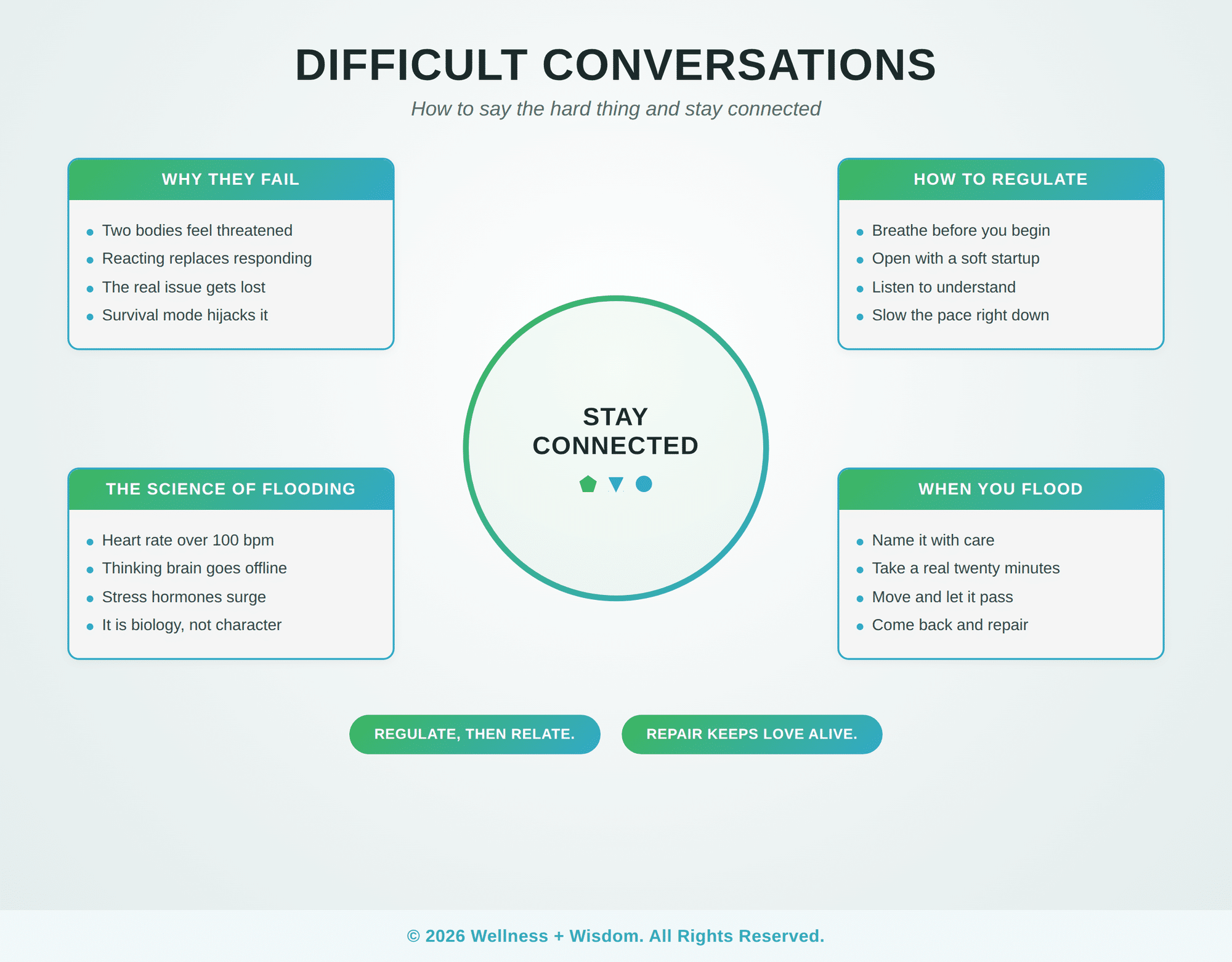
Difficult conversations go sideways because two people stop responding and start reacting, driven by a survival response that fires long before either of them chooses it. You have felt this. One moment you are trying to work something out, and the next you are defending, attacking, or shutting down, and you cannot quite explain how you got there so fast.
Here is the reframe that changes everything: in that heated moment, you are not dealing with a stubborn partner. You are dealing with two neural systems that have decided a conversation is a threat. When the body perceives threat, it does not care about resolution. It cares about safety, and it will hijack the whole exchange to get it. The words become weapons or walls, and the actual issue gets lost.
Understanding this is the first liberation. The problem is rarely that you picked the wrong words or that your partner is impossible. The problem is that both bodies got activated, and activated bodies cannot connect. Once you see that, you stop fighting the person and start working with the physiology, which is the whole approach we teach across the Wellness + Wisdom Podcast and inside our mission.
The science of flooding
Flooding is a measurable physiological state in which conflict activates your survival response so strongly that clear thinking becomes nearly impossible. This is not a metaphor or a personality quirk. It was documented in a research lab, and knowing the mechanism gives you real power over it.
The relationship researcher John Gottman spent decades studying couples in his lab, wiring them to heart monitors while they discussed points of conflict. He identified a state he called flooding, or diffuse physiological arousal. As detailed in his work on physiological self-soothing, when a person's heart rate climbs past roughly one hundred beats per minute during a conflict, the higher brain functions responsible for empathy, listening, and problem solving begin to shut down. In his words, past that point you cannot truly hear what your partner is telling you no matter how hard you try.
What is happening biologically is the fight-or-flight response taking over. Your sympathetic neural system fires, stress hormones surge, your heart speeds, and blood moves away from the thinking brain toward the muscles that would help you fight or flee. Your body is preparing for a physical threat that is not actually there. A peer-reviewed study on emotional flooding in couple conflicts found that a person's propensity to flood is closely tied to their experienced and expressed anger and to how aversive a partner's behavior feels in the moment, confirming that flooding is a real and central factor in how conflict escalates.
This is why willpower alone fails in a heated conversation. You cannot think your way calm once you are flooded, because the thinking part is the very thing going offline. The lever is the body, and specifically the neural system that governs whether you feel safe. Regulate that, and your intelligence comes back online. That is not soft advice. It is working with the actual machinery.
Before the conversation: regulate first
The most important part of a difficult conversation happens before you say a single word, in the state you bring to it. If you walk in already activated, already braced for battle, your body will read threat from the first sentence and flooding becomes almost inevitable. If you walk in regulated, you give the whole exchange a fighting chance.
Regulating first is simple, though not always easy. A few minutes of slow breathing, with the exhale longer than the inhale, settles your neural system and tells your body it is safe. This is the foundation of the BREATHE™ work, and it is never more useful than right before a hard talk. You are not calming down so you can suppress what you feel. You are calming down so you can actually say it well.
It also helps to get clear on your real intention before you begin. Are you trying to win, or to be understood and to understand? Are you here to punish, or to connect and solve? The neural system of the person across from you will feel the difference before you finish your first sentence. When your intention is connection, your body carries a different signal, and their body tends to answer it. This inner clarity is part of the identity work in the L.I.F.E. Method™, because how you show up in conflict is a direct expression of who you have become.
Timing is part of regulating first, and it is wildly underrated. Trying to have a hard conversation when one of you is exhausted, hungry, rushing out the door, or already frazzled from the day is setting a match next to dry kindling. A tired, depleted body floods faster and recovers slower. Choosing a moment when you both have some capacity is not avoidance. It is respect for the biology involved. There is nothing weak about saying, “This matters to me and I want to give it real attention, can we talk tonight after dinner instead of right now.” That single choice can be the difference between a breakthrough and a blowup.
Finally, name your own state honestly before you begin, even if only to yourself. If you notice you are already activated, already rehearsing zingers, already braced for the worst, that awareness is gold. It gives you the chance to breathe, soften, and reset before you open your mouth, rather than discovering you were flooded only after the damage is done. Self awareness is the quiet superpower underneath every other skill here, and it is precisely what the inner work of the Liberated Life Tribe is designed to build.
The first three minutes matter most
How a difficult conversation begins predicts how it ends with startling accuracy. Gottman's research found that the first three minutes of a conflict discussion could predict its outcome with remarkable reliability. Conversations that opened with what he called a softened startup, expressing feelings and needs without criticism or contempt, rarely spiraled into flooding. Conversations that opened with attack rarely ended in resolution.
A softened startup is a skill you can learn. Instead of opening with “you always” or “you never,” which put the other person's body on immediate defense, you lead with your own experience. “I have been feeling distant lately and I miss you” lands in a completely different place than “you never make time for me,” even though they point at the same issue. The first invites connection. The second declares war, and the other neural system responds accordingly.
This is not about being fake or swallowing your truth. It is about opening the door in a way that keeps both bodies out of survival mode long enough to actually talk. The harder the topic, the more the startup matters. You can say almost anything to almost anyone if you begin from care rather than contempt. We explore this kind of relational skill often in our latest episodes, because it changes marriages, friendships, and families.
During the conversation: staying present
Staying present during a difficult conversation means keeping your own neural system regulated enough that your thinking brain stays online, and noticing the moment it starts to slip. Presence is not a personality trait. It is a practice, and it is trainable.
The core skill is monitoring your own body while you talk. Notice your heart rate climbing. Notice your jaw tightening, your breath going shallow, the heat rising in your chest. These are the early signals of flooding, and catching them early is everything, because it is far easier to settle a body that is warming up than one that is already boiling. When you feel the signs, slow your breath, soften your posture, and remind yourself that you are safe and this is someone you care about, not a threat.
Listening is the other half. Real listening, the kind where you are actually trying to understand rather than just waiting for your turn to defend, is one of the fastest ways to keep both bodies calm. When a person feels genuinely heard, their neural system settles, because being understood is a safety signal at the deepest level. You do not have to agree to understand. Reflecting back what you hear, even in a hard conversation, is a gift that keeps the whole exchange human. These are the practical tools we gather in our store and teach in community.
Watch your language in real time, because words are either bridges or walls. Absolute words like always and never are almost always inaccurate, and the other person's body knows it, so they defend against the exaggeration instead of hearing the need underneath. Speaking from I rather than you keeps you on your own side of the net, describing your experience instead of prosecuting theirs. And tone carries more than content. The same sentence delivered with warmth lands as an invitation, and delivered with contempt lands as an attack, even when the words are identical. Your body sets the tone before your mind chooses the words, which is exactly why regulating first is not a nicety but the whole foundation.
There is also enormous power in slowing the pace. Flooding thrives on speed, on rapid fire back and forth where each person is reacting before the last sentence lands. When you deliberately slow down, leave a breath of silence before you respond, and let each person finish, you give both neural systems room to stay regulated. Silence in a hard conversation is not awkward. It is spacious. It is where understanding actually has a chance to form, and it is one of the simplest ways to keep a charged exchange from tipping into a fight.
What to do when you get triggered
When you get triggered and feel yourself flooding, the single most powerful move is to pause the conversation before you say something you will regret. This is not weakness or avoidance. It is wisdom, and the research backs it directly.
In Gottman's studies, when flooded couples were interrupted and asked to stop talking about their issue and simply read magazines for half an hour, their heart rates dropped and their conversations became noticeably more positive and productive when they resumed. The break did what willpower could not. It let the body come back to baseline so the thinking brain could return. This is why taking a genuine time-out of at least twenty minutes is one of the most effective tools you have.
The way you take the break matters. Do not storm off or slam a door, which reads as abandonment to your partner's neural system and makes things worse. Instead, name it with care. Something like “I want to keep talking about this and I am getting too activated to do it well, so I need twenty minutes to settle, then let us come back to it.” That sentence tells the other person you are not leaving the relationship, only pausing the intensity. And during the break, do not rehearse your argument or stew in resentment. Breathe, walk, move your body, and let the wave pass. You will return a different, wiser version of yourself.
One more piece makes time-outs work: you have to come back. A break without a return is just avoidance dressed up as regulation, and the other person will feel the difference. When you say you need twenty minutes, keep that promise and re-open the conversation once you are settled. Following through is what turns a pause into trust. Over time, your partner learns that when you step away you always circle back, and that reliability makes it safe for both of you to take the breaks you need without either of you fearing that the issue will simply be buried and never resolved.
The L.I.F.E. Method and conscious communication
Conscious communication is not a set of scripts. It is an expression of who you have become, which is exactly why the L.I.F.E. Method™ reaches your relationships even though it is an identity transformation system. Its four pillars, Liberation, Integration, Frequency, and Embodiment, each show up directly in how you handle hard conversations.
Liberation frees you from the inherited conflict patterns you absorbed growing up, the yelling or the stonewalling or the icy withdrawal you learned before you had any choice. Integration is the work of owning your own triggers rather than blaming them on your partner. Frequency is the regulated, grounded state you learn to hold and return to, even under pressure. And Embodiment is the whole thing made real, the difference between knowing you should stay calm and actually being able to do it in the heat of the moment.
Much of what gets triggered in conflict is not even about the present. It is old material, inherited patterns and unhealed wounds surfacing through a current disagreement. This is the territory of Emotional Epigenetics™, and it is why the same fights repeat until the deeper pattern is met. When you do that inner work, difficult conversations stop being battles to survive and become opportunities to deepen, which is the whole invitation of the Liberated Life Tribe.
The power of repair
Repair is the skill that separates thriving relationships from failing ones, and it matters far more than never rupturing in the first place. Every close relationship has hard conversations that go sideways sometimes. What predicts whether the relationship lasts is not the absence of rupture. It is the presence of repair.
Repair means coming back after a conversation went badly and reconnecting. It can be as simple as “I did not handle that well, and I am sorry. Can we try again?” That single move, offered sincerely, does something profound to the other person's neural system. It tells them the bond is safe even when the moment was hard, and that safety is the soil everything else grows in. Couples who repair well can weather almost anything. Couples who let ruptures harden into distance slowly lose each other.
So if you read this after a conversation already went wrong, take heart. It is not too late. The repair is available right now, and it is one of the most powerful, connecting things a human being can offer another. Reaching back is never weakness. It is the strength that keeps love alive. This is the kind of embodied relational mastery we walk through together in the Liberated Life Tribe and across the latest episodes.
Repair also gets easier the more you practice it, and the more regulated you become at the root. When your baseline state is calmer, you flood less often, you catch yourself faster, and you reach back sooner. That is the quiet gift of the whole-person work behind our mission. You are not just learning conversation techniques. You are becoming the kind of person whose presence makes hard conversations safer for everyone in the room. Techniques help in the moment. Transformation changes the moments themselves. Over time, the people closest to you feel the difference, because they can bring you the hard things and trust that the two of you will find your way through them together.
Frequently asked questions
How do I have a difficult conversation without fighting?
The key is to regulate your body before and during the conversation so your thinking brain stays online. Take a few minutes of slow breathing first, open with a softened startup that expresses your feelings without criticism, listen to genuinely understand, and pause the conversation if you feel yourself flooding. Fights happen when both neural systems shift into survival mode, so keeping the body calm is what keeps the conversation productive.
What is emotional flooding?
Emotional flooding is a physiological state, identified by researcher John Gottman, in which conflict activates your fight-or-flight response so strongly that clear thinking becomes nearly impossible. Heart rate climbs, stress hormones surge, and the parts of the brain responsible for empathy and problem solving go offline. It is a body event, not a character flaw, which is why willpower alone cannot fix it in the moment.
Why do I shut down during conflict?
Shutting down, or stonewalling, is a common flooding response where the neural system becomes so overwhelmed that withdrawing feels like the only way to find safety. It is usually not stubbornness or indifference. It is a survival reaction. The way through is to notice the early signs of overwhelm, take a genuine break to let your body settle, and return once you are regulated enough to stay present.
How long should a time-out during an argument last?
Research suggests at least twenty minutes, because that is roughly how long the body needs to come down from a flooded state. In Gottman's studies, flooded couples who took a real break had lower heart rates and more productive conversations afterward. During the break, avoid rehearsing your argument, and instead breathe, move, and let the physiological wave pass so you return regulated.
How do I bring up a hard topic with my partner?
Open with a softened startup that leads with your own experience rather than an accusation. Saying “I have been feeling distant and I miss you” invites connection, while “you never make time for me” puts the other person's body on defense. The first three minutes strongly predict how the whole conversation goes, so beginning from care rather than contempt makes an enormous difference.
What if the conversation already went badly?
Reach for repair. Coming back afterward and saying something like “I did not handle that well, I am sorry, can we try again” is one of the most powerful things you can do for a relationship. Repair matters more than never rupturing, because it tells the other person the bond is safe even when a moment was hard. It is never too late to reconnect.
You can say the hard thing and stay connected
Difficult conversations are not the enemy of a good relationship. Avoided conversations are. When you learn to keep your body regulated, open with care, listen to understand, pause when you flood, and repair when you rupture, you gain the freedom to be fully honest and fully connected at the same time. That is not a small skill. It is one of the deepest forms of love there is.
Join the Liberated Life Tribe and receive your 10 day Self Liberation Blueprint at liberatedlife.com. It is a free community for people learning to love and communicate from a regulated, liberated place.
Studies and External Resources
Every external source referenced in this article, verified against the original publication:
- Emotional Flooding in Response to Negative Affect in Couple Conflicts (peer-reviewed, PMC)
- The Gottman Institute, Physiological Self-Soothing and flooding
- Understanding and Coping With Emotional Flooding (Psychology Today)
About Josh Trent
Josh Trent is an Identity Transformation Architect and the award winning host of the Wellness + Wisdom Podcast, with over 15 million downloads since 2015. He is the creator of the L.I.F.E. Method™ Identity Transformation System and steward of the Emotional Epigenetics™ and BREATHE: Breath + Wellness™ systems of self mastery, impacting over 1,000 students worldwide. Explore his story, browse wellness tools in the store, or start with the Liberated Life Tribe. Josh lives in Austin, Texas with his wife Carrie, daughter Nayah, and son Novah.
Peace and power.
Disclosure: We may earn a commission from certain links on this site when you make a purchase, at no extra cost to you. These commissions help support Wellness + Wisdom and do not affect the products or resources we choose to recommend. Full disclosure .