
By Josh Trent | Wellness + Wisdom Podcast Host & Identity Transformation Architect
“Growth rarely moves in a straight line, and the timing is almost never ours to dictate. Learning to trust the process means doing your part with heart, then releasing your grip and letting your life unfold in its own perfect time.”
Josh Trent
Learning how to trust the process is one of the most freeing shifts you can make, because so much of our anxiety comes from demanding to know how everything will turn out and when. So many of us grip tightly to a specific outcome and a specific timeline, exhausting ourselves trying to force our growth, our healing, or our whole life to unfold exactly as we once planned. Learning to trust the process gently loosens that exhausting grip, teaching you to do your part with heart and then release control, letting your life unfold in its own perfect time. This liberating work lives at the very heart of the L.I.F.E. Method™.
Here is the joy forward truth at the center of it all. Learning how to trust the process does not mean sitting back passively or pretending everything is fine, it means engaging fully with your life while releasing the anxious need to control every step and outcome. When you truly trust the unfolding, you free up enormous energy and discover a deep peace that all your controlling could never give you. When you learn to trust the process, you finally come home to faith, ease, and the quiet confidence that you are exactly where you need to be right now. Let us explore exactly how.
Table of Contents
- What Trusting the Process Really Means
- Why It Feels So Hard to Trust
- The Hidden Cost of Not Trusting
- The Science of Trust and Letting Go
- How to Trust the Process
- Trusting the Process Versus Being Passive
- Trusting the Process and the L.I.F.E. Method
- Celebrating Your Own Unfolding
- Trust Is a Lifelong Practice
- When Trust Feels Impossible
- Frequently Asked Questions
- Studies and External Resources
- About Josh Trent
What Trusting the Process Really Means
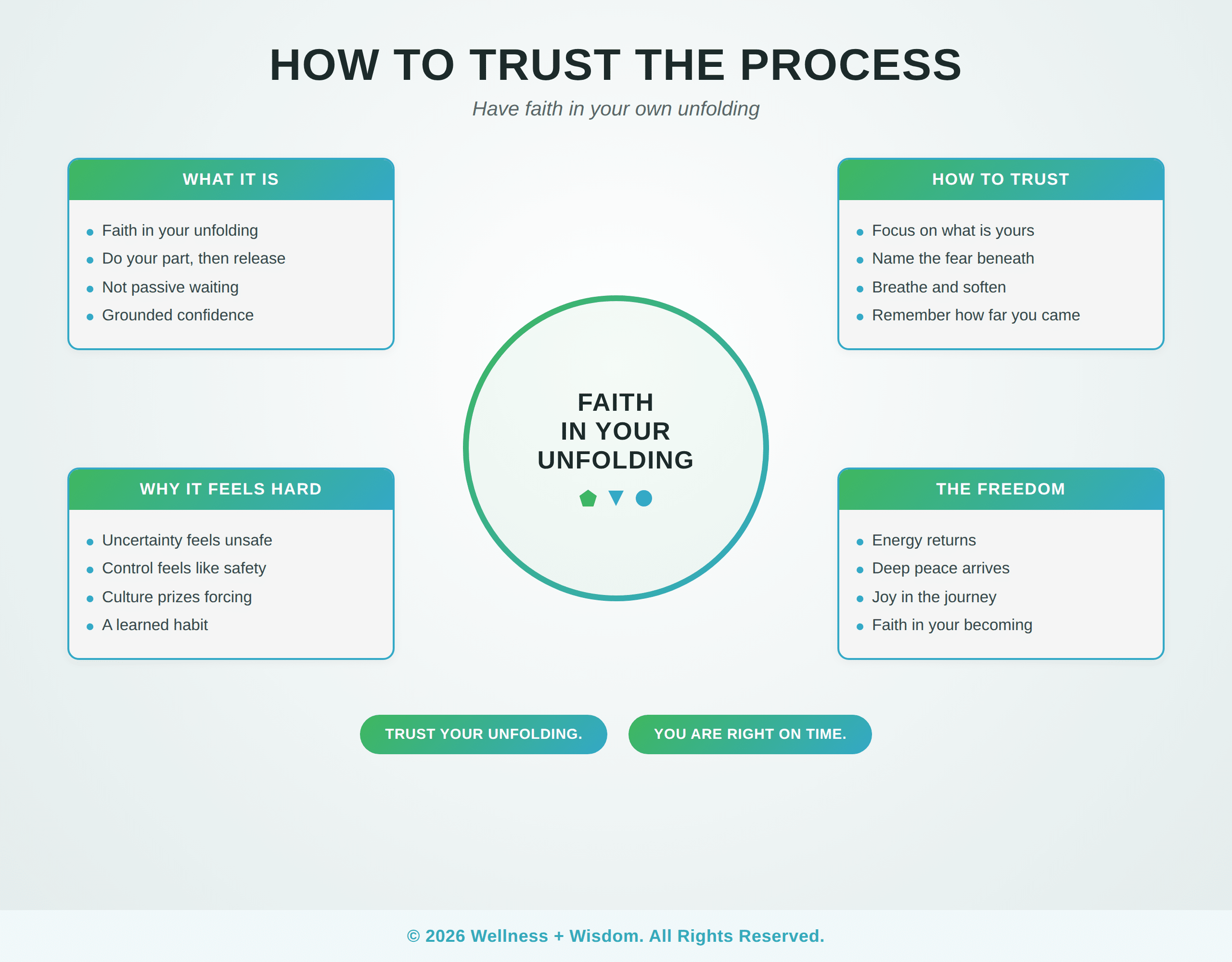
Trusting the process means having real faith in your own unfolding, doing your part with intention and then releasing the anxious need to control exactly how and when everything turns out. It is a grounded, quiet confidence that your growth, your healing, and your whole life are moving forward even when you cannot see the whole path. In its truest sense, trusting the process is trading anxious control for faith in your own becoming.
This is very different from passive waiting, because trusting the process still involves showing up, taking real action, and giving your full effort. What truly changes is your relationship to outcomes and timing, releasing the anxious demand that things unfold exactly as you planned and precisely when you want them to. You do your part with heart, and then you trust the unfolding rather than gripping it.
Trusting the process also frees the enormous energy that anxious controlling quietly consumes, since trying to force and micromanage every outcome is genuinely exhausting. When you finally release your grip on the timeline, you reclaim all that energy and discover a deep and abiding peace, the ease that comes from faith in your own becoming rather than a constant fight with reality. Learning to trust the process in this way is a cornerstone of a peaceful, growing life, a theme we return to often on the Wellness + Wisdom Podcast.
Why It Feels So Hard to Trust
Trusting the process feels genuinely hard because uncertainty can feel deeply uncomfortable, and gripping tightly to control feels like the only way to keep ourselves safe from disappointment. When we cannot see how things will turn out, the anxious mind tries hard to force certainty, demanding guarantees that life simply cannot ever give. This deep need for control is very often rooted in old fear.
On top of this, many of us learned early that we could only rely on ourselves, so releasing control and trusting a larger unfolding feels genuinely unsafe. We also live in a culture that prizes hustle, forcing, and instant results, quietly teaching us that trusting and allowing is somehow weak or lazy. Understanding that the struggle to trust was learned, often for very understandable reasons, replaces self judgment with compassion, which is where real change begins, much like the gentle work of reparenting yourself.
Seeing why trust feels hard is genuinely freeing, because it means your struggle to trust is not a personal failing but a natural response of a system trying to keep you safe. The gripping was simply learned over time, and like any learned pattern, it can be gently softened with practice. You can honor the part of you that learned to control in order to feel safe while gently teaching yourself that you are safe enough now to trust your own unfolding, which is deeply connected to neural system regulation.
The Hidden Cost of Not Trusting
Recognizing the hidden cost of not trusting the process helps loosen its grip, because the constant struggle to force outcomes quietly takes far more from us than we realize. What feels like staying in control often drains our energy and steals our peace, all while the certainty we chase remains forever out of reach. Seeing this clearly makes trust feel not just possible but deeply worth cultivating.
Not trusting costs us our peace, keeping us in a near constant state of worry, impatience, and anxious effort as we try to force life onto our timeline. While we grip so tightly to a specific outcome, we rarely ever feel at ease, because there is always something more to control, rush, or fix. This constant inner tension is one of the quietest and heaviest costs of refusing to trust the unfolding.
It also costs us our energy, since the effort of trying to force and micromanage every outcome is genuinely exhausting. Many of us feel deeply and chronically tired not from meaningful effort but from the constant strain of fighting against the natural timing of our own lives. Not trusting can also quietly cost us our joy, since gripping so tightly to the future leaves little room to appreciate the growth and the gifts already present in this very moment.
Perhaps most importantly, refusing to trust the process robs us of the peace that faith offers, keeping us braced against a life that is often unfolding far better than our anxious mind believes. Recognizing that not trusting is costing you far more than it gives is genuinely motivating, because it helps you choose faith and ease over the exhausting fight, supporting the kind of grounded confidence that lets you actually enjoy your journey, which deepens your whole spiritual wellness.
The Science of Trust and Letting Go
The science of stress offers real support for learning to trust the process. Bruce McEwen described in the New England Journal of Medicine how chronic stress produces allostatic load, the cumulative wear on a body whose alarm rarely rests. The constant vigilance of trying to control every single outcome keeps the stress response switched on, while gently learning to release control and trust gives your whole system the recovery it genuinely needs, supporting real neural system regulation.
Naming your fear helps you release it too. Research by Matthew Lieberman and colleagues, published in Psychological Science, found that putting feelings into words reduces activity in the brain's alarm center. When you gently name the fear that lives beneath your need to control, rather than being ruled by it, you help calm the very circuits that drive anxious gripping, making it far easier to soften into real trust.
There is an uplifting dimension too. Barbara Fredrickson's research, published in American Psychologist, shows that positive emotions like trust and openness broaden our awareness and build lasting personal resources, while fear and gripping narrow and deplete us. When you release your control and open to faith in your own unfolding, you widen your whole perspective and access far more creativity, clarity, and joy. Trust, in this real sense, opens you back up to life, and it draws on genuine emotional intelligence.
How to Trust the Process
Learning how to trust the process is a gentle, gradual practice of doing your part and then releasing your grip on the outcome, again and again. It grows with practice, and every release deepens your faith. Here are practices that help.
1. Focus on What Is Yours to Do
Gently direct your energy toward your own actions and effort, which are genuinely within your own control, and release the outcome and timing, which simply are not. Distinguishing clearly what is yours to do from what is not frees you from exhausting yourself over the uncontrollable.
2. Name the Fear Beneath the Grip
Ask yourself gently what you are truly afraid would happen if you stopped forcing things, since the need to control is almost always driven by an underlying fear. Naming that fear directly and honestly gently loosens its grip and softens your need to control, which pairs beautifully with journaling.
3. Breathe and Soften Your Grip
Use slow and conscious breath to calm your body and gently soften the physical grip of anxious control. Breathwork is one of the most powerful ways to release tension and return to trust, which is why breathwork is such a faithful companion to letting go.
4. Look Back at How Far You Have Come
Gently remember the past challenges you truly could not see your way through, and how they eventually resolved or taught you something genuinely valuable. Noticing that life has carried you through before builds real, earned trust that it can surely carry you again.
5. Practice Faith and Surrender
Gently choose to trust in the unfolding of your life and your Connection to Creator and God, releasing your grip and simply allowing things to move in their own perfect time. Practicing surrender, again and again over time, gradually replaces anxious control with grounded faith.
Begin with whatever practice feels most accessible to you and be patient and kind with yourself, since releasing a pattern of control held for years genuinely takes time. Every small act of trust deepens your faith. When you want community and support for this journey, the Liberated Life Tribe is here for you.
Trusting the Process Versus Being Passive
One of the most important distinctions in this work is the difference between trusting the process and being passive, because trusting is not the same as giving up or sitting back. Trust is an active, engaged faith, while passivity is a checked out withdrawal, and the two come from entirely different places within us.
Being passive comes from a place of avoidance or quiet resignation, doing very little and simply hoping things somehow work out on their own. Trusting the process is something completely different, it means engaging fully with your life, giving your very best effort, and then releasing your grip on the outcome and timing. You keep showing up and taking action, but without the anxious controlling that exhausts you.
The key difference is that trust is empowering rather than avoidant. You do your own part with real presence and intention, and then you release your grip on the results, trusting life and Creator and God to handle whatever is beyond you. This is never laziness at all, it is a profound strength, the wisdom to give your all and the faith to release the rest, which is a beautiful part of your whole self growth journey.
Trusting the Process and the L.I.F.E. Method
Learning to trust the process is woven through the L.I.F.E. Method™, our system for identity transformation built on four pillars: Liberation, Integration, Frequency, and Embodiment. Trust touches every one of them, transforming your relationship with your own unfolding at the deepest level.
Liberation frees you from the old anxious belief that you must control everything to be safe, letting you finally rest in faith rather than fear. Integration helps you make real peace with the parts of your journey you would rather rush past, honoring even the slow and difficult seasons as a vital part of your becoming. Frequency raises your whole inner state from anxious gripping toward grounded trust, and Embodiment brings that trust out of the realm of ideas and into how you actually move through your days.
This is exactly why we hold trusting the process as genuine transformation work rather than a simple mindset tweak. When you learn to trust your own unfolding, you are not just soothing your worries, you are transforming your whole identity from someone who must force life into shape to someone who gracefully partners with it, resting in your Connection to Creator and God. That is a deep and truly joyful freedom, one that gently reshapes your whole experience of growth, which is the heart of learning to authentic identity.
Celebrating Your Own Unfolding
The joyful heart of this work is celebrating your own unfolding, honoring the growth and progress already happening in your life rather than fixating only on how far you still have to go. When you learn to celebrate your becoming rather than criticizing your own pace, the whole journey grows gentler and far more joyful.
Celebrating your own unfolding means truly noticing the quiet progress, the ways you have grown, the challenges you have moved through, and the small steps you take each day even when the big outcome is not yet visible. Each of these is genuine, real growth worth honoring, and acknowledging them steadily builds real trust that your journey is unfolding just as it should, which is a beautiful part of learning to celebrate small wins.
And here is the beautiful part. When you learn to truly trust the process and live from faith rather than anxious gripping, you become calmer, lighter, and far more at peace, quietly inspiring the people around you toward their own trust. Your own faith quietly gives others permission to release their grip too, showing them that peace is possible and that life can genuinely be trusted to unfold. In this way, learning how to trust the process becomes a gift that ripples far beyond yourself, bringing more ease and faith to every relationship you touch, which is a spirit we cherish in learning to cultivate everyday joy.
Trust Is a Lifelong Practice
Learning how to trust the process is not a single act you complete once, but a lifelong practice of releasing and returning to faith across the changing seasons of your life. Life will keep presenting new uncertainty, so trust is far less a one time event and more an ongoing practice of loosening your grip and choosing faith again. This is wonderful news, because it means you can always return to trust no matter how tightly you have been holding on.
This understanding takes the pressure off getting it perfect. You will certainly have days when the old gripping returns, moments when fear tightens your hold, and seasons when trusting feels much harder, and all of that is completely human. What matters is the gentle returning, the steady practice of noticing the grip and softening back into faith whenever you can.
Understanding trust as an ongoing practice also keeps it compassionate. Each time you catch yourself gripping again, you have a fresh opportunity to breathe, soften, and release once more, and every single release deepens your capacity for faith. Over time, living from trust rather than from anxious control becomes far more natural, a steady, quiet peace woven through your days.
So approach your own journey with patience and warmth. There is no finish line, only the ongoing, freeing practice of releasing control and returning to trust, and celebrating the growth you discover along the way. This steady trust supports every dimension of your wellbeing and deepens your whole experience of your own becoming, growing richer with time, which is closely tied to learning to find inner peace.
When Trust Feels Impossible
If trusting the process feels impossible right now, you are in good company, and it is completely understandable, especially if life has felt unpredictable or if control has been your way of feeling safe for a long time. Learning to trust does not mean forcing yourself to release everything at once, it means gently loosening your grip a little at a time, at a pace that honors you.
When trust feels far away, it genuinely helps to start with the very smallest releases, softening your grip on one small outcome, breathing through the discomfort, or simply remembering one time life carried you before. You do not have to trust everything all at once at all, you simply keep practicing faith in small ways, and over time trusting grows far more natural. Meeting your own fear with compassion, rather than force, is itself part of the healing.
It is also genuinely worth remembering that a deep, persistent struggle to trust, especially when rooted in trauma or anxiety, can be gently supported by working with a qualified therapist. There is real and genuine strength in seeking help, and a skilled professional can offer effective tools for building trust and gently releasing the grip of control. Wherever you are, be patient and kind with yourself, honor your own pace, and trust that faith in your own unfolding is something you can genuinely cultivate, one gentle release at a time.
Frequently Asked Questions
What does it mean to trust the process?
Trusting the process means having faith in your own unfolding, doing your part with intention and then releasing the anxious need to control exactly how and when everything turns out. It is a grounded confidence that your growth and life are moving forward even when you cannot see the whole path, trading anxious control for faith in your own becoming.
Why is it so hard to trust the process?
Because uncertainty feels uncomfortable, and gripping for control feels like the only way to stay safe from disappointment. Many of us also learned early to rely only on ourselves, and live in a culture that prizes forcing and instant results. Understanding that the struggle to trust was learned, rather than a flaw, opens the way to gently releasing it.
How do I learn to trust the process?
Focus on what is yours to do and release the rest, name the fear beneath your need to control, use slow conscious breath to soften your grip, remember how life has carried you before, and practice trusting the unfolding and Creator and God. Start with whatever feels most accessible and be patient, since this takes time.
Is trusting the process the same as being passive?
No. Being passive means doing little and hoping things work out. Trusting the process means engaging fully, giving your best effort, and then releasing your grip on the outcome and timing. Trust is empowering rather than avoidant, the wisdom to give your all and the faith to release the rest.
Is there science behind trusting the process?
Yes. Research shows constant vigilance keeps the stress response activated and wears on the body, naming your fear calms the brain's alarm center, and trust and openness broaden awareness while fear narrows and depletes us. Trusting the process genuinely supports your wellbeing and opens you back up to clarity and joy.
What if I can't trust the process yet?
That is understandable, especially if life has felt unpredictable or control has kept you feeling safe. You do not have to release everything at once. Start with the smallest releases and breathe through the discomfort. A deep struggle to trust, especially when rooted in trauma or anxiety, can be gently supported by a qualified therapist.
Studies and External Resources
The science in this article rests on peer reviewed research. These are the sources referenced throughout.
- McEwen BS. (1998). Protective and damaging effects of stress mediators. New England Journal of Medicine. PubMed: 9428819
- Lieberman MD, et al. (2007). Putting Feelings Into Words: Affect Labeling Disrupts Amygdala Activity in Response to Affective Stimuli. Psychological Science. PubMed: 17576282
- Fredrickson BL. (2001). The role of positive emotions in positive psychology. The broaden-and-build theory of positive emotions. American Psychologist. PubMed: 11315248
About Josh Trent
Josh Trent is an Identity Transformation Architect and the award winning host of the Wellness + Wisdom Podcast, with over 15 million downloads since 2015. He is the creator of the L.I.F.E. Method™ Identity Transformation System and steward of the Emotional Epigenetics™ and BREATHE: Breath + Wellness™ systems of self mastery, impacting over 1,000 students worldwide. Join the Liberated Life Tribe and receive your 10 day Self Liberation Blueprint at liberatedlife.com. Josh lives in Austin, Texas with his wife Carrie, daughter Nayah, and son Novah. Peace and power.
Disclosure: We may earn a commission from certain links on this site when you make a purchase, at no extra cost to you. These commissions help support Wellness + Wisdom and do not affect the products or resources we choose to recommend. Full disclosure .