
By Josh Trent | Wellness + Wisdom Podcast Host & Identity Transformation Architect
“Joy is not something that happens to you when life finally cooperates. It is something you cultivate, like a garden, right in the middle of an ordinary day. Tend it daily, and it will bloom in you.”
Josh Trent
Learning how to cultivate joy is one of the most life giving practices you can bring into your days, because joy is far less about your circumstances than most of us were taught. So many of us wait patiently for joy to arrive, quietly believing it will show up once the goal is reached, the problem is solved, or life finally settles down for good. But real joy is something you cultivate on purpose, a practice of tending your inner life so that gladness can grow even in the middle of an ordinary week. This joyful practice sits at the heart of the L.I.F.E. Method™ and everything we celebrate together.
Here is the joy forward truth at the center of it all. You do not have to wait for perfect conditions to experience joy, and you do not have to earn it through achievement. Joy is available right now, as a practice you can cultivate through simple, intentional choices that gently open your heart to the goodness already present in your life. When you learn how to cultivate joy, you turn even the most ordinary days into a quiet celebration of being alive, and that changes the whole texture of a life. Let us explore exactly how.
Table of Contents
- What It Means to Cultivate Joy
- Joy Is a Practice, Not a Circumstance
- Joy Versus Happiness: An Important Difference
- The Science of Joy and Wellbeing
- How to Cultivate Joy Every Day
- A Simple Daily Joy Practice
- Joy as a Spiritual Practice
- Joy and the Wellness Pentagon
- What Blocks Our Joy and How to Clear It
- Celebrating Joy as a Way of Life
- Frequently Asked Questions
- Studies and External Resources
- About Josh Trent
What It Means to Cultivate Joy
To cultivate joy means to actively tend your inner life so that gladness can grow, rather than waiting passively for happiness to arrive from the outside. It is the daily practice of intentionally noticing, welcoming, and nurturing joy in your everyday experience, treating it like a garden you lovingly care for rather than a lottery you simply hope to win. Joy becomes something you actively participate in creating, not just something that happens to you when the conditions happen to line up.
This is a genuinely different way of relating to joy than most of us learned. We often treat joy as a byproduct of good circumstances, something we will feel once conditions improve. Learning how to cultivate joy gently reverses that, inviting you to generate and welcome gladness right now, in the life you already have, through the way you direct your attention and open your heart. Joy becomes a practice rather than a prize.
Importantly, cultivating joy is not about forcing positivity or denying life's real difficulties. It is about deliberately making room for goodness alongside whatever else is true, choosing again and again to notice, welcome, and savor what is genuinely beautiful in your day. This gentle, honest practice builds a steady inner gladness that does not depend on everything going right in your life, a theme we return to often on the Wellness + Wisdom Podcast.
Joy Is a Practice, Not a Circumstance
Joy is far more a practice than a circumstance, which is wonderful news, because it means joy is largely within your reach regardless of what is happening around you. While our circumstances certainly affect us, research and lived experience both show that lasting joy depends far more on our inner habits and attention than on our external conditions. The people who live with the most joy are usually not the luckiest, but those who have quietly cultivated it as a daily practice.
This matters because it changes where we look for joy. Instead of waiting for life to finally hand us happiness, we can take up the daily practice of generating it, through gratitude, presence, connection, and the way we choose to see the world. Joy stops being something that happens only to the lucky and becomes something genuinely available to anyone willing to tend it with care. This is deeply empowering, since it gently puts joy back in your own hands.
Understanding joy as a practice also frees you from the exhausting wait for perfect conditions. You no longer have to postpone your gladness until the goal is finally reached or the problem is fully solved, because you can cultivate joy right in the middle of an unfinished, imperfect, ordinary life. This is honestly one of the most freeing truths there is, and it lives right at the center of our work on gratitude and everyday gladness.
Joy Versus Happiness: An Important Difference
Understanding the difference between joy and happiness is one of the most helpful clarifications on this journey, because it reveals why joy is something we can genuinely cultivate. Happiness tends to be tied to circumstances, rising and falling with what happens to us, while joy is a deeper, steadier gladness that we can tend regardless of conditions.
Happiness is wonderful, and there is nothing at all wrong with enjoying it fully, but by its very nature it tends to come and go with our circumstances. We feel happy when things go our way and less happy when they do not, which makes happiness a somewhat fragile foundation. Joy, by contrast, runs deeper. It is a felt gladness rooted in presence, gratitude, and warm connection, and because of that, it does not require everything to go perfectly in order to be present in us.
This is exactly why joy, unlike happiness, can be cultivated as a practice. Because joy rests on inner habits rather than external circumstances, we can tend and grow it quite deliberately, even during the most ordinary or genuinely difficult seasons. Learning how to cultivate joy means patiently building the inner practices that generate this steadier gladness, so it becomes increasingly available to us no matter what any given day holds.
None of this means we ignore happiness or pretend hard things do not affect us. It simply means we always have access to a deeper well than circumstance alone, a durable, resilient joy we can cultivate from within. That is a profoundly hopeful truth, and it puts a rich, resilient gladness within reach for anyone willing to practice, supported by the steady work of neural system regulation.
The Science of Joy and Wellbeing
The science of positive emotion offers beautiful support for the practice of cultivating joy. The researcher Barbara Fredrickson, in work published in American Psychologist, developed the broaden and build theory of positive emotions. Her research shows that joy and other positive emotions broaden our awareness and, over time, build lasting personal resources, everything from resilience to relationships to physical health. Joy is not just pleasant, it is genuinely constructive.
Joy reaches the body as well. Research by Bethany Kok and Barbara Fredrickson, published in Psychological Science, found that positive emotions and warm social connection support physical wellbeing in an upward spiral, each feeding the other over time. Cultivating joy, in other words, is a real and lasting investment in your physical health, not a frivolous or optional indulgence. The gladness you tend today quietly strengthens your body and your resilience for the days to come.
Even our resistance to stress is affected. The classic research by Sheldon Cohen and colleagues, published in the New England Journal of Medicine, showed that our psychological state influences our vulnerability to illness, revealing how deeply mind and body are connected. A life rich in cultivated joy supports not only our emotional wellbeing but our physical resilience over time, which is exactly why we treat joy as genuine medicine rather than a luxury, supporting the whole person vision of the Wellness Pentagon™.
How to Cultivate Joy Every Day
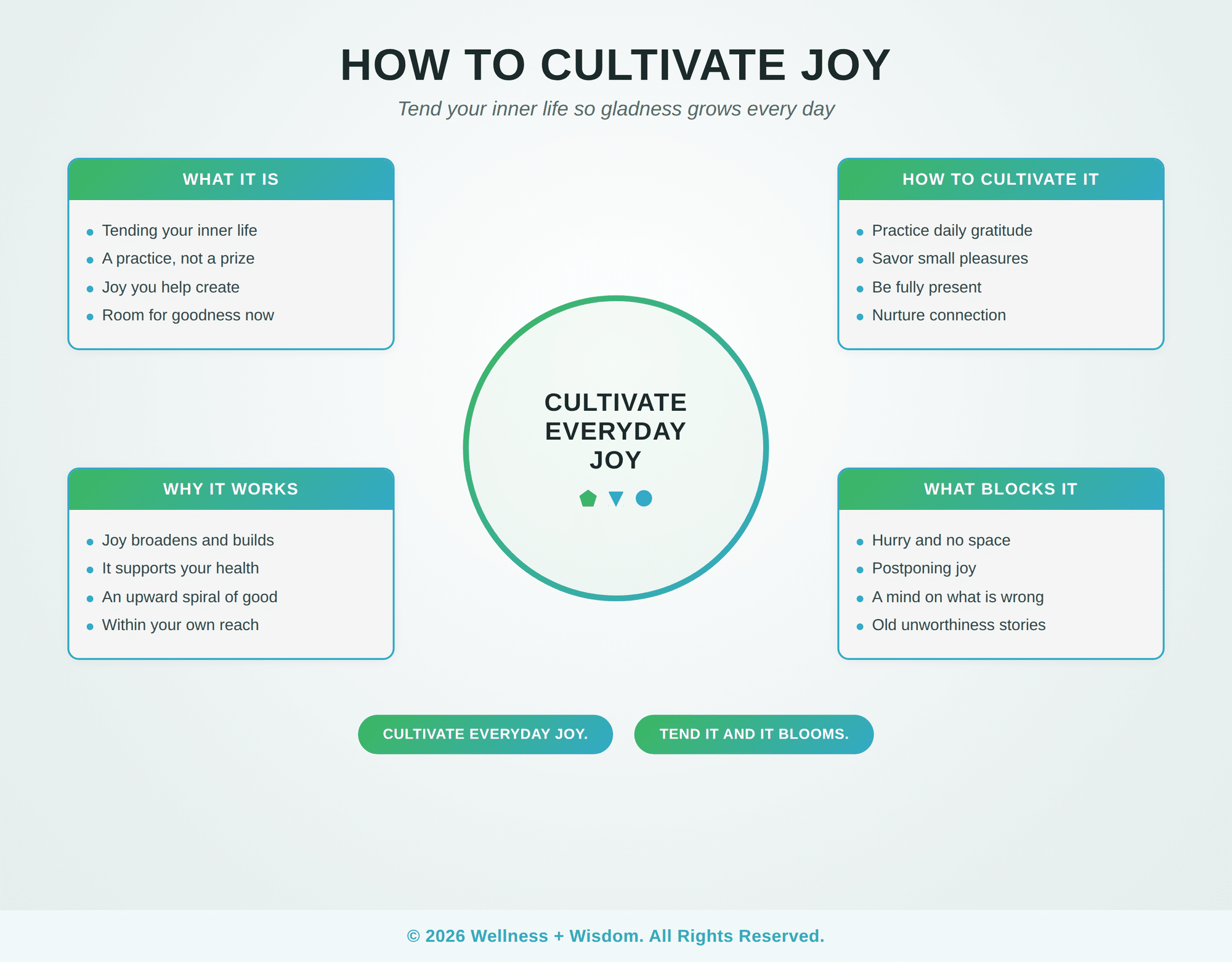
Learning how to cultivate joy is a practice you can begin today, and it grows more natural the more you tend it. The goal is to gently weave small, intentional acts of joy into your ordinary days, so that gladness becomes a familiar daily rhythm rather than a rare and occasional visitor. Here are simple, powerful ways to begin.
1. Practice Daily Gratitude
Regularly noticing what you are thankful for is one of the most reliable ways to cultivate joy. Taking a moment each and every day to savor a few genuine blessings trains your attention toward goodness and quietly lifts your whole inner state over time.
2. Savor Small Pleasures
Slow down just enough to truly enjoy the small delights of daily life, a warm cup of coffee, sunlight through a window, or a good, genuine laugh. Savoring these ordinary joys fully, rather than rushing right past them, multiplies the gladness already quietly available in your day.
3. Be Fully Present
Joy lives in the present moment, never in the endless rush toward the next thing. Practicing presence, through the breath or simple gentle attention, opens you to the goodness that is right in front of you, which is why breathwork is such a faithful companion to joy.
4. Nurture Connection
Joy multiplies in warm connection with others. Reaching out, sharing laughter, and spending real time with people you love is one of the surest ways to cultivate gladness, since we are quite simply built to find joy together.
5. Move and Play
Let your body join the practice through movement, dance, time in nature, or simple play. Joy is deeply embodied, and letting yourself move and play invites gladness to flow freely through you, refreshing your whole system at once.
Begin with one practice and let it become a natural habit. Cultivating joy is a genuine skill that strengthens with use, and every small act of joy builds a slightly more glad and open inner world. When you want community for this joyful journey, the Liberated Life Tribe is here for you.
A Simple Daily Joy Practice
One of the easiest ways to begin cultivating joy is to build a simple daily practice that bookends your day with gladness. You do not need anything elaborate at all, just a few minutes of intentional attention in the morning and again in the evening can gradually transform your inner state over time.
In the morning, before the rush of the day begins, take a few quiet moments to set a joyful intention for yourself. You might name a few things you are genuinely grateful for, take several slow, easy breaths, and consciously choose to look for goodness in the day that lies ahead. This one simple morning practice tunes your attention toward joy before the world can pull it in a thousand different directions, which is why it pairs so beautifully with journaling.
In the evening, take a few moments to savor the joys of the day just lived. Recall the small delights, the kind moments, and the little gifts you might otherwise overlook entirely, and let yourself genuinely appreciate each one. This gentle evening practice trains your mind to notice and store the good, so that joy accumulates over time rather than slipping away unremembered. Over time, you become someone who naturally sees the gladness in ordinary days.
The beauty of this practice is its simplicity and its power. Just a few quiet, unhurried minutes at each end of your day, practiced consistently over time, gradually rewires your attention toward joy and builds a genuinely steadier inner gladness. This is how to cultivate joy in a way that actually lasts and deepens, through small, repeated acts of intentional attention that compound over time into a genuinely more joyful life.
Joy as a Spiritual Practice
At its deepest level, cultivating joy is a spiritual practice, a way of honoring the gift of life and opening to a gladness that runs beneath circumstances. Many spiritual traditions across the ages have pointed to joy as a fruit of the inner life, a quiet sign of connection to something larger than ourselves. Joy, in this deeper sense, is not merely a passing feeling but a genuine form of reverence and gratitude.
Spiritually, joy flows from gratitude for the gift of existence and from your Connection to Creator and God. When you truly remember that your life is a gift and that you are deeply and unconditionally loved, joy arises naturally as the response of a grateful heart. This kind of joy does not depend on everything going well at all, because it rests on something far deeper than circumstance, a felt sense of being held, known, and cherished. Cultivating it is one of the truest ways of tending your very spirit.
This is why joy can coexist even with hardship. When your gladness is genuinely rooted in gratitude and your Connection to Creator and God, it becomes a steady inner light that even real difficulty cannot fully extinguish. Cultivating spiritual joy means returning again and again to that deeper source, letting gratitude and love quietly fill you regardless of the day's changing conditions. This is joy at its richest and most durable, and it grounds our whole approach to spiritual wellness.
Joy and the Wellness Pentagon
Cultivating joy supports every dimension of your wellbeing, which is why it connects so beautifully to the Wellness Pentagon™, our whole person framework spanning the physical, mental, emotional, spiritual, and financial dimensions of a thriving life. Joy is not a separate category but a current that flows through them all, strengthening the whole.
Emotionally, joy lifts your whole inner state and builds resilience, while mentally it broadens your thinking and opens you to fresh new possibilities. Physically, as the research shows, cultivated joy supports your body's health and resilience over time. Spiritually, joy deepens your sense of connection and gratitude, and even in the financial dimension of life, a joyful, grounded state helps you make wiser, calmer, less fearful decisions. In this way, joy quietly nourishes the entire pentagon at once.
This is why we hold joy as such an essential practice rather than a luxury. Tending your gladness is not separate from your wellbeing, it is one of the most powerful ways to support all of it at once. When you truly cultivate joy, you are genuinely caring for your whole self, raising your frequency toward gladness across every single dimension of your life, which is the very heart of raising your inner emotional state.
What Blocks Our Joy and How to Clear It
If joy sometimes feels hard to access, you are in good company, and understanding the common blocks helps you clear them with compassion. One of the most frequent is simply hurry, a life so full of rushing that there is no space left to notice and savor the goodness that joy requires. Slowing down, even just a little, is very often the first real step back toward gladness.
Another common block is the habit of postponing joy, telling ourselves we will be happy once some condition is met. This keeps joy perpetually in the future, always just out of reach. Gently choosing to cultivate joy now, right in the unfinished present, breaks that old pattern and returns your gladness to today where it belongs. A related block is a mind long trained toward what is wrong or missing, which we can slowly and patiently retrain toward gratitude and goodness instead.
Old patterns can quietly block joy too, including a hidden belief that we do not deserve to feel glad, or that joy is somehow frivolous or unearned. Meeting these old beliefs with gentleness, and understanding them as outdated stories rather than truths about you, allows joy to flow far more freely. The way through all of these blocks is the same tender practice, returning again and again to presence, gratitude, and the intentional cultivation of joy, which takes real emotional courage and a supportive morning routine.
Celebrating Joy as a Way of Life
The most beautiful fruit of cultivating joy is that it becomes a way of life, turning your ordinary days into an ongoing celebration of being alive. When joy becomes a genuine practice woven through your daily rhythm, you stop waiting for special occasions to feel glad and start finding real reasons to celebrate right in the everyday.
Celebrating joy as a way of life means treating each new day as an opportunity for gladness, noticing and honoring the countless small gifts that quietly fill an ordinary life. It means letting yourself delight in the simplest of things, celebrating who you are and the life you have been given, and choosing gladness as a steady daily orientation rather than an occasional visitor. Joy becomes less an event and more a way of walking through the world, a practice we cherish in learning to celebrate yourself.
And here is the beautiful ripple. When you cultivate joy as a genuine way of life, your gladness becomes quietly contagious, giving everyone around you gentle permission to find and tend their own joy too. Your visible, unforced delight in ordinary life becomes a quiet invitation, showing others that joy is truly available and genuinely worth tending. In this way, cultivating joy becomes a gift you extend far beyond yourself, brightening every relationship and community you touch, which is exactly the spirit we share in the Liberated Life Tribe and our celebration of small wins.
Frequently Asked Questions
What does it mean to cultivate joy?
To cultivate joy means to actively tend your inner life so gladness can grow, rather than waiting passively for happiness to arrive from outside. It is the practice of intentionally noticing, welcoming, and nurturing joy in daily life, treating it like a garden you care for. Joy becomes something you participate in creating, not just something that happens to you.
Is joy really a practice rather than a circumstance?
Largely, yes. While circumstances affect us, research and experience show that lasting joy depends far more on our inner habits and attention than on external conditions. This is empowering, because it means we can cultivate joy through gratitude, presence, and connection, rather than waiting for perfect conditions that may never arrive.
How do I cultivate joy in everyday life?
Begin with daily gratitude and savoring small pleasures like a warm drink or sunlight. Practice being fully present, nurture warm connection with people you love, and let your body join through movement and play. Start with one practice and let it become a natural daily habit that steadily lifts your inner state.
Is there science behind cultivating joy?
Yes. Fredrickson's broaden and build research shows positive emotions like joy build lasting resources such as resilience. Kok and Fredrickson found joy and connection support physical health in an upward spiral. Cohen's research shows our psychological state influences our vulnerability to illness. Cultivating joy is a genuine investment in emotional and physical wellbeing.
Can I feel joy even during hard times?
Yes. When joy is rooted in gratitude and your Connection to Creator and God, it becomes a steady inner light that difficulty cannot extinguish. This kind of cultivated joy does not deny hardship but coexists with it, resting on something deeper than circumstance. Returning to that deeper source lets gladness remain available even in difficult seasons.
What blocks joy and how do I clear it?
Common blocks include hurry that leaves no space to savor, the habit of postponing joy until conditions improve, and a mind trained toward what is wrong. Old beliefs that we do not deserve gladness can block it too. The way through is the same gentle practice of returning to presence, gratitude, and the intentional cultivation of joy.
Studies and External Resources
The science in this article rests on peer reviewed research. These are the sources referenced throughout.
- Fredrickson BL. (2001). The role of positive emotions in positive psychology. The broaden-and-build theory of positive emotions. American Psychologist. PubMed: 11315248
- Kok BE, Fredrickson BL, et al. (2013). How positive emotions build physical health. Psychological Science. PubMed: 23649562
- Cohen S, et al. (1991). Psychological stress and susceptibility to the common cold. New England Journal of Medicine. PubMed: 1713648
About Josh Trent
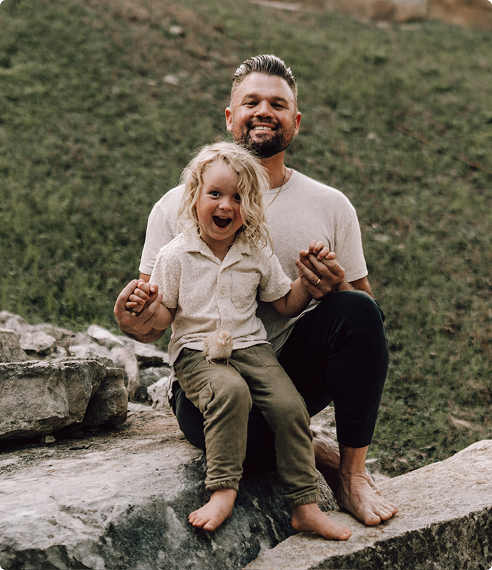
Josh Trent is an Identity Transformation Architect and the award winning host of the Wellness + Wisdom Podcast, with over 15 million downloads since 2015. He is the creator of the L.I.F.E. Method™ Identity Transformation System and steward of the Emotional Epigenetics™ and BREATHE: Breath + Wellness™ systems of self mastery, impacting over 1,000 students worldwide. Join the Liberated Life Tribe and receive your 10 day Self Liberation Blueprint at liberatedlife.com. Josh lives in Austin, Texas with his wife Carrie, daughter Nayah, and son Novah. Peace and power.
Disclosure: We may earn a commission from certain links on this site when you make a purchase, at no extra cost to you. These commissions help support Wellness + Wisdom and do not affect the products or resources we choose to recommend. Full disclosure .