
By Josh Trent | Wellness + Wisdom Podcast Host & Identity Transformation Architect
“Perfectionism promises that if you just get it right, you will finally be enough. But you were already enough. Letting go of perfect is how you come home to the joy that was always available.”
Josh Trent
Learning how to let go of perfectionism is one of the most liberating shifts you can make, because perfectionism quietly steals the joy from a life that is already worthy of celebration. So many of us live under the exhausting, unspoken belief that we must get everything right, look flawless, and never once fall short, as if our very worth depended on it. Letting go of perfectionism is the freeing, joyful process of releasing that impossible standard and discovering that you are genuinely free to live, create, and celebrate exactly as you are. This liberation lives at the heart of the L.I.F.E. Method™.
Here is the joy forward truth at the center of it all. You do not have to be perfect to be worthy, to be loved, or to live a genuinely beautiful life. That was never the deal, even if it felt like it was. Perfectionism was never once the price of your value, and releasing it does not make you lazy or less in any way, it simply makes you free. When you learn how to let go of perfectionism, you trade a life of anxious, exhausting striving for one of joyful, wholehearted living, and the relief of that trade is hard to overstate. Let us explore why we chase perfect and how to finally release it with compassion.
Table of Contents
- What Perfectionism Really Is
- Perfectionism Versus Healthy Excellence
- Where Perfectionism Comes From
- The Hidden Cost of Chasing Perfect
- How Perfectionism Affects Your Relationships
- How to Let Go of Perfectionism
- The Science of Self Compassion and Ease
- Letting Go of Perfect in the L.I.F.E. Method
- Celebrating Progress Over Perfection
- Gentle Reminders for the Recovering Perfectionist
- Frequently Asked Questions
- Studies and External Resources
- About Josh Trent
What Perfectionism Really Is
Perfectionism is the belief that you must be flawless to be acceptable, tying your sense of worth to getting everything right. It is not the same as healthy striving for excellence, which is joyful and flexible. Perfectionism is rigid and anxious, driven by a fear of falling short rather than a love of doing well. At its root, it is far less about genuinely high standards and much more about the painful feeling that anything less than perfect makes you not enough, which simply is not true.
This is why perfectionism is so exhausting. Because the standard is genuinely impossible, it can never truly be met, which means the perfectionist lives in a constant, quiet state of falling short no matter how much they actually achieve. There is always a flaw to fix, a way it could have been better, a next level to reach before allowing any rest or celebration. The finish line keeps quietly moving, and joy stays perpetually just out of reach no matter how hard you run toward it.
Recognizing perfectionism for exactly what it is offers real and immediate relief, because it reveals the whole pattern as a learned way of seeking safety rather than any true reflection of your worth. You are not required to be perfect to be valuable, and the impossible standard that has driven you for so long was never actually attainable or even necessary in the first place. Seeing this clearly is the first real step toward freedom, and it lifts a weight most perfectionists have carried for as long as they can remember, a theme we explore across the Wellness + Wisdom Podcast.
Perfectionism Versus Healthy Excellence
One of the most freeing distinctions on this journey is the difference between perfectionism and healthy excellence, because many people fear that letting go of perfect means letting go of quality. In truth, they are very different, and releasing perfectionism actually tends to improve your work rather than diminish it.
Healthy excellence is the joyful pursuit of doing well because you love the work and value the outcome. It is flexible, energizing, and rooted in a stable sense of worth, so a mistake becomes simply useful information rather than a threat to your entire identity. Perfectionism, by sharp contrast, is rigid and fear driven, tying your very worth to flawless results, so every small imperfection feels like a personal failure. One flows from love, the other from fear.
The practical difference is enormous. Someone pursuing healthy excellence can take real risks, learn from their mistakes, finish their work, and celebrate their progress, all of which help them grow and create freely and joyfully. Someone caught in perfectionism often freezes, procrastinates, or eventually burns out, because the constant fear of falling short makes every single step feel dangerous. Excellence expands you and opens you up, while perfectionism quietly constricts you.
This means letting go of perfectionism does not lower your standards, it actually frees you to reach them with far more ease and joy. You get to keep your love of doing meaningful work while releasing the anxious grip that made it so heavy. That is the beautiful truth at the center of this shift: you can be genuinely excellent and genuinely free at the same time, which is real emotional courage.
Where Perfectionism Comes From
Perfectionism usually comes from early experiences where love, approval, or safety felt conditional on performing well. As children, many of us learned that being good, achieving, or getting things right earned us praise and connection, while falling short brought disappointment or withdrawal. We absorbed the message that our worth depended on our performance, and perfectionism became a strategy to stay safe and loved.
This means perfectionism is not a character flaw but a protective adaptation, one that often made real sense in the environment where it formed. A child who learned early that mistakes were dangerous, or that only excellence earned love and belonging, understandably grew into an adult who chases perfect everywhere they go. Understanding this replaces self judgment with compassion, which is essential, because you cannot shame yourself out of perfectionism. Compassion is where the real release begins, much like the gentle work of reparenting yourself.
Seeing the roots of perfectionism with kindness is genuinely freeing, because it means the pattern is not the truth of who you are. It was a survival strategy chosen long ago, and like any learned pattern, it can be gently updated. The part of you that learned to chase perfect was only ever trying to keep you safe and loved, and it can now learn a new, far kinder way of being, which is deeply connected to healing our self defeating patterns.
The Hidden Cost of Chasing Perfect
The pursuit of perfect carries a real and often hidden cost, one worth naming clearly so the invitation to let go feels worth accepting. Chasing perfect keeps you in a chronic state of pressure and self scrutiny, which quietly drains your energy, your joy, and your peace across every area of life.
Emotionally, perfectionism tends to crowd out joy and rest, because there is always something not yet good enough to fully relax and celebrate. It can fuel real anxiety and harsh self criticism, keeping the body in a subtle but constant state of stress as you brace against the ever present possibility of falling short. Over time, this ongoing pressure quietly wears on your wellbeing, and the joy that should naturally accompany your efforts gets lost somewhere in the endless striving.
Perfectionism also quietly limits us. The fear of not doing something perfectly can stop us from ever starting at all, keeping our gifts hidden and our dreams quietly on hold for years. Relationships can quietly suffer too, since it is genuinely hard to be fully present and vulnerable when part of you is always performing and monitoring. Naming this cost is not meant to add pressure but to offer motivation and compassion, because the freedom on the other side is so worth it, and it supports the whole person balance of the Wellness Pentagon™.
How Perfectionism Affects Your Relationships
Perfectionism does not only affect your work and your inner life, it quietly shapes your relationships too, often in ways we do not immediately notice. When we believe we must be flawless to be worthy, we tend to carry that same impossible standard into how we connect with others.
Perfectionism can make it hard to be vulnerable, because vulnerability means letting others see our imperfect, unpolished selves. We may hide our real struggles, perform a carefully curated version of who we are, or avoid asking for help entirely, all of which quietly create distance in our closest relationships. True intimacy requires being seen as we really are, and perfectionism makes that feel dangerously exposing. It can also feed the exhausting habit of people pleasing, as we try to be perfect for everyone else.
Perfectionism can also spill outward as unrealistic expectations of others, or as difficulty being fully present because part of us is always evaluating. When we are relentlessly hard on ourselves, we often become quietly hard on the people around us too, or so anxious about getting things right that we cannot simply relax and enjoy the connection. The relentless pressure we place on ourselves quietly ripples outward into how we love and how we connect.
The beautiful news is that letting go of perfectionism opens the door to deeper, more genuine relationships. As you release the need to be flawless, you become far more able to be real, vulnerable, and present, which is exactly what true intimacy is quietly built on. Your imperfect, authentic, tender self is far more lovable and far more connecting than any polished performance ever could be, a truth we celebrate throughout our work on relationships.
How to Let Go of Perfectionism
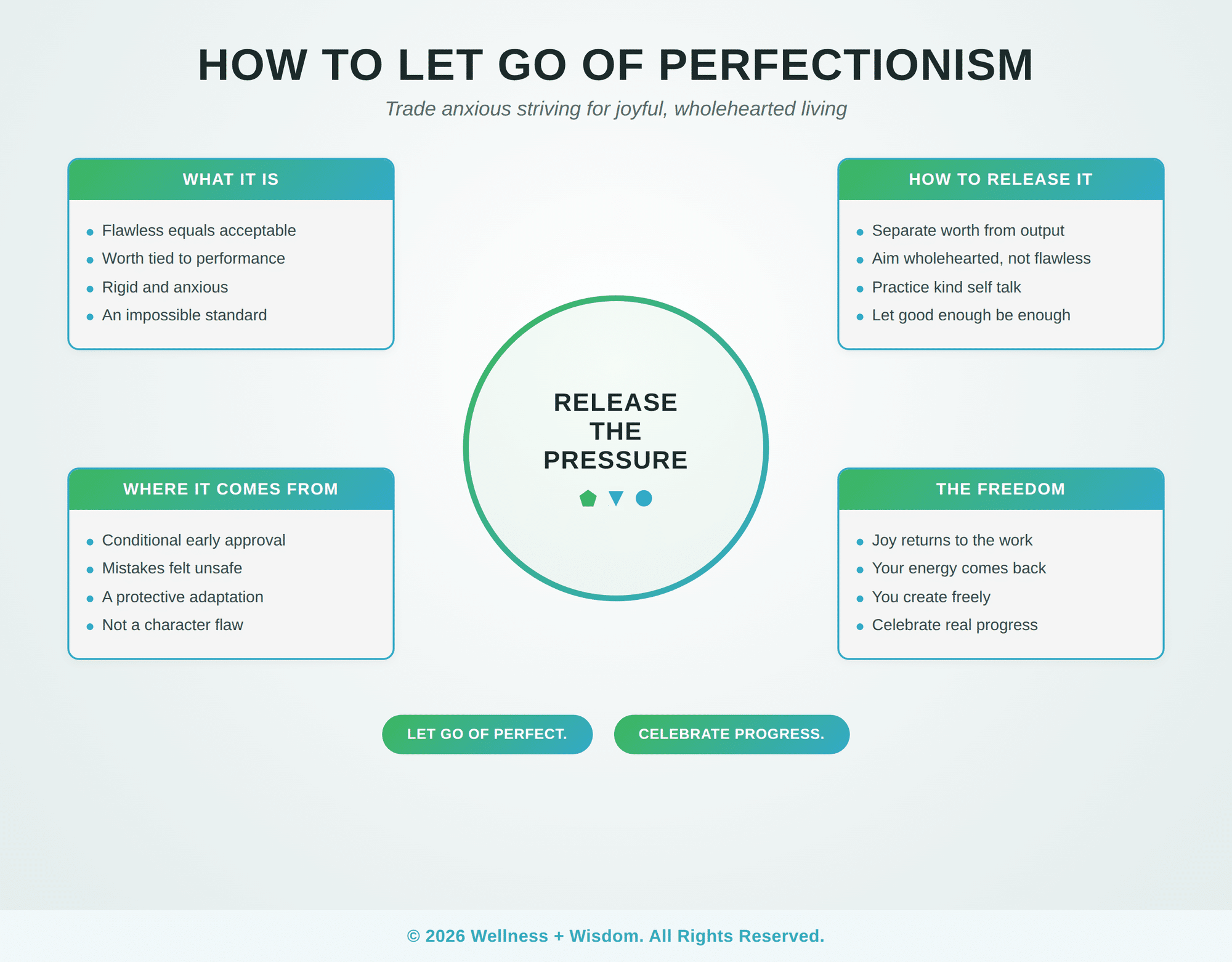
Learning how to let go of perfectionism is a gentle, gradual practice of releasing the impossible standard and choosing joy and self compassion instead. It is not about lowering your standards into carelessness but about freeing yourself from the anxious grip of perfect. Here are practices that help.
1. Separate Your Worth From Your Performance
Gently remind yourself that your value does not depend on getting everything right. Practicing this simple truth, again and again, slowly loosens perfectionism's grip and rebuilds a steady sense of worth that rests on who you are, not on what you produce, which is the heart of healthy self worth.
2. Aim for Wholehearted, Not Flawless
Shift your goal from perfect to wholehearted, from flawless execution to simply showing up with genuine effort, heart, and presence. Wholehearted living celebrates the beauty of real, imperfect, tender humanity, which is far more nourishing and connecting than any flawless performance could ever be.
3. Practice Kind Self Talk
Notice your inner critic and practice responding with the warmth you would offer a dear friend. Softening your self talk from harsh to genuinely kind is one of the most powerful ways to release perfectionism and calm your whole system at once.
4. Let Things Be Good Enough
Practice finishing things at good enough rather than endlessly polishing them toward an impossible ideal. Learning that good enough is truly and genuinely good enough frees up enormous energy and finally lets you complete and actually enjoy your work and your life.
5. Celebrate Effort and Progress
Deliberately honor your real effort and steady progress rather than fixating only on flawless outcomes. Celebrating how far you have come, rather than fixating on what is imperfect, rewires your focus toward joy, much like learning to celebrate small wins.
Begin with one practice and be patient and kind with yourself, since letting go of a lifelong pattern takes time. If perfectionism is fueling significant anxiety or distress, please also reach out to a qualified professional for personalized support. When you want community for this journey, the Liberated Life Tribe is here for you.
The Science of Self Compassion and Ease
The science of the mind and body offers real support for letting go of perfectionism, because the harsh striving it involves takes a genuine physiological toll. The researcher Bruce McEwen described in the New England Journal of Medicine how chronic stress produces allostatic load, the cumulative wear of a body whose alarm never fully rests. The constant pressure of perfectionism is one quiet source of that wear.
Softening the inner critic helps directly. Research by Matthew Lieberman and colleagues, published in Psychological Science, found that putting feelings into words reduces activity in the brain's alarm center. When you notice and name the anxious pressure of perfectionism, and respond with kindness rather than more criticism, you help your body move out of a state of threat and into greater ease. Self compassion is not soft indulgence at all but genuine, measurable physiological support for your whole system.
There is an uplifting dimension too. Barbara Fredrickson's research, published in American Psychologist, shows that positive emotions broaden our awareness and build lasting resources, while fear and pressure narrow us. Letting go of perfectionism and making real room for joy literally opens you up, making you more creative, resilient, and alive than anxious striving ever could on its best day. Ease, it turns out, is not only kinder but often more effective, supporting the kind of neural system regulation that helps you thrive.
Letting Go of Perfect in the L.I.F.E. Method
Letting go of perfectionism is a beautiful expression of the Liberation pillar within the L.I.F.E. Method™, our system for identity transformation built on four pillars: Liberation, Integration, Frequency, and Embodiment. Perfectionism is honestly one of the heaviest burdens of who you are not, and releasing it is a profound and joyful act of liberation.
Liberation frees you from the inherited belief that you must be flawless to be worthy, releasing the anxious standard that has driven you. As that burden lifts, the other pillars come alive: Integration helps you accept and embrace your whole, imperfect self, Frequency raises your inner state from anxious pressure toward joy, and Embodiment lets you feel the freedom of wholehearted living in your body rather than just understanding it in your mind.
This is why we hold letting go of perfectionism as genuine liberation work rather than a mere productivity tip. You are not merely becoming more relaxed about outcomes, you are freeing your very identity from a false and needlessly heavy standard, and reclaiming your inherent worth as a beloved creation in your Connection to Creator and God. That is a deep and joyful freedom, one that ripples through your whole life and every relationship you have.
Celebrating Progress Over Perfection
The joyful heart of letting go of perfectionism is learning to celebrate progress over perfection, to honor how far you have come rather than fixating on how far from flawless you remain. This single shift transforms the entire experience of growth, turning what was a punishing, joyless pursuit into a genuinely joyful journey.
When you celebrate progress, you feed yourself encouragement and joy along the way rather than withholding all satisfaction until some impossible standard is met. You get to feel genuinely good about your real efforts and genuine growth, which makes the whole path far more sustainable and a great deal more delightful. Progress that is celebrated is progress that continues, because joy is a far better and more sustainable fuel than harsh pressure ever was.
This is also simply a kinder, truer way to live. Perfect does not actually exist, but progress is deeply real and beautiful, and honoring it aligns you with the true texture of a real human life. When you shift from demanding perfection to celebrating progress, you free yourself to actually enjoy your own becoming, delighting in each real step rather than dismissing it as not yet enough. That joyful celebration of the real is the sweet reward of letting perfectionism go, and it is a practice we cherish in the art of celebrating yourself.
Gentle Reminders for the Recovering Perfectionist
Letting go of perfectionism is a journey, not a single decision, and a few gentle reminders can help you stay kind to yourself along the way. These are gentle truths worth returning to again whenever the old pattern quietly tightens its grip on you.
Remember that letting go of perfect does not mean you stop caring or lower your standards into carelessness. It simply means you release the anxious, impossible grip of perfect while still doing meaningful work with real, genuine care. You can absolutely be excellent and free at the very same time, pursuing what matters from joy rather than fear. Excellence and ease are truly not enemies, and the very best work often flows from a relaxed, wholehearted, unpressured place.
Remember too that recovering from perfectionism is itself a process you do not have to do perfectly. You will have days when the old pattern returns and tightens its grip, and that is completely and utterly human. What matters is meeting those harder moments with the same compassion you are learning to offer yourself in everything else, and gently returning, again and again, to wholehearted, imperfect living. Be patient with your own unfolding, celebrate every single step toward freedom, and know deep down that a joyful, wholehearted life is absolutely available to you, a journey we walk together in the Liberated Life Tribe and across our latest episodes.
Frequently Asked Questions
What is perfectionism?
Perfectionism is the belief that you must be flawless to be acceptable, tying your worth to getting everything right. It differs from healthy striving for excellence, which is joyful and flexible. Perfectionism is rigid and anxious, driven by fear of falling short. At its root it is less about high standards and more about feeling that anything less than perfect makes you not enough.
Where does perfectionism come from?
Usually from early experiences where love, approval, or safety felt conditional on performing well. Many of us learned that achieving earned praise and connection while falling short brought disappointment. We absorbed the message that worth depends on performance. Perfectionism is not a character flaw but a protective adaptation that once made sense.
How do I let go of perfectionism?
Begin by separating your worth from your performance, and aim for wholehearted rather than flawless. Practice kind self talk in place of the inner critic, let things be good enough rather than endlessly polishing, and celebrate effort and progress instead of only perfect outcomes. Be patient, since releasing a lifelong pattern takes time and compassion.
Does letting go of perfectionism mean lowering my standards?
No. Letting go of perfectionism does not mean you stop caring or become careless. It means releasing the anxious, impossible grip of perfect while still doing meaningful work with genuine care. You can be excellent and free at the very same time, pursuing what truly matters from joy rather than from fear. Excellence and ease are not enemies.
Is there science behind releasing perfectionism?
Yes. Research shows chronic stress, including the constant pressure of perfectionism, creates allostatic load that wears on the body. Lieberman's work shows naming feelings calms the brain's alarm center, so self compassion offers real physiological support. Fredrickson's research shows positive emotion broadens and builds us, while pressure narrows us, so ease is often more effective too.
Why celebrate progress instead of perfection?
Because perfect does not exist, but progress is real and beautiful. Celebrating progress feeds you encouragement and joy along the way rather than withholding satisfaction until an impossible standard is met, which makes growth sustainable and delightful. Honoring your real efforts aligns you with the actual texture of a human life and keeps you moving forward with joy.
Studies and External Resources
The science in this article rests on peer reviewed research. These are the sources referenced throughout.
- McEwen BS. (1998). Protective and damaging effects of stress mediators. New England Journal of Medicine. PubMed: 9428819
- Lieberman MD, et al. (2007). Putting Feelings Into Words: Affect Labeling Disrupts Amygdala Activity in Response to Affective Stimuli. Psychological Science. PubMed: 17576282
- Fredrickson BL. (2001). The role of positive emotions in positive psychology. The broaden-and-build theory of positive emotions. American Psychologist. PubMed: 11315248
About Josh Trent
Josh Trent is an Identity Transformation Architect and the award winning host of the Wellness + Wisdom Podcast, with over 15 million downloads since 2015. He is the creator of the L.I.F.E. Method™ Identity Transformation System and steward of the Emotional Epigenetics™ and BREATHE: Breath + Wellness™ systems of self mastery, impacting over 1,000 students worldwide. Join the Liberated Life Tribe and receive your 10 day Self Liberation Blueprint at liberatedlife.com. Josh lives in Austin, Texas with his wife Carrie, daughter Nayah, and son Novah. Peace and power.
Disclosure: We may earn a commission from certain links on this site when you make a purchase, at no extra cost to you. These commissions help support Wellness + Wisdom and do not affect the products or resources we choose to recommend. Full disclosure .