
By Josh Trent | Wellness + Wisdom Podcast Host & Identity Transformation Architect
“Courage is not the absence of fear in your body. It is the willingness to feel the fear all the way through and stay. The bravest thing most of us will ever do is let ourselves feel.”
Josh Trent
Emotional courage is the quiet, everyday bravery of letting yourself feel what you actually feel, and it may be the single most underrated strength a human being can develop. We tend to picture courage as something dramatic, running into danger, standing on a stage, taking a great risk. But the deepest courage is often invisible from the outside. It is the willingness to turn toward a hard feeling instead of fleeing it, to stay present with grief or fear or anger long enough to let it move through. This kind of quiet bravery sits at the very center of the L.I.F.E. Method™ and everything we teach about real freedom.
Here is the joy forward promise. On the far side of emotional courage is not more pain, which is what we secretly fear. It is freedom. When you are no longer afraid of your own inner world, you stop organizing your whole life around avoiding certain feelings. You become free to love fully, take real risks, and live from truth rather than fear. This article is an invitation to build that bravery, one felt moment at a time.
Table of Contents
- What Emotional Courage Really Is
- Why We Learned to Fear Our Feelings
- The Science of Facing Difficult Emotions
- What Avoiding Your Feelings Costs You
- The Difference Between Bravery and Toughness
- Emotional Courage and the L.I.F.E. Method
- How to Build Emotional Courage
- Teaching the Next Generation to Feel
- The Freedom on the Other Side
- Frequently Asked Questions
- Studies and External Resources
- About Josh Trent
What Emotional Courage Really Is
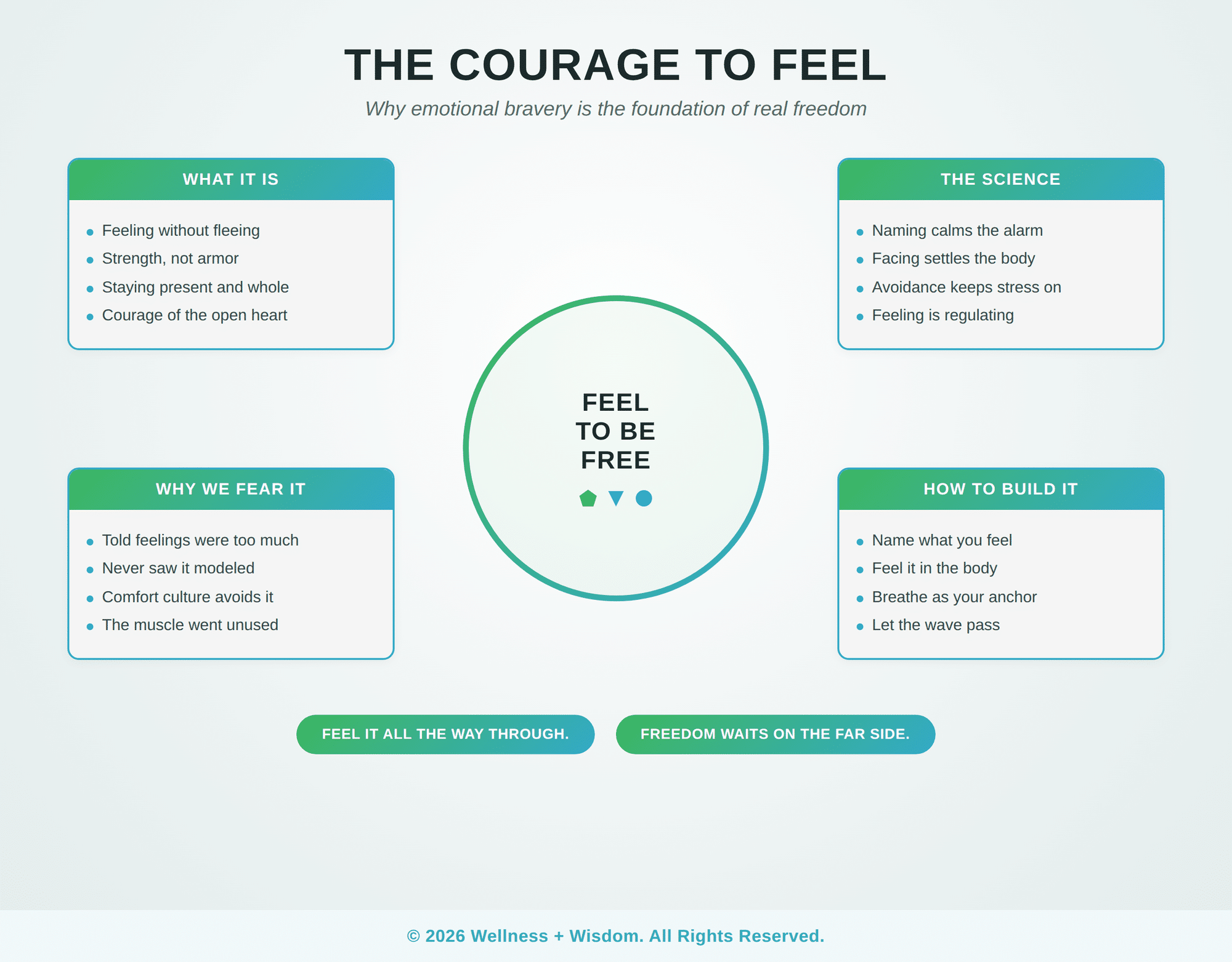
Emotional courage is the capacity to feel your feelings fully, without running, numbing, or pushing them away. It is not about being fearless, and it is not about wallowing or being ruled by emotion. It is the middle path, the ability to stay present with whatever arises in you, to let it be felt, and to let it move through. In a culture that constantly offers us ways to escape our inner experience, choosing to feel is genuinely brave.
Notice that this is a very different picture of strength than the one most of us were handed. We often equate strength with not feeling, with keeping it together, with never letting anything get to us. But that is not strength. That is armor, and armor is heavy. Real emotional strength is not the ability to feel nothing. It is the ability to feel everything and remain standing, grounded, and whole. The armored person may look invulnerable, but they are also cut off from much of life. The brave person feels the wind and the weather and keeps walking anyway.
The word courage itself points to this. It comes from the root for heart. To have courage is to act from the heart, and the heart is where feeling lives. So emotional courage is courage in its most original sense, the bravery to keep your heart open even when it would be easier to shut it down. Every tradition of wisdom has pointed to this same truth, that an open heart is both the most vulnerable thing in the world and the most powerful. This is the foundation of genuine emotional intelligence, and it is a skill anyone can grow.
Why We Learned to Fear Our Feelings
If feeling is so natural, why do so many of us fear our own emotions? The answer usually traces back to what we learned early in life. As children, most of us received subtle and not so subtle messages that certain feelings were unacceptable. We were told not to cry, to calm down, to stop being so sensitive, or that big feelings were a burden to the adults around us. Over time, we learned to associate our own emotions with danger or rejection.
Many of us also simply never saw emotional courage modeled. If the adults who raised us fled their own feelings through work, distraction, anger, or numbing, we absorbed the lesson that feelings are to be managed and avoided, not felt and honored. We inherited their emotional strategies along with their eye color, a pattern we explore deeply in our work on inherited patterns. A father who could not cry often raises a son who cannot either, and a mother who swallowed her anger often raises a daughter who does the same, until someone in the line finally chooses to feel and breaks the chain.
There is also the simple fact that difficult emotions are uncomfortable, and our whole modern world is engineered to help us avoid discomfort. With endless distraction always at hand, the muscle of staying present with a hard feeling rarely gets exercised, and like any unused muscle, it weakens. None of this is a personal failing. It is simply what most of us were taught, or more accurately, what most of us were never taught. And the good news is that what was learned can be relearned, at any age. We can teach ourselves the emotional courage we were never shown.
The Science of Facing Difficult Emotions
The science here is deeply encouraging, because it shows that facing your feelings actually calms your body rather than overwhelming it. Research by Matthew Lieberman and colleagues, published in Psychological Science, found that the simple act of putting feelings into words, what they called affect labeling, reduced activity in the amygdala, the brain's alarm center. In plain terms, naming and facing an emotion turns down the internal alarm, while avoiding it leaves that alarm quietly ringing.
This flips our usual fear on its head. We avoid feelings because we assume that facing them will make things worse, that we will be flooded and unable to cope. But the research suggests the opposite. Turning toward an emotion with awareness helps the body settle. Avoidance, not feeling, is what keeps us stuck in a state of low grade threat. Emotional courage is not just noble. It is neurologically regulating.
There is a beautiful practical implication here. You do not have to fix or analyze a feeling to benefit. Often, simply naming it honestly, this is grief, this is fear, this is anger, begins to settle your system. This is why practices that help us face and name our emotions are so powerful, and why we build them into everything from the 90 second rule to our approach to feeling emotions safely.
What Avoiding Your Feelings Costs You
Avoiding your emotions is not free. It carries a steep and often hidden price, which is worth naming so the invitation to courage feels worth accepting. When we consistently push feelings away, they do not disappear. They go underground, where they keep influencing us from the shadows, shaping our moods, our reactions, and our choices without our awareness.
There is a physical cost too. Unfelt emotion keeps the body's stress response subtly activated. The researcher Bruce McEwen described in the New England Journal of Medicine how a chronically activated stress response creates allostatic load, the cumulative wear that builds when the body's alarm never fully switches off. A life spent avoiding feeling is a life of quiet, ongoing internal stress, which over time takes a real toll on the body. Even our physical resilience is affected, as foundational psychoneuroimmunology research by Sheldon Cohen and colleagues has shown.
Then there is the cost to our aliveness and our relationships. You cannot selectively numb. When you wall off the painful feelings, you wall off the beautiful ones too, dimming joy along with grief. And because real intimacy requires the willingness to be felt and to feel, emotional avoidance quietly starves our closest connections. The refusal to feel, meant to protect us, ends up costing us the very richness of life. This is one of the deep themes behind our work on the culture of numbing out.
The Difference Between Bravery and Toughness
It is important to draw a clear line between real bravery and the kind of toughness our culture often praises, because they look similar from the outside but are opposites underneath. Toughness, as it is usually meant, is about not feeling. It is the clenched jaw, the stiff upper lip, the refusal to let anything get to you. It can look strong, but it is really a strategy for avoidance, a way of armoring against the inner world rather than meeting it.
The bravery we are talking about is the willingness to feel, which requires far more strength than shutting down ever does. Anyone can build a wall. It takes real courage to lower it and let yourself be moved. Suppression may look composed, but underneath it the unfelt emotion is still there, still active, still shaping the body and the behavior from the shadows. Toughness manages the appearance of calm while the storm rages on inside.
This distinction matters enormously for how we understand strength, especially for those who were raised to equate manhood or maturity with never showing feeling. True emotional leadership is not the absence of feeling. It is the presence of enough inner steadiness to feel deeply and stay grounded. The strongest people are not those who feel the least, but those who can feel the most and remain whole.
When you understand this, you can let go of the exhausting project of appearing unaffected and step into something far more powerful and far more honest. You can be both soft and strong, both deeply feeling and deeply grounded. That combination is not weakness. It is the mark of genuine emotional maturity, and it is available to anyone willing to practice it.
Emotional Courage and the L.I.F.E. Method
Emotional courage is woven through the entire L.I.F.E. Method™, our system for identity transformation built on four pillars: Liberation, Integration, Frequency, and Embodiment. You cannot truly transform while fleeing your own inner world, so the bravery to feel becomes the doorway to everything else.
Liberation asks for the courage to feel the old pain you have been avoiding so it can finally release its grip. Integration asks for the courage to face and welcome the parts of yourself you have exiled, bringing them home. Frequency asks for the courage to feel your way into a higher, truer inner state rather than numbing out at a lower one. And Embodiment asks for the courage to actually inhabit your body and its sensations, rather than living up in your head where feelings can be avoided. At every step, the work is made possible by the willingness to feel.
This is why we treat the willingness to feel as foundational rather than optional. It is not one technique among many. It is the ground the whole transformation stands on. When you build this capacity, you are not just handling emotions better. You are building the capacity for genuine change, deeper connection, and a fuller relationship with your Connection to Creator and God. Explore this further through our programs and the Wellness + Wisdom Podcast.
How to Build Emotional Courage
Emotional courage is a skill, and like any skill it grows through practice. You do not build it by making one heroic leap. You build it through many small, repeated acts of staying present with what you feel. Here are practices that strengthen the muscle.
1. Name What You Feel
Start with the simplest brave act, naming your emotion honestly. When something arises, quietly say to yourself what it is. This is sadness. This is anxiety. As the research shows, naming a feeling begins to settle your system, and it is the first step in facing rather than fleeing it.
2. Feel It in Your Body
Emotions live in the body as sensation. Practice locating a feeling physically, the tightness in the chest, the heaviness in the belly, and simply breathing into it. You are teaching yourself that you can feel a sensation without being destroyed by it, which is the heart of emotional bravery. Most feelings are far more tolerable in the body than they are in the anxious stories the mind tells about them, and meeting them as pure sensation often takes away much of their sting.
3. Use the Breath as an Anchor
Breath is what makes it possible to stay present with intensity. A few slow, conscious breaths signal safety to your neural system and give you a steady place to stand while a feeling moves through. This is why breathwork is a core tool in the BREATHE™ program.
4. Let the Wave Pass
An emotion is a wave. When you stop resisting it and let it rise, crest, and fall, it moves through in a surprisingly short time. Practice riding one wave at a time, trusting that it will pass. Each time it does, you prove to yourself that you can survive feeling, and your courage grows.
5. Practice With Support
You do not have to do this alone. Facing difficult emotions is often easier and safer in the presence of a trusted person or community. Doing this brave inner work alongside others who understand is one reason the Liberated Life Tribe exists.
Choose one practice and begin today. This bravery is built the way physical strength is built, through consistent, gentle repetition. Be patient and kind with yourself, and let the capacity grow at the pace of lived experience.
Teaching the Next Generation to Feel
One of the most beautiful reasons to build this bravery is that we pass it on, whether we mean to or not. Children learn how to handle emotions largely by watching the adults around them. When a child sees a grown up feel a hard emotion, name it, and move through it with grace, that child learns that feelings are safe and survivable. When they see the adults flee or explode, they learn the opposite.
This means the inner work you do is never just for you. Every time you meet your own feelings with courage instead of avoidance, you are quietly modeling emotional health for the young people in your life. You are giving them permission to feel, and showing them how. This is one of the deepest gifts of conscious parenting, breaking a generational pattern of avoidance and replacing it with a legacy of presence.
You can also teach it directly, in simple ways. Helping a child name what they feel, letting them know that all feelings are welcome even when all behaviors are not, and staying calm and present while they move through a big emotion all build their capacity for emotional bravery. You do not have to do it perfectly. Children learn as much from watching us repair after we get it wrong as they do from us getting it right.
Seen this way, your own courage to feel becomes a form of generational healing. The steadiness you build in yourself becomes the emotional inheritance you leave behind, one that can ripple forward for generations. There is hardly a more meaningful reason to do this work, and it is a theme we return to often in our teaching on raising emotionally intelligent children.
The Freedom on the Other Side
It is worth painting a clear picture of what emotional courage actually gives you, because the reward is enormous. When you are no longer afraid of your own feelings, an extraordinary freedom opens up. So much of human suffering comes not from our emotions themselves but from our frantic efforts to avoid them. Remove that fear, and life changes profoundly. What once felt like a minefield of feelings to be avoided becomes simply the rich, moving texture of being alive.
You become free to love without holding back, because you are no longer protecting yourself from the vulnerability that love requires. You become free to take real risks, because failure and disappointment lose their terror when you know you can feel them and survive. You become free to be authentic, because you no longer have to hide the parts of yourself that carry difficult feelings. The willingness to feel is quite literally the foundation of freedom.
There is also a deep peace that comes with it. When you know you can handle whatever you feel, a background anxiety that many people carry their whole lives finally begins to quiet. You stop bracing against your own inner world. That constant, low level bracing takes an enormous amount of energy, and when it finally relaxes, many people are surprised by how much lighter and more present they feel. You come to trust yourself, not because life will be painless, but because you know you can meet whatever comes with an open heart. That trust is one of the greatest gifts a person can give themselves, and it ripples outward into every relationship and every generation that follows. Instead of managing life from a defensive crouch, you begin to move through it with an open chest and a steady heart. Challenges still come, and feelings still hurt, but they no longer run the show from behind the scenes. You get to be the author of your life rather than the manager of your avoidance. When you want support and community for this journey, our latest episodes and the Liberated Life Tribe are here for you.
Frequently Asked Questions
What is emotional courage?
Emotional courage is the capacity to feel your feelings fully, without running, numbing, or pushing them away. It is not fearlessness or being ruled by emotion, but the ability to stay present with whatever arises and let it move through. In a culture full of ways to escape our inner experience, choosing to feel is genuinely brave, and it is the foundation of emotional intelligence.
Why is facing difficult emotions so hard?
Most of us learned early that certain feelings were unacceptable, hearing messages to stop crying or calm down, and many never saw emotional courage modeled by the adults around us. On top of that, difficult emotions are uncomfortable and modern life offers endless distraction, so the muscle of staying present with a feeling rarely gets exercised. None of this is a personal failing, and it can be relearned.
Does facing my emotions actually help, or make things worse?
Research suggests facing them helps. A study by Lieberman and colleagues found that naming a feeling reduced activity in the amygdala, the brain's alarm center. Turning toward an emotion with awareness helps the body settle, while avoidance leaves the alarm quietly ringing. Facing your feelings is not just noble, it is neurologically regulating.
What does avoiding my feelings cost me?
Avoided emotions do not disappear, they go underground and keep shaping your moods and choices. Unfelt emotion also keeps the stress response subtly active, adding to what researchers call allostatic load over time. And because you cannot selectively numb, walling off pain also dims joy and quietly starves your closest relationships.
How do I start building emotional courage?
Begin small. Name what you feel honestly, locate the feeling in your body and breathe into it, use slow conscious breathing as an anchor, and let each emotional wave rise and pass without resisting it. Practicing with the support of a trusted person or community makes it safer. Courage grows through consistent, gentle repetition, not one heroic leap.
How does emotional courage connect to the L.I.F.E. Method?
Emotional courage is the ground the whole L.I.F.E. Method™ stands on. Liberation, Integration, Frequency, and Embodiment each require the willingness to feel rather than flee, from releasing old pain to inhabiting the body. Building emotional courage is not just handling emotions better, it is building the capacity for genuine transformation and deeper connection.
Studies and External Resources
The science in this article rests on peer reviewed research. These are the sources referenced throughout.
- Lieberman MD, et al. (2007). Putting Feelings Into Words: Affect Labeling Disrupts Amygdala Activity in Response to Affective Stimuli. Psychological Science. PubMed: 17576282
- McEwen BS. (1998). Protective and damaging effects of stress mediators. New England Journal of Medicine. PubMed: 9428819
- Cohen S, Tyrrell DA, Smith AP. (1991). Psychological stress and susceptibility to the common cold. New England Journal of Medicine. PubMed: 1713648
About Josh Trent
Josh Trent is an Identity Transformation Architect and the award winning host of the Wellness + Wisdom Podcast, with over 15 million downloads since 2015. He is the creator of the L.I.F.E. Method™ Identity Transformation System and steward of the Emotional Epigenetics™ and BREATHE: Breath + Wellness™ systems of self mastery, impacting over 1,000 students worldwide. Join the Liberated Life Tribe and receive your 10 day Self Liberation Blueprint at liberatedlife.com. Josh lives in Austin, Texas with his wife Carrie, daughter Nayah, and son Novah.
Disclosure: We may earn a commission from certain links on this site when you make a purchase, at no extra cost to you. These commissions help support Wellness + Wisdom and do not affect the products or resources we choose to recommend. Full disclosure .