
By Josh Trent | Wellness + Wisdom Podcast Host & Identity Transformation Architect
“We did not lose our feelings. We buried them under an endless supply of distraction. Coming alive again is not about feeling less. It is about being brave enough to feel at all.”
Josh Trent
We are living in a numbing out society, and most of us do not even notice it, because numbness has quietly become the water we swim in. The moment a hard feeling rises, there is a screen to scroll, a snack to grab, a drink to pour, a notification to chase, a show to binge. None of these are evil. But together they form a culture of constant low grade sedation, a thousand small ways to avoid being fully present with ourselves. The result is a generation that is entertained, stimulated, and busy, yet quietly disconnected from the aliveness we were made for. Reclaiming that aliveness is at the very heart of the Wellness Pentagon™.
Here is the joy forward truth that changes everything. The capacity to feel deeply is not gone. It is only buried, and what is buried can be uncovered. On the other side of the numbness is not more pain, as we secretly fear. On the other side is color, connection, presence, and joy, the whole vivid range of being human that numbness quietly took from us. This article is an invitation to gently put down the sedatives of modern life and come back to the vivid, feeling life that is your birthright.
Table of Contents
- What Numbing Out Really Means
- How Numbing Out Became the New Normal
- Digital Distraction and the Attention Economy
- The Science of Avoidance and the Stress Response
- The Hidden Cost of a Numbed Life
- Numbing Out Society and the Wellness Pentagon
- The Opposite of Numbing Is Feeling
- What Comes Alive on the Other Side
- How to Come Back to Life
- Frequently Asked Questions
- Studies and External Resources
- About Josh Trent
What Numbing Out Really Means
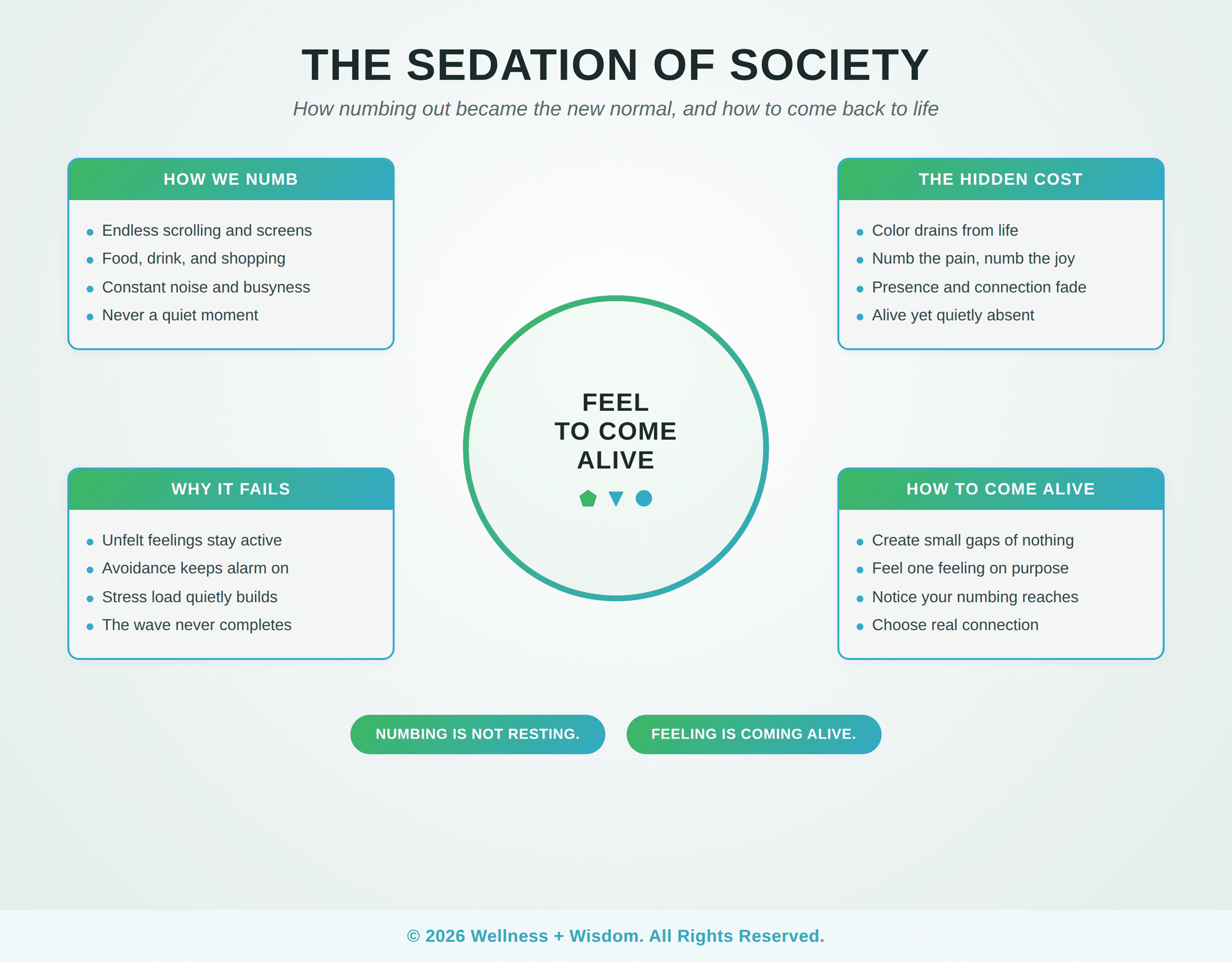
Numbing out is the act of using something external to avoid an internal experience. When a feeling arises that we do not want to feel, discomfort, boredom, anxiety, loneliness, grief, we reach for something to take the edge off. That something might be a phone, food, alcohol, work, shopping, or endless entertainment. The behavior is not the problem in itself. The problem is the intention behind it, which is to not feel what is actually there.
It helps to understand that numbing is a survival strategy, not a character flaw. When feelings are overwhelming and we lack tools to move through them, numbing is a way the psyche protects itself. In small doses and for short seasons, that protection can be genuinely useful. The trouble is that in modern life, the tools of numbing are infinite, frictionless, and always within reach, so a temporary coping strategy becomes a permanent way of living. That is what turns individual numbing into a numbing out society.
There is also an important distinction between rest and numbing. Rest restores you and leaves you more present and alive. Numbing depletes you and leaves you more disconnected, even when it looks like relaxation. Two hours of true rest and two hours of anxious scrolling can look similar from the outside, but they leave your neural system in completely different states. Learning to tell the difference is the first step back toward aliveness.
How Numbing Out Became the New Normal
A numbing out society did not appear by accident. It was built, piece by piece, by a modern world engineered to capture and hold your attention. Much of our technology is intentionally designed to be as compelling as possible, delivering small hits of novelty and reward that keep us reaching for more. When distraction is this available and this optimized, choosing to sit with a difficult feeling instead becomes an act of real countercultural courage.
Layer on top of that the pace and pressure of modern life. Many people are genuinely overwhelmed, carrying more stress, more information, and more demands than any previous generation. When the load is that heavy and the tools of numbing are that easy, numbing is the path of least resistance. It is not weakness. It is a predictable human response to an environment that offers escape more readily than it offers support. This connects deeply to what we explore in the roots of addiction.
There is also a cultural story at work, one that treats constant productivity and constant stimulation as virtues and treats stillness as laziness or even as something to fear. In a world that never stops, the quiet space where feelings live starts to feel threatening. So we fill every gap. We numb the commute, the meal, the waiting room, the moment before sleep. Slowly, the capacity to simply be with ourselves, unentertained and unmedicated, begins to atrophy. Reclaiming that capacity is central to the L.I.F.E. Method™ and everything we teach on the Wellness + Wisdom Podcast.
Digital Distraction and the Attention Economy
No honest conversation about a numbing out society can skip the role of technology, because our devices are the most powerful numbing tools ever created. Much of the digital world runs on what is often called the attention economy, where a company's success depends on how many hours of your attention it can capture. To win that competition, products are carefully engineered to be as compelling and habit forming as possible, delivering an endless stream of novelty that keeps you reaching for the next hit.
This is where sedation culture and an addiction to distraction meet. The phone in your pocket offers an instant escape from any uncomfortable moment, available every second of every day with no friction at all. Boredom, awkwardness, sadness, even a few seconds of stillness can be dissolved with a single tap. Over time, the brain learns that it never has to tolerate discomfort, and the muscle that lets us sit with a hard feeling slowly weakens from disuse.
None of this means technology is the enemy or that you need to throw your phone in a lake. It means the design of these tools is not neutral, and using them consciously requires real intention. When you understand that the pull toward constant distraction is engineered, you can stop blaming yourself for feeling hooked and start making deliberate choices about when and how you engage. That shift from unconscious reaching to conscious choosing is the beginning of freedom, and it connects directly to our work on self sabotage and addiction and connection.
The goal is not a life with no screens. It is a life where you are the one deciding, where the tools serve your aliveness instead of quietly draining it. Reclaiming that authority over your own attention is one of the most important acts of self respect available in the modern world. When you decide where your attention goes, you decide where your life goes, because attention is the raw material that every meaningful thing is built from. Guard it well, and you guard your one precious life.
The Science of Avoidance and the Stress Response
The science here is both fascinating and clarifying. When we avoid an emotion, we do not actually make it go away. Research by Matthew Lieberman and colleagues, published in Psychological Science, showed that the simple act of naming a feeling, what they called affect labeling, reduced activity in the amygdala, the brain's alarm center. The implication is powerful. Turning toward a feeling and naming it calms the body, while turning away from it leaves the alarm quietly ringing in the background.
This is why numbing is such a poor long term strategy. The unfelt feeling does not dissolve when we distract ourselves. It stays active beneath the surface, keeping the stress response subtly switched on. The researcher Bruce McEwen described in the New England Journal of Medicine how a chronically activated stress response produces allostatic load, the cumulative wear that erodes the body over time. A life of chronic avoidance is a life of chronic low grade stress, even when it feels like we are relaxing.
There is a deep irony here. We numb to escape discomfort, but numbing actually preserves the very discomfort we are trying to avoid, while adding the extra cost of disconnection on top. The feeling we would not face stays stuck, and our aliveness dims in the process. Meeting a feeling directly, by contrast, allows it to move through and complete, which is exactly what the body is designed to do. Your neural system knows how to process emotion. It just needs us to stop interrupting the process.
The Hidden Cost of a Numbed Life
The cost of living in a numbing out society is enormous, precisely because it is so hidden. Numbness does not announce itself with dramatic pain. It arrives as a slow fading, a gradual draining of color from life. You do not notice the moment joy got quieter or the moment you stopped feeling deeply moved. You just wake up one day sensing that something is missing, even though nothing is obviously wrong. That vague ache of missing out on your own life is one of the quietest and most common forms of suffering in the modern world, and almost no one names it out loud.
Here is the crucial part that almost no one tells you. You cannot selectively numb. When you numb the difficult feelings, you numb the beautiful ones too. The same wall that keeps out grief keeps out joy. The same barrier that dulls anxiety dulls awe, love, and delight. Emotion is not a set of separate channels you can mute individually. It is one system, and when you turn down the volume to avoid pain, you turn down the volume on everything, including the aliveness that makes life worth living.
There is a relational cost as well. Numbing is isolating by nature, because true connection requires presence, and presence requires feeling. When we are numbed out, we are physically near people yet emotionally absent, scrolling beside our loved ones instead of being with them. Over time this quiet absence erodes the very relationships that are meant to nourish us. The antidote is not more information about connection. It is the courage to be present, a theme we return to in our work on emotional intelligence.
Numbing Out Society and the Wellness Pentagon
Viewed through the Wellness Pentagon™, the effects of a numbing out society touch all five dimensions of wellbeing at once. This is why numbness feels so pervasive and why no single fix ever seems to resolve it. It is not a problem in one area. It is a dimming of the whole system.
Physically, chronic numbing through food, alcohol, or sedentary distraction takes a real toll on the body and keeps the stress response quietly active. Mentally, a constantly stimulated and distracted mind loses its capacity for depth, focus, and original thought. Emotionally, numbing flattens the entire range of feeling, which is the very core of the problem. Spiritually, it severs our Connection to Creator and God, because presence and reverence require exactly the stillness that numbing helps us avoid. And financially, a numbed, distracted life often drives compulsive spending and undermines the clear, grounded decision making that real wealth requires.
Seeing it this way is oddly hopeful. Because all five dimensions are connected, a shift in one begins to ripple through the others. When you reclaim your capacity to feel in even one area, you start to wake up the whole system. You do not have to fix everything at once. You just have to begin coming back to life somewhere, and let the aliveness spread. Our wellness tools and the full L.I.F.E. Method are built to help you do exactly that.
The Opposite of Numbing Is Feeling
The way out of a numbing out society is beautifully simple to name, even if it takes courage to practice. The opposite of numbing is feeling. Not being overwhelmed by feeling, and not drowning in it, but developing the capacity to be present with whatever arises and to let it move through you. This is a skill, and like any skill it grows stronger with practice.
Most of us fear that if we stop numbing and actually feel, we will be flooded and unable to cope. In my experience, and in the experience of the many people I have walked alongside, the opposite is true. Feelings are far more manageable than we imagine when we stop fighting them. An emotion is a wave. When you let it rise, crest, and fall without interference, it moves through in a surprisingly short time. It is the resistance to feeling, not the feeling itself, that keeps us stuck. Once you learn this in your own body, even once, it changes your relationship with every difficult emotion that follows.
This is where breathwork becomes so valuable, because the breath is the bridge between avoiding and allowing. A few conscious breaths can create just enough safety in the body to let a feeling be felt rather than fled. This is the foundation of the BREATHE™ program, and it is why we treat the breath as a primary tool for coming back to life. When you can breathe through a feeling, you no longer need to numb it, and something you buried long ago finally gets to complete. This is also the heart of building an honest relationship with your emotions.
What Comes Alive on the Other Side
It is worth painting a clear picture of what waits on the other side of a numbing out society, because fear of the unknown is part of what keeps us numb. We imagine that if we stop numbing, we will be swallowed by pain. What actually happens is the opposite. As the numbness lifts, life comes back into color, and the return of feeling is overwhelmingly a return of good things.
Food tastes better. Music moves you again. A conversation with someone you love becomes something you feel in your chest rather than something you half attend to. Ordinary moments, morning light, a child's laugh, the first sip of coffee, regain the vividness they had when you were young. This is not a spiritual abstraction. It is the direct, physical experience of a system that is no longer sedated, a body and mind that are finally awake to the life in front of them.
There is also a deeper reward. When you can feel, you can connect, create, and grow in ways that numbness makes impossible. Your relationships deepen because you are actually present for them. Your creativity returns because it was always fueled by feeling. Your Connection to Creator and God becomes accessible again, because reverence requires presence. This is the aliveness at the center of true identity transformation and the freedom we help people reclaim through breaking old patterns.
The pain you were avoiding does still get felt on this path, that part is honest and true. But it moves through and completes rather than staying stuck, and it turns out to be far more survivable than the slow, colorless ache of a numbed life. Feeling fully is not the harder choice in the long run. It is the one that gives you your life back.
How to Come Back to Life
Coming back from a numbing out society is not about willpower or deprivation. It is about gently, consistently choosing presence over escape until aliveness becomes your default again. Here are practices that make the path walkable.
1. Create Small Gaps of Nothing
Reclaim the tiny moments you usually fill with a screen. The wait in line, the first minute in the car, the pause before sleep. Instead of reaching for distraction, simply be there, breathing, noticing. These small gaps retrain your capacity to be present without stimulation.
2. Feel One Feeling on Purpose
Once a day, when an emotion arises, choose to feel it instead of numbing it. Name it, breathe into it, and let it move. You are proving to yourself, one feeling at a time, that you can survive being present, and that the wave always passes.
3. Notice Your Numbing Reaches
Begin to notice, without judgment, the moments you reach for a numbing agent. What feeling were you avoiding right before you grabbed the phone or the snack? This gentle awareness is the doorway to choice. You cannot change a pattern you cannot see.
4. Choose Real Connection
Numbness thrives in isolation, and presence grows in connection. Put the phone away and be fully with someone. Have the real conversation. Community is one of the most powerful antidotes to a numbed life, which is exactly why the Liberated Life Tribe exists.
5. Move and Get in Your Body
Numbing pulls us up into the head and out of the body. Movement, breath, and time in nature bring us back down into direct, felt experience. A walk without headphones, a few conscious breaths, bare feet on the ground. These simple acts are powerful ways to feel alive again.
Start with whichever one calls to you, and practice it gently. Aliveness is not recovered in a single dramatic moment. It returns the way dawn arrives, gradually, and then all at once. Each small choice to be present instead of escaping is a vote for the life you actually want, and those votes add up faster than you expect. When you want support and community for the journey back, our latest episodes and programs are here to walk with you.
Frequently Asked Questions
What does it mean to live in a numbing out society?
It means living in a culture where distraction and low grade sedation have become the default response to any uncomfortable feeling. A numbing out society offers infinite, frictionless ways to avoid being present, from endless scrolling to constant snacking, so temporary coping becomes a permanent way of living and our capacity to feel deeply slowly fades.
Is numbing out the same as relaxing?
No. Rest restores you and leaves you more present and alive, while numbing depletes you and leaves you more disconnected, even when it looks like relaxation. Two hours of genuine rest and two hours of anxious scrolling can appear similar, but they leave your neural system in very different states.
Why can't I just numb the bad feelings and keep the good ones?
Because emotion is one integrated system, not separate channels. When you numb the difficult feelings, you numb the beautiful ones too. The same wall that blocks grief and anxiety also blocks joy, awe, and love. This is the hidden cost of numbing, a gradual flattening of your entire emotional range.
What does the science say about avoiding emotions?
Research by Lieberman and colleagues found that naming a feeling reduces activity in the amygdala, the brain's alarm center, while avoidance leaves that alarm quietly active. Combined with McEwen's work on allostatic load, this suggests chronic avoidance keeps the stress response switched on, quietly wearing on the body over time.
How do I start feeling again without getting overwhelmed?
Begin small and use the breath. Once a day, choose to feel one feeling on purpose, naming it and breathing into it as it moves through. Emotions are waves that rise, crest, and pass when you stop resisting them. A few conscious breaths create enough safety in the body to feel rather than flee.
How does this connect to the Wellness Pentagon?
A numbing out society dims all five dimensions of the Wellness Pentagon™ at once, physical, mental, emotional, spiritual, and financial. Because they are interconnected, reclaiming your capacity to feel in even one area begins to wake up the whole system, which is why coming back to life anywhere helps everywhere.
Studies and External Resources
The science in this article rests on peer reviewed research. These are the sources referenced throughout.
- Lieberman MD, et al. (2007). Putting Feelings Into Words: Affect Labeling Disrupts Amygdala Activity in Response to Affective Stimuli. Psychological Science. PubMed: 17576282
- McEwen BS. (1998). Protective and damaging effects of stress mediators. New England Journal of Medicine. PubMed: 9428819
- Cohen S, Tyrrell DA, Smith AP. (1991). Psychological stress and susceptibility to the common cold. New England Journal of Medicine. PubMed: 1713648
About Josh Trent
Josh Trent is an Identity Transformation Architect and the award winning host of the Wellness + Wisdom Podcast, with over 15 million downloads since 2015. He is the creator of the L.I.F.E. Method™ Identity Transformation System and steward of the Emotional Epigenetics™ and BREATHE: Breath + Wellness™ systems of self mastery, impacting over 1,000 students worldwide. Join the Liberated Life Tribe and receive your 10 day Self Liberation Blueprint at liberatedlife.com. Josh lives in Austin, Texas with his wife Carrie, daughter Nayah, and son Novah.
Disclosure: We may earn a commission from certain links on this site when you make a purchase, at no extra cost to you. These commissions help support Wellness + Wisdom and do not affect the products or resources we choose to recommend. Full disclosure .