
By Josh Trent | Wellness + Wisdom Podcast Host & Identity Transformation Architect
“Burnout is rarely a sudden collapse. It is a slow accumulation of feelings you never had time to feel. The emotional inventory is how you empty the tank before it overflows.”
Josh Trent
An emotional inventory is one of the simplest and most powerful practices for burnout prevention, and almost nobody is taught it. Most people treat their feelings the way they treat a full inbox they never open, letting the unread count climb until the whole system crashes. Burnout is what that crash looks like in a human being. The good news, and the entire point of this article, is that a short daily emotional inventory can catch the buildup early, long before it becomes a breakdown. This practice sits at the heart of the Wellness Pentagon™ and everything we teach about emotional intelligence.
Here is the joy forward promise. Preventing burnout is not about doing less of what you love or lowering your ambition. It is about staying current with your inner world so that your energy stays clean and renewable. When you know what you feel, you can tend to it in minutes. When you do not, it compounds silently until it takes months to recover. The emotional inventory is the difference between maintenance and repair, and maintenance is always cheaper. Think of your emotional inventory burnout prevention practice as the least expensive insurance you will ever buy for your energy.
Table of Contents
- What an Emotional Inventory Actually Is
- How Burnout Really Builds
- Why We Learned to Ignore Our Feelings
- The Science of Naming What You Feel
- Early Signs You Are Heading Toward Burnout
- The Daily Emotional Inventory Practice
- Emotional Inventory Across the Wellness Pentagon
- When the Inventory Reveals Something Deeper
- Building the Habit So It Actually Sticks
- Frequently Asked Questions
- Studies and External Resources
- About Josh Trent
What an Emotional Inventory Actually Is
An emotional inventory is a brief, honest check in with your inner world, a moment where you stop and ask what you are actually feeling and what those feelings might be telling you. It is not analysis, and it is not fixing. It is simply noticing, naming, and allowing. Think of it as reading the dashboard of your own body before the warning lights turn into a breakdown on the side of the road.
Most of us are experts at ignoring our internal signals. We push through fatigue, override frustration, and swallow disappointment, telling ourselves we will deal with it later. Later rarely comes. The feelings do not disappear when we ignore them. They go underground, where they quietly drain our energy and shape our behavior without our awareness. An emotional inventory brings them back into the light, where they can actually be tended.
The practice is ancient in spirit and simple in form. Contemplative traditions have always known that turning attention inward is the beginning of wisdom. What is new is our understanding of why it works at the level of the brain and body, and how directly it connects to burnout prevention. When you make the emotional inventory a daily habit, you stop letting unfelt feelings accumulate, and accumulation is exactly what burnout is made of. This is a core practice in the L.I.F.E. Method™ and something we return to often on the Wellness + Wisdom Podcast.
How Burnout Really Builds
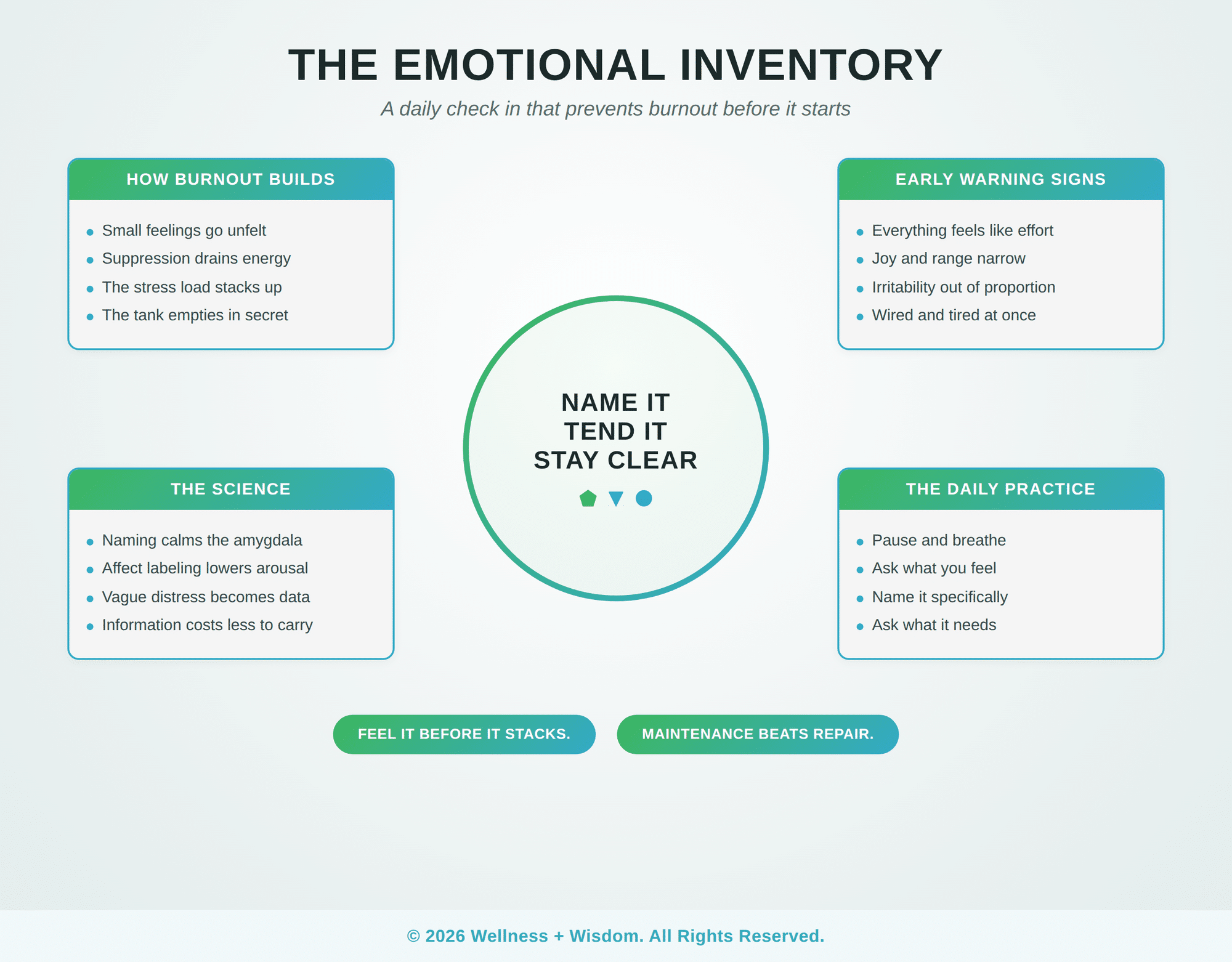
To understand why an emotional inventory prevents burnout, you have to understand how burnout actually forms. The World Health Organization now recognizes burnout as an occupational phenomenon, defined by three features: exhaustion, a growing sense of cynicism or detachment from your work, and a decline in your sense of accomplishment. But those are the late stage symptoms. The real story begins much earlier and much quieter.
Burnout builds through accumulation. Each day brings small emotional demands, a frustrating meeting, a disappointment, a moment of anxiety, a swallowed grief. Individually, none of them is overwhelming. But when you never process them, they stack. The researcher Bruce McEwen described this kind of accumulation in the New England Journal of Medicine as allostatic load, the cumulative wear that builds when the stress system stays switched on without recovery. Unfelt emotions are a major contributor to that load.
Here is the part most people miss. Your body does not distinguish between a feeling you have processed and one you have suppressed the way you might hope. A suppressed feeling still activates your stress chemistry. It still costs energy to hold down. In fact, the effort of suppression is itself a drain. So the person who prides themselves on never letting feelings show is often the person whose tank is emptying fastest, because they are paying twice, once for the feeling and once for the holding.
This is why burnout so often blindsides high functioning, capable people. They are so good at overriding their internal signals that they never notice the tank running low until it hits empty. The emotional inventory interrupts this exact pattern. It is a daily release valve that keeps the pressure from building to the breaking point. Learn how the body stores what we suppress in our piece on bioenergetic memory.
Why We Learned to Ignore Our Feelings
If the emotional inventory is so simple and so effective, why does almost no one do it? The answer is that most of us were quietly trained to ignore our feelings long before we had any say in it. As children, many of us learned that certain emotions were unwelcome, that big feelings were too much, or that the fastest way to keep the peace was to swallow what we felt and carry on. That early lesson becomes an adult habit of overriding our own signals, which is the very pattern an emotional inventory burnout prevention routine is designed to interrupt.
Our culture reinforces this every day. We celebrate people who push through, who never let it show, who keep performing no matter what they are carrying. Vulnerability is often treated as weakness, and stillness is treated as laziness. So we learn to treat our inner world as an inconvenience to be managed rather than a source of vital information to be honored. The cost of that bargain is invisible right up until the moment it is not.
There is also a simple fear underneath the avoidance. Many people worry that if they actually stopped to feel what they feel, they would be overwhelmed, that the dam would break and they would not be able to function. In my experience, the opposite is true. It is the unfelt feelings, the ones held down with constant effort, that overwhelm us. The felt feeling moves through and releases. The suppressed feeling is the one that floods the system when it finally breaks free.
Understanding this changes everything. The emotional inventory is not a risk. It is the safest possible way to relate to your feelings, because it lets them move in small, manageable doses every day rather than building into a flood. Turning toward your inner world, gently and regularly, is an act of maturity and self respect, and it is the beginning of real emotional intelligence.
The Science of Naming What You Feel
The emotional inventory works because of a beautifully simple mechanism in the brain. When you put a feeling into words, something measurable happens in your neural circuitry. Researcher Matthew Lieberman and his colleagues, publishing in Psychological Science, showed that the simple act of labeling an emotion, what they called affect labeling, reduced activity in the amygdala, the brain's threat and alarm center, while increasing activity in the regions associated with regulation and perspective.
In plain language, naming a feeling calms it. When you say to yourself, I am feeling anxious, or I am feeling grief, you are not indulging the emotion. You are actually turning down its intensity at the level of the brain. This is why the emotional inventory is not soft or self indulgent. It is one of the most efficient regulation tools we have, and it takes only a few honest words.
There is a deeper reason this matters for burnout prevention. An emotion that is named can be metabolized and released. An emotion that stays vague and unnamed tends to linger as a background hum of distress, keeping your neural system subtly activated. Over days and weeks, that background hum is the very thing that erodes your reserves. The emotional inventory converts vague, draining distress into specific, workable information, and information is far less costly to carry than confusion.
This connects directly to the science we explore in how emotions shape gene expression and in the field of Emotional Epigenetics™. Your inner emotional climate is not separate from your biology. It is one of its most powerful inputs, and naming what you feel is a way of tending that climate on purpose.
Early Signs You Are Heading Toward Burnout
One of the gifts of a regular emotional inventory is that it makes the early signs of burnout visible while there is still time to respond. Most people only recognize burnout once it has fully arrived. With a daily check in, you catch the drift much sooner. Here are the early signals worth watching for.
The first is a growing sense that everything is an effort, that tasks which used to feel manageable now feel heavy. The second is emotional flatness, a narrowing of your range where you feel less joy, less enthusiasm, and less connection than you used to. The third is irritability that seems out of proportion, a short fuse that surprises even you. The fourth is a creeping cynicism, a voice that says none of this matters or nothing will change. And the fifth is physical, showing up as disrupted sleep, tension you cannot shake, or a body that feels wired and tired at the same time.
None of these signals means you have failed. They are your system communicating, and communication is a gift. When you catch them early through your emotional inventory, you can adjust with small course corrections, more rest, a boundary, a conversation, a day of recovery. When you ignore them, they escalate until the only remedy left is a long and costly recovery. Catching the signal early is the entire game, and it is exactly what a daily emotional practice makes possible.
The Daily Emotional Inventory Practice
Here is the practice itself, simple enough to do in a few minutes and powerful enough to change the trajectory of your week. You can do it in a journal, on a walk, in the shower, or sitting quietly with your morning coffee. What matters is consistency, not ceremony.
1. Pause and Land in the Body
Before you can take an honest inventory, you have to arrive. Take three slow breaths, with the exhale longer than the inhale, and let your attention drop from your busy mind into your body. This simple shift moves you out of thinking about your day and into feeling it, which is where the real information lives.
2. Ask the Open Question
Ask yourself, what am I actually feeling right now? Then wait. Do not answer with what you think you should feel. Wait for what is actually there. Sometimes it arrives as a word, sometimes as a sensation, a tightness, a heaviness, a flutter. All of it is valid data.
3. Name It Specifically
Give the feeling a name, and be as specific as you can. Not just bad, but disappointed. Not just fine, but quietly anxious. This is the affect labeling that calms the amygdala. The more precise the name, the more the feeling settles. If several feelings are present, name each one. You are allowed to feel more than one thing at once.
4. Ask What It Needs
Once a feeling is named, ask it gently, what do you need? Sometimes the answer is rest. Sometimes it is a boundary, a conversation, or simply to be acknowledged. Often, being named and felt is all a feeling needs to release. You do not have to act on every answer. You just have to listen.
5. Close With Gratitude
End by naming one thing you are grateful for. This is not about bypassing the hard feelings. It is about holding the full picture, both the difficulty and the goodness, so your neural system ends the inventory in a state of safety and openness rather than distress.
That is the whole practice. Five short steps, a few minutes a day. Done consistently, it keeps your emotional tank current, so it never quietly empties into burnout. You will be surprised how much lighter a week feels when nothing is left to accumulate in the dark, and how much more energy you have for the people and the work you love when your inner world is tended rather than ignored. When you are ready to practice it alongside others walking the same path, the Liberated Life Tribe is built for exactly this kind of shared, sustainable growth.
Emotional Inventory Across the Wellness Pentagon
The Wellness Pentagon™ teaches that true health requires nourishment across five dimensions: physical, mental, emotional, spiritual, and financial. The emotional inventory is a practice that strengthens all five at once, which is why it is such a high leverage habit.
Emotionally, it is obvious. The inventory builds the awareness and regulation that are the core of emotional intelligence. Mentally, it clears the fog that unprocessed feelings create, freeing up bandwidth for focus and good judgment. Physically, by lowering the stress load of suppressed emotion, it protects your sleep, your energy, and your long term health. Spiritually, the daily turning inward deepens your Connection to Creator and God, because presence with yourself is the doorway to presence with something larger. And financially, a person who is not quietly burning out makes clearer, wiser, less reactive decisions, which over time is worth more than almost any productivity hack.
This is the pattern with the most powerful practices. They are never isolated. A single daily emotional inventory sends ripples through every dimension of your wellbeing, which is exactly why we treat emotional intelligence as foundational rather than optional. Tend the emotional dimension well, and the whole Pentagon grows steadier beneath you. Build your own practice with our wellness tools and explore the full L.I.F.E. Method.
When the Inventory Reveals Something Deeper
Sometimes the emotional inventory surfaces more than the ordinary feelings of a busy life. Sometimes it reveals a pattern, a grief that keeps returning, an anxiety with deep roots, a heaviness that will not lift. When that happens, it is not a sign that the practice is failing. It is a sign that it is working, that you are finally hearing something that has been asking for attention for a long time.
These deeper patterns often have their roots earlier than this week or this job. Many of them are inherited, shaped by the emotional atmosphere we grew up in and even by the stress our ancestors carried, a theme we explore in our work on inherited limiting beliefs and breaking generational patterns. The daily inventory keeps you current with the surface, but when something deeper surfaces, it deserves deeper support.
This is where breathwork, somatic practice, and community become invaluable. Some feelings live below the level of language and need the body, the breath, and safe connection to move. If your emotional inventory keeps pointing to the same tender place, treat that as an invitation rather than a problem. It is your system showing you exactly where the next layer of freedom is waiting. The BREATHE™ program and the Wellness + Wisdom Podcast are here to walk you into that deeper work when you are ready.
Remember, the goal of the emotional inventory is not to become a person who never struggles. It is to become a person who stays in honest relationship with their inner world, so that struggle never has to build in secret until it becomes burnout. That honest relationship is a form of self respect, and it is the foundation of a life you can actually sustain.
Building the Habit So It Actually Sticks
The emotional inventory burnout prevention practice only works if it becomes automatic, and habits stick best when they are anchored to something you already do. Rather than trying to find a new slot in your day, attach the inventory to an existing anchor. Do it during your first cup of coffee, on your commute, in the shower, or as the last thing before you close your laptop. The anchor removes the need for willpower and makes the practice nearly effortless.
Keep the bar low, especially at the start. A thirty second check in that you actually do every day is worth infinitely more than a twenty minute ritual you abandon after a week. Consistency is the whole mechanism here. The value comes from staying current with your inner world day after day, not from any single profound session. On hard days, even naming one feeling counts as a complete inventory.
Expect resistance, and do not let it stop you. Some days you will not want to look inward, and those are often the days the practice matters most. The resistance itself is information. When you least feel like checking in is frequently when your tank is running lowest. Meeting that resistance with a gentle, brief inventory is exactly how you catch burnout in its early, reversible stage.
Finally, let the practice evolve. Some seasons your inventory will be quick and light. Others it will surface deeper material that asks for more time, breath, or support. Both are fine. The point is not to perform the practice perfectly but to keep the channel open, so that your feelings always have a regular, welcome place to be heard. That open channel is the single most reliable form of burnout prevention I know.
Frequently Asked Questions
What is an emotional inventory?
An emotional inventory is a brief daily check in where you pause, notice what you are feeling, name it specifically, and ask what it needs. It is not analysis or fixing. It is simply staying current with your inner world so that unprocessed feelings do not accumulate into burnout.
How does an emotional inventory prevent burnout?
Burnout builds through the accumulation of unfelt, unprocessed emotions that keep your stress system activated. A daily emotional inventory releases that pressure early by naming and tending feelings before they compound. It is maintenance rather than repair, which keeps your energy clean and renewable.
Why does naming a feeling actually help?
Research by Matthew Lieberman and colleagues found that labeling an emotion, called affect labeling, reduces activity in the amygdala, the brain's alarm center, while engaging the regulation regions. In simple terms, naming a feeling turns down its intensity in the brain, which is why the practice is so calming and efficient.
How long does an emotional inventory take?
Just a few minutes. The practice is five short steps: pause and breathe, ask what you are feeling, name it specifically, ask what it needs, and close with gratitude. Consistency matters far more than length. A short daily inventory beats an occasional long one.
What if my emotional inventory keeps surfacing the same painful feeling?
That is a sign the practice is working and pointing you toward something deeper that deserves attention. Recurring feelings often have roots in earlier or even inherited patterns. Treat it as an invitation to bring in breathwork, somatic practice, or supportive community to help that deeper layer move.
How does this fit the Wellness Pentagon?
The emotional inventory strengthens all five dimensions of the Wellness Pentagon™ at once. It builds emotional intelligence, clears mental fog, lowers physical stress load, deepens spiritual presence, and supports wiser financial decisions by keeping you out of reactive, depleted states. One small daily practice, quietly strengthening every part of your life at the same time.
Studies and External Resources
The science in this article rests on peer reviewed research and authoritative institutions. These are the sources referenced throughout.
- Lieberman MD, et al. (2007). Putting Feelings Into Words: Affect Labeling Disrupts Amygdala Activity in Response to Affective Stimuli. Psychological Science. PubMed: 17576282
- McEwen BS. (1998). Protective and damaging effects of stress mediators. New England Journal of Medicine. PubMed: 9428819
- World Health Organization. Burn out an occupational phenomenon, International Classification of Diseases. WHO ICD-11
About Josh Trent
Josh Trent is an Identity Transformation Architect and the award winning host of the Wellness + Wisdom Podcast, with over 15 million downloads since 2015. He is the creator of the L.I.F.E. Method™ Identity Transformation System and steward of the Emotional Epigenetics™ and BREATHE: Breath + Wellness™ systems of self mastery, impacting over 1,000 students worldwide. Join the Liberated Life Tribe and receive your 10 day Self Liberation Blueprint at liberatedlife.com. Josh lives in Austin, Texas with his wife Carrie, daughter Nayah, and son Novah.
Disclosure: We may earn a commission from certain links on this site when you make a purchase, at no extra cost to you. These commissions help support Wellness + Wisdom and do not affect the products or resources we choose to recommend. Full disclosure .