
By Josh Trent | Wellness + Wisdom Podcast Host & Identity Transformation Architect
“Rest is not the reward for your worth. Rest is the soil your worth grows from. Hustle culture sells you the opposite, and your biology pays the bill.”
Josh Trent
Hustle culture stress is not a mindset problem. It is a biological event happening inside your cells right now, and it is quietly rewriting how your genes express themselves. We have been sold a story that grinding harder, sleeping less, and wearing exhaustion like a badge of honor is the price of success. The truth your body already knows is different. Chronic overwork floods your system with stress chemistry that, over months and years, changes your biology in measurable ways. This is the missing conversation in the wellness world, and it sits right at the center of the Wellness Pentagon™ and Emotional Epigenetics™.
Here is the joy forward promise of this article. You are not stuck with the biology hustle culture handed you. The same system that learns stress can learn safety. The same body that adapted to the grind can adapt to rest. And when it does, you do not lose your ambition. You get it back in a cleaner, more sustainable form, powered by a regulated neural system instead of a depleted one.
Table of Contents
- What Hustle Culture Stress Actually Does to Your Body
- Cortisol, Allostatic Load, and the Slow Erosion
- Why Hustle Culture Stress Is an Epigenetic Stressor
- The Overwork and Health Connection the Data Confirms
- Burnout Epigenetics: When the Grind Becomes Your Baseline
- The Real Cost of the Grind Is Not Just Your Health
- Hustle Culture Across the Wellness Pentagon
- Rest as Healing: The Biology of Recovery
- Seven Practices to Reverse Hustle Culture Stress
- Frequently Asked Questions
- Studies and External Resources
- About Josh Trent
What Hustle Culture Stress Actually Does to Your Body
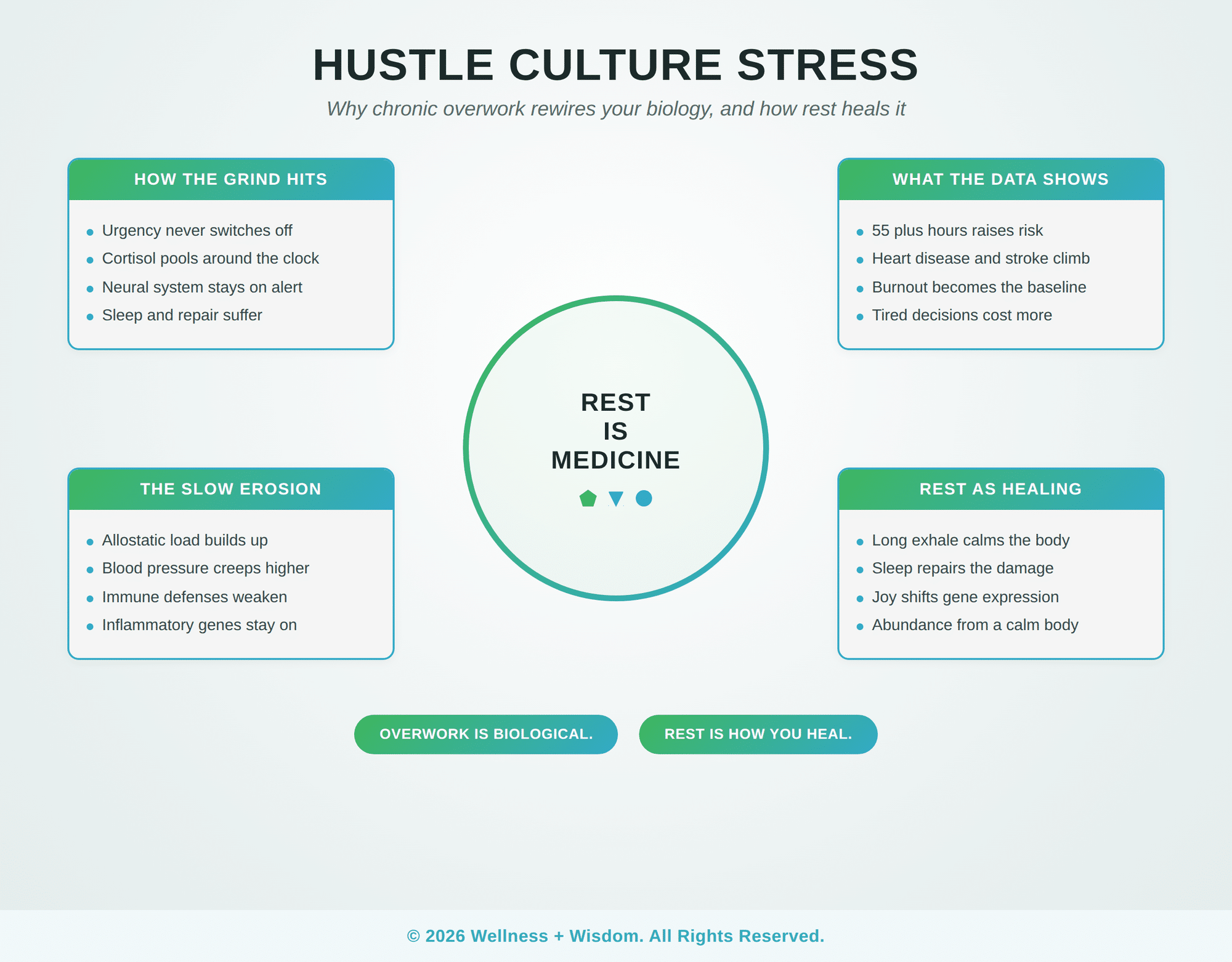
Hustle culture stress begins the moment your body decides that rest is unsafe. When you live in a constant state of urgency, deadlines, notifications, and the belief that stopping means falling behind, your brain reads that environment as an ongoing threat. It does not distinguish between a lion in the grass and an inbox that never empties. To your biology, both are danger, and both trigger the same ancient survival response.
That response is elegant when it is brief. Your body mobilizes energy, sharpens focus, and prepares you to act. The problem is not stress itself. Stress is a healthy, adaptive tool. The problem is that hustle culture never lets the response turn off. You are meant to sprint and then recover. Hustle culture asks you to sprint and then sprint again, day after day, until the sprint becomes your resting state. That is when a helpful tool becomes a slow form of harm.
I lived this for years. I told myself the exhaustion was dedication. I told myself the tight chest and the racing mind were just what ambition felt like. What I did not understand, until I studied the science behind psychoneuroimmunology, was that my body was keeping a detailed record of every unrecovered day, and that record was shaping my health from the inside out.
Cortisol, Allostatic Load, and the Slow Erosion
The central character in the story of hustle culture stress is cortisol. Cortisol is not a villain. It is a brilliant hormone that wakes you up in the morning, regulates your metabolism, and helps you rise to a challenge. In short bursts it is exactly what you want. The trouble starts when cortisol stops cycling and starts pooling, when your body pumps it out around the clock because it never gets the signal that the threat has passed.
The researcher Bruce McEwen gave us the language for what happens next. In a landmark paper in the New England Journal of Medicine, he described the concept of allostatic load, the cumulative wear and tear on the body that builds when stress systems stay switched on too long. Allostasis is the process of achieving stability through change. Allostatic load is the price you pay when that process never gets to rest and reset.
Think of it like a credit card for your biology. A little stress, paid back with a little recovery, keeps your account healthy. But hustle culture keeps charging without paying it down. The interest compounds in the form of disrupted sleep, elevated blood pressure, blood sugar swings, weakened immune function, and a neural system that forgets how to downshift. This is the slow erosion, and most people do not notice it until the bill comes due.
What makes this so important is that the erosion is not inevitable. Allostatic load is a description of accumulated stress, not a life sentence. Reduce the load, restore the recovery, and the body begins to heal. That is the entire premise of the L.I.F.E. Method™ and the reason we treat rest as a skill rather than a luxury.
Why Hustle Culture Stress Is an Epigenetic Stressor
Here is where hustle culture stress moves from uncomfortable to genuinely consequential. Chronic stress does not just make you feel tired. It reaches down to the level of your genes and changes how they are read. This is the field of Emotional Epigenetics™, and it is the missing link between how you live and how your biology responds.
Your genes are not your destiny. They are more like a piano, and your environment, your emotions, and your stress levels are the hands that decide which keys get played. Epigenetic signals, chemical tags that sit on top of your DNA, determine whether a given gene is switched on loudly, played softly, or silenced. Chronic stress is one of the most powerful hands on that piano. It can turn up the volume on inflammatory genes and turn down the genes that support repair, calm, and resilience.
This is why two people can face similar workloads and end up in completely different places. It is not only about the hours. It is about the accumulated epigenetic signal of years spent in survival mode versus years spent in regulation. The person who learned to recover, breathe, and return to safety is quite literally expressing a different version of their genome than the person who stayed in the grind. Your patterns become your biology, and your biology becomes your experience.
The empowering part is that epigenetic tags can change. Unlike your fixed DNA sequence, these tags respond to how you live. Shift the inputs, and over time you shift the expression. This is not wishful thinking. It is the frontier of stress science, and it is the reason a joy forward life is also a biologically healthier one. Explore this deeper in our piece on inherited limiting beliefs and how programming gets rewritten.
The Overwork and Health Connection the Data Confirms
If hustle culture stress were only a matter of feeling frazzled, it would still be worth addressing. But the overwork and health connection is far more serious than most people realize, and the data is sobering. In a landmark global analysis, the World Health Organization and the International Labour Organization estimated that long working hours led to roughly 745,000 deaths from stroke and heart disease in a single year. Working 55 hours or more per week was associated with a meaningfully higher risk of dying from these conditions compared with a standard working week.
Sit with that number. Hundreds of thousands of lives, connected to the very grind that hustle culture celebrates. This is not a fringe claim from a wellness blog. It is the conclusion of the largest study of its kind, produced by two of the most credible health institutions on earth. The badge of honor we wear for overwork turns out to carry a real biological cost.
The mechanism is exactly what we have been describing. Long hours feed chronic stress, chronic stress elevates cortisol and blood pressure, and the cardiovascular system pays over time. Add poor sleep, missed movement, and the emotional weight of never feeling caught up, and you have a recipe for the slow erosion made visible. This is why financial wellness and physical wellness are not separate conversations. The way you earn is a health input.
None of this means ambition is the enemy. It means unrecovered ambition is the enemy. The goal is not to want less or build less. The goal is to build from a regulated body so that your work adds to your life rather than quietly subtracting from it.
Burnout Epigenetics: When the Grind Becomes Your Baseline
Burnout is what happens when hustle culture stress stops being an episode and becomes an identity. The World Health Organization now recognizes burnout as an occupational phenomenon, marked by exhaustion, cynicism or detachment, and a drop in a sense of accomplishment. What that clinical description misses is the felt experience. Burnout is the moment your body stops cooperating with the story your mind keeps telling it.
Burnout epigenetics is the way that prolonged depletion leaves a lasting signature on your biology. When survival mode becomes your baseline, your body recalibrates around it. Your resting heart rate creeps up. Your sleep architecture degrades. Your capacity for joy narrows, because a body braced for threat has little bandwidth left for delight. The grind becomes the default setting, and even on a day off, you cannot fully land in rest.
I want to be clear and honest here. Burnout is not a personal failing, and it is not a sign that you are weak. It is a predictable biological outcome of a nonstop demand meeting a body that was designed to cycle between effort and recovery. When you remove the recovery, burnout is not a risk. It is simply the math. Understanding that removes the shame, and removing the shame is the first step toward change. If this resonates, the 90 second emotion rule is a practical starting point for meeting the feelings underneath the grind.
The Real Cost of the Grind Is Not Just Your Health
There is a quiet lie at the center of the grind, which is that working more always earns more. For a while it can look that way. But past a certain point the returns invert. A depleted brain makes worse decisions, misses opportunities, and strains relationships that took years to build. The overwork that was supposed to create abundance starts quietly draining it instead.
This is why financial wellness cannot be separated from physical and emotional wellness. Money is not made by hours alone. It is made by clear thinking, steady nerves, creative insight, and the capacity to show up fully for the people you serve. Every one of those is a product of a regulated body. When you trade your regulation for more hours, you often trade your best work for your most tired work, and then call it dedication.
I have watched this in my own life and in the lives of hundreds of students. The season where I finally protected my rest was not the season my work suffered. It was the season it got sharper. Decisions came faster and cleaner. Ideas arrived that never had room to surface when my mind was full. The grind had convinced me that stepping back would cost me. Stepping back is what gave me back the very edge I thought I was protecting.
There is also a deeper cost that never shows up on a spreadsheet. The years lost to a body braced for threat are years you do not get to feel present for. Your children grow. Your relationships shift. Your one precious life moves whether you are regulated enough to feel it or not. No amount of money recovers a decade spent too depleted to be there for it. That is the real bill, and rest is how you stop paying it.
So the invitation is not to abandon ambition. It is to build an ambition your body can actually sustain, one that compounds over decades instead of collapsing in a few hard years. That is what real, joy forward abundance looks like, and it is the heart of true financial wellness.
Hustle Culture Across the Wellness Pentagon
The Wellness Pentagon™ teaches that true health requires nourishment across five dimensions: physical, mental, emotional, spiritual, and financial. Hustle culture stress does not damage just one side. It pulls at all five at once, which is why it feels so totalizing and so hard to escape.
Physically, it disrupts sleep, movement, and recovery, driving the cortisol load we have been describing. Mentally, it narrows your focus to the next task, eroding the spaciousness that creativity and good judgment require. Emotionally, it leaves you reactive and thin skinned, because a depleted body has no reserve for regulation. Spiritually, it severs your Connection to Creator and God, because presence and reverence cannot bloom in a mind that is always racing to the next thing. Financially, and this is the great irony, it often makes you poorer at the very work you are sacrificing everything for, because exhausted decisions are worse decisions.
When you see hustle culture through the Pentagon, the solution stops being a single hack and becomes a rebalancing. You do not fix burnout with one green smoothie or one meditation app. You restore the whole system, side by side, until effort and rest breathe together again. Take our wellness tools and start with the dimension that feels most starved.
Rest as Healing: The Biology of Recovery
If hustle culture stress is the disease, rest as healing is the medicine, and it is far more active than it sounds. Rest is not the absence of doing. It is a physiological process during which your body repairs tissue, consolidates memory, clears metabolic waste from the brain, and returns your neural system to a state of safety. Nothing about that is passive.
During genuine rest, your parasympathetic branch takes the wheel. Cortisol falls. Heart rate variability rises, which is a strong marker of resilience. Growth and repair hormones do their quiet work. The inflammatory genes that hustle culture kept switched on begin to settle, and the restorative genes get their turn to be expressed. In other words, rest is where the epigenetic damage of overwork starts to reverse. This is why we teach that rest is productive, not opposed to productivity.
The tragedy of hustle culture is that it treats rest as the thing you earn after the work is done, which means it never arrives, because the work is never done. The healthier and frankly more effective model flips this. You rest so that the work can be good. You recover so that the effort can be sustained. Rest becomes the foundation of ambition rather than its afterthought. Learn how the breath opens this door in our guide to box breathing.
Seven Practices to Reverse Hustle Culture Stress
Knowing the science is not enough. Reversing hustle culture stress is a practice, and it is built one small, repeated choice at a time. Here are seven that I use and teach.
1. Reclaim the First Hour
Before you touch a screen, give your body one hour of regulation. Breathe, move, pray, sit in the quiet, feel the sun. Starting the day in safety instead of urgency changes the entire cortisol curve that follows. This one shift is the highest leverage change most people can make.
2. Practice the Extended Exhale
Several times a day, inhale for four seconds and exhale for eight. The long exhale directly stimulates the vagus nerve and tells your body the threat has passed. It takes ninety seconds and it interrupts the stress breathing loop that hustle culture keeps running. This is a cornerstone of the BREATHE™ program.
3. Build a Hard Stop
Choose a time in the evening when work ends and does not resume. Not because the work is finished, but because your recovery is not optional. The body needs a reliable signal that the sprint is over so it can begin to repair. A consistent hard stop is worth more than an occasional day off.
4. Protect Your Sleep Like an Asset
Sleep is when the epigenetic repair of rest happens most powerfully. Treat it as the most valuable appointment on your calendar. Dim the lights, drop the temperature, and let the last hour before bed be slow. Every night of real sleep pays down a portion of your allostatic load.
5. Do One Thing Purely for Joy
Hustle culture makes everything instrumental, a means to an end. Reclaim one activity that has no purpose except delight. Joy is not a distraction from healing. It is a physiological state that lowers stress chemistry and shifts gene expression toward calm and repair. Read more on this in our piece on identity transformation.
6. Move Without Punishing Yourself
Movement is medicine, but hustle culture turns even exercise into another grind. Walk, stretch, dance, and let your body move in ways that feel like release rather than another performance to optimize. Gentle daily movement regulates the neural system far better than occasional punishment.
7. Reconnect to Something Larger
Chronic hustle shrinks your world to the next task. Practices that restore your Connection to Creator and God, whether prayer, stillness, time in nature, or gratitude, widen it again. That widening is not soft. It is a powerful regulator that reminds your body it is held and safe. Our work on generational patterns often begins right here.
Start with one. Practice it until it is stable, then add another. This is how biology rewires, not through a dramatic overhaul, but through repeated signals of safety, sent day after day, until your body believes them. When you are ready to go deeper with a community walking the same path, the Liberated Life Tribe and the Wellness + Wisdom Podcast are here for you.
Frequently Asked Questions
What is hustle culture stress?
Hustle culture stress is the chronic stress that builds when overwork, urgency, and the belief that rest is unearned keep your body in survival mode without recovery. Over time it elevates cortisol, raises allostatic load, and changes how your genes are expressed, which affects sleep, mood, immunity, and cardiovascular health.
Can hustle culture stress actually change your biology?
Yes. Chronic stress influences epigenetic tags that sit on top of your DNA and shape whether genes are expressed loudly or quietly. Prolonged overwork can amplify inflammatory pathways and suppress repair pathways. The encouraging part is that these tags respond to how you live, so restoring rest and regulation can shift expression back toward calm and repair.
How many hours of work is too much?
Research from the World Health Organization and the International Labour Organization links working 55 hours or more per week to a meaningfully higher risk of stroke and heart disease. There is no single perfect number for everyone, but the further you push past a standard week without recovery, the higher the biological cost tends to climb.
Is rest really productive, or is that just an excuse?
Rest is one of the most productive things you can do, because it is when your body repairs tissue, consolidates learning, lowers cortisol, and resets your neural system. Effort without recovery degrades over time. Rest is what makes sustained, high quality work possible, which is why we treat it as a skill rather than a reward.
How do I start recovering from burnout when I cannot just quit my job?
You begin with small, repeatable signals of safety inside your current life. Reclaim the first hour of your day, practice extended exhale breathing, build a reliable evening hard stop, and protect your sleep. You do not need a dramatic life change to begin. You need consistent recovery, sent to your body day after day, until it believes rest is safe again.
How does hustle culture stress connect to Emotional Epigenetics?
Emotional Epigenetics™ is the understanding that your emotional patterns, beliefs, and environment shape your genetic expression. Hustle culture stress is a powerful environmental and emotional input that pushes expression toward inflammation and depletion. Changing the input, through rest, breath, and regulation, is how you change the output.
Studies and External Resources
The science in this article rests on peer reviewed research and authoritative institutions. These are the sources referenced throughout.
- McEwen BS. (1998). Protective and damaging effects of stress mediators. New England Journal of Medicine. PubMed: 9428819
- Pega F, et al. (2021). Global, regional, and national burdens of ischemic heart disease and stroke attributable to exposure to long working hours. Environment International, 154:106595. DOI: 10.1016/j.envint.2021.106595
- Cohen S, Tyrrell DA, Smith AP. (1991). Psychological stress and susceptibility to the common cold. New England Journal of Medicine. PubMed: 1713648
- World Health Organization. Burn out an occupational phenomenon, International Classification of Diseases. WHO ICD-11
About Josh Trent
Josh Trent is an Identity Transformation Architect and the award winning host of the Wellness + Wisdom Podcast, with over 15 million downloads since 2015. He is the creator of the L.I.F.E. Method™ Identity Transformation System and steward of the Emotional Epigenetics™ and BREATHE: Breath + Wellness™ systems of self mastery, impacting over 1,000 students worldwide. Join the Liberated Life Tribe and receive your 10 day Self Liberation Blueprint at liberatedlife.com. Josh lives in Austin, Texas with his wife Carrie, daughter Nayah, and son Novah.
Disclosure: We may earn a commission from certain links on this site when you make a purchase, at no extra cost to you. These commissions help support Wellness + Wisdom and do not affect the products or resources we choose to recommend. Full disclosure .