
By Josh Trent | Wellness + Wisdom Podcast Host & Identity Transformation Architect
“Criticism is information, not a verdict on your worth. Learning how to handle criticism is learning to keep the gold and let the rest go, one calm breath at a time.”
Josh Trent
Learning how to handle criticism with calm and confidence is one of the most growth accelerating skills you can build, because feedback is one of the fastest ways to get better at anything. Yet for most of us, criticism stings. Our face gets hot, our heart races, and suddenly we are either defending ourselves or quietly replaying the comment for days. That reaction is completely human. Our brains are wired to treat social judgment as a real threat. The beautiful news is that you can train yourself to stay steady, separate the useful from the hurtful, and use feedback as fuel. It all begins with your breath, which is why this work is so closely tied to BREATHE™.
Here is the joy forward truth at the center of it all. Your worth is not up for debate every time someone shares an opinion. When you know that deep in your body, criticism loses its power to shake you, and you become free to learn from it. When you learn how to handle criticism this way, you grow faster, connect more honestly, and carry far less hurt through your days. Let us explore exactly how.
Table of Contents
- What Criticism Really Is
- Why Criticism Stings So Much
- The Gift of Receiving Feedback Well
- The Science of Criticism and Growth
- How to Handle Criticism
- Learning From Criticism Versus Absorbing It
- How to Handle Criticism With BREATHE™
- Celebrating Your Growth
- Receiving Feedback Is a Lifelong Practice
- When Criticism Feels Crushing
- Frequently Asked Questions
- Studies and External Resources
- About Josh Trent
What Criticism Really Is
Criticism is someone's perspective on what could be better about your actions, work, or choices, shaped by their own experiences, values, and emotional state. It is information. Sometimes it is accurate and helpful. Sometimes it is partly true. Sometimes it says far more about the person giving it than about you.
It helps to recognize that not all criticism is the same. Constructive criticism is specific, focused on behavior, and offered with the intention of helping you improve. Destructive criticism is vague, focused on your character, and often comes from frustration or a desire to hurt. Most real world feedback lands somewhere in between, with a seed of truth wrapped in clumsy delivery. Learning to tell the difference is a skill, and it gets easier with practice.
Most importantly, criticism is about something you did, not who you are. Even when someone delivers it poorly, you get to decide what it means. You can take the useful part, set aside the rest, and continue growing. This distinction between action and identity is a theme we return to often on the Wellness + Wisdom Podcast, because it is the doorway to a much freer way of living.
Why Criticism Stings So Much
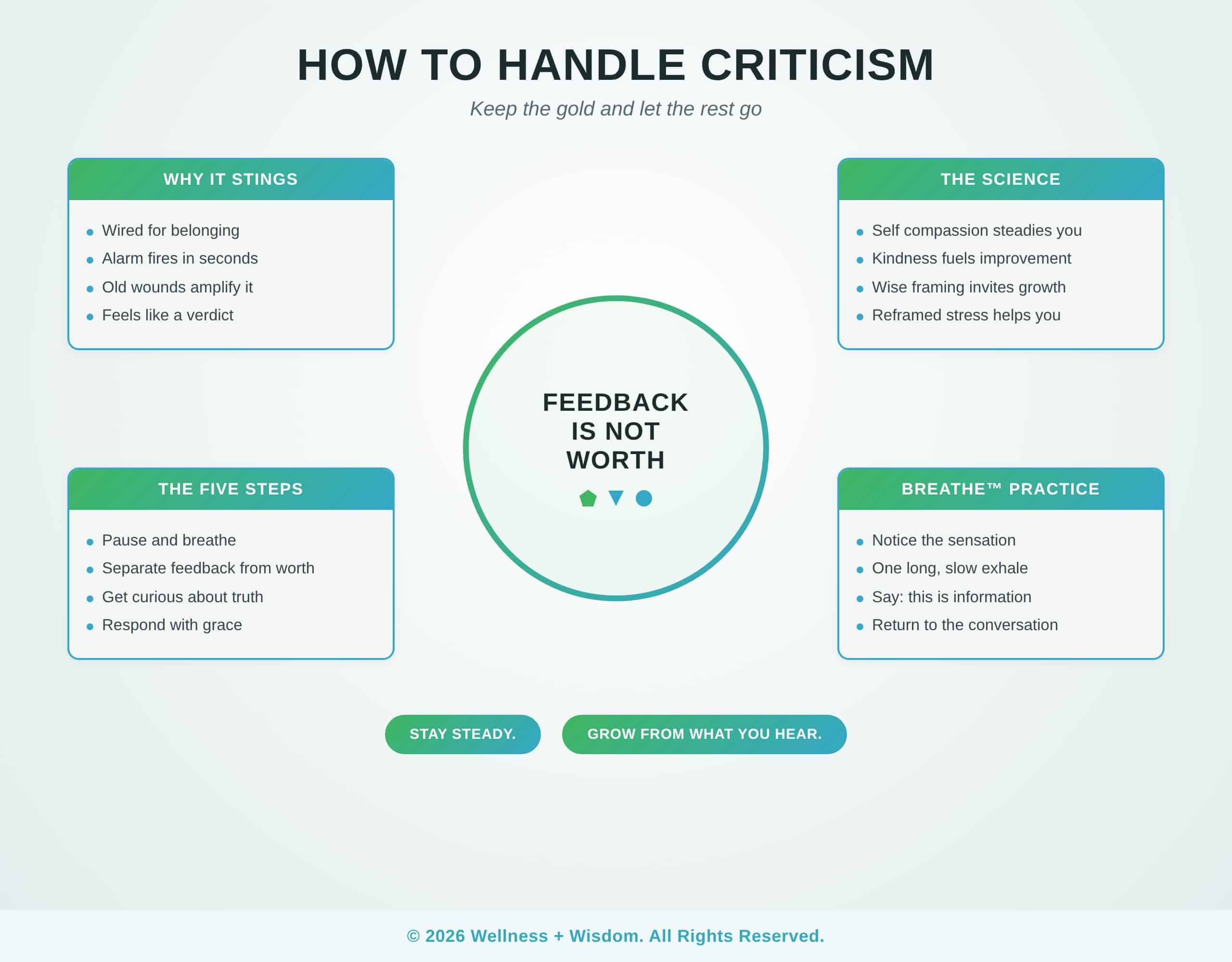
Criticism stings because human beings are wired for belonging, and for most of our history, being judged negatively by the group could threaten our very survival. Your neural system still reacts to criticism as if something important is at stake, even when it is just a comment on an email.
When criticism lands, the alarm system in your brain can activate within a fraction of a second. Your body shifts into a protective state, and the thinking part of your brain becomes harder to access. In that state, it is natural to defend, explain, attack back, or shut down. None of these responses mean you are fragile. They mean your protective system is working exactly as it was designed to.
Old experiences often amplify the sting. If you grew up with frequent criticism, conditional approval, or harsh correction, your body may have learned that feedback means danger. A small comment today can then echo every painful moment from the past. Seeing this clearly replaces self judgment with compassion. It also helps you stop taking things personally, because you can recognize when your reaction is bigger than the present moment. If you have spent years seeking approval to feel safe, the practices in how to stop seeking approval are a beautiful companion.
The Gift of Receiving Feedback Well
Receiving feedback well gives you faster growth, stronger relationships, greater confidence, and a reputation as someone people trust to hear the truth. When you can take in criticism without crumbling or counterattacking, you open doors that stay closed for people who cannot.
Think about how much growth is hidden in honest feedback. A colleague notices a blind spot in your presentation. A partner shares how your tone lands. A mentor points out a habit that is holding you back. Each of these is a gift, even when it is uncomfortable. People who can hear these things grow far faster than people who defend against them.
Receiving feedback well also deepens relationships. When people know they can be honest with you without a blowup, they trust you more. Conversations become more real. Teams become more effective. Families become closer. And here is the part I love most. When criticism stops shaking you, you become free to try bold things. You can create, share, and lead without being paralyzed by the fear of what others might say. That freedom is closely connected to learning to stop fearing failure.
The Science of Criticism and Growth
The science of criticism shows that self compassion helps people respond to negative feedback with more balance and greater motivation to improve, that the way feedback is framed shapes whether people act on it, and that reinterpreting your body's stress response as fuel helps you perform under pressure. You can change how criticism affects you.
Start with self compassion. In a series of studies published in the Journal of Personality and Social Psychology, Mark Leary and colleagues found that people higher in self compassion responded to unflattering feedback and difficult events with more balanced, less extreme emotional reactions, while still taking responsibility for their part. Treating yourself kindly did not make people complacent. It helped them stay steady.
Self compassion also fuels growth. Research by Juliana Breines and Serena Chen, published in Personality and Social Psychology Bulletin, found that people who were encouraged to treat a weakness or failure with self compassion were more motivated to improve. In one study, after doing poorly on a test, participants guided toward self compassion spent more time studying for a retest than those who received a self esteem boost or no guidance. Kindness, not harshness, drove improvement.
How feedback is delivered matters too. In a study published in the Journal of Experimental Psychology: General, David Yeager and colleagues found that when critical comments on students' essays came with a short note expressing high standards and confidence that the student could meet them, students were more likely to revise their work. And research led by Jeremy Jamieson in the same journal found that people taught to see their racing heart as their body preparing them to perform showed healthier physical responses during a stressful evaluation. Your interpretation shapes your biology.
How to Handle Criticism
You learn how to handle criticism by pausing to breathe, separating the feedback from your worth, getting curious about what is true, responding with grace, and deciding what to keep. These five steps help you stay steady in the moment and grow from what you hear. Here is how I practice and teach them.
1. Pause and Breathe
When criticism lands, resist the urge to respond immediately. Take one or two slow breaths with a long exhale. This simple pause gives your thinking brain a chance to come back online and helps you respond rather than react. If the feedback is in writing, give yourself time before replying, even if it is just a few minutes. The 90 second emotion rule is a wonderful companion here.
2. Separate Feedback From Worth
Remind yourself that criticism is about an action or result, not about who you are. You might even say it to yourself quietly: “This is feedback about my work, not a verdict on me.” This distinction helps you stay open, because you are no longer defending your entire identity. You are simply considering information.
3. Get Curious About What Is True
Ask yourself, “Is there anything here I can learn from?” Even poorly delivered criticism often contains a seed of truth. You can also ask the other person clarifying questions: “Can you give me an example?” or “What would you like to see instead?” Curiosity shifts you from defense to learning and often reveals that the feedback is more helpful than it first sounded.
4. Respond With Grace
Thank the person for sharing, even if you do not yet agree. “Thank you for telling me. I am going to think about that.” This keeps the relationship intact and gives you space to reflect. If you disagree after reflection, you can share your perspective calmly, which is beautifully supported by the practices in how to speak your truth.
5. Decide What to Keep
After the emotions settle, decide what to do with the feedback. Keep what is useful, take action on it, and let the rest go. Not all criticism deserves to change you. You are the one who chooses. Writing down what you learned can help it stick and help you release the sting. Journaling is especially helpful here, as explored in journaling and brain health.
It can also help to invite feedback on your own terms. Rather than waiting for criticism to arrive unexpectedly, ask trusted people for input regularly. “What is one thing I could do better in our meetings?” “What would make my writing clearer?” When you ask, you shift from being on the receiving end of judgment to being an active learner. Feedback you requested tends to feel far less threatening, and over time, your neural system learns that hearing hard things is safe and even helpful. Many leaders and creators find that a habit of asking for feedback transforms their relationship with criticism entirely.
Start with one of these steps the next time you receive feedback. You will not do it perfectly, and that is fine. Every time you practice, it gets easier. And if you would love to grow alongside people doing the same work, the Liberated Life Tribe is a warm community to join.
Learning From Criticism Versus Absorbing It
Learning from criticism means taking what is useful and letting the rest go, while absorbing criticism means letting every negative word sink in as truth about who you are. The difference is enormous, both for your growth and your wellbeing.
When we absorb criticism, a single comment can replay in our minds for days. We generalize it: “My boss criticized one slide, so I must be bad at my job.” We let it shrink our confidence and silence our voice. Over time, absorbing criticism can make us afraid to try anything new, because we expect every attempt to bring more pain. If this pattern feels familiar, the practices in how to quiet your inner critic can help, since outer criticism often lands hardest when our inner critic agrees with it.
Learning from criticism looks different. You hear the feedback, consider it with curiosity, extract what is useful, and act on it. Then you release the rest. You do not need to agree with everything to benefit from something. This approach keeps your sense of worth intact while still allowing you to grow. It also helps to remember that people's criticism often reflects their own stress, preferences, and history. Not every opinion is a truth you need to carry.
How to Handle Criticism With BREATHE™
BREATHE™ offers one of the fastest ways to stay steady under criticism, because your breath directly shapes the state of your neural system. When feedback triggers your alarm system, slow, intentional breathing helps you return to a calm, open state where you can actually hear what is being said.
Inside BREATHE™, I teach a simple practice for moments of criticism. First, notice the sensation in your body. Maybe it is heat in your face, tightness in your chest, or a knot in your stomach. Simply notice it without judgment. Second, take one breath in through your nose and let out a long, slow exhale through your mouth. Repeat this two or three times. Third, silently say to yourself, “I am safe. This is information.” Then return your attention to the conversation.
This practice takes less than thirty seconds and can be done in the middle of a meeting without anyone noticing. Practiced daily, even when no criticism is present, it trains your neural system to recover more quickly from stress. Over time, you may notice that feedback that once felt overwhelming now feels manageable. That growing steadiness is the heart of neural system regulation. To go deeper with breath and identity, explore our L.I.F.E. Method™ programs.
Celebrating Your Growth
Celebrating your growth in handling criticism helps reinforce the new patterns you are building. Your brain learns through reward, so when you notice and appreciate a moment of steadiness, you strengthen your capacity to stay calm the next time.
Think about a time you received feedback and handled it better than you would have before. Maybe you paused instead of snapping. Maybe you asked a curious question instead of defending yourself. Maybe you thanked someone even though it stung. These are real victories, and they deserve recognition. Take a moment to acknowledge them, even just with a quiet “I handled that well.”
You can also celebrate the growth that came from the feedback itself. When you act on useful criticism and see improvement, connect that improvement back to the feedback. This helps you see criticism as a source of growth rather than a threat, which makes future feedback easier to welcome. There is a whole practice around honoring these moments in celebrating small wins, and it pairs beautifully with this work.
Receiving Feedback Is a Lifelong Practice
Receiving feedback well is a lifelong practice, because every new role, relationship, and creative project brings fresh opportunities to be seen, evaluated, and challenged. The more you grow and the more visible you become, the more feedback you will receive. That is a sign of a meaningful life, not a problem to avoid.
Some feedback will be easy to hear. Some will touch tender places. Some will come from people you deeply respect, and some from strangers who do not know you at all. Over time, you will develop a sense of whose feedback to weigh heavily and whose to hold lightly. A helpful question is, “Does this person know me, understand the context, and want good things for me?” Feedback from people who meet those criteria deserves careful attention.
Another helpful practice is to notice your own patterns of giving feedback. How do you offer criticism to your partner, children, colleagues, or yourself? Often, the way we receive criticism mirrors the way we give it. When you practice offering feedback that is specific, kind, and focused on behavior rather than character, you naturally become more skilled at receiving it too. You start to recognize helpful feedback when you hear it, and you become a safer person for others to grow around.
This is also where the Wellness Pentagon™ becomes helpful. When you are well rested, emotionally grounded, and connected to something larger than any single opinion, including your Connection to Creator and God, criticism lands on a much steadier foundation. A strong sense of self that does not depend on outside approval is one of the greatest gifts of this work. You will find many guests sharing how they learned to receive criticism with grace across our latest episodes.
When Criticism Feels Crushing
If criticism feels crushing right now, you are in very good company, and it is completely understandable. Learning how to handle criticism does not mean you will never feel hurt by feedback again. It means you will gently build your capacity to stay steady and grow, a little at a time, at a pace that honors where you are.
When criticism feels overwhelming, start with the smallest step. One slow breath before you respond. One reminder that this is about your work, not your worth. One conversation with a trusted friend who can help you sort the useful from the hurtful. Writing the feedback down and returning to it the next day, when emotions have settled, can also bring surprising clarity. Supportive tools like a quality journal or a breath training device can help, and you can find a few we trust in our wellness tools store.
It is also important to know that ongoing harsh criticism, especially when it is constant, demeaning, or meant to control you, is not constructive feedback. You deserve respect, and it is okay to set boundaries with people who consistently criticize in hurtful ways, which is explored in how to set healthy boundaries. If criticism stirs up intense shame or past pain, a qualified therapist can offer compassionate support. Wherever you are, be patient and kind with yourself, and trust that learning how to handle criticism is something you can absolutely grow, one calm breath at a time.
Ready to go deeper? Join the Liberated Life Tribe and receive your 10 day Self Liberation Blueprint at liberatedlife.com. It is free, it is guided, and each day helps you build a steadier sense of self that feedback cannot shake.
Frequently Asked Questions
How do I handle criticism without getting defensive?
Pause and take a slow breath before responding. Remind yourself that the feedback is about your actions, not your worth. Get curious by asking clarifying questions, and thank the person for sharing. Giving yourself time to reflect before deciding what to do helps you respond rather than react.
Why does criticism hurt so much?
Humans are wired for belonging, so social judgment can trigger the brain's alarm system as if something important is at stake. Past experiences of harsh criticism can amplify this reaction. Understanding this helps you treat your response with compassion and calm your body before responding.
How can I tell if criticism is constructive?
Constructive criticism tends to be specific, focused on behavior, and offered to help you improve. Destructive criticism is often vague, focused on your character, or delivered to hurt or control. Ask whether the person knows the context and wants good things for you before giving their words heavy weight.
Does self compassion make people complacent?
No. Research shows the opposite. People encouraged to treat a failure with self compassion were more motivated to improve and spent more time preparing for a retest. Self compassion helps people respond to feedback with balance and keeps them engaged in growth.
What should I say when someone criticizes me?
A simple, gracious response works well: “Thank you for telling me. I am going to think about that.” You can also ask, “Can you give me an example?” or “What would you like to see instead?” These responses keep the conversation open while giving you time to reflect.
What if the criticism is unfair or hurtful?
You do not have to accept every opinion as truth. Take what is useful and let the rest go. If criticism is constant, demeaning, or controlling, it is okay to set boundaries. A trusted friend or qualified therapist can help you sort through feedback that stirs up deep pain.
Studies and External Resources
The science in this article rests on peer reviewed research. These are the sources referenced throughout.
- Leary MR, et al. (2007). Self compassion and reactions to unpleasant self relevant events: the implications of treating oneself kindly. Journal of Personality and Social Psychology. PubMed: 17484611
- Breines JG, Chen S. (2012). Self compassion increases self improvement motivation. Personality and Social Psychology Bulletin. PubMed: 22645164
- Yeager DS, et al. (2014). Breaking the cycle of mistrust: wise interventions to provide critical feedback across the racial divide. Journal of Experimental Psychology: General. PubMed: 23937186
- Jamieson JP, et al. (2012). Mind over matter: reappraising arousal improves cardiovascular and cognitive responses to stress. Journal of Experimental Psychology: General. PubMed: 21942377
About Josh Trent
Josh Trent is an Identity Transformation Architect and the award winning host of the Wellness + Wisdom Podcast, with over 15 million downloads since 2015. He is the creator of the L.I.F.E. Method™ Identity Transformation System and steward of the Emotional Epigenetics™ and BREATHE: Breath + Wellness™ systems of self mastery, impacting over 1,000 students worldwide. Join the Liberated Life Tribe and receive your 10 day Self Liberation Blueprint at liberatedlife.com. Josh lives in Austin, Texas with his wife Carrie, daughter Nayah, and son Novah. Peace and power.
Disclosure: We may earn a commission from certain links on this site when you make a purchase, at no extra cost to you. These commissions help support Wellness + Wisdom and do not affect the products or resources we choose to recommend. Full disclosure .