
By Josh Trent | Wellness + Wisdom Podcast Host & Identity Transformation Architect
“A boundary is not a wall that keeps people out. It is a gate that you get to open and close, so that your yes means yes and your love has somewhere safe to grow from.”
Josh Trent
Learning how to set healthy boundaries is one of the most freeing and loving skills you can build, because boundaries protect your energy, your peace, and your ability to show up fully for the people and things you care about. So many of us were quietly taught that saying no is selfish, so we overextend, overgive, and slowly lose ourselves trying to keep everyone else happy. Setting healthy boundaries gently reverses all of that, teaching you to honor your own needs and limits so that your yes finally becomes genuine and your relationships grow far more honest. This liberating skill lives at the heart of the L.I.F.E. Method™.
Here is the joy forward truth at the center of it all. Boundaries are never walls that push people away, they are the loving structures that actually let real connection flourish. When you honor your own limits, you show up with far more presence, more energy, and more genuine love, rather than the quiet resentment and depletion of self abandonment. When you learn how to set healthy boundaries, you protect your own wellbeing and deepen your relationships at the very same time, which is a rare and beautiful combination. Let us explore exactly how.
Table of Contents
- What Healthy Boundaries Really Are
- Types of Boundaries You Can Set
- Why Boundaries Feel So Hard
- The Science of Boundaries and Wellbeing
- How to Set Healthy Boundaries
- Boundaries Are an Act of Love
- Boundaries and the L.I.F.E. Method
- Celebrating Your Yes and Your No
- When Setting Boundaries Feels Uncomfortable
- Boundaries Are a Lifelong Practice
- Frequently Asked Questions
- Studies and External Resources
- About Josh Trent
What Healthy Boundaries Really Are
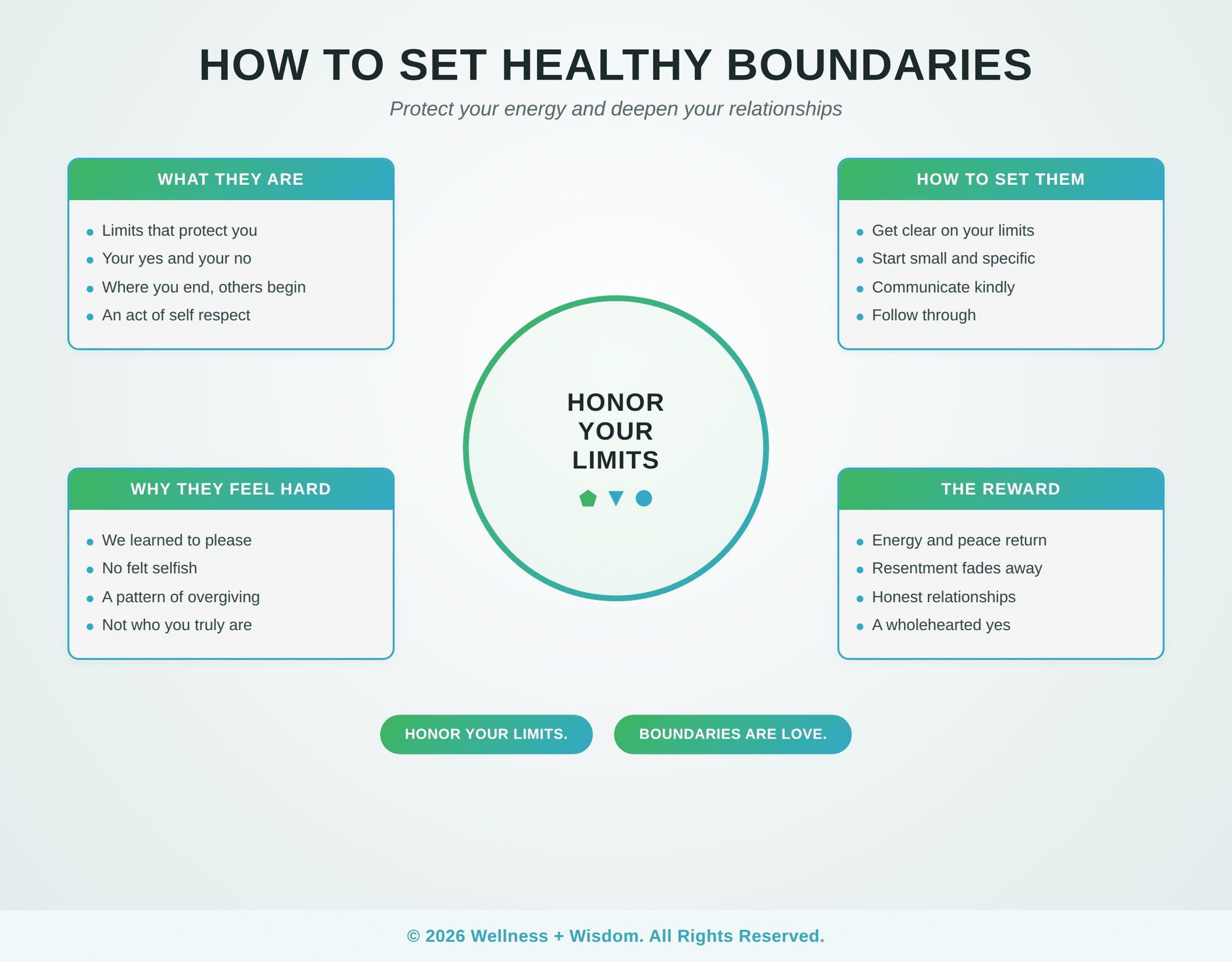
Healthy boundaries are the clear limits and guidelines you set around your time, your energy, your body, and your emotions in order to protect your wellbeing and honor your genuine needs. They are your own way of communicating what is okay and what is not okay for you, so that you can move through your relationships and your life from a steady place of respect for yourself. Healthy boundaries lovingly define where you end and another person begins.
This is a genuinely positive and loving thing, never a harsh or cold one. Healthy boundaries are never about shutting people out or trying to control others, they are simply about honoring yourself so that you can engage with the world in a sustainable, honest, and loving way. In practice, a boundary is simply a clear statement of your own limits, offered with as much kindness as firmness, so that everyone involved knows exactly where you stand.
Boundaries show up in every single area of life, from how much you give of your time, to what you will and will not tolerate in your relationships, to how you protect your emotional energy. When your boundaries are healthy, you feel far more grounded, respected, and free, because you are no longer quietly betraying yourself just to please everyone else. Learning to set them well is a profound and freeing act of self respect, a theme we return to often on the Wellness + Wisdom Podcast.
Types of Boundaries You Can Set
Healthy boundaries come in several forms, and understanding the different types helps you notice where in your life you may need to set them. Boundaries are not only about big, dramatic confrontations, they show up in many quiet, everyday ways across your relationships, your work, and your own inner life.
Physical boundaries protect your body and personal space, honoring your own comfort with touch, closeness, and privacy. Emotional boundaries protect your inner world, allowing you to hold your own feelings without automatically taking on everyone else's, and to share your emotions only when it genuinely feels safe. Time and energy boundaries protect your most precious resources of all, helping you decide how much you give and to whom, so that you do not run yourself completely empty trying to be everything to everyone.
There are also mental boundaries, which honor your own thoughts, values, and opinions even when they differ from those around you, and relational boundaries, which define clearly how you expect to be treated in your connections. In our modern world, digital boundaries have become important too, protecting your attention and peace from the constant pull of screens and notifications, which pairs beautifully with a grounded morning routine.
Recognizing these different types of boundaries helps you see much more clearly where your own limits may need honoring. You might have strong, clear boundaries in one area of life and genuinely struggle in another, and that is completely normal and human. The invitation is simply to notice, with real compassion, where you tend to overextend or abandon yourself, and to gently begin honoring your needs right there, which is a beautiful part of your whole self growth journey.
Why Boundaries Feel So Hard
Setting boundaries feels genuinely hard for many of us because we were taught, whether directly or indirectly, that our worth depends on pleasing others and that saying no makes us selfish or unkind. From a very early age, some of us learned that keeping the peace, meeting everyone else's needs, and never disappointing anyone was simply how we earned love and safety. This can make setting boundaries feel dangerous rather than healthy.
This early conditioning runs very deep in us, and it often turns into a lifelong pattern of chronic overgiving, people pleasing, and quiet self abandonment. We say yes when we truly mean no, we overextend ourselves until we are completely exhausted, and we quietly resent the very people we are trying so hard to please. Understanding that this whole pattern was learned, rather than being a true reflection of who you really are, replaces self judgment with compassion, which is exactly where real change begins, much like the gentle work of reparenting yourself.
Seeing the roots of boundary difficulty clearly is genuinely freeing, because it means the fear of setting boundaries is not the truth of who you are. It was a survival strategy learned long ago, and like any learned pattern, it can be gently updated. You can honor the part of you that once learned to keep everyone happy while gently teaching yourself a new, healthier way of relating, which is deeply connected to healing people pleasing.
The Science of Boundaries and Wellbeing
The science of the mind and body offers real support for setting healthy boundaries, because living without them takes a genuine toll. The researcher Bruce McEwen described in the New England Journal of Medicine how chronic stress produces allostatic load, the cumulative wear of a body whose alarm never fully rests. A life of constant overgiving and quiet self abandonment is one significant source of that ongoing stress and cumulative wear.
Naming your needs helps directly. Research by Matthew Lieberman and colleagues, published in Psychological Science, found that putting feelings into words reduces activity in the brain's alarm center. When you clearly name your limits and needs, both to yourself and to others, you help your own system settle and gradually move out of the low grade stress of unspoken resentment. Clarity is calming, and boundaries begin with that clarity.
There is an uplifting dimension too. Barbara Fredrickson's research, published in American Psychologist, shows that positive emotions broaden our awareness and build lasting resources, while chronic stress and depletion narrow us. Healthy boundaries protect the energy and wellbeing that allow joy and connection to flourish, making you more present and generous rather than depleted. Boundaries, in this real sense, are what make sustainable love and lasting joy genuinely possible, supporting the kind of neural system regulation that helps you thrive.
How to Set Healthy Boundaries
Learning how to set healthy boundaries is a gentle, gradual practice of honoring your own needs and communicating them with clarity and kindness. It grows genuinely easier with practice, and every boundary you set strengthens your relationship with yourself a little more. Here are practices that help.
1. Get Clear on Your Limits
Notice carefully what drains you, what feels like far too much, and where you consistently feel resentment building, since these are all signals pointing toward needed boundaries. Getting clear on your own limits is the essential first step of all, because you simply cannot honor a boundary you have not yet identified in yourself.
2. Start Small and Specific
Begin with smaller, lower stakes boundaries rather than tackling the very hardest one first. Practicing with smaller, more manageable situations builds your confidence and skill steadily over time, so that setting boundaries gradually comes to feel more natural and far less daunting.
3. Communicate Clearly and Kindly
State your boundary simply and warmly, without over explaining yourself or apologizing excessively for having needs. A clear, kind statement of your limit, offered with genuine respect, honors both yourself and the other person at once, and it draws on real emotional intelligence.
4. Expect Some Discomfort
Know that setting boundaries may feel genuinely uncomfortable at first, especially if it is new for you, and that this discomfort is completely normal rather than a sign you are doing something wrong. Letting yourself feel the discomfort fully without abandoning your boundary is exactly how the skill grows stronger over time.
5. Follow Through With Consistency
Honor your own boundaries by actually following through on them consistently, since a boundary you do not uphold quietly teaches others that they can ignore it. Consistency, always offered with warmth and kindness, is what makes your boundaries real and steadily builds genuine self trust in yourself.
Begin with just one practice and be patient and kind with yourself, since learning to set boundaries after a whole lifetime of overgiving genuinely takes time. Every single boundary you honor is a real act of self respect that grows stronger and steadier over time. When you want community and support for this journey, the Liberated Life Tribe is here for you.
Boundaries Are an Act of Love
One of the most beautiful truths about healthy boundaries is that they are actually an act of love, both for yourself and for others, rather than a rejection of anyone. Far from pushing people away, clear and loving boundaries create the safety and honesty that allow genuine closeness to truly flourish.
Boundaries are deeply loving toward yourself because they honor your real needs, protect your precious energy, and affirm that you genuinely matter. This kind of self love is not selfish at all, it is the very foundation that lets you show up for others sustainably rather than from depletion and quiet resentment. You simply cannot pour from an empty cup, and healthy boundaries are how you keep your own cup full enough to give freely and joyfully.
Boundaries are also deeply loving toward others, because they replace hidden resentment with real honesty and let your relationships rest on truth rather than on silent self sacrifice. When you are clear about your own limits, the people in your life know exactly where they stand and can genuinely trust your yes, because they know you are also willing to say no when you need to. This kind of honesty deepens real connection far more than endless people pleasing ever could, which is a beautiful part of learning to celebrate the people you love.
Boundaries and the L.I.F.E. Method
Learning to set healthy boundaries is a beautiful expression of the Liberation pillar within the L.I.F.E. Method™, our system for identity transformation built on four pillars: Liberation, Integration, Frequency, and Embodiment. The old pattern of self abandonment is one of the heaviest burdens of who you are not, and learning to set boundaries is a genuine and joyful act of liberation.
Liberation frees you from the inherited belief that your worth somehow depends on pleasing everyone and never once disappointing anyone. As that burden lifts, the other pillars come alive: Integration helps you honor and include your own needs alongside others', Frequency raises your inner state up from resentment and depletion toward genuine peace and generosity, and Embodiment lets you feel your boundaries as a steady, grounded presence in your body rather than just an idea in your mind.
This is why we hold boundary setting as genuine liberation work rather than a simple communication tip. You are not merely learning to say no, you are reclaiming your fundamental right to honor yourself and to build your relationships on truth, restoring your dignity as a beloved creation in your Connection to Creator and God. That is a deep and joyful freedom, one that transforms your whole life and every relationship in it.
Celebrating Your Yes and Your No
The joyful heart of healthy boundaries is learning to celebrate both your yes and your no, honoring your right to choose how you spend your precious energy and life. When your yes is truly genuine and your no is fully honored, both become real sources of joy rather than obligation or guilt.
Celebrating your no means recognizing that every single time you honor a real limit, you are affirming your own worth and protecting what matters most to you. A boundary honored is a real, small victory worth celebrating, because it strengthens your self respect and frees your precious energy for what truly matters most. Rather than feeling guilty for your honest no, you can genuinely feel proud of your growing self loyalty, much like learning to celebrate small wins.
Celebrating your genuine yes is every bit as beautiful. When you have healthy boundaries firmly in place, your yes becomes wholehearted and genuine, given freely and gladly rather than out of obligation or fear. You get to say yes to the people and things you truly love, with your whole energy and full presence, which is a far richer and more generous gift than a resentful yes ever could be. In this beautiful way, boundaries turn both your yes and your no into joyful expressions of a life you are now consciously choosing, which is the heart of learning to celebrate yourself.
When Setting Boundaries Feels Uncomfortable
If setting boundaries feels uncomfortable, you are in good company, and understanding why helps you move through it with compassion. For many of us, especially those who learned early to keep everyone happy, saying no can trigger real guilt, anxiety, or a deep fear of disappointing others. This discomfort is a normal part of growth, not a sign you are doing something wrong.
It genuinely helps to remember that the discomfort of setting a boundary is usually temporary, while the depletion of never setting one is ongoing and unending. Letting yourself feel the initial awkwardness without abandoning your boundary is exactly how you build both the skill and the self trust, and the discomfort tends to fade steadily as boundaries become more natural. Meeting your own guilt with real gentleness, rather than letting it override your limits, is a genuinely powerful practice, and it takes real emotional courage.
Sometimes others may push back a little when you first begin setting boundaries, especially if they were used to your endless yes, and that can feel discouraging at first. Yet their discomfort is not a sign that you are wrong, it is very often simply the natural adjustment to a new and healthier dynamic. The people who truly care about you will, in time, come to respect your boundaries, and the relationships that deepen on this new honesty are exactly the ones worth keeping. The way through all of this is always the same gentle practice, honoring your limits with kindness and consistency, and celebrating each step toward a life of greater self respect, one small boundary at a time.
Boundaries Are a Lifelong Practice
Setting healthy boundaries is not a single achievement you complete once, but a lifelong practice of honoring yourself again and again across the changing seasons of your life. As you grow and your circumstances shift over the years, your boundaries will naturally evolve too, and that is exactly as it should be. This is wonderful news, because it means you can always keep refining and strengthening your boundaries no matter where you are starting from.
This understanding takes the pressure off getting it perfect. You will certainly have moments when you slip back into old patterns of overgiving, or when you set a boundary imperfectly, and that is completely and utterly human. What matters most is the overall direction, the steady returning to self honoring that gradually builds a much healthier way of relating over time.
Understanding boundaries as an ongoing practice also keeps it compassionate. Each new relationship, each new season, and each new challenge offers fresh opportunities to honor your needs and further strengthen your boundaries. Over time, setting boundaries becomes less something you have to brace yourself for and more simply a natural, easy expression of self respect, woven quietly through how you live and how you love.
So approach your own journey here with real patience and warmth toward yourself. There is no finish line, only the ongoing, freeing practice of honoring yourself more and more fully, and celebrating each boundary as another step toward a life of genuine self respect. This steady self honoring supports every dimension of your self worth and only grows richer with time.
Frequently Asked Questions
What are healthy boundaries?
Healthy boundaries are the limits and guidelines you set around your time, energy, body, and emotions to protect your wellbeing and honor your needs. They communicate what is okay and what is not okay for you, so you can move through relationships from a place of self respect. Boundaries define where you end and another person begins.
Why is it so hard to set boundaries?
Because many of us were taught that our worth depends on pleasing others and that saying no is selfish. This early conditioning turns into a lifelong pattern of overgiving and self abandonment. Understanding that this pattern was learned, rather than who you truly are, replaces self judgment with compassion and makes it possible to gently build a healthier way of relating.
How do I start setting healthy boundaries?
Begin by getting clear on your limits, noticing what drains you or breeds resentment. Start with smaller, lower stakes boundaries, communicate them clearly and kindly without over apologizing, expect some discomfort at first, and follow through consistently. Each boundary you honor builds your confidence and strengthens your relationship with yourself over time.
Are boundaries selfish?
No. Boundaries are actually an act of love for yourself and others. They honor your needs so you can show up sustainably rather than from depletion and resentment. They also replace hidden resentment with honesty, letting relationships rest on truth. Clear boundaries create the safety and honesty that allow genuine closeness to flourish, deepening connection rather than harming it.
Is there science behind setting boundaries?
Yes. Research shows chronic stress, including constant overgiving, creates allostatic load that wears on the body. Lieberman's work shows naming your needs calms the brain's alarm center. Fredrickson's research shows positive emotion broadens and builds us while depletion narrows us. Boundaries protect the energy that allows joy and connection to flourish.
What if setting boundaries feels uncomfortable?
That is completely normal, especially if keeping everyone happy is familiar to you. The discomfort of setting a boundary is usually temporary, while the depletion of never setting one is ongoing. Letting yourself feel the awkwardness without abandoning your boundary builds the skill and self trust, and it fades as boundaries become more natural.
Studies and External Resources
The science in this article rests on peer reviewed research. These are the sources referenced throughout.
- McEwen BS. (1998). Protective and damaging effects of stress mediators. New England Journal of Medicine. PubMed: 9428819
- Lieberman MD, et al. (2007). Putting Feelings Into Words: Affect Labeling Disrupts Amygdala Activity in Response to Affective Stimuli. Psychological Science. PubMed: 17576282
- Fredrickson BL. (2001). The role of positive emotions in positive psychology. The broaden-and-build theory of positive emotions. American Psychologist. PubMed: 11315248
About Josh Trent
Josh Trent is an Identity Transformation Architect and the award winning host of the Wellness + Wisdom Podcast, with over 15 million downloads since 2015. He is the creator of the L.I.F.E. Method™ Identity Transformation System and steward of the Emotional Epigenetics™ and BREATHE: Breath + Wellness™ systems of self mastery, impacting over 1,000 students worldwide. Join the Liberated Life Tribe and receive your 10 day Self Liberation Blueprint at liberatedlife.com. Josh lives in Austin, Texas with his wife Carrie, daughter Nayah, and son Novah. Peace and power.
Disclosure: We may earn a commission from certain links on this site when you make a purchase, at no extra cost to you. These commissions help support Wellness + Wisdom and do not affect the products or resources we choose to recommend. Full disclosure .