
By Josh Trent | Wellness + Wisdom Podcast Host & Identity Transformation Architect
“Stress is not the enemy. It is energy looking for direction. Learning how to manage stress is learning to turn that energy into fuel for the life you are building.”
Josh Trent
Learning how to manage stress is one of the most empowering skills you will ever build, because stress is not going anywhere, and the way you relate to it shapes your health, your relationships, and your joy. Deadlines, traffic, family needs, money decisions, big dreams. Life asks a lot of us. Many of us were taught to treat stress as a threat to eliminate, yet that approach often leaves us feeling even more overwhelmed. The research tells a more hopeful story. Stress can be guided, softened, and even transformed into a source of strength. One of the fastest doorways is your breath, which is why this work pairs so beautifully with BREATHE™.
Here is the joy forward truth at the center of it all. Your stress response exists to help you rise to meet what matters. When you understand it, work with it, and give your body regular chances to return to calm, stress stops running your life and starts serving it. When you learn how to manage stress well, you get to keep the energy and lose the overwhelm. Let us explore exactly how.
Table of Contents
- What Stress Really Is
- Why Stress Builds Up
- The Gift of a Resilient Response
- The Science of Stress
- How to Manage Stress
- Managing Stress Versus Avoiding It
- How to Manage Stress With BREATHE™
- Celebrating Every Calm Return
- Stress Mastery Is a Lifelong Practice
- When Stress Feels Like Too Much
- Frequently Asked Questions
- Studies and External Resources
- About Josh Trent
What Stress Really Is
Stress is your body and mind's natural response to a demand or challenge, mobilizing energy, focus, and resources so you can meet it. When you face something that matters, your heart rate rises, your breathing quickens, and stress hormones flow. This is not a malfunction. It is an ancient system designed to help you act.
In short bursts, the stress response is incredibly useful. It sharpens your attention before a big presentation, gives you energy during a hard workout, and helps you respond quickly when something unexpected happens. Athletes, performers, and leaders all rely on it. The challenge comes when the stress response stays switched on for too long without a chance to recover. That is when stress shifts from helpful to heavy.
So the goal is not a stress free life. The goal is a flexible neural system that can rise to meet a challenge and then return to rest. Think of it like a wave. A healthy stress response rises, crests, and settles back down. Managing stress well means helping that wave complete its cycle rather than getting stuck at the top. We talk about this rhythm often on the Wellness + Wisdom Podcast, because it sits underneath almost every other kind of wellbeing.
Why Stress Builds Up
Stress builds up when demands keep coming without enough recovery in between, so the body never fully returns to its calm baseline. Modern life rarely offers natural pauses. We move from emails to meetings to errands to screens, and the stress response keeps getting triggered before it has a chance to settle.
Our thoughts add another layer. The stress response can be triggered not only by real events but by imagined ones. Replaying a hard conversation or worrying about next week sends the same signals through your body as if those situations were happening right now. That is why so much of our stress lives in our heads, and why the practices in how to stop overthinking can be such a relief.
Culture plays a role too. Many of us absorbed the belief that being busy means being valuable, so we keep pushing past our limits. That pattern is explored beautifully in the hidden cost of hustle culture. And for some of us, early experiences taught the neural system to stay on high alert, always scanning for the next problem, which is described in why you might always feel on alert. None of this is a personal failing. It is simply what happens when a brilliant survival system meets a nonstop world.
The Gift of a Resilient Response
A resilient stress response gives you more energy, clearer thinking, healthier relationships, and the confidence that you can handle whatever life brings. When you know how to rise and then return to calm, challenges stop feeling like threats and start feeling like opportunities to grow.
Your body feels the difference first. When stress gets a chance to complete its cycle, your body spends more time in rest and repair. Sleep deepens. Digestion settles. Your immune system gets the resources it needs. This connection between mind and body is profound, and it is mapped out in detail in how stress affects your immune system.
Your relationships feel it too. When you are not running on constant stress, you have more patience, more presence, and more warmth for the people you love. You listen better. You react less. And you stop bringing the weight of the workday into every evening at home. Most beautifully, a resilient response frees you to say yes to bigger dreams. When you trust yourself to handle pressure, you stop playing small, and you begin to move from survival into creation, which is explored in shifting from survival mode to creation mode.
The Science of Stress
The science of stress shows that how you think about stress shapes how it affects you, that reframing stress as helpful improves how your body responds, that time in nature calms the stressed mind, and that a few minutes of slow breathing can lift mood and lower arousal. You have far more influence over stress than you may realize.
Start with belief. In a study published in Health Psychology, Abiola Keller and colleagues analyzed data from nearly 29,000 American adults and followed them for about eight years. People who reported a lot of stress and also believed that stress was harming their health had a higher risk of premature death. People who reported just as much stress but did not see it as harmful had no such increase. How you view stress appears to matter alongside how much of it you have.
Next, consider reframing. Research led by Jeremy Jamieson and published in the Journal of Experimental Psychology: General found that people who were taught to see their racing heart and quick breath as signs that their body was preparing them to perform showed a healthier cardiovascular response during a stressful public speaking task, along with less attention pulled toward threat. Simply understanding stress as fuel changed how the body responded.
Nature helps as well. In a study by Gregory Bratman and colleagues in the Proceedings of the National Academy of Sciences, people who took a 90 minute walk in a natural setting showed less rumination and reduced activity in a brain region associated with repetitive negative thinking, compared with people who walked in an urban setting. And a randomized study from Stanford researchers in Cell Reports Medicine found that five minutes a day of cyclic sighing, a breath with a long exhale, improved mood and reduced physiological arousal more than mindfulness meditation over a month. Small, simple practices make a real difference.
How to Manage Stress
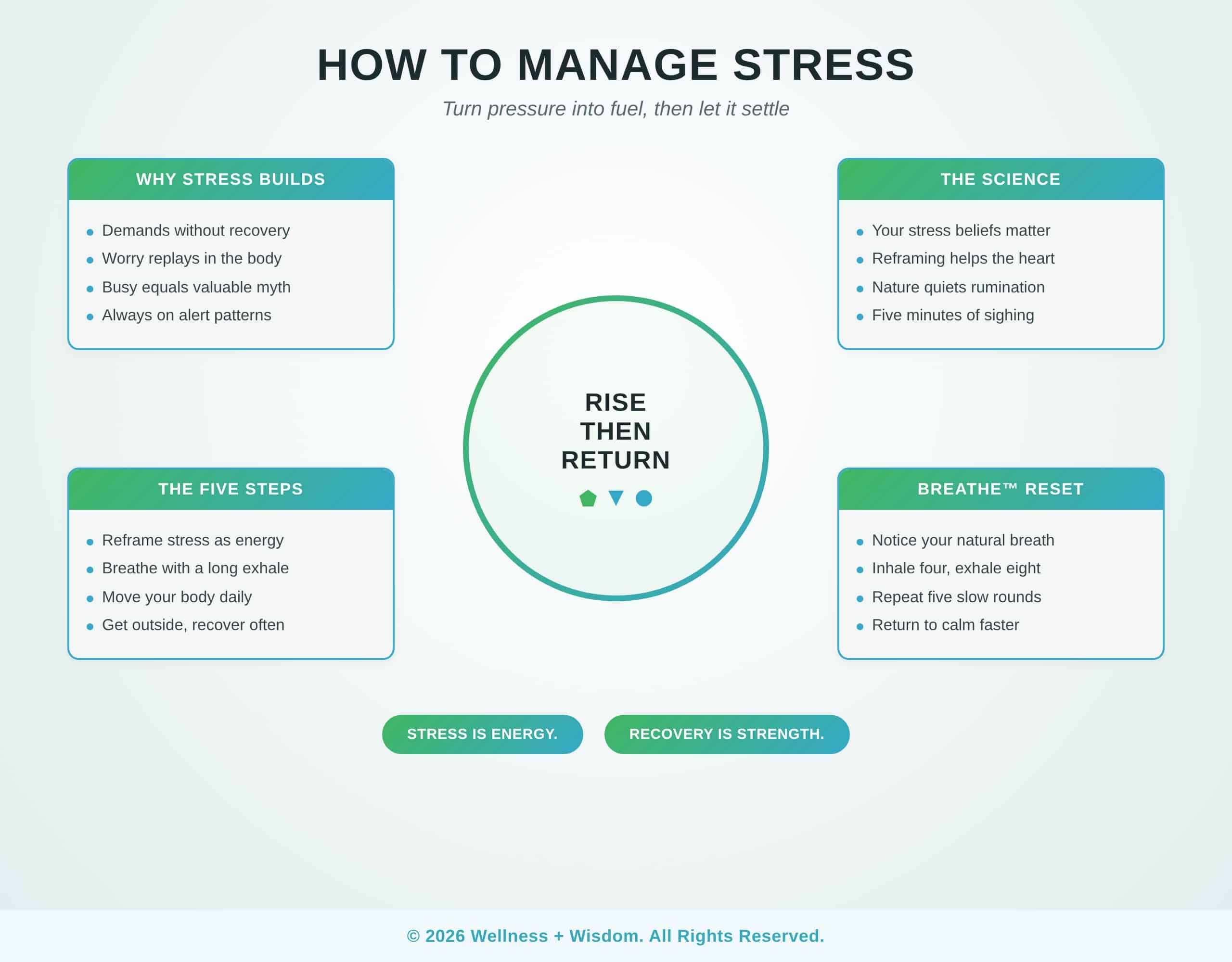
You learn how to manage stress by reframing stress as energy, breathing with a long exhale, moving your body, getting outside, and building recovery into every day. These five steps work together to help your stress response rise when needed and settle when the moment passes. Here is how I practice and teach them.
1. Reframe Stress as Energy
When you notice your heart racing or your palms sweating before something important, try telling yourself, “My body is getting me ready.” This simple reframe, supported by the research above, helps your body respond in a more efficient and less draining way. You are not ignoring the stress. You are partnering with it. The feeling stays the same, but its meaning changes, and meaning shapes biology.
2. Breathe With a Long Exhale
Your exhale is a direct signal to your body that it is safe to soften. Try two short inhales through the nose followed by a long, slow exhale through the mouth, repeated a few times. Or breathe in for four counts and out for eight. Within a minute, many people notice their shoulders drop and their thoughts slow down. For a simple structure you can practice daily, box breathing is a beautiful place to start.
3. Move Your Body
Movement is one of the most natural ways to help the stress cycle complete. A brisk walk, a dance in the kitchen, a short workout, or even shaking out your arms and legs gives the energy of stress somewhere to go. You do not need an intense session. Ten minutes of movement can noticeably shift how you feel. Some people also love brief cold exposure as a way to practice staying calm under intensity, explored in cold exposure epigenetics.
4. Get Outside
Step outside whenever you can, even for a few minutes. Look at trees, sky, or water. Feel the air on your skin. Nature has a remarkable ability to quiet the busy mind and invite the body back into rest. If you can, take your phone calls on a walk or eat lunch outside. These small shifts add up across a week.
5. Build Recovery Into Every Day
Recovery is not something you earn after you have done everything. It is what makes everything else possible. Schedule small pauses between tasks, protect your sleep, and give yourself at least one moment each day that is purely restorative. Learning to rest without guilt is one of the most powerful stress management skills there is. Setting healthy boundaries protects that recovery time.
Start with one or two of these steps and practice them consistently. Over time, they become your natural way of meeting life. And if you would love to practice alongside a supportive community, the Liberated Life Tribe is a warm place to grow.
Managing Stress Versus Avoiding It
Managing stress means meeting challenges with skill and recovering well afterward, while avoiding stress means steering away from anything that feels demanding. Avoidance can feel like relief in the short term, but it often shrinks your life and leaves the underlying stress unresolved.
When we avoid stress, we might skip the hard conversation, turn down the exciting opportunity, or numb out with endless scrolling. In the moment, it feels easier. But the things we avoid often grow larger in our minds, and the stress we were trying to escape simply waits for us. Over time, avoidance can teach the neural system that challenges are dangerous, which makes the next challenge feel even harder.
Managing stress is different. It says, “This matters to me, so I am going to meet it, and then I am going to take care of myself.” You lean in, you use your tools, and you recover. Each time you do this, you build evidence that you can handle difficult things. That evidence becomes confidence, and confidence makes future stress feel lighter. Presence is a big part of this, which is why the practices in how to practice mindfulness are such a natural companion to this work.
How to Manage Stress With BREATHE™
BREATHE™ offers one of the most direct ways to manage stress, because your breath is a bridge between your conscious mind and your automatic stress response. You cannot simply think your heart rate down, but you can breathe it down. That makes breath your most portable stress tool.
Inside BREATHE™, I teach a simple three part reset for stressful moments. First, notice. Place a hand on your belly and feel your breath exactly as it is, without changing it. Second, lengthen. Breathe in through your nose for four counts and out through your mouth for six to eight counts, letting the exhale be slow and soft. Repeat this five times. Third, return. Let your breath find its own natural rhythm and notice how your body feels now.
This reset takes about one minute, and you can use it anywhere: before a meeting, in the car, after a difficult email, or lying in bed at night. Practiced daily, it does more than calm a single moment. It trains your neural system to return to calm more quickly on its own. That growing flexibility is the heart of neural system regulation. To go deeper with breath and identity, explore our L.I.F.E. Method™ programs.
Celebrating Every Calm Return
Celebrating every time you return to calm is one of the most effective ways to build lasting stress resilience. Your brain learns through reward, so when you notice and appreciate a moment of recovery, you strengthen the pathways that make recovery easier next time.
So many of us only notice our stress, not our recoveries. We remember the moment we snapped, not the ten moments we breathed and stayed steady. Try flipping that focus. At the end of each day, name one moment when you handled stress well. Maybe you took three breaths before replying to a tense message. Maybe you went for a walk instead of scrolling. Maybe you asked for help. These are real wins.
Celebration also shifts the emotional tone of your growth. Instead of seeing stress management as another task you are failing at, you begin to see it as a skill you are steadily mastering. That shift alone can lower stress. There is a whole practice around honoring these moments in celebrating small wins, and it makes the journey feel joyful.
Stress Mastery Is a Lifelong Practice
Stress mastery is a lifelong practice, because every season of life brings new challenges and new opportunities to grow your capacity. A new job, a growing family, a health change, or a big creative leap will each stretch you in different ways. That stretch is not a sign that you are doing it wrong. It is a sign that you are living fully.
Over time, you will learn your own stress signals. Maybe your jaw tightens, your sleep gets lighter, or you start reaching for your phone more often. Noticing these early signs lets you respond sooner, with a breath, a walk, or an honest conversation, before stress builds into overwhelm. This awareness is a gift you give your future self.
It can also help to create a simple personal stress plan before you need it. Write down three things that reliably help you settle, like a walk around the block, a five minute breath practice, or a call with a friend who makes you laugh. Keep the list somewhere you will see it, like your phone lock screen or the inside of a notebook. When stress rises, you will not have to think about what to do. You simply choose one item from the list and begin. Planning ahead turns stress management from a scramble into a ritual, and rituals are far easier to follow when life gets loud. Review the list every few months and update it as you discover what works best for you, because the practices that help most will change as you grow.
This is also where the Wellness Pentagon™ becomes so helpful. Stress touches every dimension of your life: physical, mental, emotional, spiritual, and financial. Caring for each one creates a stronger foundation. Many people find that prayer, stillness, and a deeper Connection to Creator and God offer a kind of peace that no technique alone can provide. And money stress deserves special care too, which is explored in how money stress changes your biology. You will find many guests sharing their own stress practices across our latest episodes.
When Stress Feels Like Too Much
If stress feels like too much right now, you are in very good company, and it is completely understandable. Learning how to manage stress does not mean you will never feel overwhelmed again. It means you will gently build your capacity to meet life, a little at a time, at a pace that honors where you are.
When stress feels overwhelming, start with the smallest possible step. One long exhale. One minute outside. One glass of water. One honest sentence to someone you trust. These tiny actions still count, and they help your body remember that it can return to calm. It can also help to write down everything that is on your mind, then circle the one thing you can do today. Simple tools like a breath training device or a quality journal can support this, and you can find a few we trust in our wellness tools store.
It is also important to know that ongoing stress that affects your sleep, health, relationships, or ability to function deserves real care. A qualified therapist, counselor, or health professional can offer compassionate, effective support. There is real strength in asking for help. Wherever you are, be patient and kind with yourself, and trust that learning how to manage stress is something you can absolutely grow, one breath at a time. If anxious thoughts are a big part of your stress, the practices in how to calm an anxious mind are a gentle next step.
Ready to go deeper? Join the Liberated Life Tribe and receive your 10 day Self Liberation Blueprint at liberatedlife.com. It is free, it is guided, and each day gives you a simple practice for meeting life with more calm and strength.
Frequently Asked Questions
What is the best way to manage stress quickly?
Slow your breathing with a long exhale. Try two short inhales through the nose followed by a long, slow exhale, repeated a few times. Research from Stanford found that just five minutes a day of this kind of breathing improved mood and reduced physiological arousal. Stepping outside or moving your body also helps quickly.
Is all stress bad for you?
No. Short bursts of stress help you focus, perform, and rise to challenges. Stress becomes harmful when it stays switched on without enough recovery. Research also suggests that viewing stress as helpful rather than harmful can change how your body responds and may influence long term health outcomes.
How does mindset affect stress?
Mindset shapes how your body responds. People taught to see their racing heart as their body preparing them to perform showed healthier cardiovascular responses under pressure. A large study also found that high stress was linked with higher mortality risk mainly among people who believed stress was harming their health.
Does nature really reduce stress?
Yes. A study in the Proceedings of the National Academy of Sciences found that a 90 minute walk in nature reduced rumination and activity in a brain region linked to repetitive negative thinking, compared with an urban walk. Even short moments outside can help your body and mind settle.
How can I recover from stress each day?
Build small pauses between tasks, move your body, get outside, protect your sleep, and practice a few minutes of slow breathing. Recovery is not a reward you earn after finishing everything. It is what allows you to keep meeting challenges with energy and clarity.
When should I get help for stress?
If stress is affecting your sleep, health, relationships, or ability to function, or if it feels constant and overwhelming, reach out to a qualified therapist, counselor, or health professional. Asking for support is a sign of strength, and effective help is available.
Studies and External Resources
The science in this article rests on peer reviewed research. These are the sources referenced throughout.
- Keller A, et al. (2012). Does the perception that stress affects health matter? The association with health and mortality. Health Psychology. PubMed: 22201278
- Jamieson JP, et al. (2012). Mind over matter: reappraising arousal improves cardiovascular and cognitive responses to stress. Journal of Experimental Psychology: General. PubMed: 21942377
- Bratman GN, et al. (2015). Nature experience reduces rumination and subgenual prefrontal cortex activation. Proceedings of the National Academy of Sciences. PubMed: 26124129
- Balban MY, et al. (2023). Brief structured respiration practices enhance mood and reduce physiological arousal. Cell Reports Medicine. PubMed: 36630953
About Josh Trent
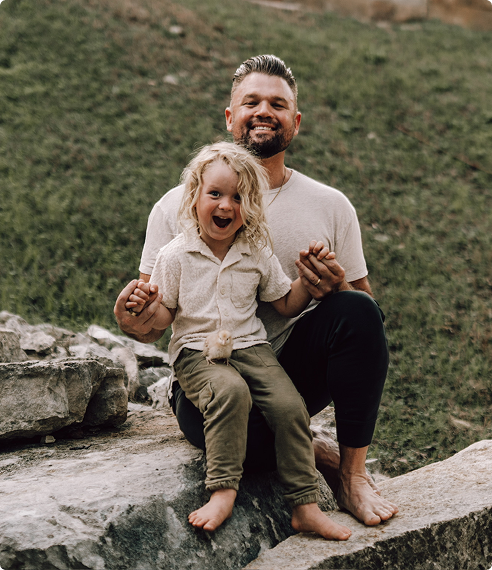
Josh Trent is an Identity Transformation Architect and the award winning host of the Wellness + Wisdom Podcast, with over 15 million downloads since 2015. He is the creator of the L.I.F.E. Method™ Identity Transformation System and steward of the Emotional Epigenetics™ and BREATHE: Breath + Wellness™ systems of self mastery, impacting over 1,000 students worldwide. Join the Liberated Life Tribe and receive your 10 day Self Liberation Blueprint at liberatedlife.com. Josh lives in Austin, Texas with his wife Carrie, daughter Nayah, and son Novah. Peace and power.
Disclosure: We may earn a commission from certain links on this site when you make a purchase, at no extra cost to you. These commissions help support Wellness + Wisdom and do not affect the products or resources we choose to recommend. Full disclosure .