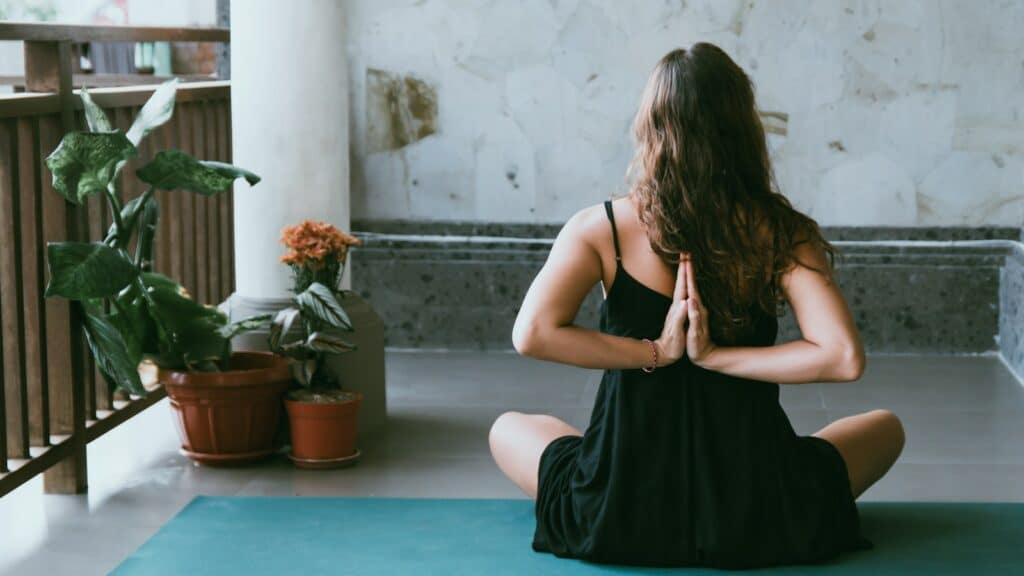
By Josh Trent | Wellness + Wisdom Podcast Host & Identity Transformation Architect
“This moment is the only place your life is actually happening. Learning how to practice mindfulness is learning to show up for it, one breath at a time.”
Josh Trent
Learning how to practice mindfulness is one of the simplest and most powerful gifts you can give yourself, because it brings you back to the only moment you can ever truly live in: this one. So many of us spend our days half here and half somewhere else, replaying yesterday, rehearsing tomorrow, scrolling through a dozen other lives while our own life quietly passes by. Mindfulness gently gathers your attention back home. It is not a mystical skill reserved for monks. It is a practical, learnable way of paying attention, and it pairs beautifully with the breath practices inside BREATHE™.
Here is the joy forward truth at the center of it all. Mindfulness does not ask you to empty your mind or become someone else. It invites you to notice what is already here, with curiosity and kindness, so you can taste your coffee, hear your child's laugh, and feel the sun on your skin as if for the first time. When you learn how to practice mindfulness, ordinary moments become doorways to presence, and presence is where joy lives. Let us explore exactly how.
Table of Contents
- What Mindfulness Really Means
- Why Our Attention Wanders
- The Gift of a Present Mind
- The Science of Mindfulness
- How to Practice Mindfulness
- Mindfulness Versus Emptying Your Mind
- How to Practice Mindfulness With BREATHE™
- Celebrating Every Return
- Mindfulness Is a Lifelong Practice
- When Mindfulness Feels Hard
- Frequently Asked Questions
- Studies and External Resources
- About Josh Trent
What Mindfulness Really Means
Mindfulness is the practice of paying attention to the present moment, on purpose, with openness and without judgment. It means noticing your breath, your body, your thoughts, your feelings, and the world around you as they are right now, rather than getting lost in stories about the past or the future.
Notice the two parts of that definition. The first is attention. Mindfulness is about where you place your awareness and how steadily it can rest there. The second is attitude. Mindfulness is not cold observation. It carries a quality of warmth, curiosity, and acceptance, like a kind friend who is genuinely interested in what you are experiencing. You can be mindful of joy, of boredom, of sadness, of a cup of tea. Nothing is excluded.
Mindfulness can be practiced formally, by sitting for a few minutes and paying attention to your breath, and informally, by bringing full presence to everyday activities like walking, washing dishes, or listening to someone you love. Both matter. Formal practice builds the muscle, and informal practice weaves it into your life. Over time, mindfulness stops being something you do and becomes a way you live. It is a theme we explore again and again on the Wellness + Wisdom Podcast, because presence is the ground every other kind of growth stands on.
Why Our Attention Wanders
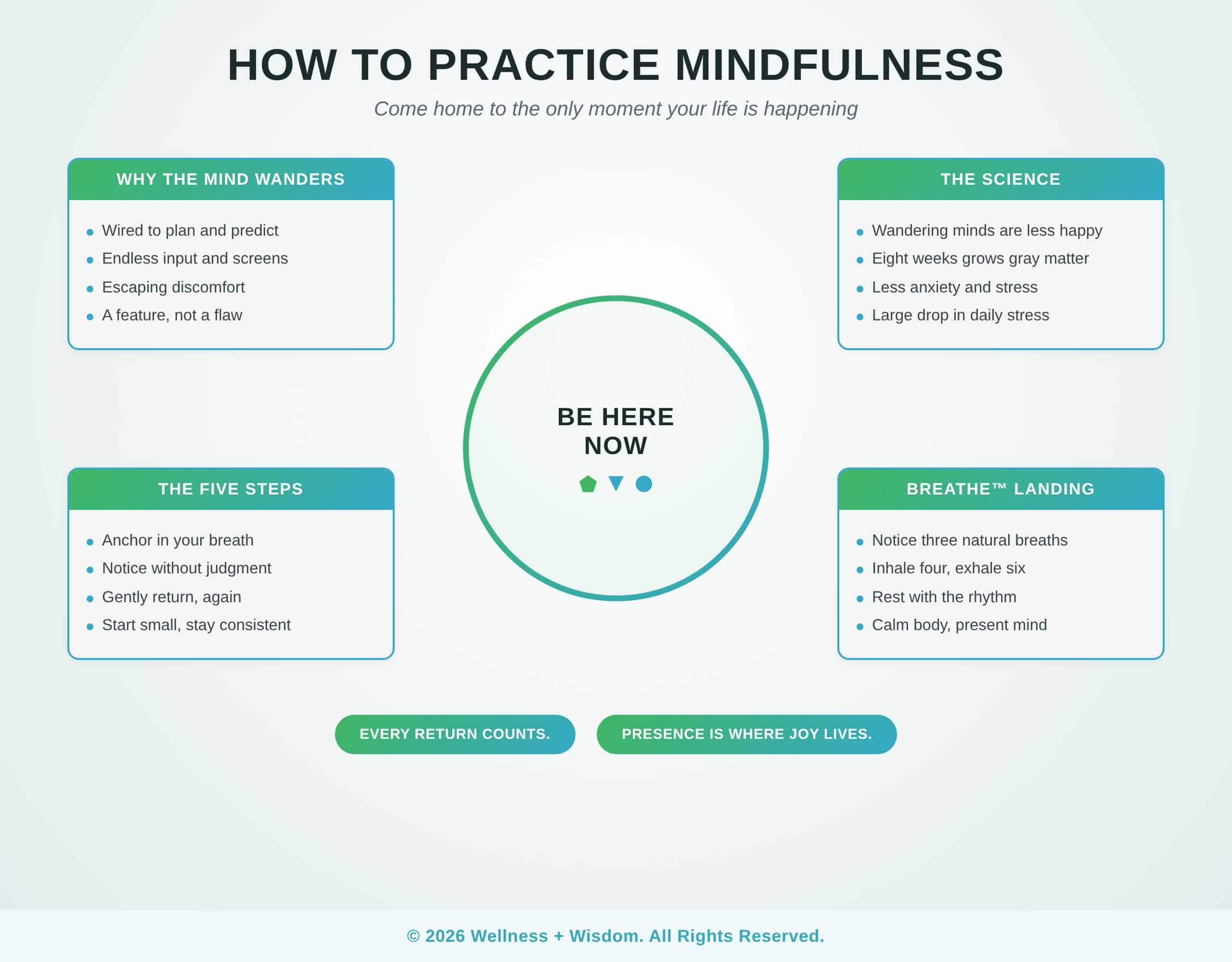
Our attention wanders because the human mind is built to plan, predict, and solve problems, and in a world full of constant input, that natural tendency can pull us out of the present almost all day long. A wandering mind is not a flaw. It is a feature that simply needs a gentle guide.
Think about how much competes for your attention in a single hour. Notifications, emails, headlines, to do lists, and the endless pull of the screen in your pocket. Each of these trains your brain to jump from one thing to the next. On top of that, unresolved feelings and worries tend to loop in the background, quietly tugging at your awareness. It is no wonder so many of us feel scattered and tired. If this resonates, the practices in how to quiet the noise in your mind are a beautiful companion to this article.
There is also a protective reason the mind leaves the present. When the present moment holds something uncomfortable, a hard feeling, a tense body, a difficult conversation, the mind often escapes into planning or distraction. That makes complete sense. Mindfulness gently teaches your neural system that it is safe to stay, that you can be with what is here without being overwhelmed. That sense of safety is the heart of neural system regulation, and it grows with every mindful breath.
The Gift of a Present Mind
A present mind gives you more calm, more clarity, deeper relationships, and far more access to the simple joys already woven into your day. When your attention rests here, life stops feeling like a blur and starts feeling like something you are actually living.
Your relationships change first. When you are fully present with someone, they feel it. Conversations become richer. Your partner feels seen. Your children feel heard. Friends notice that you are really there. Presence is one of the most loving gifts you can offer, and mindfulness makes it possible. This is the same quality that makes being present such a transformational practice.
Your inner world changes too. Mindfulness creates a little space between you and your thoughts, so you can notice a worry without being swept away by it. That space is where wisdom lives. You start responding to life instead of reacting to it. Stress loosens its grip. And here is the part I love most. When you are present, joy has a place to land. The taste of a ripe peach, the warmth of a hug, the color of the evening sky. These moments were always available. Mindfulness simply helps you notice them, which is why it pairs so beautifully with learning to cultivate daily gratitude.
The Science of Mindfulness
The science of mindfulness shows that a wandering mind tends to be a less happy mind, that mindfulness practice is linked with measurable changes in the brain, and that mindfulness programs reliably reduce stress and anxiety. This is one of the most studied wellness practices in modern research.
Start with the wandering mind. Researchers Matthew Killingsworth and Daniel Gilbert at Harvard, publishing in Science, used a smartphone app to ask thousands of adults what they were doing, what they were thinking about, and how happy they felt at random moments throughout the day. Minds were wandering in nearly half of all samples, and people were less happy when their minds wandered than when they were focused on what they were doing. Their memorable conclusion was the title of the paper itself: a wandering mind is an unhappy mind.
Next, consider the brain. In a study led by Britta Hölzel and published in Psychiatry Research: Neuroimaging, people who completed an eight week Mindfulness Based Stress Reduction program showed increases in gray matter concentration in brain regions involved in learning and memory, emotion regulation, self awareness, and perspective taking, compared with a waitlist group. Eight weeks of practice was associated with real structural change.
Finally, consider the bigger picture. A systematic review and meta analysis led by Madhav Goyal at Johns Hopkins, published in JAMA Internal Medicine, examined 47 randomized trials and found moderate evidence that mindfulness meditation programs improved anxiety, depression, and pain. And a meta analysis led by Bassam Khoury in the Journal of Psychosomatic Research, focused on healthy adults, found that Mindfulness Based Stress Reduction produced a large reduction in stress along with improvements in anxiety, depression, distress, and quality of life. Mindfulness is not a trend. It is a well supported practice for a calmer, clearer life.
How to Practice Mindfulness
You learn how to practice mindfulness by anchoring in your breath, noticing without judgment, gently returning when your mind wanders, bringing presence to everyday moments, and starting small enough to be consistent. These five steps work for complete beginners and deepen beautifully over time. Here is how I practice and teach them.
1. Anchor in Your Breath
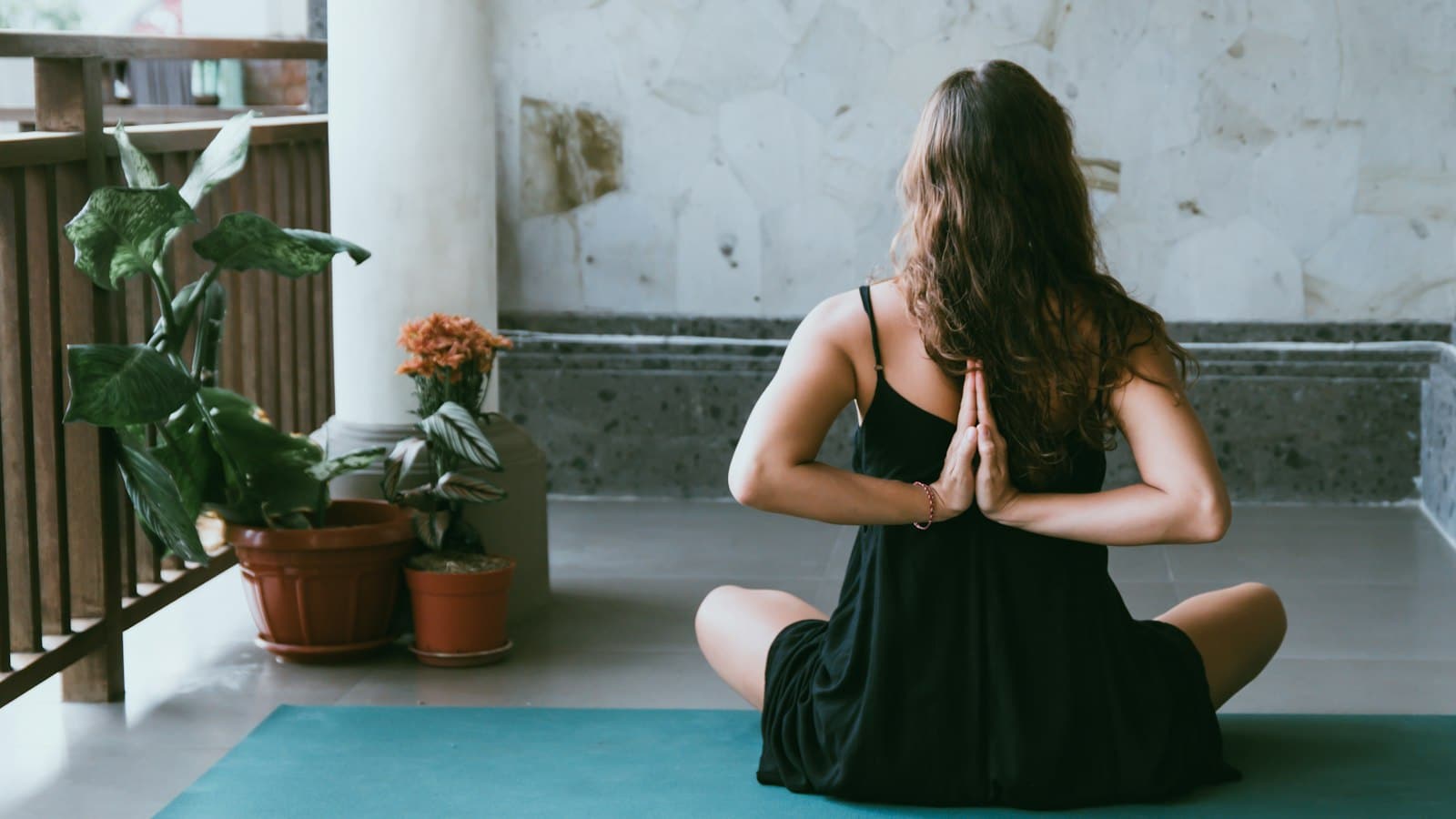
Find a comfortable seat, close your eyes or soften your gaze, and bring your attention to your breath. Notice the cool air entering your nose and the warm air leaving. Feel your belly or chest rise and fall. You do not need to change your breath. Simply feel it. The breath is always with you and always happening in the present, which makes it the perfect anchor for your attention.
2. Notice Without Judgment
As you rest with your breath, you will notice other things. A sound outside. An itch. A thought about dinner. A feeling of restlessness. Simply notice each one, as if you were watching clouds drift across the sky. You might gently label it, “thinking,” “hearing,” “feeling,” and then let it pass. There is nothing to fix and nothing to push away. This gentle noticing is the same skill that helps you sit with difficult emotions without being overwhelmed.
3. Gently Return When Your Mind Wanders
Your mind will wander. Every single time. That is not failure. That is the practice. The moment you notice your mind has drifted is a moment of mindfulness. Celebrate it, and gently guide your attention back to your breath. You might do this a hundred times in ten minutes, and each return strengthens your capacity for presence, much like a repetition strengthens a muscle.
4. Bring Presence to Everyday Moments
Choose one ordinary activity each day and do it with full attention. Drink your morning tea and really taste it. Walk to your car and feel your feet touching the ground. Wash your hands and notice the temperature of the water. These informal moments carry mindfulness out of the meditation cushion and into your whole life. They also make everything feel more vivid and more alive.
5. Start Small and Stay Consistent
Begin with just three to five minutes a day. Consistency matters far more than duration. A short practice you do every day will change you more than a long practice you do once a month. Anchor your practice to something you already do, like after your morning coffee or before bed, which is exactly the approach in how to build healthy habits. Over time, you can lengthen your practice as it starts to feel like home.
Be patient and kind with yourself as you begin. There is no such thing as a perfect meditation. Every moment of presence counts. And if you would love to practice alongside people walking the same path, the Liberated Life Tribe is a warm and welcoming place to grow.
Mindfulness Versus Emptying Your Mind
Mindfulness is not about emptying your mind or stopping your thoughts. It is about changing your relationship with your thoughts so they no longer run the show. This is one of the most common misunderstandings, and clearing it up makes the practice far more enjoyable.
Many people try meditation for the first time, notice that their mind is busy, and decide they are bad at it. But a busy mind is simply a human mind. The goal was never to create a blank screen. The goal is to notice what is happening with curiosity and kindness, and to rest your attention on your anchor as best you can. Thoughts can come and go like traffic outside a window. You do not need to stop the traffic. You simply stop chasing every car.
This shift is profoundly freeing. When you stop fighting your thoughts, they lose much of their power. You begin to see that you are not your thoughts. You are the awareness that notices them. That awareness is spacious, steady, and calm, no matter how busy the mind gets. This is why mindfulness pairs so naturally with learning to stop overthinking, and why so many people find a deep sense of peace once they understand it.
How to Practice Mindfulness With BREATHE™
BREATHE™ offers one of the most accessible doorways into mindfulness, because your breath is always present, always available, and always connected to how you feel. When you bring mindful attention to your breath, you are practicing presence and calming your neural system at the same time.
Inside BREATHE™, we often begin mindfulness with what I call a breath landing. It takes about one minute, and you can do it anywhere. First, pause and notice three breaths exactly as they are, without changing anything. Second, gently slow your breath, inhaling through your nose for four counts and exhaling for six. Third, let your breath return to its natural rhythm and simply rest your attention there for a few more cycles. Notice how your body feels now compared with a minute ago.
This practice combines the attention training of mindfulness with the calming power of a longer exhale. Many people find it easier to stay present when their body feels settled, and many find their body settles more easily when their attention is present. The two support each other in a beautiful loop. Practiced daily, the breath landing becomes a reliable way to return home to yourself, whether you are sitting in traffic, waiting for a meeting to start, or lying in bed at night. To go deeper with breath, identity, and presence, explore our L.I.F.E. Method™ programs.
Celebrating Every Return
Celebrating every return to the present is one of the kindest and most effective ways to grow your mindfulness practice. Each time you notice your mind has wandered and come back, you have just done the practice successfully. That moment deserves appreciation, not criticism.
So many people approach meditation with a harsh inner voice. “I cannot focus. I am doing this wrong.” That voice makes practice feel like a test you keep failing. Try flipping it. Every time you notice you have drifted, smile inwardly and say, “Welcome back.” Treat yourself the way you would treat a puppy learning to sit, with patience and warmth. Your brain learns through positive feeling, and this gentle celebration makes it far more likely you will keep practicing.
You can also celebrate the small shifts you notice in daily life. Maybe you caught yourself rushing and slowed down. Maybe you tasted your lunch for the first time in weeks. Maybe you stayed calm in a moment that used to rattle you. These are signs that mindfulness is taking root. There is a whole practice around honoring these moments in celebrating small wins, and it makes the journey feel joyful.
Mindfulness Is a Lifelong Practice
Learning how to practice mindfulness is a lifelong journey rather than a skill you master once, because every day brings new moments to be present for. Some days your mind will feel calm and spacious. Other days it will feel busy and restless. Both are part of the journey, and both are welcome.
Over months and years, many people notice that mindfulness quietly reshapes their whole life. They react less and respond more. They listen better. They savor more. They feel more connected to themselves, to the people they love, and to the world around them. Many also find that mindfulness opens a deeper sense of Connection to Creator and God, because stillness creates space to listen to something larger than the busy mind.
One gentle way to deepen your practice over time is to notice the moments that pull you out of presence most often. For some people it is the phone. For others it is a certain kind of conversation, a time of day, or a familiar worry. You do not need to fight these moments. Simply let them become reminders. Every time you reach for your phone, you might take one conscious breath first. Every time a familiar worry arises, you might feel your feet on the floor. In this way, the very things that used to scatter you become invitations to come home.
This is where the Wellness Pentagon™ becomes so helpful. Mindfulness supports your mental and emotional health, but it also influences your physical health through better sleep and stress regulation, your spiritual health through stillness, and even your financial health through calmer, wiser decisions. Presence touches every part of a well lived life. If you want to hear how others weave mindfulness into their days, you will find many conversations across our latest episodes.
When Mindfulness Feels Hard
If mindfulness feels hard right now, you are in very good company, and it is completely understandable. Learning how to practice mindfulness does not mean your mind will suddenly become quiet. It means you will gently build your capacity for presence, a little at a time, at a pace that honors where you are.
When sitting still feels uncomfortable, try moving meditation instead. A slow, mindful walk where you feel each step can be easier than sitting for many people, especially during stressful seasons. You can also shorten your practice to just one minute or a few breaths. Keeping your eyes open, practicing outside in nature, or using a simple guided recording can all make the practice more welcoming. Helpful tools like a comfortable meditation cushion or a breath training device can support you too, and you can find a few we trust in our wellness tools store.
It is also important to know that for some people, especially those carrying trauma, turning inward can sometimes bring up strong emotions or memories. If that happens, it is completely okay to open your eyes, ground yourself by noticing what you can see and hear, and return to your day. Working with a qualified therapist or a trauma informed mindfulness teacher can offer safe, compassionate support. Wherever you are, be patient and kind with yourself, and trust that the quiet practice of presence will meet you exactly where you are. If anxiety is part of your experience, the practices in how to calm an anxious mind are a gentle next step.
Ready to go deeper? Join the Liberated Life Tribe and receive your 10 day Self Liberation Blueprint at liberatedlife.com. It is free, it is guided, and it is a beautiful way to build a daily practice of presence with a community that has your back.
Frequently Asked Questions
What is mindfulness in simple terms?
Mindfulness is paying attention to the present moment on purpose, with openness and without judgment. It means noticing your breath, body, thoughts, feelings, and surroundings as they are right now, rather than getting lost in the past or the future, and meeting your experience with curiosity and kindness.
How do beginners practice mindfulness?
Start with three to five minutes a day. Sit comfortably, rest your attention on your breath, notice thoughts and sensations without judging them, and gently return to your breath whenever your mind wanders. You can also bring full attention to everyday activities like eating, walking, or washing dishes.
Is it normal for my mind to wander during mindfulness?
Yes, completely normal. Research from Harvard found that minds wander in nearly half of waking moments. The practice is not keeping your mind still. It is noticing when it wanders and kindly guiding it back. Each return is a successful moment of mindfulness that strengthens your attention over time.
How long does it take for mindfulness to work?
Many people feel calmer after a single short session. Research on eight week Mindfulness Based Stress Reduction programs shows measurable reductions in stress and changes in brain regions linked with emotion regulation and self awareness. Consistent daily practice, even a few minutes, matters more than long occasional sessions.
What is the difference between mindfulness and meditation?
Mindfulness is a quality of present moment awareness you can bring to anything you do. Meditation is a formal practice where you set aside time to train attention, often using mindfulness. You can be mindful while walking or eating, and meditation is one of the most effective ways to strengthen that capacity.
Can mindfulness help with anxiety and stress?
Yes. A meta analysis in JAMA Internal Medicine found moderate evidence that mindfulness meditation programs improve anxiety, depression, and pain, and research on healthy adults found large reductions in stress. For persistent anxiety or trauma, combining mindfulness with support from a qualified therapist is the most helpful path.
Studies and External Resources
The science in this article rests on peer reviewed research. These are the sources referenced throughout.
- Killingsworth MA, Gilbert DT. (2010). A wandering mind is an unhappy mind. Science. PubMed: 21071660
- Hölzel BK, et al. (2011). Mindfulness practice leads to increases in regional brain gray matter density. Psychiatry Research: Neuroimaging. PubMed: 21071182
- Goyal M, et al. (2014). Meditation programs for psychological stress and well being: a systematic review and meta analysis. JAMA Internal Medicine. PubMed: 24395196
- Khoury B, et al. (2015). Mindfulness based stress reduction for healthy individuals: A meta analysis. Journal of Psychosomatic Research. PubMed: 25818837
About Josh Trent
Josh Trent is an Identity Transformation Architect and the award winning host of the Wellness + Wisdom Podcast, with over 15 million downloads since 2015. He is the creator of the L.I.F.E. Method™ Identity Transformation System and steward of the Emotional Epigenetics™ and BREATHE: Breath + Wellness™ systems of self mastery, impacting over 1,000 students worldwide. Join the Liberated Life Tribe and receive your 10 day Self Liberation Blueprint at liberatedlife.com. Josh lives in Austin, Texas with his wife Carrie, daughter Nayah, and son Novah. Peace and power.
Disclosure: We may earn a commission from certain links on this site when you make a purchase, at no extra cost to you. These commissions help support Wellness + Wisdom and do not affect the products or resources we choose to recommend. Full disclosure .