
By Josh Trent | Wellness + Wisdom Podcast Host & Identity Transformation Architect
“You do not rise to the level of your goals. You return to the level of your identity. Learning how to build healthy habits is really learning how to become the person who already lives them.”
Josh Trent
Learning how to build healthy habits is one of the most life changing skills you will ever practice, because your habits quietly shape almost every hour of your day. So many of us have started a new routine with a burst of excitement, only to watch it fade a few weeks later and wonder what is wrong with us. Nothing is wrong with you. You were simply taught to build habits with willpower, when lasting habits are built with identity, environment, and joy. That shift sits at the heart of the L.I.F.E. Method™.
Here is the joy forward truth at the center of it all. Healthy habits are not punishments you force yourself through. They are daily acts of love for the person you are becoming. When you learn how to build healthy habits from the inside out, the effort gets lighter over time, because your brain starts doing the work for you. Let us explore exactly how.
Table of Contents
- What a Healthy Habit Really Is
- Why Most New Habits Fade
- The Gift of Habits That Carry You
- The Science of Habit Formation
- How to Build Healthy Habits
- Identity Habits Versus Willpower Habits
- How to Build Healthy Habits With the L.I.F.E. Method™
- Celebrating Every Small Win
- Habits Are a Lifelong Practice
- When You Miss a Day
- Frequently Asked Questions
- Studies and External Resources
- About Josh Trent
What a Healthy Habit Really Is
A healthy habit is a supportive action you repeat so often in the same context that it becomes automatic, requiring little conscious effort or decision. It is not the same as a goal, and it is not the same as a resolution. A goal is something you want. A habit is something you do without needing to talk yourself into it.
That automatic quality is the whole magic. When drinking water after you wake up, taking a short walk after lunch, or breathing for five minutes before bed becomes automatic, it stops costing you energy. Your brain no longer debates it. You simply do it, the same way you brush your teeth without holding a meeting with yourself first. That frees up your attention for creativity, connection, and the things that light you up.
I like to think of healthy habits as votes for who you are becoming. Every time you show up for a small supportive action, you cast a vote for the version of you that lives with energy, presence, and purpose. One vote does not change much. Hundreds of votes change everything. This is why habits are really about identity transformation, and it is a conversation we return to often on the Wellness + Wisdom Podcast.
Why Most New Habits Fade
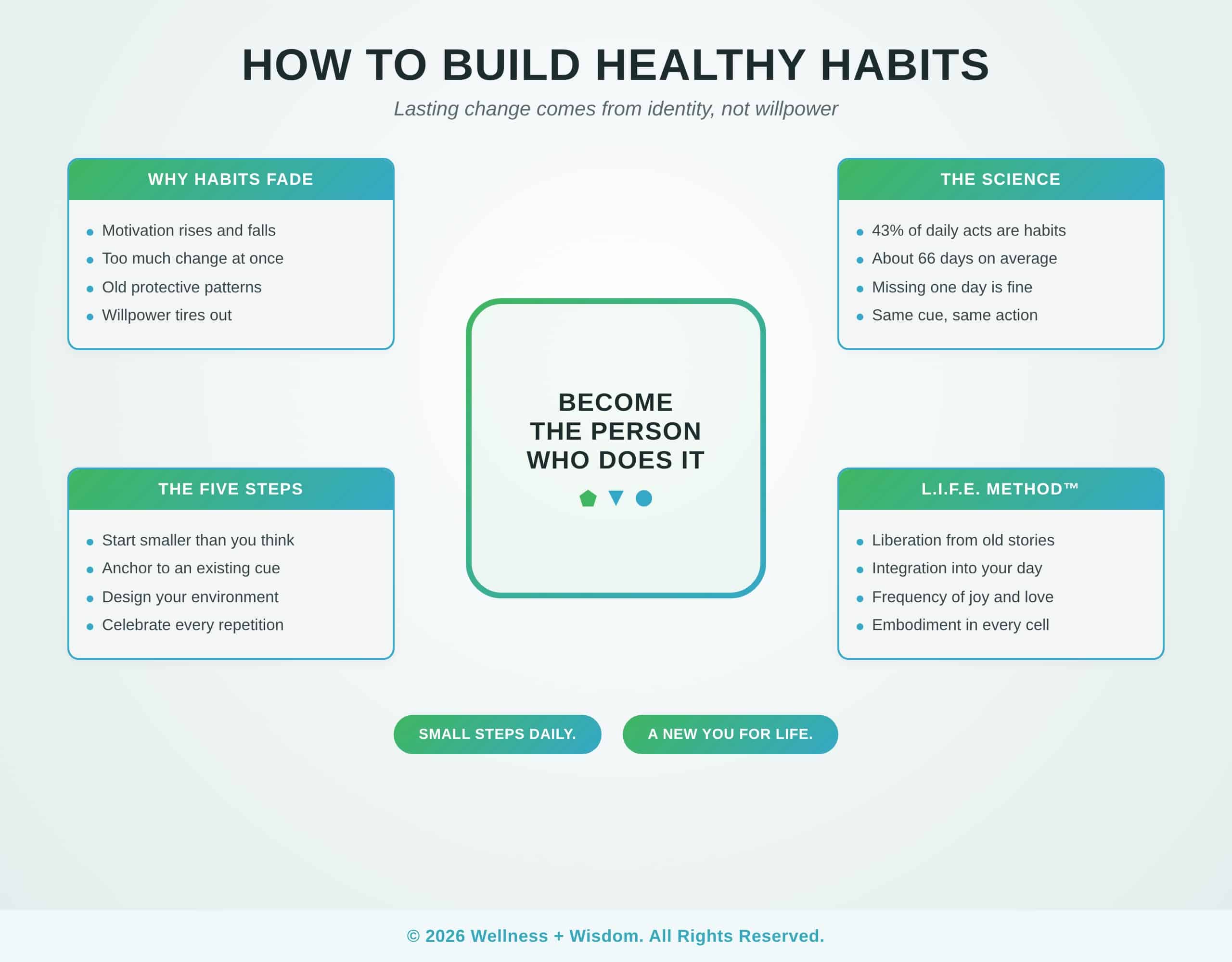
Most new habits fade because they depend on motivation and willpower, which naturally rise and fall from day to day. Motivation is a wonderful spark, but it is not a reliable engine. When a habit only happens on the days you feel inspired, it will disappear on the days you feel tired, busy, or stressed, which for most of us is a lot of days.
The second reason is that we try to change too much at once. We decide to wake up at five, meditate for an hour, cut out sugar, journal three pages, and run every morning, all starting Monday. It is a beautiful vision, but it asks your neural system to rewire everything overnight. That level of change feels like a threat to your body, and your body responds by pulling you back toward what feels familiar and safe.
There is also a deeper layer. Many of our patterns were learned long before we chose them, absorbed from the rhythms and stress responses of the families we grew up in. If you notice that you keep starting and stopping, that is not a character flaw. It is often an old protective pattern, which we explore in the epigenetic roots of self sabotage. Seeing this clearly replaces shame with compassion, and compassion is where lasting change begins.
The Gift of Habits That Carry You
Habits that carry you give you more energy, more peace, and more freedom, because the best parts of your life start happening on autopilot. Instead of fighting yourself every morning, you wake up into a rhythm that already supports you. That is one of the most underrated forms of self love there is.
Think about how much mental energy goes into deciding whether to do something you know is good for you. Should I exercise today? Should I go to bed early? Should I have the salad or the fries? Every one of those decisions drains a little from your tank. When a healthy behavior becomes a habit, the decision disappears. You get that energy back, and you can pour it into the work, people, and dreams that matter most.
Habits also create momentum. One small healthy habit tends to make the next one easier. A morning walk makes it easier to eat well, which makes it easier to sleep, which makes it easier to wake up with energy for the walk. This upward spiral is exactly how the Wellness Pentagon™ works: when you strengthen one side, physical, mental, emotional, spiritual, or financial, every other side gets a little stronger too.
The Science of Habit Formation
The science of habit formation shows that habits form through repetition of an action in a consistent context until the context alone triggers the behavior automatically. This is good news, because it means habits are not about superhuman discipline. They are about repetition, consistency, and smart design.
First, consider how much of your life already runs on habit. Research by Wendy Wood and colleagues, published in the Journal of Personality and Social Psychology, used daily diaries to track what people did throughout the day and found that roughly 43 percent of daily behaviors were performed almost every day, usually in the same location, often while people were thinking about something else. A huge share of your life is already automatic. The opportunity is to make sure those automatic patterns are ones that serve you.
Second, consider how long it takes. A well known study led by Phillippa Lally at University College London, published in the European Journal of Social Psychology, followed 96 people as they each tried to build a new daily habit, like drinking water with lunch or going for a short run. On average it took about 66 days for the behavior to become automatic, with a huge range from 18 to 254 days depending on the person and the habit. And here is the beautiful part. Missing a single day did not meaningfully set people back. Consistency over time mattered far more than perfection.
Third, consider why context matters so much. In a major review in the Annual Review of Psychology, Wendy Wood and Dennis Rünger explain that habits are stored as links between a context and a response. Once a habit forms, the cue in the environment triggers the behavior, even when your intentions shift. A review by Benjamin Gardner and colleagues in the British Journal of General Practice made the practical point clear: repeating a simple action in response to the same daily cue is one of the most reliable ways to make a healthy behavior stick. Design the cue, repeat the action, and let time do the rest.
How to Build Healthy Habits
You learn how to build healthy habits by starting tiny, anchoring each new habit to an existing cue, shaping your environment, connecting the habit to your identity, and celebrating every repetition. These five steps work with your brain instead of against it. Here is how I practice and teach them.
1. Start Smaller Than You Think
Choose a version of your habit so small it feels almost too easy. One push up. One minute of breathing. One glass of water. Two sentences in a journal. The point is not the size of the action. The point is teaching your brain that this is something you do every day. Once the habit is automatic, you can grow it. Starting small also quiets the inner critic, which is why this pairs so well with learning to let go of perfectionism.
2. Anchor It to Something You Already Do
Attach your new habit to an existing routine, a practice often called habit stacking. After I pour my morning coffee, I will take three slow breaths. After I sit down for lunch, I will drink a full glass of water. After I brush my teeth at night, I will write one thing I am grateful for. Your existing routine becomes the cue, and the science shows that a consistent cue is what turns a behavior into a habit.
3. Design Your Environment for Ease
Make the healthy choice the easy choice. Put your running shoes by the door. Keep a water bottle on your desk. Leave your journal on your pillow. Move your phone charger out of the bedroom. Your environment is constantly whispering suggestions to your brain, so set it up to whisper the habits you want. This is one of the most loving forms of self care, because it means your future self does not have to rely on willpower.
4. Connect It to Who You Are Becoming
Instead of saying “I am trying to exercise,” say “I am someone who moves my body every day.” Instead of “I am trying to meditate,” say “I am someone who makes space for stillness.” This small language shift changes everything, because your brain works hard to act in line with your identity. When a habit is part of who you are, it stops being a chore and becomes an expression of yourself. This is the core of how identity transformation works.
5. Celebrate Every Repetition
Every time you complete your habit, give yourself a small moment of celebration. A smile, a fist pump, a quiet “yes,” a check mark on your calendar. Celebration creates a feeling of reward, and your brain repeats what feels rewarding. This is not silly. It is one of the most effective ways to wire in a new behavior, and it makes the whole journey more joyful.
Start with just one habit, not five. Give it a few months to settle in before you add the next. You can build an entire life this way, one tiny habit at a time. And when you want a community cheering you on, the Liberated Life Tribe is a beautiful place to practice consistency together.
Identity Habits Versus Willpower Habits
Identity habits are built around who you are becoming, while willpower habits are built around forcing yourself through a task you feel you should do. Both can get you started. Only one tends to last. The difference comes down to where the energy comes from.
Willpower habits feel like a constant negotiation. You set an alarm, you argue with yourself, you push through, and you feel proud for a day or two. But willpower is like a muscle that tires, and when life gets busy or stressful, the negotiation becomes harder to win. Eventually the habit fades, and many people blame themselves, when really the approach was the problem all along.
Identity habits feel completely different. They grow from a sense of who you are and what you value. You do not go for a walk because you are supposed to. You go because you are someone who loves feeling alive in your body. You do not journal because a book told you to. You journal because you are someone who listens to your inner world. When the habit flows from identity, there is very little to negotiate. It simply feels like you. This is why the shift from doing to being is so powerful, and it is beautifully explored in embodiment, the missing piece between knowing and doing.
How to Build Healthy Habits With the L.I.F.E. Method™
The L.I.F.E. Method™ gives you a complete framework for healthy habits through four pillars: Liberation, Integration, Frequency, and Embodiment. Each pillar addresses a different reason habits fade, and together they help a new behavior become a natural part of who you are.
Liberation is about freeing yourself from the old story that says you are someone who never sticks with anything. Before a new habit can take root, it helps to release the identity that keeps pulling you back. Notice the old beliefs, thank them for trying to protect you, and choose a new story about who you are.
Integration is about weaving your new habit into the life you already live, rather than building a separate life on top of it. This is where habit stacking and environment design shine. When the habit fits naturally into your existing rhythms, it stops feeling like an extra task and starts feeling like part of the flow.
Frequency is about the energy and emotional state you bring to your habits. When you practice from a frequency of joy, gratitude, and self love, your habits feel nourishing instead of punishing. A walk taken in gratitude feels completely different from a walk taken in guilt, and your body knows the difference.
Embodiment is about letting the habit live in your body, not just your mind. You do not only think about being someone who breathes, moves, and rests well. You feel it. Every repetition settles the new identity a little deeper into your cells, until the habit is simply who you are. If you want a powerful first habit to embody, a daily practice with BREATHE™ is a beautiful place to begin.
Celebrating Every Small Win
Celebrating every small win is one of the most effective ways to make a healthy habit stick, because your brain learns through positive feeling. When you notice and honor a repetition, you send a signal that this behavior is good and worth repeating. Over time, that signal becomes the fuel that keeps the habit going.
So many of us were taught to wait until we reach the finish line to feel good about ourselves. But habits are built in the small moments, not at the finish line. If you only celebrate when you have run the marathon, you miss the hundreds of tiny wins that got you there. Celebrating the small wins makes every step of the journey feel meaningful.
Try keeping a simple habit tracker and giving yourself a moment of joy every time you mark a day complete. Notice how good it feels to keep a promise to yourself. That feeling of self trust is precious, and it grows with every small win. There is a whole practice around this in celebrating small wins, and it is one of my favorite tools for making change feel joyful.
Habits Are a Lifelong Practice
Building healthy habits is a lifelong practice, because your life keeps changing and your habits get to grow with you. The habits that serve you in one season may need to shift in the next. That is not failure. That is growth.
A new job, a move, a new baby, an injury, or a big loss can all disrupt routines that once felt automatic. When that happens, you are not starting over from zero. You are simply rebuilding with all the wisdom you have already gained. Return to the basics. Start small. Find a new cue. Celebrate the first repetition. Your brain remembers more than you think.
Your habits also deepen as you do. A breathing habit that starts as one minute a day might grow into a rich daily practice. A walking habit might grow into a love of hiking. A journaling habit might become a doorway into your inner world. Trusting this slow unfolding is part of the joy, which is beautifully explored in how to trust the process. You can find hundreds of conversations on habit, identity, and growth across our latest episodes.
When You Miss a Day
If you miss a day, take a breath and know that you are in very good company. Building lasting habits does not require a perfect streak. The research is clear that missing a single day does not meaningfully slow habit formation. What matters is coming back.
The real risk is not the missed day. It is the story you tell yourself about the missed day. If you say “I blew it, I always do this,” that story can turn one missed day into a missed month. If you say “I missed yesterday, so today I will do the smallest version,” you keep the habit alive. A helpful rule many people love is simple: never miss twice. One missed day is life. Two missed days is the start of a new pattern, so make the next day your comeback.
Be especially kind to yourself in these moments, because self criticism drains the very energy you need to begin again. Speak to yourself the way you would speak to a friend who is learning something new. This gentle approach is the heart of learning to practice self compassion. And if you want simple tools that support daily rhythms, like a quality journal or a breath training device, you can find a few we trust in our wellness tools store. Wherever you are, trust that learning how to build healthy habits is something you can absolutely grow, one tiny repetition at a time.
Ready to go deeper? Join the Liberated Life Tribe and receive your 10 day Self Liberation Blueprint at liberatedlife.com. It is free, it is guided, and it is a perfect daily rhythm to build your next healthy habit around.
Frequently Asked Questions
How long does it take to build a healthy habit?
Research from University College London found that it took an average of about 66 days for a new daily behavior to become automatic, with a range from 18 to 254 days depending on the person and the habit. Simple habits form faster, and missing a single day did not meaningfully slow progress.
What is the best way to start a new habit?
Start smaller than you think, anchor the habit to something you already do every day, and design your environment so the healthy choice is the easy choice. Connect the habit to who you are becoming and celebrate each repetition, since your brain repeats what feels rewarding.
What is habit stacking?
Habit stacking means attaching a new habit to an existing routine, such as taking three slow breaths after you pour your morning coffee. The existing routine becomes a reliable cue, and research shows that repeating an action in response to the same cue is what helps a behavior become automatic.
Why do I keep failing to stick with habits?
Most habits fade because they rely on motivation and willpower, which naturally rise and fall. Trying to change too much at once also overwhelms your system. Starting tiny, using consistent cues, and building habits around your identity rather than willpower makes them far more likely to last.
What happens if I miss a day?
Missing one day does not erase your progress. Research shows consistency over time matters far more than a perfect streak. The key is to return the next day, ideally with the smallest version of your habit, and to speak to yourself with kindness rather than criticism.
How does identity help build habits?
When you see a habit as part of who you are, such as “I am someone who moves my body every day,” your brain works to act in line with that identity. The habit stops feeling like a chore to negotiate and becomes a natural expression of the person you are becoming.
Studies and External Resources
The science in this article rests on peer reviewed research. These are the sources referenced throughout.
- Wood W, Quinn JM, Kashy DA. (2002). Habits in everyday life: thought, emotion, and action. Journal of Personality and Social Psychology. PubMed: 12500811
- Lally P, van Jaarsveld CHM, Potts HWW, Wardle J. (2010). How are habits formed: Modelling habit formation in the real world. European Journal of Social Psychology. DOI: 10.1002/ejsp.674
- Wood W, Rünger D. (2016). Psychology of Habit. Annual Review of Psychology. PubMed: 26361052
- Gardner B, Lally P, Wardle J. (2012). Making health habitual: the psychology of habit formation and general practice. British Journal of General Practice. PubMed: 23211256
About Josh Trent
Josh Trent is an Identity Transformation Architect and the award winning host of the Wellness + Wisdom Podcast, with over 15 million downloads since 2015. He is the creator of the L.I.F.E. Method™ Identity Transformation System and steward of the Emotional Epigenetics™ and BREATHE: Breath + Wellness™ systems of self mastery, impacting over 1,000 students worldwide. Join the Liberated Life Tribe and receive your 10 day Self Liberation Blueprint at liberatedlife.com. Josh lives in Austin, Texas with his wife Carrie, daughter Nayah, and son Novah. Peace and power.
Disclosure: We may earn a commission from certain links on this site when you make a purchase, at no extra cost to you. These commissions help support Wellness + Wisdom and do not affect the products or resources we choose to recommend. Full disclosure .