By Josh Trent | Wellness + Wisdom Podcast Host & Identity Transformation Architect
“The way you speak to yourself when no one is listening shapes your whole life. When you learn to meet yourself with the same kindness you give the people you love, everything begins to soften and heal.”
Josh Trent
Learning how to practice self compassion is one of the most healing shifts you can make, because the way you treat yourself shapes your entire inner world. So many of us are far harder on ourselves than we would ever dream of being on a friend, criticizing our own mistakes, dismissing our pain, and holding ourselves to impossible standards. Learning to practice self compassion gently reverses all of that, teaching you to meet yourself with the same warmth, understanding, and steady kindness you would naturally offer someone you love. This deeply healing inner shift lives at the very heart of the L.I.F.E. Method™.
Here is the joy forward truth at the center of it all. You never have to earn your own kindness through perfection at all, and being gentle with yourself is never weakness, it is truly one of the deepest forms of strength and wisdom there is. When you learn to treat yourself with genuine compassion, you build a safe inner home from which real growth, joy, and resilience can truly flourish. When you learn how to practice self compassion, you gently transform your entire relationship with yourself. This inner shift touches every part of your authentic identity. Let us explore exactly how.
Table of Contents
- What Self Compassion Really Is
- The Three Parts of Self Compassion
- Why We Are So Hard on Ourselves
- The Science of Self Compassion
- How to Practice Self Compassion
- Self Compassion Is Not Weakness
- Self Compassion and the L.I.F.E. Method
- Celebrating Yourself With Kindness
- When Self Compassion Feels Hard
- Self Compassion Is a Lifelong Practice
- Frequently Asked Questions
- Studies and External Resources
- About Josh Trent
What Self Compassion Really Is
Self compassion is the practice of treating yourself with the same warmth, understanding, and steady care you would offer a good friend, especially in your own moments of struggle, failure, or pain. It means meeting your own difficulties with real warmth and kindness rather than harsh judgment, and recognizing that imperfection is simply part of being human. Self compassion, at its very core, is simply learning to be a genuinely good friend to yourself.
This is a genuinely gentle and powerful practice, never self pity or making excuses. Self compassion honors your genuine struggles and treats them with real care, while still holding you with dignity and gently encouraging your growth. It is the real difference between harshly beating yourself up when you fall short and offering yourself genuine understanding, which actually helps you recover and try again with courage.
Self compassion has a few key elements, including treating yourself kindly rather than critically, remembering that struggle is simply part of our shared humanity, and meeting your pain with gentle awareness rather than either ignoring it or being overwhelmed by it. Together, these elements create a warm, supportive inner relationship that steadies you through all of life's challenges. Building this kind of steady inner kindness is a genuine cornerstone of lasting wellbeing, a theme we return to often on the Wellness + Wisdom Podcast.
The Three Parts of Self Compassion
Self compassion is often understood as having three interwoven parts, and seeing each of them clearly helps you practice it more fully and completely. These three interwoven elements work together to create a warm, steady inner relationship with yourself, and each one of them can be gently cultivated over time and practice.
The first part is self kindness, treating yourself with genuine warmth and understanding rather than harsh criticism whenever you struggle. Instead of attacking yourself for a simple mistake, you offer yourself the same gentleness you would freely give a friend, which soothes rather than wounds. This warm, steady kindness truly is the beating heart of all self compassion.
The second part is common humanity, remembering that struggle, failure, and imperfection are simply part of the shared human experience rather than signs that something is uniquely wrong with you. When you recall that everyone stumbles and hurts at times, your own pain feels far less isolating, and you begin to feel genuinely connected rather than utterly alone. This simple recognition gently softens the shame that so often accompanies difficulty.
The third part is mindful awareness, meeting your own painful thoughts and feelings with balanced, gentle attention rather than either suppressing them entirely or being completely swept away by them. You acknowledge your pain honestly, holding it with real care, without either exaggerating it or pushing it aside. Together, these three parts weave into a genuinely compassionate way of relating to yourself, which supports your whole self growth journey.
Why We Are So Hard on Ourselves
Most of us are so hard on ourselves because we learned early that criticism motivates and that being tough on ourselves is how we improve and stay safe. Some of us grew up with critical voices, impossibly high expectations, or the quiet message that we were only lovable when we performed well, and we slowly internalized that harshness as our own inner critic. This kind of early conditioning can make self kindness feel almost foreign.
On top of all this, our modern culture often celebrates relentless self improvement and treats self criticism as a virtue, leaving us believing that if we are not hard on ourselves, we will surely become lazy or complacent. So we drive ourselves relentlessly with harshness, truly believing it keeps us on track, when in honest truth it often leaves us anxious, depleted, and afraid. Understanding that this harshness was simply learned, rather than being the truth of what you deserve, replaces self judgment with real compassion, which is exactly where lasting change begins, much like the gentle work of reparenting yourself.
Seeing clearly why we are so hard on ourselves is genuinely freeing, because it means your inner critic is simply not the truth about your worth. That harsh inner voice was learned long ago, often absorbed directly from others, and like any learned pattern, it can be gently softened and replaced over time. You can honor the part of you that once learned to be harsh while gently teaching yourself a new, kinder way of relating to yourself, which is deeply connected to healing our inherited beliefs.
The Science of Self Compassion
The science of kindness and positive emotion offers beautiful support for practicing self compassion. Barbara Fredrickson's research, published in American Psychologist, shows that positive emotions like warmth and kindness broaden our awareness and build lasting personal resources, everything from resilience to overall wellbeing. Treating yourself with real compassion is not just pleasant, it genuinely strengthens you from the inside over time.
Meeting your pain with words helps as well. Research by Matthew Lieberman and colleagues, published in Psychological Science, found that putting feelings into words reduces activity in the brain's alarm center. When you gently name your own struggle and offer yourself real understanding, rather than harsh criticism, you help your own system settle and soothe, supporting the kind of neural system regulation that self compassion nurtures.
Warmth and connection reach the body too. Research by Bethany Kok and Barbara Fredrickson, published in Psychological Science, found that positive emotion and warm connection support physical wellbeing in a genuine upward spiral, each one feeding the other. Self compassion, which naturally generates inner warmth and a real sense of safety within, is a genuine investment in your physical health as well as your happiness, showing clearly that kindness toward yourself is genuinely good medicine.
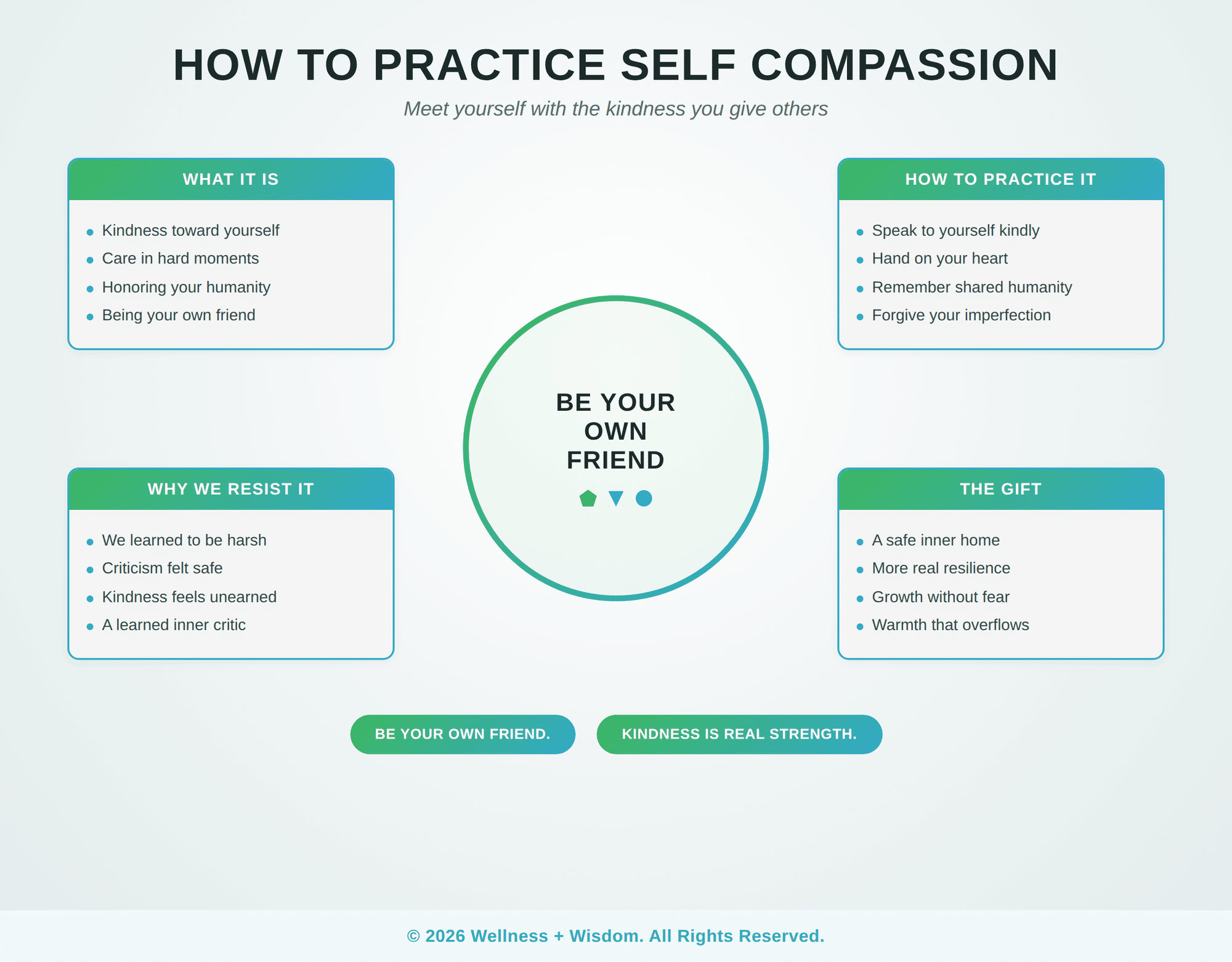
How to Practice Self Compassion
Learning how to practice self compassion is a gentle, gradual practice of slowly shifting from harsh self criticism toward warm, steady self kindness. It grows more natural with steady practice over time, and every moment of self kindness gently softens your whole inner world. Here are practices that help.
1. Speak to Yourself as a Friend
When you struggle or fall short in some way, notice how you are actually speaking to yourself and gently offer the same words you would give a dear friend. Speaking to yourself with a good friend's warm kindness is truly the heart of self compassion, and it draws on real emotional intelligence.
2. Place a Hand on Your Heart
In moments of real pain, a simple gesture like placing a hand on your heart can offer genuine comfort and warmth. This simple physical act of kindness helps soothe your system and gently reminds you that you are worthy of care.
3. Remember Your Shared Humanity
When you feel as though you are the only one in the world struggling, gently remind yourself that imperfection and difficulty are simply part of being human. Remembering that everyone struggles at times softens isolation and self judgment, quietly connecting you to our shared human experience.
4. Meet Your Pain With Gentle Awareness
Rather than ignoring your pain or being completely overwhelmed by it, acknowledge it honestly with gentle, caring awareness. Simply naming what you feel with kindness, and without judgment, allows the pain to be gently held and to soften over time.
5. Forgive Your Own Imperfection
Let go of the impossible standard of perfection and offer yourself real grace for being beautifully, imperfectly human. Forgiving your own mistakes and human limitations gradually frees you from the exhausting weight of harsh self judgment.
Begin with whatever practice feels most accessible to you and be patient and kind with yourself, since learning self compassion after years of self criticism genuinely takes time. Every single moment of kindness toward yourself gently softens your whole inner world. When you want community and support for this journey, the Liberated Life Tribe is here for you.
Self Compassion Is Not Weakness
One of the most important truths about self compassion is that it is a genuine strength, not a weakness or a form of letting yourself off the hook. Far from making you soft or lazy, self compassion actually builds the very resilience and motivation that harsh self criticism only undermines.
Many of us quietly fear that if we are kind to ourselves, we will somehow lose our drive or make excuses for poor behavior. Yet both the research and lived experience point the opposite way, since people who treat themselves with compassion tend to be more resilient, more motivated, and more willing to take real responsibility, precisely because they are not paralyzed by fear of their own harsh judgment. Self compassion quietly creates a safe inner space in which real growth finally becomes possible.
All of this makes real, intuitive sense when you consider how genuine growth actually happens in a person. A young child learns best from a supportive, encouraging teacher rather than a harsh, critical one, and exactly the same is true for the tender child that lives within each of us. When you meet your own mistakes with real understanding rather than attack, you recover faster, learn far more from them, and try again with real courage. Self compassion, far from being weak in any way, is the very ground from which real strength and lasting growth arise, which is closely tied to genuine emotional courage.
Self Compassion and the L.I.F.E. Method
Practicing self compassion is a beautiful expression of the Integration pillar within the L.I.F.E. Method™, our system for identity transformation built on four pillars: Liberation, Integration, Frequency, and Embodiment. Integration is about welcoming and embracing all the parts of yourself with acceptance, and self compassion is how you hold even your struggling, imperfect parts with real love.
When you are harsh with yourself, you quietly reject and exile the very parts of you that are already hurting or falling short. Integration warmly invites you to welcome those parts back home with compassion, holding your whole self with acceptance rather than judgment. Liberation frees you from the old belief that you must earn kindness through perfection, Frequency raises your inner state from criticism and fear toward genuine warmth and safety, and Embodiment lets you feel that self compassion as real care in your body rather than just an idea in your mind.
This is exactly why we hold self compassion as genuine transformation work rather than just a simple feel good practice. You are not merely being nicer to yourself, you are actively healing your relationship with yourself and reclaiming your worth as a beloved creation in your Connection to Creator and God. That is a deep and joyful freedom, one that transforms your whole inner life and every relationship that flows from it, including your relationships with others.
Celebrating Yourself With Kindness
The joyful heart of self compassion is learning to celebrate yourself with real kindness, honoring your worth, your efforts, and your beautifully human journey rather than constantly critiquing yourself. When self kindness slowly becomes your natural default, celebration comes easily, because you are finally, fully on your own side.
Celebrating yourself with kindness means recognizing your real efforts and steady growth, appreciating your good qualities, and treating yourself as someone genuinely worthy of both care and joy. Rather than waiting until you are somehow perfect to finally feel worthy, you can honor yourself right now, exactly as you are, with all of your beautiful imperfections. This gentle celebration is never arrogance, it is simply the warmth of being on genuinely friendly terms with yourself, which is a beautiful part of learning to celebrate yourself.
And here is the beautiful part. When you treat yourself with real compassion and celebrate your own worth, you naturally become kinder and more accepting of others too, since the warmth you give yourself quietly overflows. Your own self compassion also gives others permission to be gentle with themselves, quietly modeling a kinder, softer way of being human. In this beautiful way, learning how to practice self compassion becomes a gift that ripples far beyond yourself, softening every relationship and community you touch, which is a spirit we cherish in learning to celebrate the people you love.
When Self Compassion Feels Hard
If self compassion feels genuinely hard or even undeserved, you are in very good company, and it is completely understandable, especially if kindness toward yourself is still unfamiliar. For those who learned early in life to be harsh with themselves, self compassion can feel awkward, uncomfortable, or even completely unearned at first. This is simply a normal response to old conditioning, never a sign that you do not deserve kindness.
The key is to start small and very gently, offering yourself even a little kindness in the most ordinary moments and letting your capacity grow naturally over time. You might begin by simply noticing your inner critic and gently softening its harsh tone, or by placing a hand on your heart in a genuinely hard moment. You do not have to feel worthy of compassion in order to begin practicing it at all, and the felt sense of deserving tends to grow steadily as you go. Meeting your own resistance with gentle patience, rather than yet more harsh criticism, is itself a real and beautiful act of self compassion.
It is also genuinely worth remembering that if harsh self criticism, deep shame, or persistent low mood weigh heavily on you, working with a qualified therapist can offer truly invaluable support. There is real and genuine strength in seeking help, and a skilled professional can help you build a kinder, healthier relationship with yourself over time. Wherever you happen to be beginning, be gentle with yourself, honor your own pace, and know that learning to treat yourself with compassion is a beautiful journey of coming home to your own heart, one that deepens as you keep coming home to yourself.
Self Compassion Is a Lifelong Practice
Learning how to practice self compassion is not a single achievement you complete just once, but a lifelong practice of meeting yourself with more kindness across all the changing seasons of your life. Self compassion is less a fixed state and more a steady way of relating to yourself that you keep deepening. This is genuinely wonderful news, because it means you can always keep growing kinder toward yourself no matter where you happen to be starting from.
This understanding takes the pressure off getting it perfect. You will certainly have moments when the old harshness returns, when you slip back into self criticism, or when kindness feels genuinely out of reach, and all of that is completely human. What matters most is the overall direction, the steady returning to self kindness that gradually softens your whole inner world over time.
Understanding self compassion as a lifelong, ongoing practice also keeps it gentle and forgiving. Each new struggle offers a fresh opportunity to meet yourself with warmth, to gently soften the inner critic, and to strengthen your capacity for self kindness. Over time, compassion toward yourself becomes far less something you have to consciously remember and more simply how you naturally relate to your own heart.
So approach your own journey here with real patience and warmth toward yourself. There is no finish line, only the ongoing, healing practice of treating yourself with more compassion, and celebrating your own beautifully human journey along the way. This steady self kindness supports every dimension of your wellbeing and deepens your whole spiritual wellness, growing richer with time.
Frequently Asked Questions
What is self compassion?
Self compassion is the practice of treating yourself with the same warmth, understanding, and care you would offer a good friend, especially in moments of struggle or failure. It means meeting your difficulties with kindness rather than harsh judgment and recognizing that imperfection is part of being human. Self compassion is simply being a good friend to yourself.
Why am I so hard on myself?
Because many of us learned early that criticism motivates and that being tough on ourselves keeps us safe and improving. Some grew up with critical voices or the message that love was conditional on performance. Understanding that this harshness was learned, rather than the truth of what you deserve, opens the way to a kinder relationship with yourself.
How do I start practicing self compassion?
Speak to yourself as you would a dear friend, place a hand on your heart in hard moments, remember that struggle is part of shared humanity, meet your pain with gentle awareness, and forgive your own imperfection. Start with whatever feels most accessible and be patient, since learning self compassion after years of self criticism takes time.
Is self compassion just weakness or making excuses?
No. Self compassion is a genuine strength, not weakness or letting yourself off the hook. People who treat themselves with compassion tend to be more resilient, more motivated, and more willing to take responsibility, because they are not paralyzed by fear of harsh self judgment. Self compassion creates the safe inner space in which real growth happens.
Does self compassion actually help?
Yes. Research shows positive emotions like warmth build lasting resources such as resilience, naming your pain with kindness calms the brain's alarm center, and warm connection supports physical health in an upward spiral. Self compassion is a genuine investment in both your wellbeing and your health, showing that kindness toward yourself is real medicine.
What if being kind to myself feels undeserved?
That is common if harshness toward yourself is familiar. Start small, offering yourself even a little kindness in ordinary moments. You do not have to feel worthy of compassion to begin, and the sense of deserving grows as you practice. If harsh self criticism or deep shame weigh heavily, working with a qualified therapist offers invaluable support.
Studies and External Resources
The science in this article rests on peer reviewed research. These are the sources referenced throughout.
- Fredrickson BL. (2001). The role of positive emotions in positive psychology. The broaden-and-build theory of positive emotions. American Psychologist. PubMed: 11315248
- Lieberman MD, et al. (2007). Putting Feelings Into Words: Affect Labeling Disrupts Amygdala Activity in Response to Affective Stimuli. Psychological Science. PubMed: 17576282
- Kok BE, Fredrickson BL, et al. (2013). How positive emotions build physical health. Psychological Science. PubMed: 23649562
About Josh Trent
Josh Trent is an Identity Transformation Architect and the award winning host of the Wellness + Wisdom Podcast, with over 15 million downloads since 2015. He is the creator of the L.I.F.E. Method™ Identity Transformation System and steward of the Emotional Epigenetics™ and BREATHE: Breath + Wellness™ systems of self mastery, impacting over 1,000 students worldwide. Join the Liberated Life Tribe and receive your 10 day Self Liberation Blueprint at liberatedlife.com. Josh lives in Austin, Texas with his wife Carrie, daughter Nayah, and son Novah. Peace and power.
Disclosure: We may earn a commission from certain links on this site when you make a purchase, at no extra cost to you. These commissions help support Wellness + Wisdom and do not affect the products or resources we choose to recommend. Full disclosure .