
By Josh Trent | Wellness + Wisdom Podcast Host & Identity Transformation Architect
“You were never lost. You just wandered far from the one you already are. Coming home to yourself is the sweetest journey there is, because the door was open the whole time.”
Josh Trent
Coming home to yourself is the gentle, profound journey of returning to your authentic self, the you that has been present underneath all the roles, expectations, and stories you have gathered along the way. Many of us spend long years quietly drifting away from who we really are, shaped by what others wanted from us or by what we thought we had to become in order to be loved. Coming home is the joyful process of finding your way back, of remembering and celebrating the self that was here the whole time, patiently waiting to be welcomed. This homecoming is the heart of the L.I.F.E. Method™ and everything we walk together.
Here is the joy forward truth at the center of it all. You do not have to build a self or invent a better version of who you are. Your authentic self is not lost, only temporarily obscured, and coming home is less a striving and much more a gentle remembering. When you find your way back to yourself, you discover a deep, quiet joy that no external achievement can offer, the joy of finally being at home in your own life. It is the kind of peace that does not depend on anything going right, because it rests on simply being who you are. Let us explore what this homecoming means and how to walk toward it.
Table of Contents
- What It Means to Come Home to Yourself
- Why We Drift Away From Ourselves
- The Homes We Try to Find in Others
- The Feeling of Coming Home
- How to Come Home to Yourself
- Staying Home: Making It a Practice
- Coming Home to Yourself as a Spiritual Return
- The Science of Feeling at Home in Yourself
- Celebrating the Self You Come Home To
- Frequently Asked Questions
- Studies and External Resources
- About Josh Trent
What It Means to Come Home to Yourself
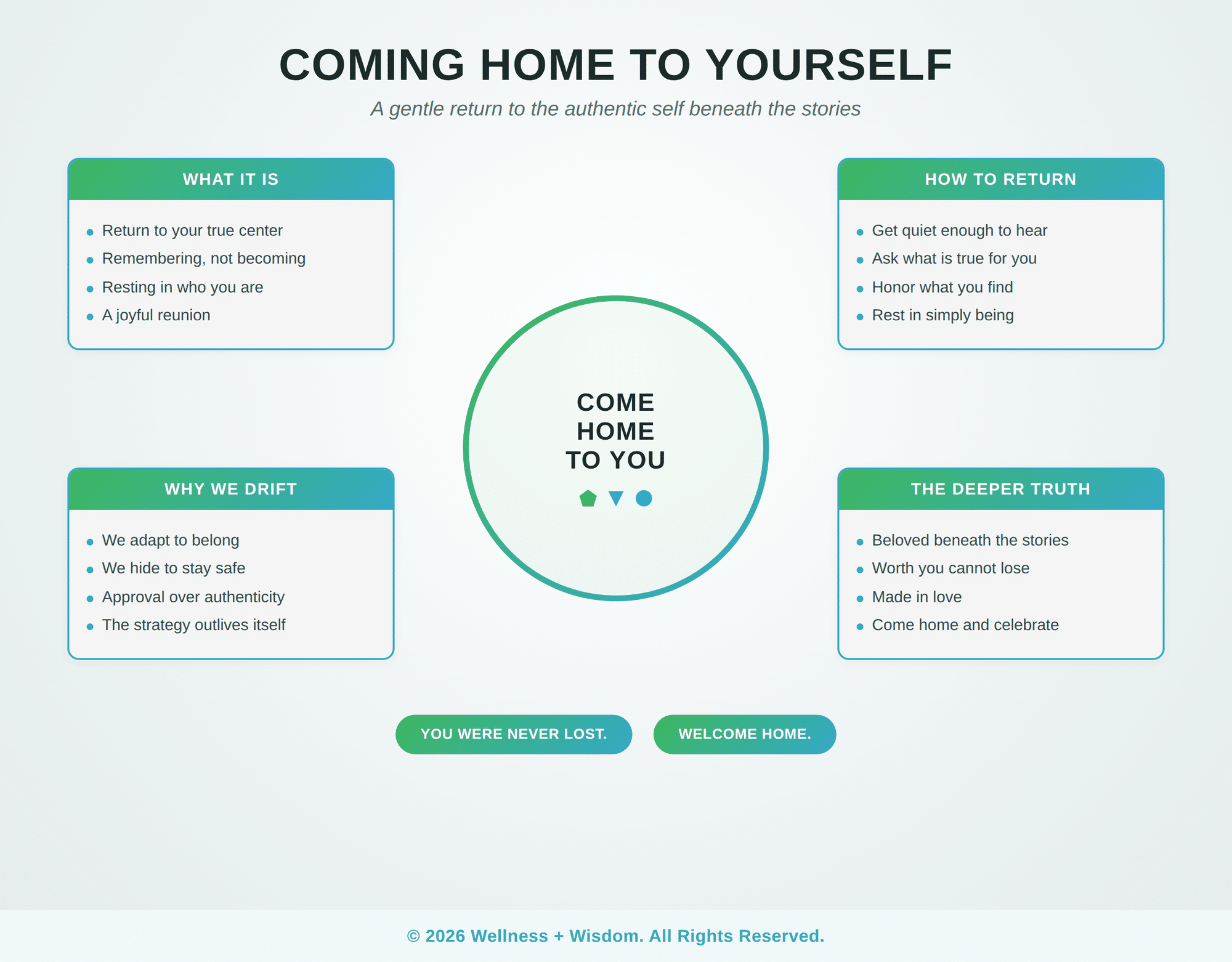
To come home to yourself means to reconnect with your authentic self, the deepest truth of who you are, after time spent living from the surface of expectations and roles. It is a return to your own center, a felt reunion with the self that knows what you value, what you feel, and what is true for you beneath every borrowed opinion. Coming home is not about becoming someone new but about remembering someone you have always been. The self you are returning to never went anywhere. It simply waited beneath the noise.
This homecoming has a distinct quality of relief and rightness. Where living far from yourself feels effortful, like wearing a costume that never quite fits, coming home feels like exhaling into your own skin. You stop performing and start simply being. The exhaustion of maintaining a self that was never quite you begins to fall away. There is a settledness to it, a sense that you no longer have to prove or pretend, because you are finally resting in who you actually are. That rest is the whole reward.
Coming home to yourself is also a deeply celebratory act. It is not a grim excavation of what is wrong, but a joyful rediscovery of what is real and beautiful in you. As you return, you get to delight in the authentic self you find, honoring the one who was waiting for you all along without a trace of resentment. This is exactly why we hold this whole journey as a joyful homecoming to be celebrated rather than a problem to be solved, a theme we return to often on the Wellness + Wisdom Podcast.
Why We Drift Away From Ourselves
We drift away from ourselves gradually and understandably, usually in the very human effort to belong, to be loved, and to stay safe. As children, we learn quickly which parts of us are welcomed and which are not, and we quietly adapt, tucking away the pieces that seemed too much or somehow not enough. Over time, these small adaptations accumulate into a whole way of living that can carry us far from our true center without our ever noticing the drift.
This drifting is not a failure but a survival strategy, one that often served us genuinely well when we were young and utterly dependent on the approval of others. We shaped ourselves to fit our families, our cultures, and our circumstances, learning early to prioritize acceptance over authenticity because our young survival depended on it. The trouble is that the strategy outlives its usefulness, and one day we may look up and realize we have been living someone else's version of our life, as we explore in our work on authentic identity.
Understanding this with compassion is essential, because it means the distance from yourself was never a moral flaw. You did what you needed to do to move through the world safely, and the parts of you that went quiet did not disappear at all, they simply waited patiently for a safer day. The good news is that what was adapted can be gently and patiently unwound, and the authentic self that seemed lost is always quietly available to be found again, which is the heart of true liberation.
The Homes We Try to Find in Others
Before we learn to come home to ourselves, most of us spend years trying to find home somewhere out in the world, in other people, in achievement, in approval. It is a deeply human search, and an entirely understandable one, but these external homes can never fully hold us, because they depend on things outside our control.
We look for home in our relationships, quietly hoping that another person will finally make us feel whole and safe. We look for it in success, believing the next achievement will let us rest at last. We look for it in the approval of others, shaping ourselves to earn a belonging that always feels one step away. Each of these searches carries a real grain of beauty, and none of them is wrong to want, yet each also leaves us subtly homeless, because we are seeking outside ourselves for something that can only ever be found within, a pattern we explore in our work on people pleasing.
This does not mean relationships and accomplishments do not matter, because they profoundly do. It simply means they were never designed to be the foundation of our belonging. When we come home to ourselves first, we can enjoy our relationships and achievements as beautiful additions to a life already grounded, rather than as desperate attempts to fill an aching inner void. The home within makes every outer connection healthier, freer, and far less burdened by need.
There is real relief in discovering this. You can stop chasing a sense of home in things that keep slipping through your fingers and turn instead to the one home that is always available and never locked, your own authentic self. When you find home there, the constant searching quiets, and you can meet others from wholeness rather than need, which transforms your relationships from the inside out.
The Feeling of Coming Home
The feeling of coming home to yourself is unmistakable once you have tasted it, a felt sense of rightness, ease, and quiet joy that arises in the body as much as the mind. Where living far from yourself carries a subtle, constant tension, a background hum of effort and performance, coming home brings a softening, a settling, and a sense of finally arriving where you have always belonged.
You might notice it as a deep exhale, a loosening in the chest, a feeling of spaciousness and rest that you did not know you had been missing. Decisions become clearer, because you are consulting your own truth rather than everyone else's expectations. Life stops feeling like a series of anxious guesses and starts feeling like an honest expression. Life feels less like an exhausting performance for an invisible audience and more like an honest, unforced expression of who you truly are. There is a real groundedness to being home in yourself, a felt sense that you are standing on solid inner ground rather than constantly shifting to please the room.
This felt quality matters, because coming home is not merely an idea to understand but an experience to inhabit. You can think about your authentic self endlessly and still feel far from home, which is why the practices that follow are so gentle and embodied. They are designed to help you feel your way back gently, to let your body and being actually settle into the homecoming, supported by the kind of neural system regulation that helps you feel safe enough to arrive.
How to Come Home to Yourself
Coming home to yourself is a practice you can begin today, gently and without force, one small return at a time. The path is not about dramatic reinvention but about repeatedly turning toward your own truth and letting yourself rest there. Here are ways to begin the journey home.
1. Get Quiet Enough to Hear Yourself
Your authentic self tends to speak softly, often drowned out by noise, hurry, and the opinions of everyone around you. Create small moments of stillness, through breath, prayer, or simply pausing between tasks, so you can actually hear your own inner voice again beneath the din of daily life.
2. Ask What Is True for You
Gently practice asking what you actually feel, want, and value, apart from what others expect. These honest questions gently turn your attention inward and begin reconnecting you with your own center, which is the essence of feeling your truth safely.
3. Honor What You Find
As your authentic self begins to speak, practice honoring it rather than overriding it. Taking your own feelings and needs seriously, even in the smallest ways, tells your deepest self that it is finally safe to come home and be seen.
4. Reparent the Parts That Went Quiet
Meet the tender parts of you that once had to hide away with real warmth and open welcome. Offering yourself the acceptance you may have longed for is a profound act of homecoming, and the heart of reparenting yourself.
5. Let Yourself Rest in Being
Coming home ultimately means learning to simply be, without the constant doing or proving that once felt mandatory. Practice resting in your own presence, letting yourself simply exist without justification or apology. This is where the deepest homecoming of all lives, in the quiet, unhurried permission to just be you.
Begin with whatever practice calls to you, and be patient and kind with the process. Coming home to yourself is a gentle, lifelong journey, and every small return deepens your felt sense of belonging in your own life and your own skin. When you want support and community for this journey, the Liberated Life Tribe is here for you.
Staying Home: Making It a Practice
Coming home to yourself is not a single arrival but a practice of returning, again and again, throughout your life. We do not come home just once and stay forever. We drift and return, drift and return, and the real skill is learning to notice sooner when we have wandered and to gently find our way back. Homecoming is a rhythm, not a destination.
This is actually freeing, because it takes the pressure off getting it perfect. You will lose touch with yourself sometimes, pulled away by stress, busyness, or old patterns, and that is completely human and nothing to be ashamed of. What matters is not that you never leave, which no one manages, but that you learn to return more quickly and more kindly each time. Every single return strengthens the path home, wearing it smoother and making it easier to find your way back the next time you wander.
Small daily practices keep the way home clear. A few quiet breaths, a moment of honest self check in, a gentle pause to ask what is true for you right now, all of these are small but real acts of returning home. Woven quietly through your day, they keep you connected to your center even amid the noise and demands of ordinary life, which is why a grounded morning routine and simple breathwork are such faithful companions on this path.
Over time, with practice, staying home becomes far more natural than wandering ever was. The authentic self that once felt hard to reach becomes your familiar ground, the place you actually live from rather than a place you only occasionally manage to visit. This is the fruit of the practice, a life increasingly lived from your own center, and it is one of the most quietly joyful transformations there is. You gradually become someone who is at home in themselves wherever they happen to go, needing no particular circumstance to feel whole.
Coming Home to Yourself as a Spiritual Return
At its deepest level, coming home to yourself is a spiritual return, a remembering of your inherent belovedness and worth. Beneath all the layers of conditioning and adaptation lies not a flaw to be fixed but a beloved self, whole and worthy, waiting patiently to be welcomed home with open arms. This is the sacred dimension of the journey, and for many people it turns out to be the most moving part of all.
Spiritually, coming home means reconnecting with your Connection to Creator and God, remembering that you were made with love and carry inherent value that no wandering could ever erase. The parts of you that felt unworthy or unwelcome were never the truth of you at all. They were only ever the wounds and stories laid over a self that was always held in love. Coming home is simply remembering that deeper truth again.
This spiritual homecoming brings a profound and steady peace, because it rests your worth on something entirely unshakeable. When you know yourself as beloved at the deepest level, you no longer have to earn your place in the world through performance or striving. You can simply come home to the truth of who you are and rest there, celebrating the sacred self you find. This is the ground of genuine spiritual wellness, and it changes how you meet every part of life.
The Science of Feeling at Home in Yourself
The science of the mind and body offers real support for what coming home to yourself feels like and why it matters so much. When we live far from ourselves, in chronic performance and self monitoring, the body often carries a low grade tension. The researcher Bruce McEwen described in the New England Journal of Medicine how ongoing stress produces allostatic load, the cumulative wear of a system that never fully settles.
Coming home to yourself is, in part, a settling of that system. Research by Matthew Lieberman and colleagues, published in Psychological Science, found that simply naming our inner experience reduces activity in the brain's alarm center. Turning toward and honoring our own truth, rather than suppressing it, helps the body move out of a state of subtle threat and into one of safety and ease, which is a deeply felt part of what coming home actually means.
There is an uplifting dimension too. Barbara Fredrickson's research, published in American Psychologist, shows that positive emotions broaden our awareness and build lasting inner resources. The joy and relief of coming home to yourself are not just pleasant feelings but genuine builders of resilience and wellbeing that quietly strengthen you over time. Homecoming, in other words, is genuinely good for you, body and soul, supporting the whole person balance of the Wellness Pentagon™.
Celebrating the Self You Come Home To
The final and most beautiful movement of coming home is celebration, delighting in the authentic self you have returned to rather than immediately trying to improve it. So often we treat homecoming as the start of yet another self improvement project, but the deeper invitation is simply to celebrate who you find waiting there. The one who was patiently waiting deserves to be welcomed home with joy rather than a critique.
Celebrating the self you come home to means honoring your quirks, your gifts, your unique way of seeing the world, and your simple, irreplaceable existence. It means looking at the authentic you with warmth and delight rather than critique or a list of things to fix. This celebration is not arrogance in the slightest but reverence, a joyful recognition of the beloved self that was here all along, wholly worthy of being cherished exactly as it is.
And here is the beautiful ripple. When you come home to yourself and celebrate who you really are, you quietly give everyone around you permission to do the same. Your visible peace and quiet joy in being yourself becomes a living invitation to everyone around you to stop performing and come home too. In this quiet way, your homecoming becomes a gift that extends far beyond you, into every relationship and community you touch, which is the deep purpose behind everything we do in the Liberated Life Tribe and our latest episodes.
Frequently Asked Questions
What does coming home to yourself mean?
Coming home to yourself means reconnecting with your authentic self, the deepest truth of who you are, after time spent living from expectations and roles. It is a return to your own center, a felt reunion with the self that knows what you value and what is true for you. It is not about becoming someone new but remembering someone you have always been.
Why do we lose touch with our true selves?
We drift away gradually, usually in the human effort to belong and stay safe. As children we learn which parts of us are welcomed, and we quietly adapt, tucking away pieces that seemed too much or not enough. These adaptations were survival strategies that served us, but they can carry us far from our center until we are living someone else's version of our life.
What does coming home to yourself feel like?
It feels like a deep exhale, a softening and settling in the body, and a sense of finally arriving where you belong. Decisions become clearer because you consult your own truth, and life feels less like a performance and more like honest expression. There is a groundedness to it, a sense of standing on solid inner ground.
How do I start coming home to myself?
Begin by getting quiet enough to hear your own inner voice, then gently ask what you actually feel, want, and value apart from others' expectations. Honor what you find, meet the tender parts of you that went quiet with warmth, and practice simply resting in your own presence without needing to prove anything.
Is coming home to yourself a spiritual experience?
For many it is. At its deepest, coming home is a remembering of your inherent belovedness and worth, a reconnection with your Connection to Creator and God. It rests your worth on something entirely unshakeable, so you no longer have to earn your place through performance. You can simply come home to the truth of who you are and rest there.
Is there science behind feeling at home in yourself?
Yes. Research on allostatic load shows how living in chronic performance keeps the body tense, while naming and honoring our truth, as Lieberman's work shows, calms the brain's alarm center. Fredrickson's research shows the joy and relief of homecoming build lasting inner resources. Coming home is genuinely good for body and soul.
Studies and External Resources
The science in this article rests on peer reviewed research. These are the sources referenced throughout.
- McEwen BS. (1998). Protective and damaging effects of stress mediators. New England Journal of Medicine. PubMed: 9428819
- Lieberman MD, et al. (2007). Putting Feelings Into Words: Affect Labeling Disrupts Amygdala Activity in Response to Affective Stimuli. Psychological Science. PubMed: 17576282
- Fredrickson BL. (2001). The role of positive emotions in positive psychology. The broaden-and-build theory of positive emotions. American Psychologist. PubMed: 11315248
About Josh Trent
Josh Trent is an Identity Transformation Architect and the award winning host of the Wellness + Wisdom Podcast, with over 15 million downloads since 2015. He is the creator of the L.I.F.E. Method™ Identity Transformation System and steward of the Emotional Epigenetics™ and BREATHE: Breath + Wellness™ systems of self mastery, impacting over 1,000 students worldwide. Join the Liberated Life Tribe and receive your 10 day Self Liberation Blueprint at liberatedlife.com. Josh lives in Austin, Texas with his wife Carrie, daughter Nayah, and son Novah. Peace and power.
Disclosure: We may earn a commission from certain links on this site when you make a purchase, at no extra cost to you. These commissions help support Wellness + Wisdom and do not affect the products or resources we choose to recommend. Full disclosure .