
By Josh Trent | Wellness + Wisdom Podcast Host & Identity Transformation Architect
“Freedom is not a thought you think. It is a feeling you finally let yourself have in the body, the moment the bracing stops and you can breathe all the way down.”
Josh Trent
Liberation embodiment is the experience of freedom lived not as an idea in your head but as a felt reality in your body. We often talk about liberation as a concept, something we understand or aspire to. But real liberation is something you feel, a physical loosening, an inner spaciousness, a settling of the whole system that has been braced against life for far too long. When freedom becomes embodied, it stops being a philosophy and becomes the way you actually walk through the world. You feel it in how you stand, how you breathe, and how you meet the people and moments of your day. This is the heart of the L.I.F.E. Method™ and everything we teach about lasting transformation.
Here is the joy forward invitation. Liberation is not something you have to earn through years of struggle, nor is it a distant reward for getting everything right. It is your natural state, waiting underneath the tension and the old patterns, ready to be felt the moment you create the safety to feel it. You are not building freedom from nothing. You are uncovering something that was always there beneath the armor. This article explores what liberation actually feels like in the body, why freedom is a felt experience, and the practices that help you embody it more and more.
Table of Contents
- What Liberation Actually Feels Like in the Body
- Why Freedom Is a Felt Experience, Not Just an Idea
- Why We Sometimes Fear Our Own Freedom
- How the Body Holds Our Invisible Cages
- Liberation Embodiment and the L.I.F.E. Method
- The Science of Release
- Liberation Is Not the Same as Escape
- Signs You Are Becoming Free
- Practices to Feel Liberation in the Body
- Frequently Asked Questions
- Studies and External Resources
- About Josh Trent
What Liberation Actually Feels Like in the Body
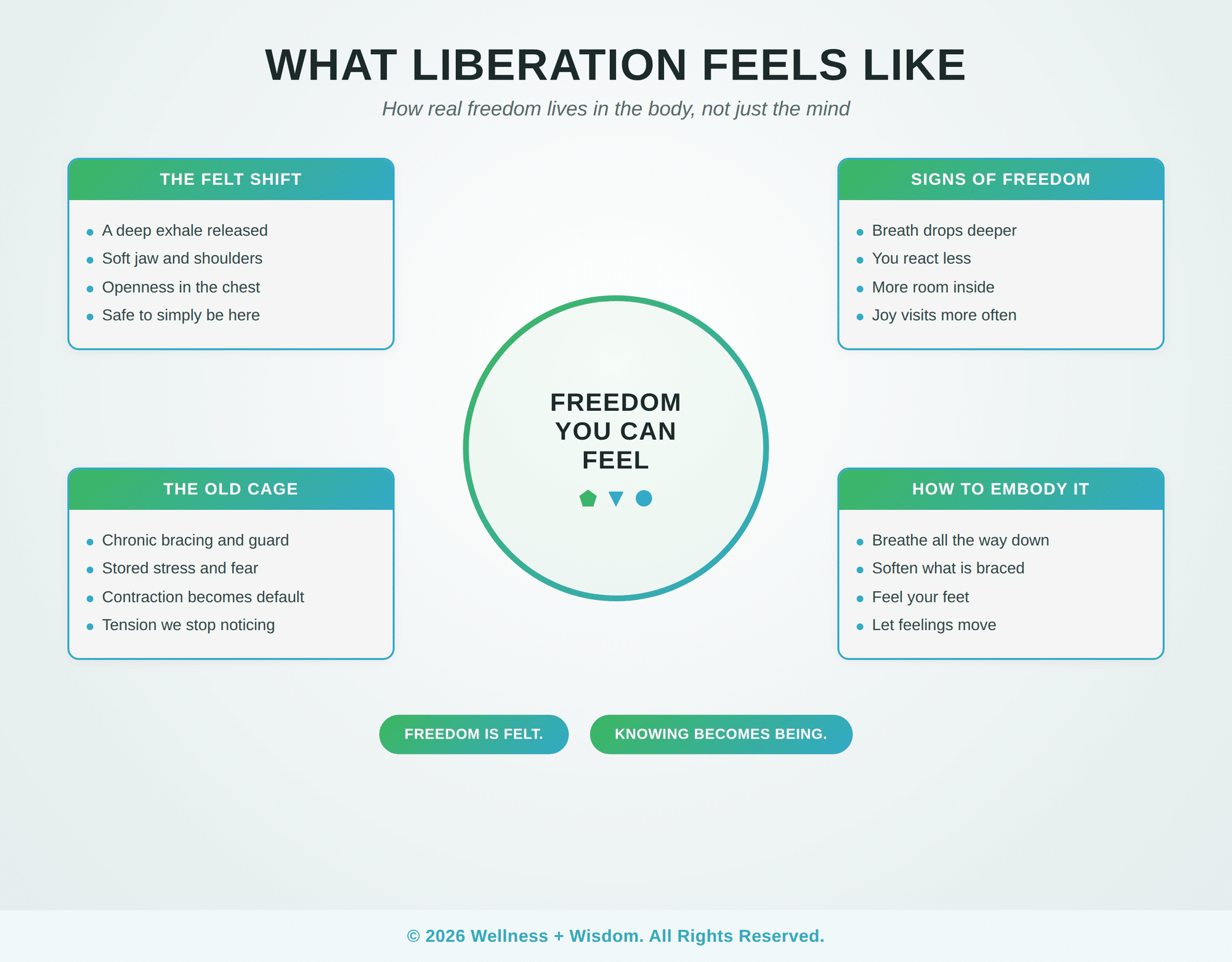
Liberation in the body feels like a deep exhale you did not know you were holding. It is a softening of the jaw, a dropping of the shoulders, a warmth and openness in the chest where there was once a tight guard. Where survival feels like clenching, contracting, and bracing, liberation feels like expansion, ease, and a quiet sense that it is safe to simply be here now.
Many people are so used to living in low grade tension that they do not even recognize it until it releases. Then, often for the first time in years, they feel what it is like to let the belly soften, to breathe all the way down, to feel their feet on the ground without urgency. That felt shift, from armored to open, is what liberation actually is at the level of the body. It is not something you accomplish through force but something you allow through safety. It is not dramatic. It is a homecoming. And like any homecoming, it can bring tears, not of sadness but of relief, as the body finally lets down a guard it has carried for far too long.
This is why we speak of liberation embodiment rather than just liberation as an idea. You can understand freedom perfectly and still live in a braced, contracted body. True liberation is when the understanding drops out of the head and into the body, when your system itself relaxes into a felt sense of safety and openness. That is the freedom worth seeking, and it is available to you, a truth we return to often on the Wellness + Wisdom Podcast. No amount of external change can substitute for it, because a person can rearrange their entire life and still carry the same braced body into the new one.
Why Freedom Is a Felt Experience, Not Just an Idea
Freedom is ultimately a felt experience because your body, not your intellect, is where your sense of safety and threat actually lives. You can decide intellectually that you are safe and still feel anxious, because the body holds its own memory and its own truth. This is why insight alone so often fails to free us. We can understand exactly why we are the way we are and still feel trapped, because understanding lives in the mind while liberation lives in the body.
Think of how often you have known better and still felt stuck. You knew a fear was irrational, yet your chest still tightened. You knew you were worthy, yet your body still braced for rejection. That gap between what you know and what you feel is precisely the gap that embodiment closes. It is one of the most common sources of quiet suffering, the felt distance between the freedom we understand and the freedom we actually live. Real freedom is not just changing your mind. It is changing what your body expects and how it holds itself in the world. The body learns through experience and repetition, not through argument, which is why lasting freedom is grown patiently rather than decided in an instant.
This is genuinely good news, because it means liberation is not just a matter of thinking positively or trying harder to believe you are free. It is a matter of gently teaching your body a new felt reality through experience, breath, and safety. That is a far more reliable path than trying to think your way to freedom, and it is the foundation of true embodiment practice.
Why We Sometimes Fear Our Own Freedom
Here is a tender truth that surprises many people: we often fear the very freedom we say we want. Liberation asks us to let go of what is familiar, and even a cage can feel safe when we have lived in it long enough. The contracted, guarded way of being may be uncomfortable, but it is known, and the unknown of true openness can feel strangely threatening to a system built around protection.
For some of us, our very identity has become entangled with our struggle. We have worn our tension, our vigilance, or our story of hardship for so long that we are not sure who we would be without it. Freedom can feel like a kind of loss, as if letting go of the bracing means letting go of ourselves. Some part of us quietly wonders who we will be on the other side of the struggle we have known so long. This is a normal and human fear, and naming it gently is the first step in moving through it.
There is also the simple fact that feeling more can be frightening when we have spent years feeling less. Liberation opens us to the full range of life, including the tender and vulnerable places we armored ourselves against. The body may resist opening precisely because opening once felt unsafe. Meeting that resistance with patience and compassion, rather than force, is how it slowly softens. Nothing about liberation asks you to override your body. It asks you to earn its trust.
Understanding this fear is deeply freeing in itself, because it means your hesitation is not a failure but a form of protection that once made sense. You do not have to fight your way to freedom. You can invite your body into it gently, proving to it through small, safe experiences that openness will not destroy you. That patient, compassionate approach is the essence of true reparenting yourself.
How the Body Holds Our Invisible Cages
Before liberation can be felt, it helps to understand how the body comes to hold our invisible cages in the first place. When we live through chronic stress, fear, or old trauma, the body adapts by staying subtly braced and guarded, ready to protect us. Over time, that protective bracing becomes our default, a cage of tension we no longer even notice we are carrying.
The researcher Bruce McEwen described in the New England Journal of Medicine how chronic stress produces allostatic load, the cumulative wear that builds when the body's alarm never fully switches off. A body carrying years of unresolved stress and unfelt emotion lives in a state of quiet, ongoing contraction. This is the physical shape of feeling trapped, and it is why so many people carry tension they cannot explain. The cage is invisible precisely because we have lived inside it so long that it feels like simply who we are.
The beautiful implication is that liberation, in part, means helping the body finally lay down its armor. As the old stress and stored emotion move through and release, the body can return to its natural state of ease and openness. The cage was never entirely the world outside. It was also the bracing within, and that bracing can soften, which is exactly what we support through neural system regulation and breath.
Liberation Embodiment and the L.I.F.E. Method
Liberation embodiment lives at the very heart of the L.I.F.E. Method™, our system for identity transformation built on four pillars: Liberation, Integration, Frequency, and Embodiment. Notice that liberation and embodiment are two of the four pillars, and this article sits precisely where they meet.
Liberation is the freeing of your energy and identity from the old patterns, beliefs, and inherited burdens that have kept you contracted. Embodiment is the practice of bringing that freedom all the way into the body, so it becomes a lived, felt reality rather than a fleeting insight. Together, they ensure that transformation is not just something you think about but something you actually inhabit and live from. Frequency and Integration surround this work, raising your inner state and weaving your fragmented parts back into wholeness.
This is why we insist that real transformation must be embodied. An insight that stays in the head changes very little, but a shift that lands in the body changes everything, including how you carry yourself, how you relate, and how you meet your Connection to Creator and God. Liberation embodiment is the point where knowing becomes being, and that is where lasting change lives. Explore this deeper through our programs and the practice of surrender.
The Science of Release
The science of emotional release supports what contemplatives have always known, that letting go has real, measurable effects on the body. Research by James Pennebaker and colleagues, published in the Journal of Consulting and Clinical Psychology, found that expressing and processing difficult experiences was associated with measurable benefits, including improvements related to immune function. When we finally release what we have been holding, the body responds in kind, easing out of the tension it had been carrying.
There is also the power of naming what we feel. Research by Matthew Lieberman and colleagues, published in Psychological Science, found that putting feelings into words reduced activity in the amygdala, the brain's alarm center. Part of how liberation becomes embodied is through this gentle turning toward and naming of what has been stored, which helps the body settle out of its old state of threat and into ease.
Taken together, this research points to something hopeful. The freedom we seek is not only a spiritual or psychological event but a physiological one. As we process and release what we have carried, and as we teach the body a new felt sense of safety, our biology itself shifts toward openness and calm. Liberation is written in the body, and the body can learn it, which is the deep promise behind learning to feel safely. What was stored can be released, and what was braced can soften, given enough safety and time.
Liberation Is Not the Same as Escape
It is important to distinguish true liberation from its convincing imitation, escape. Escape is the attempt to get away from what we feel, through distraction, numbing, or spiritual bypassing that floats above the body rather than settling into it. It can look like freedom, but it is really just another form of avoidance, and it leaves the underlying cage fully intact.
Real liberation, by contrast, moves toward what we feel rather than away from it. It does not rise above the body but drops more deeply into it. Where escape says get me out of here, embodied freedom says it is safe to be fully here now. One runs from the present moment, the other finally arrives in it. This is why the freest people are not those who have detached from their feelings, but those who can be present with all of them without being overwhelmed.
This distinction matters enormously on the spiritual path, because so much that is marketed as freedom is actually a sophisticated escape. Chasing constant bliss, using practice to avoid difficult emotions, or treating the body as something to transcend are all subtle forms of running away. We explore this trap directly in our work on spiritual bypassing, because grounded freedom is so much more real than any spiritual escape.
True liberation embodiment is not about leaving your humanity behind but about inhabiting it more fully and freely. It is the freedom to feel, to be present, to meet life as it is with an open heart and a settled body. That embodied presence is far more liberating than any attempt to escape, and it is the freedom that actually lasts, deepening your sense of authentic identity rather than dissolving it. You do not have to leave your life to be free. You get to become free within it.
Signs You Are Becoming Free
How do you know liberation embodiment is unfolding in you? The signs are felt and subtle, but unmistakable once you learn to notice them. They tend to show up in the body and in the small textures of daily life long before they announce themselves as a dramatic breakthrough.
You might notice that you breathe more deeply and easily, that your shoulders and jaw are softer, that your body feels less braced. You might find that you react less and respond more, that things which once triggered you now have less grip. You might feel a new spaciousness, a sense that there is room inside you, and a growing capacity to simply be present without rushing to fix or escape the moment.
Emotionally, you may find yourself more willing to feel, less afraid of your own inner world, and more able to let feelings move through you without being overwhelmed. You laugh more easily. You rest more deeply, and sleep comes more readily to a body that is no longer standing guard through the night. Joy visits more often and stays a little longer. Small pleasures you used to rush past, the warmth of the sun, a good meal, a real laugh, begin to land more fully, because a freer body is a body that can actually receive them. These are the quiet signs that the cage is opening, that liberation is becoming embodied, and that you are returning to the freedom that was always your nature, a journey we walk together in the Liberated Life Tribe. None of them arrive all at once, and that is exactly as it should be, since the body unlearns its bracing gradually, the same way it learned it. This gentle unfolding is part of what we teach through the Wellness Pentagon.
Practices to Feel Liberation in the Body
Liberation embodiment grows through practice, through gently and repeatedly teaching your body a new felt sense of freedom until it becomes your new normal. Here are practices that help.
1. Breathe All the Way Down
Most of us breathe shallowly and high in the chest, a quiet habit of chronic bracing. Practice slow, full breaths that reach all the way into the belly. This single act signals safety to your neural system and begins to unwind the physical shape of feeling trapped.
2. Soften What Is Braced
Throughout the day, gently scan for tension in your jaw, shoulders, belly, and hands, and consciously soften it. Each small release teaches your body that it is safe to let go, slowly dissolving the armor of chronic contraction.
3. Feel Your Feet on the Ground
Grounding brings you out of the anxious mind and into the present, embodied moment. Simply feeling your feet on the earth, fully and without hurry, is a small but powerful act of embodiment that returns you to the here and now, the only place freedom can actually be felt.
4. Let Feelings Move Through
Liberation requires letting stored emotion finally move. Practice staying present with a feeling, breathing into it, and letting it rise and pass, which releases what the body has been holding. This is the heart of emotional courage.
5. Move and Express
The body loves to move, and movement is a natural way to release and embody freedom. Dance, shake, stretch, or simply move in whatever way feels good, letting your body express the freedom it is learning to feel. Even a few minutes of free movement can shift you from contraction into a felt sense of aliveness.
Choose one practice and begin today. Liberation embodiment is not a destination you arrive at once but a felt freedom you return to again and again, deepening over time. When you want support and community for this journey, the Liberated Life Tribe and our latest episodes are here for you.
Frequently Asked Questions
What is liberation embodiment?
Liberation embodiment is the experience of freedom lived not as an idea in your head but as a felt reality in your body. It is a physical loosening, an inner spaciousness, and a settling of a system that has been braced against life. When freedom becomes embodied, it stops being a philosophy and becomes the way you actually move through the world.
What does freedom actually feel like in the body?
Liberation feels like a deep exhale you did not know you were holding, a softening of the jaw, a dropping of the shoulders, and warmth and openness in the chest. Where survival feels like clenching and bracing, liberation feels like expansion, ease, and a quiet sense that it is safe to simply be here now. It is less dramatic than a homecoming.
Why is insight alone not enough to feel free?
Because your body, not your intellect, is where your sense of safety and threat lives. You can understand exactly why you are the way you are and still feel trapped, because understanding lives in the mind while liberation lives in the body. Real freedom is not just changing your mind but changing what your body expects and how it holds itself.
How does liberation connect to the L.I.F.E. Method?
Liberation and Embodiment are two of the four pillars of the L.I.F.E. Method™, alongside Integration and Frequency. Liberation frees your energy and identity from old patterns, while Embodiment brings that freedom all the way into the body as a lived reality. Together they ensure transformation is something you inhabit, not just think about.
Is there science behind emotional release and freedom?
Yes. Research by Pennebaker found that expressing and processing difficult experiences was associated with measurable benefits, including immune function. Research by Lieberman found that naming feelings reduces activity in the brain's alarm center. As we release what we carry and teach the body safety, our physiology itself shifts toward openness and calm.
How do I start embodying more freedom?
Begin with the breath, taking slow full breaths that reach the belly. Gently soften tension in your jaw, shoulders, and hands throughout the day. Feel your feet on the ground to return to the present, let feelings move through rather than bottling them, and use movement to release and express. Freedom is embodied through small, repeated practice.
Studies and External Resources
The science in this article rests on peer reviewed research. These are the sources referenced throughout.
- Pennebaker JW, Kiecolt-Glaser JK, Glaser R. (1988). Disclosure of traumas and immune function: health implications for psychotherapy. Journal of Consulting and Clinical Psychology. PubMed: 3372832
- Lieberman MD, et al. (2007). Putting Feelings Into Words: Affect Labeling Disrupts Amygdala Activity in Response to Affective Stimuli. Psychological Science. PubMed: 17576282
- McEwen BS. (1998). Protective and damaging effects of stress mediators. New England Journal of Medicine. PubMed: 9428819
About Josh Trent
Josh Trent is an Identity Transformation Architect and the award winning host of the Wellness + Wisdom Podcast, with over 15 million downloads since 2015. He is the creator of the L.I.F.E. Method™ Identity Transformation System and steward of the Emotional Epigenetics™ and BREATHE: Breath + Wellness™ systems of self mastery, impacting over 1,000 students worldwide. Join the Liberated Life Tribe and receive your 10 day Self Liberation Blueprint at liberatedlife.com. Josh lives in Austin, Texas with his wife Carrie, daughter Nayah, and son Novah.
Disclosure: We may earn a commission from certain links on this site when you make a purchase, at no extra cost to you. These commissions help support Wellness + Wisdom and do not affect the products or resources we choose to recommend. Full disclosure .