
By Josh Trent | Wellness + Wisdom Podcast Host & Identity Transformation Architect
“Your mind is a beautiful tool, but it makes a cruel master. When you learn to step out of the endless loop of thought and back into the present, you reclaim the peace that was always underneath the noise.”
Josh Trent
Learning how to stop overthinking is one of the most freeing shifts you can make, because the endless loops of worry and analysis drain your energy and steal your peace. So many of us live trapped inside our own busy heads, endlessly replaying conversations, rehearsing worst case scenarios, and analyzing every single decision until we are exhausted and no closer to any real clarity. Learning to stop overthinking gently frees you from all that mental churn, teaching you to quiet the noise, return to the present moment, and genuinely trust yourself again. This liberating shift lives at the heart of the L.I.F.E. Method™.
Here is the joy forward truth at the center of it all. Overthinking is truly not a permanent part of who you are, it is simply a mental habit you can gently change with awareness and steady practice. When you learn to step out of the endless loops of thought and back into the present moment, you reclaim the peace, clarity, and energy that overthinking quietly consumes. When you learn how to stop overthinking, you come home to a quieter, calmer, and far more peaceful mind. Let us explore exactly how.
Table of Contents
- What Overthinking Really Is
- The Real Cost of Overthinking
- Why We Overthink
- The Science of Overthinking
- How to Stop Overthinking
- Overthinking Versus Healthy Reflection
- Quieting the Mind and the L.I.F.E. Method
- Celebrating a Quieter Mind
- When Overthinking Feels Relentless
- Quieting the Mind Is a Lifelong Practice
- Frequently Asked Questions
- Studies and External Resources
- About Josh Trent
What Overthinking Really Is
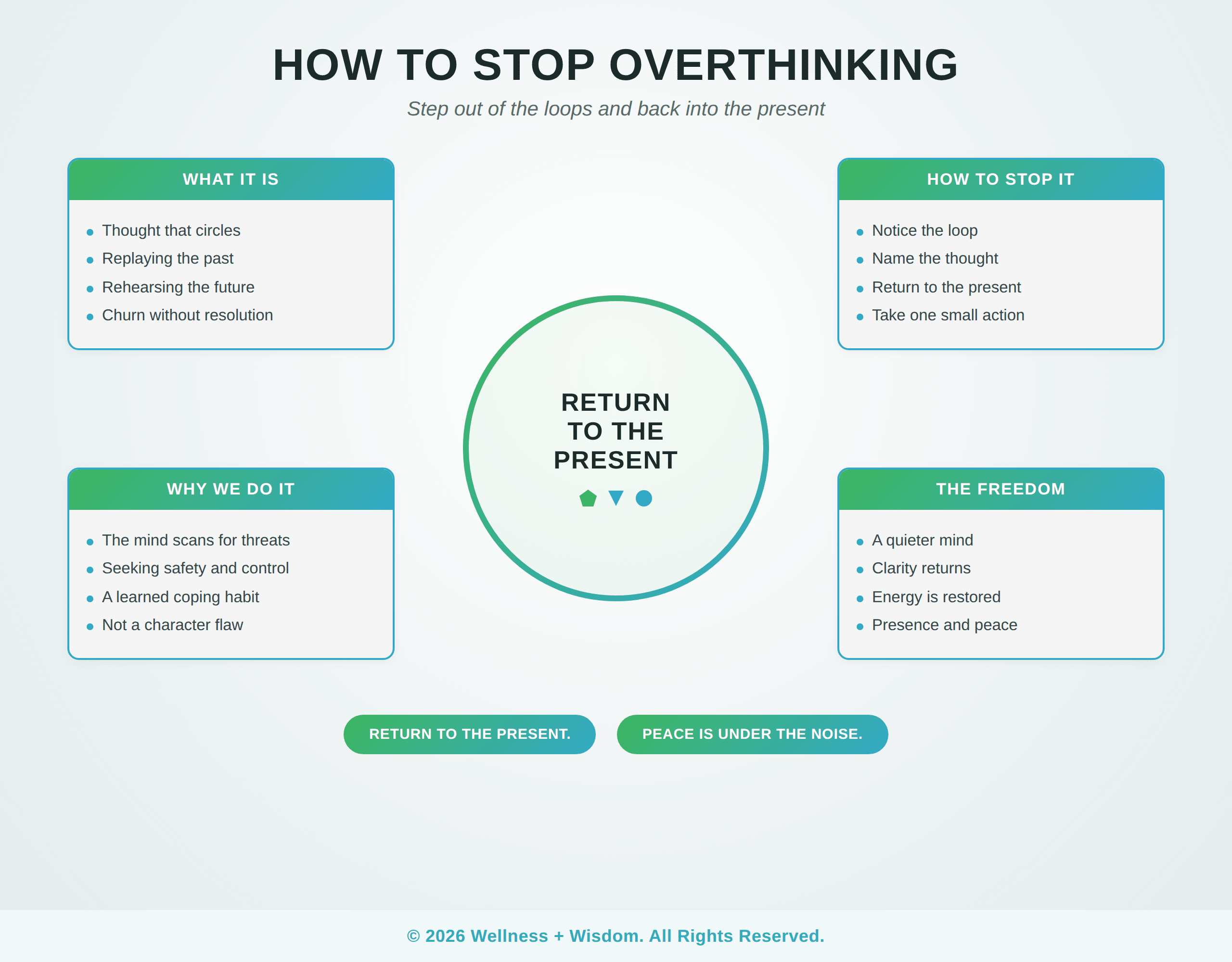
Overthinking is the habit of dwelling excessively on thoughts, worries, or decisions in a way that creates real distress rather than clarity or genuine resolution. It is the mind caught in repetitive, exhausting loops, replaying the past, worrying about the future, or analyzing something long past the point of any usefulness. Overthinking is simply thought that circles endlessly in place rather than ever moving forward.
This is genuinely different from healthy, useful thinking, which actually helps you to understand, plan, and solve real problems in your life. Overthinking tends to spin in tight circles without ever reaching any resolution, generating anxiety and exhaustion rather than genuine insight or clarity. It feels productive, as if all that mental effort simply must be accomplishing something important, but it usually leaves you far more stuck and depleted than when you first began.
Overthinking often takes two main forms, ruminating on the past, where you replay old events and mistakes, and worrying about the future, where you rehearse everything that could possibly go wrong. Both of these common forms pull you out of the present moment and into an anxious mental world of distress and worry. Learning to recognize the moment when your thinking has crossed from helpful into harmful is the very beginning of freedom, a theme we return to often on the Wellness + Wisdom Podcast.
The Real Cost of Overthinking
Recognizing the real cost of overthinking is a genuinely important part of learning to release it, because overthinking quietly takes far more from us than we ever realize. What feels like careful, responsible thinking so often drains our energy, steals our peace, and keeps us stuck, all while creating the convincing illusion that we are making real progress. Seeing this truth clearly helps loosen overthinking's tight grip on us.
Overthinking constantly costs us our presence, pulling us out of the only moment where life actually happens and into an imagined mental world of past and future. While we are lost in loops of worry and analysis, we quietly miss the conversation right in front of us, the beauty all around us, and the simple joys of being alive right now. This lost presence is honestly one of overthinking's very quietest and heaviest costs of all.
It also steadily costs us our precious energy and inner peace, since the mind churning endlessly is genuinely exhausting even when the body is completely at rest. Many of us feel deeply and chronically tired not from doing too much but from thinking too much, carrying a constant background hum of worry that quietly depletes us. Overthinking can also worsen our anxiety, disturb our sleep, and make decisions harder rather than easier, the very opposite of what it quietly promises us.
Perhaps most importantly of all, overthinking very rarely delivers the safety or clarity it seems to offer, since most of our worries never come to pass and most decisions are not improved by endless analysis. Recognizing clearly that overthinking is quietly costing you far more than it ever gives is genuinely motivating, because it helps you choose presence and trust over the exhausting churn, supporting the kind of neural system regulation that lets you feel calm.
Why We Overthink
We overthink because our minds evolved to scan for problems and threats, and in the modern world that same ancient instinct often turns inward, endlessly analyzing and worrying in search of safety and control. Overthinking is very often an attempt to feel fully prepared, to avoid all possible mistakes, or to control outcomes that are ultimately far beyond our control. The mind quietly believes that if it just thinks hard enough about everything, it can somehow protect us from harm.
On top of all this, many of us learned to overthink very early in life, perhaps in environments where we had to anticipate others' moods, avoid every mistake, or stay hypervigilant just to feel safe. This one mental pattern gradually became a deeply worn habit that follows us right into adulthood, running automatically even when it no longer serves us at all. Understanding that overthinking was simply learned, and often began as an understandable way to cope with life, rather than being the truth of who you are, replaces self judgment with real compassion, which is where real change begins, much like the gentle work of reparenting yourself.
Seeing clearly why we overthink is genuinely freeing, because it means your overthinking is not a character flaw at all but simply a habit of a mind trying to keep you safe. The whole pattern was simply learned, often for very understandable reasons, and like any learned pattern, it can be gently changed over time. You can honor the part of you that once learned to overthink simply in order to feel safe while gently teaching yourself new, calmer ways of relating to your own thoughts, which is deeply connected to neural system regulation.
The Science of Overthinking
The science of the mind offers real support for learning to quiet overthinking. Research by Matthew Lieberman and colleagues, published in Psychological Science, found that putting feelings into words reduces activity in the brain's alarm center. When you gently name out loud what you are feeling or worrying about, rather than letting it spin unspoken beneath the surface, you help calm the very circuits that fuel overthinking, which supports genuine neural system regulation.
Chronic, constant mental churning also takes a very real toll on us. Bruce McEwen described in the New England Journal of Medicine how ongoing stress produces allostatic load, the cumulative wear on a body whose alarm never fully rests. Constant, ongoing overthinking keeps the stress response switched on around the clock, while learning to quiet the mind finally gives your system the recovery it genuinely needs to restore itself.
There is an uplifting dimension too. Barbara Fredrickson's research, published in American Psychologist, shows that positive emotions broaden our awareness and build lasting personal resources over time, while anxious rumination only narrows our focus and quietly depletes us. When you step out of overthinking and into genuine calm and presence, you widen your whole perspective and access far more creativity, clarity, and joy. Quieting the mind, in this very real sense, gently opens you back up to life, and it draws on genuine emotional intelligence.
How to Stop Overthinking
Learning how to stop overthinking is a gentle, gradual practice of noticing your mental loops and returning, again and again, to the present moment. It grows more natural with steady, gentle practice over time, and every single return to presence loosens overthinking's grip a little more. Here are practices that help.
1. Notice When You Are Overthinking
Awareness is always the first step, so gently notice the moment when your mind has slipped into a loop of worry or rumination. Simply catching yourself overthinking, and doing so without judgment, creates the space to choose a different response.
2. Name the Thought
Put your worry or spinning thought into actual words, either silently, out loud, or on paper, since naming genuinely calms the mind. Labeling a thought as simply a thought, and nothing more, helps you step back from it rather than being swept away by it, which pairs beautifully with journaling.
3. Return to the Present Moment
Gently bring your attention back to the present moment through your senses, your breath, or simply what is right in front of you. Overthinking always lives in the past and the future, never here, so returning to the now is a reliable way to quiet it.
4. Use Your Breath and Body
Slow, conscious breathing and gentle movement help settle the restless, jittery energy that fuels overthinking. Coming gently into your own body interrupts the endless mental churn and grounds you firmly in the present moment, which is why breathwork is such a faithful companion to a calmer mind.
5. Take One Small Action
When overthinking keeps you feeling completely stuck, taking even a single small action can break the loop and restore a real sense of momentum. Action gently shifts you from spinning in thought to actually moving forward, which often quiets the mind far more than any amount of extra thinking ever could.
Begin with whatever practice feels most accessible to you and be patient and kind with yourself, since quieting overthinking after years of mental habit genuinely takes time. Every single gentle return to the present loosens overthinking's hold on you a little more. When you want community and support for this journey, the Liberated Life Tribe is here for you.
Overthinking Versus Healthy Reflection
One of the most useful distinctions in learning to quiet your mind is the difference between overthinking and healthy reflection, because thinking itself is not the problem. Healthy reflection helps you understand, learn, and make wise choices, while overthinking only spins in circles and drains you without any resolution.
Healthy reflection is purposeful and steadily moves you toward clarity, understanding, or a decision, and then it comes to a natural, satisfying rest. You consider something honestly, gain real insight or reach a choice, and then you let it go. Overthinking, by contrast, entirely lacks this natural resolution, circling the same thoughts endlessly without ever arriving anywhere, generating anxiety rather than insight and leaving you more stuck than before.
The key difference here is truly not how much you happen to think but whether your thinking is genuinely serving you or not. A helpful sign is to gently ask yourself whether your thinking is genuinely moving you toward understanding and action or simply spinning you in distress. When you notice that you have crossed from reflection into rumination, you can gently redirect yourself back to the present or toward a single small action, honoring your mind's intelligence without being ruled by its loops, which is a beautiful part of your whole self growth journey.
Quieting the Mind and the L.I.F.E. Method
Learning to stop overthinking is a beautiful expression of the Frequency pillar within the L.I.F.E. Method™, our system for identity transformation built on four pillars: Liberation, Integration, Frequency, and Embodiment. Frequency is all about the inner state you actually live in, and overthinking keeps you vibrating in anxiety and mental noise rather than in calm and clarity.
When you quiet overthinking, you raise your whole inner frequency from anxious churning toward peace and presence, which genuinely changes your entire experience of life. Liberation frees you from the old belief that you must think your way to safety, Integration helps you meet your anxious thoughts with real compassion rather than being ruled by them, and Embodiment brings you out of your spinning head and back into your grounded, present body.
This is exactly why we hold quieting the mind as genuine transformation work rather than just a simple relaxation tip. You are not merely calming your thoughts, you are raising your whole way of being toward presence and peace, coming home to yourself as a calm, grounded creation in your Connection to Creator and God. That is a deep and joyful freedom, one that transforms your relationship with your own mind and your whole inner peace.
Celebrating a Quieter Mind
The joyful heart of this whole practice is celebrating the quieter mind you are cultivating, honoring each moment you step out of the loops and back into presence as a real victory worth savoring. When you learn to celebrate your growing calm rather than harshly criticizing yourself for still overthinking at times, the whole journey becomes lighter and far more joyful.
Celebrating a quieter mind means truly recognizing all the small wins, the moment you caught yourself spinning and chose to return to the present, the worry you named and released, the action you took instead of endlessly analyzing. Each of these is genuine progress worth honoring, and acknowledging them reinforces your growing freedom from overthinking, which is a beautiful part of learning to celebrate small wins.
And here is the beautiful part. When you quiet your own mind and reclaim your presence, you become calmer, clearer, and far more available to the people and moments in your life, quietly inspiring others toward their own peace. Your own grounded presence quietly gives those around you permission to slow their own racing minds, showing them that a calmer, gentler way of being in the world is genuinely possible. In this beautiful way, learning how to stop overthinking becomes a gift that ripples far beyond yourself, bringing more calm and presence to every relationship you touch, which is a spirit we cherish in learning to cultivate everyday joy.
When Overthinking Feels Relentless
If overthinking feels relentless right now, you are in very good company, and it is completely understandable, especially during times of stress, uncertainty, or big life decisions. Learning to stop overthinking does not mean your mind instantly goes silent, it simply means you gradually build the ability to step out of the loops more often and return to presence more easily.
When overthinking feels truly overwhelming, it genuinely helps to be especially gentle with yourself and to return to the simplest practices, a few conscious breaths, naming what you feel, or grounding through your senses. You do not have to silence your mind completely at all, you simply keep gently redirecting your attention back to the present moment, again and again, and the loops gradually loosen their hold on you. Meeting your own anxious mind with real, steady compassion, rather than frustration, is itself an important part of the healing.
It is also genuinely worth remembering that if overthinking, anxiety, or intrusive thoughts feel overwhelming or persistent, working with a qualified therapist can offer truly invaluable support. There is real and genuine strength in seeking help, and a skilled professional can offer effective tools for quieting an anxious mind and finding lasting relief over time. Wherever you happen to be, be patient and kind with yourself, honor your own pace, and trust that a calmer, more peaceful mind is truly something you can genuinely cultivate, one gentle return to the present at a time.
Quieting the Mind Is a Lifelong Practice
Learning how to stop overthinking is not a single fix you apply just once, but a lifelong practice of gently returning to presence across all the changing seasons of your life. Your mind will always produce thoughts, so quieting overthinking is far less about silencing your mind and more about gently changing your relationship with it, over and over again. This is genuinely wonderful news, because it means you can always return to calm no matter how loud the mental noise has become in the moment.
This understanding takes the pressure off getting it perfect. You will certainly have days when overthinking takes over, moments when you spin for hours on end, and seasons when the loops feel especially strong, and all of that is completely human. What matters is the gentle returning, the steady practice of noticing the loop and coming back to the present whenever you can.
Understanding quieting the mind as a lifelong, ongoing practice also keeps it compassionate and gentle. Each time you notice you are overthinking again, you have a fresh opportunity to name it, release it, and return to now, and every single return strengthens your capacity for presence. Over time, stepping out of the loops becomes far more natural and more frequent, a steady, quiet rhythm woven through your days.
So approach your own journey here with real patience and warmth toward yourself. There is no finish line, only the ongoing, freeing practice of returning to presence and choosing calm, and celebrating the quieter mind that emerges. This steady practice supports every dimension of your wellbeing and deepens your whole spiritual wellness, growing richer with time.
Frequently Asked Questions
What is overthinking?
Overthinking is the habit of dwelling excessively on thoughts, worries, or decisions in a way that creates distress rather than clarity. It is the mind caught in repetitive loops, replaying the past or worrying about the future long past the point of usefulness. Overthinking is thought that keeps circling rather than moving forward toward resolution.
Why do I overthink everything?
Because our minds evolved to scan for problems, and that instinct often turns inward, endlessly analyzing in search of safety and control. Many of us also learned to overthink early, in environments where hypervigilance felt necessary. Understanding that overthinking was learned as a way to cope, rather than being who you are, opens the way to change.
How do I stop overthinking?
Notice when you are overthinking, name the spinning thought to calm your mind, return your attention to the present moment through your senses, use your breath and body to settle restless energy, and take one small action to break the loop. Start with whatever feels most accessible and be patient, since quieting overthinking takes time and gentle practice.
What is the difference between overthinking and reflection?
Healthy reflection is purposeful and moves toward clarity or a decision, then comes to rest. Overthinking circles the same thoughts endlessly without arriving anywhere, generating anxiety rather than insight. The key is whether your thinking is serving you, moving you toward understanding and action, or simply spinning you in distress.
Is there science behind overthinking?
Yes. Research shows naming your feelings calms the brain's alarm center, and chronic mental churning creates allostatic load that wears on the body. Positive emotion broadens awareness while anxious rumination narrows and depletes us. Quieting the mind gives your system recovery and opens you back up to clarity, creativity, and joy.
What if I can't stop overthinking?
That is understandable, especially during stress or big decisions. Your mind will not instantly go quiet, but you can build the ability to step out of the loops more often. Return to the simplest practices, a few breaths or grounding through your senses. If overthinking or anxiety feels overwhelming, working with a qualified therapist offers invaluable support.
Studies and External Resources
The science in this article rests on peer reviewed research. These are the sources referenced throughout.
- Lieberman MD, et al. (2007). Putting Feelings Into Words: Affect Labeling Disrupts Amygdala Activity in Response to Affective Stimuli. Psychological Science. PubMed: 17576282
- McEwen BS. (1998). Protective and damaging effects of stress mediators. New England Journal of Medicine. PubMed: 9428819
- Fredrickson BL. (2001). The role of positive emotions in positive psychology. The broaden-and-build theory of positive emotions. American Psychologist. PubMed: 11315248
About Josh Trent
Josh Trent is an Identity Transformation Architect and the award winning host of the Wellness + Wisdom Podcast, with over 15 million downloads since 2015. He is the creator of the L.I.F.E. Method™ Identity Transformation System and steward of the Emotional Epigenetics™ and BREATHE: Breath + Wellness™ systems of self mastery, impacting over 1,000 students worldwide. Join the Liberated Life Tribe and receive your 10 day Self Liberation Blueprint at liberatedlife.com. Josh lives in Austin, Texas with his wife Carrie, daughter Nayah, and son Novah. Peace and power.
Disclosure: We may earn a commission from certain links on this site when you make a purchase, at no extra cost to you. These commissions help support Wellness + Wisdom and do not affect the products or resources we choose to recommend. Full disclosure .