
By Josh Trent | Wellness + Wisdom Podcast Host & Identity Transformation Architect
“The page never interrupts, never judges, and never looks away. When you write down what is inside you, you finally get to hear yourself think. That is where healing begins.”
Josh Trent
Journaling brain health is one of the simplest and most powerful practices available to anyone with a pen and a few quiet minutes. It sounds almost too humble to matter, just writing your thoughts on a page. Yet a growing body of research shows that the act of putting your inner world into words does remarkable things for the brain and the body, from calming the stress response to supporting emotional healing and even influencing how you feel at a physical level. This is a practice we return to again and again in our approach to whole person wellness and the science of Emotional Epigenetics™.
Here is the joy forward invitation. You do not need to be a writer, and you do not need to journal perfectly or for hours. Even a few honest minutes on the page can shift your inner state, quiet your mind, and help you meet your life with more clarity and calm. It is one of the rare practices that asks almost nothing of you and gives back a great deal. This article walks through what journaling actually does for the brain, what the science genuinely shows, and how to begin your own practice today, no experience required.
Table of Contents
- What Journaling Does for Brain Health
- The Science of Expressive Writing
- How Writing Names and Tames Emotion
- Why Journaling Works When Talking Sometimes Does Not
- Journaling, Stress, and the Body
- Journaling Brain Health and the Wellness Pentagon
- Journaling as Epigenetic Support
- How to Start a Journaling Practice
- Different Kinds of Journaling to Try
- Common Obstacles and How to Move Through Them
- Frequently Asked Questions
- Studies and External Resources
- About Josh Trent
What Journaling Does for Brain Health
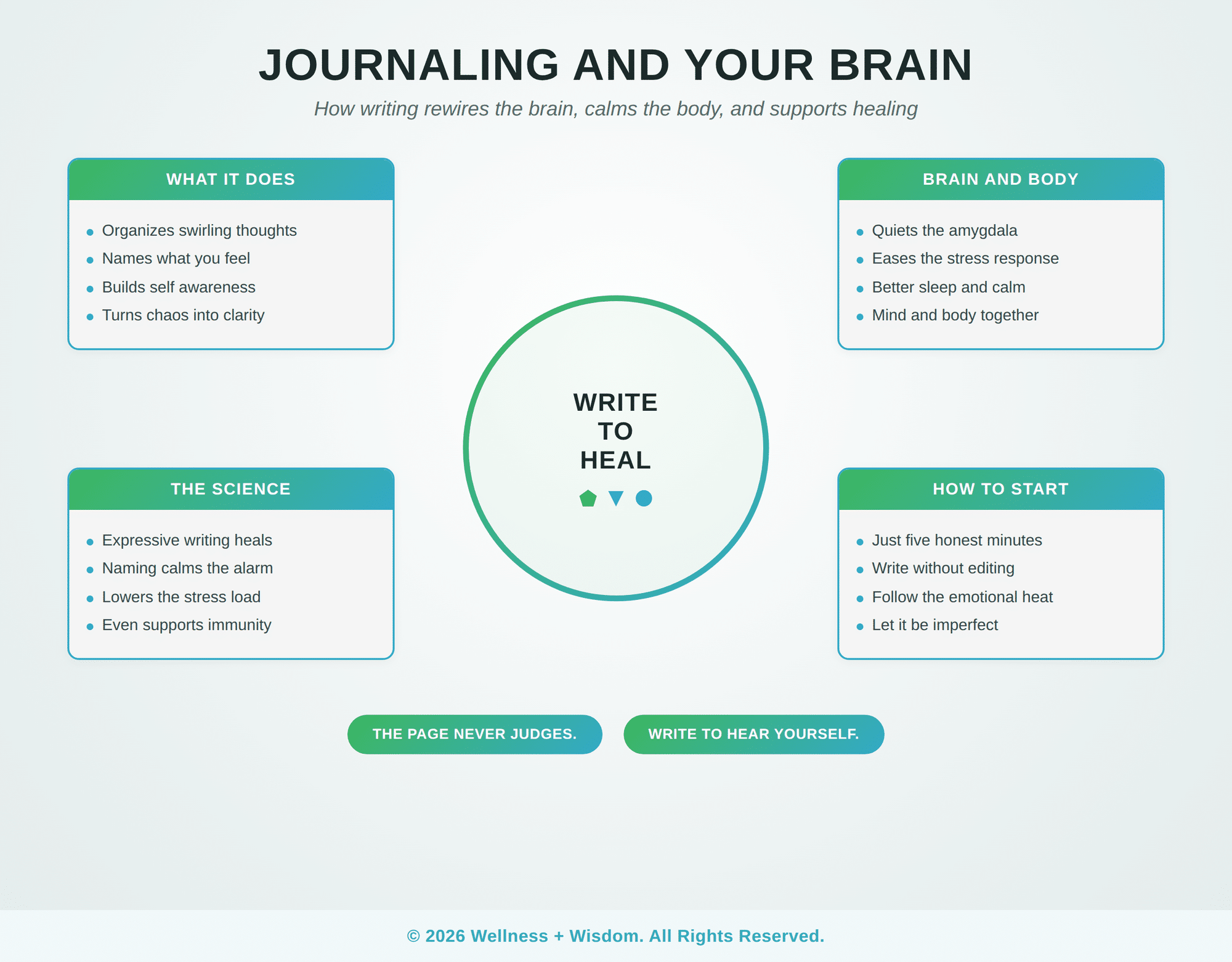
Journaling supports brain health by helping you process emotions, organize your thoughts, and move experiences from a swirling, reactive state into a clearer, more integrated one. When feelings and worries stay trapped inside as a vague churn, they tend to loop endlessly. Writing them down gives them shape and structure, which allows the brain to make sense of them rather than simply spin.
Think of your busy mind as a room full of loose papers blowing around. Journaling is the act of gathering those papers and laying them out on a table where you can actually see them. Suddenly what felt like overwhelming chaos becomes a set of specific, nameable things. This shift from formless anxiety to named experience is not just psychologically soothing. It reflects a real change in how the brain is processing the moment, moving it out of pure reactivity and into understanding. That single shift is the quiet engine behind almost every benefit journaling offers.
Over time, a regular journaling practice can strengthen self awareness, emotional regulation, and the ability to reflect rather than react. These are the very capacities that support a resilient, healthy brain and a grounded life. Journaling is like a gentle workout for the parts of you that make sense of experience, and like any workout, its benefits compound with consistency. A single entry can bring relief, but a steady practice slowly reshapes how you relate to your whole inner world. This is why we consider it a cornerstone practice for emotional intelligence and personal transformation.
The Science of Expressive Writing
The scientific study of journaling largely began with the work of psychologist James Pennebaker, whose research on expressive writing has become foundational. In one influential study published in the Journal of Consulting and Clinical Psychology, Pennebaker and colleagues found that writing about difficult or traumatic experiences was associated with measurable benefits, including improvements related to immune function. Putting hard experiences into words did not just feel good. It appeared to support the body.
This launched decades of research into what is now called expressive writing, the practice of writing openly about your deepest thoughts and feelings around a difficult experience. Across many studies, this kind of writing has been linked to a range of benefits, from reduced distress to improvements in wellbeing. The simple act of translating a painful experience into language seems to help the mind and body process and integrate it.
What is striking is how accessible this is. The benefits did not require a therapist, a special technique, or years of practice. They came from ordinary people writing honestly for a handful of sessions. This is one of the things I love most about journaling. It is a genuinely evidence supported practice for wellbeing that costs nothing and belongs to everyone, a rare gift in the world of health. You can explore related practices in our work on learning to feel safely.
How Writing Names and Tames Emotion
One of the clearest mechanisms behind journaling brain health is the power of naming what you feel. Research by Matthew Lieberman and colleagues, published in Psychological Science, found that the act of putting feelings into words, called affect labeling, reduced activity in the amygdala, the brain's alarm center. When you name an emotion, you turn down its intensity. Writing is naming on the page, and it does exactly this.
This is why journaling so often brings relief even when nothing about your circumstances has changed. The problem may still be there, but once you have written it out and named the feelings around it, your body is no longer holding it as raw, unprocessed alarm. You have moved the experience from the reactive, emotional part of the brain toward the reflective, meaning making part. In effect, you have helped your brain digest the moment. What was stuck as raw feeling becomes something you can look at, learn from, and gradually put down.
There is an old piece of wisdom that says we cannot heal what we cannot name. Journaling is one of the most reliable ways to name our inner world clearly. As you write, vague and overwhelming feelings become specific and workable ones. This is grief, this is fear, this is a longing I did not realize I had. That clarity is not just insight. It is regulation happening in real time on the page, and it is one reason journaling pairs so beautifully with an honest emotional inventory.
Why Journaling Works When Talking Sometimes Does Not
There is something uniquely powerful about writing that even talking cannot always match, and understanding it helps explain why journaling reaches us so deeply. The page is the most patient listener you will ever find. It never interrupts, never judges, never rushes you, and never makes your words about itself. In that spacious, private silence, you can finally say the things you might not feel safe saying out loud to anyone.
That privacy matters enormously. Because no one else will read it, you can be completely honest, dropping the edits and performances we all run when another person is listening. You can admit the feeling you are ashamed of, the fear you have been hiding, the truth you have not wanted to face. This radical honesty is where much of journaling's healing power lives, and it is hard to reach when you are managing how you come across to someone else.
Writing also slows your thinking down to a pace your mind can actually follow. Thoughts move fast and tangled, but the hand moves slowly, and that slowing forces a kind of clarity. You cannot write ten anxious thoughts at once. You have to take them one at a time, which naturally untangles the knot that felt so hopeless in your head. Many people find they understand their own experience for the first time simply because writing made them slow down enough to see it.
None of this replaces the value of talking with a trusted person or professional, which has its own irreplaceable gifts. But journaling offers something complementary and rare, a completely safe, private space to meet yourself with total honesty. It is a practice of coming home to your own inner voice, which is the foundation of the deeper work of reparenting yourself.
Journaling, Stress, and the Body
Journaling supports the body by helping to calm the stress response, which has real, measurable effects on physical health. When we carry unprocessed stress and emotion, the body's alarm systems stay subtly activated. The researcher Bruce McEwen described in the New England Journal of Medicine how this chronic activation produces allostatic load, the cumulative wear that builds when the stress response never fully switches off. Anything that helps discharge that load supports the whole body.
Journaling is one such tool. By giving stress and emotion an outlet and a structure, writing helps move the body out of a state of ongoing threat. Many people notice they breathe easier, sleep better, and feel lighter after putting their worries on the page. The churning that kept the alarm ringing finally has somewhere to go, and the body can begin to settle. Over time, this regular discharge can meaningfully reduce the wear that chronic stress places on your system.
This connects journaling to the deep mind body link that the field of psychoneuroimmunology has mapped, including foundational work by Sheldon Cohen and colleagues showing how psychological states influence physical resilience. When you tend your inner world on the page, you are not only helping your mind. You are supporting your neural system and your physical health at the same time, which is exactly the kind of integration we teach through breath, stillness, and reflection.
Journaling Brain Health and the Wellness Pentagon
Journaling brain health touches every dimension of the Wellness Pentagon™, which is part of why such a simple practice has such wide ranging effects. The Pentagon holds that true wellbeing requires tending five interconnected dimensions: physical, mental, emotional, spiritual, and financial. Journaling quietly serves them all.
Mentally, journaling sharpens clarity, focus, and self awareness. Emotionally, it helps you process and regulate feelings so they no longer run you from the shadows. Physically, it calms the stress response and supports the body, as the research shows. Spiritually, journaling can become a form of reflection and prayer, a way to listen inward and deepen your Connection to Creator and God. And financially, the clarity and reduced reactivity that journaling builds support the grounded, thoughtful decision making that real wealth requires.
Because these dimensions are interconnected, a practice that serves several of them at once creates a ripple effect through your whole life. This is the beauty of foundational practices like journaling, breath, and movement. They are not narrow fixes for single problems but broad supports for the entire system of your wellbeing. Explore more of these through our wellness tools and the Wellness + Wisdom Podcast.
Journaling as Epigenetic Support
Within the framework of Emotional Epigenetics™, journaling becomes even more meaningful. This framework holds that your emotional patterns, your beliefs, and your environment converge to shape how your genes express themselves. Chronic stress and unprocessed emotion are inputs that can push gene expression in an unhelpful direction, while calm, clarity, and emotional processing are inputs that can support healthier expression.
Journaling is a way of consciously shaping those inputs. Each time you write out a worry and let it settle, or name a feeling and let it move, you are lowering your stress load and tending your inner emotional climate. Given what research like Pennebaker's has shown about expressive writing supporting even immune function, it is reasonable to see journaling as one gentle way of influencing the biological environment your genes are responding to.
I want to be honest and grounded here. Journaling is not a magic cure, and no one should abandon medical care in favor of a notebook. But as one accessible, evidence supported practice for reducing stress and processing emotion, it fits beautifully into a life oriented toward healing at every level. It is a small daily act of tending the soil your biology grows in, which is the heart of how we approach gratitude and other epigenetic practices.
How to Start a Journaling Practice
Starting a journaling practice is refreshingly simple, and the key is to make it small enough that you will actually do it. Here is how to begin in a way that lasts.
1. Start Tiny
Commit to just five minutes, or even three. A practice you actually do beats an ambitious one you abandon. Lowering the bar removes the resistance and lets the habit take root. You can always write more when the words are flowing.
2. Write Without Editing
Let go of grammar, spelling, and making it good. This is not writing for anyone else. Just let the words come as they are, honestly and messily. The magic is in the honesty, not the polish, and no one ever has to read it.
3. Follow the Heat
Write about whatever carries the most emotional charge for you right now, the thing you keep thinking about or avoiding. That is where the real processing and relief live. Following the heat is how you get the deepest benefit from your minutes on the page.
4. Pair It With a Cue
Attach journaling to something you already do, like morning coffee or bedtime. Anchoring a new habit to an existing one makes it far more likely to stick. Many people find a morning routine the most natural home for it.
5. Let It Be Imperfect
Some days you will write pages, other days a single sentence, and some days you will skip it entirely. That is all fine. A journaling practice is a living relationship, not a performance. Return to it with kindness whenever you drift, and it will keep serving you for as long as you keep coming back.
Begin today, with just a few honest minutes. The practice grows naturally once you start, and its benefits compound quietly over time. When you want support and community for your inner work, the Liberated Life Tribe is here for you.
Different Kinds of Journaling to Try
There is no single right way to journal, and part of the joy is discovering which style serves you best. Here are a few well loved approaches you can experiment with, each offering its own gift.
Expressive writing, the kind studied by Pennebaker, means writing openly about a difficult experience and the feelings around it, which is especially powerful for processing and healing. Gratitude journaling means regularly writing down what you are grateful for, a practice associated with improved mood and wellbeing that gently trains your attention toward the good. Stream of consciousness or morning pages means writing whatever comes without direction, clearing the mental clutter and often surfacing insights you did not know you had.
You might also try reflective journaling, where you explore a question or an experience to understand it more deeply, or intention journaling, where you clarify what you want and how you want to show up. Some people keep a simple daily log of moods and events to notice patterns over time, which pairs naturally with the awareness we build through understanding our emotions. There is no wrong choice. The best kind of journaling is simply the kind you will actually do, so let curiosity rather than obligation guide your choice.
Feel free to mix and match these as your needs change. Some seasons call for the raw honesty of expressive writing, while others are better served by the uplift of gratitude or the clarity of intention. Let your practice evolve with you, and trust your own sense of what you need on any given day. The willingness to keep meeting yourself on the page, in whatever form, is what makes the whole thing work. Explore more guidance through our latest episodes and programs.
Common Obstacles and How to Move Through Them
If journaling is so simple and helpful, why do so many people struggle to keep it going? Understanding the common obstacles, and how gently to move through them, makes all the difference between a practice that fades and one that lasts.
The blank page can feel intimidating, as if you need something profound to say. The fix is to lower the bar completely. Start by writing exactly that, I do not know what to write, and keep going from there. The words almost always begin to flow once your hand is moving. There is no such thing as writing it wrong.
Perfectionism is another common block, the urge to make it good or coherent. Remember that this is not writing for an audience. It is thinking on paper, and thinking is messy. Give yourself full permission to be repetitive, unpolished, and imperfect. The mess is not a flaw in the practice. It is the practice working exactly as it should. A few slow breaths before you begin, the kind we teach through box breathing, can help quiet the inner critic.
Many people also worry that someone might read their private words, which quietly censors their honesty. If this is a concern, keep your journal somewhere private, or even tear up or delete entries after writing them. The healing happens in the writing itself, not in keeping it. And if you simply forget or fall off for a while, that is not failure. Just return with kindness whenever you remember. A journaling practice is meant to serve you, not to become one more thing to feel guilty about.
Frequently Asked Questions
How does journaling improve brain health?
Journaling supports brain health by helping you process emotions, organize thoughts, and move experiences from a reactive, swirling state into a clearer, integrated one. Writing gives feelings shape and structure so the brain can make sense of them rather than loop. Over time, this strengthens self awareness, emotional regulation, and the capacity to reflect rather than react.
Is there real science behind journaling?
Yes. The research of James Pennebaker on expressive writing found that writing about difficult experiences was associated with measurable benefits, including improvements related to immune function. Decades of studies since have linked expressive writing to reduced distress and improved wellbeing. Journaling is a genuinely evidence supported practice that costs nothing.
How does writing calm difficult emotions?
Through naming. Research by Lieberman and colleagues found that putting feelings into words, called affect labeling, reduced activity in the amygdala, the brain's alarm center. Writing is naming on the page, so journaling turns down the intensity of an emotion and moves the experience from the reactive part of the brain toward the reflective, meaning making part.
How long do I need to journal to see benefits?
Less than you might think. Much of the research involved just a few sessions of writing for around fifteen or twenty minutes, and many people feel relief after a single honest entry. Even three to five minutes a day can meaningfully calm the mind and body. Consistency matters more than length, so a small daily practice beats an occasional marathon.
What should I write about?
Follow the heat. Write about whatever carries the most emotional charge for you right now, the thing you keep thinking about or avoiding, since that is where the deepest processing and relief live. Do not worry about grammar or making it good. The benefit comes from honesty, not polish, and no one else ever has to read it.
Can journaling really affect my physical health?
It can support it. By calming the stress response, journaling helps reduce what researchers call allostatic load, the cumulative wear of chronic stress on the body. Pennebaker's work even linked expressive writing to immune benefits. Journaling is not a cure and never replaces medical care, but as a stress reducing practice it genuinely supports the body.
Studies and External Resources
The science in this article rests on peer reviewed research. These are the sources referenced throughout.
- Pennebaker JW, Kiecolt-Glaser JK, Glaser R. (1988). Disclosure of traumas and immune function: health implications for psychotherapy. Journal of Consulting and Clinical Psychology. PubMed: 3372832
- Lieberman MD, et al. (2007). Putting Feelings Into Words: Affect Labeling Disrupts Amygdala Activity in Response to Affective Stimuli. Psychological Science. PubMed: 17576282
- McEwen BS. (1998). Protective and damaging effects of stress mediators. New England Journal of Medicine. PubMed: 9428819
About Josh Trent
Josh Trent is an Identity Transformation Architect and the award winning host of the Wellness + Wisdom Podcast, with over 15 million downloads since 2015. He is the creator of the L.I.F.E. Method™ Identity Transformation System and steward of the Emotional Epigenetics™ and BREATHE: Breath + Wellness™ systems of self mastery, impacting over 1,000 students worldwide. Join the Liberated Life Tribe and receive your 10 day Self Liberation Blueprint at liberatedlife.com. Josh lives in Austin, Texas with his wife Carrie, daughter Nayah, and son Novah.
Disclosure: We may earn a commission from certain links on this site when you make a purchase, at no extra cost to you. These commissions help support Wellness + Wisdom and do not affect the products or resources we choose to recommend. Full disclosure .