
By Josh Trent | Wellness + Wisdom Podcast Host & Identity Transformation Architect
“Your attention is your life. Wherever it goes, your life follows. Learning how to reduce screen time is learning to give your attention back to the people, places, and moments that truly matter.”
Josh Trent
Learning how to reduce screen time is one of the most quietly transformative changes you can make, because the way you spend your attention is, in a very real sense, the way you spend your life. Most of us did not decide to spend hours each day on our phones. It simply happened, one notification, one scroll, one quick check at a time. Technology is a wonderful tool, and I am grateful for the ways it connects us and helps us learn. But when screens start to crowd out sleep, presence, movement, and real connection, it is time to take our attention back. This is not about rejecting technology. It is about choosing it on purpose, in a way that supports every dimension of the Wellness Pentagon™.
Here is the joy forward truth at the center of it all. Every minute you reclaim from mindless scrolling is a minute you can give to something that genuinely nourishes you: a conversation, a walk, a book, a nap, a moment of stillness. When you learn how to reduce screen time, you do not lose anything important. You gain your life back, one present moment at a time. Let us explore exactly how.
Table of Contents
- What Healthy Screen Use Really Looks Like
- Why Screens Are So Hard to Put Down
- The Gift of Reclaimed Attention
- The Science of Screen Time
- How to Reduce Screen Time
- Intentional Use Versus Mindless Scrolling
- How to Reduce Screen Time With the Wellness Pentagon™
- Celebrating Reclaimed Moments
- Mindful Technology Is a Lifelong Practice
- When Unplugging Feels Hard
- Frequently Asked Questions
- Studies and External Resources
- About Josh Trent
What Healthy Screen Use Really Looks Like
Healthy screen use means using technology intentionally, in ways that support your goals, relationships, and wellbeing, rather than letting it fill every spare moment by default. It is not about a specific number of hours. It is about whether your screen time serves you or quietly takes from you.
Not all screen time is the same. A video call with a faraway friend, a meaningful podcast, an online class, or a creative project can be enriching. Endless scrolling, compulsive checking, and late night browsing are a different story. They tend to leave us feeling drained, distracted, and a little emptier than before. The question is not “Am I using screens?” but “How am I using them, and how do I feel afterward?”
Healthy screen use also has a rhythm. It includes protected time without screens, especially first thing in the morning, during meals, in conversations, and before bed. It leaves room for boredom, which is often where creativity and reflection begin. And it keeps the most precious parts of life, like eye contact, touch, nature, and stillness, at the center rather than the margins. These are themes we return to often on the Wellness + Wisdom Podcast, because attention is one of our most valuable resources.
Why Screens Are So Hard to Put Down
Screens are hard to put down because many apps are designed to capture and hold our attention, using endless feeds, notifications, and unpredictable rewards that keep us coming back. It is not a personal weakness that makes scrolling hard to stop. Some of the brightest designers in the world have worked to make it that way.
Every notification, like, and new message offers a small, unpredictable reward. Our brains are wired to seek out novelty and social feedback, so these little rewards are powerful. The endless scroll removes natural stopping points, so there is never a clear moment to put the phone down. Over time, reaching for the phone becomes a habit triggered by boredom, stress, loneliness, or simply a pause in the day.
Screens also offer an easy escape from uncomfortable feelings. When we feel anxious, bored, sad, or restless, scrolling provides instant distraction. That makes sense in the moment, but it can keep us from noticing and processing what we feel. If you notice yourself reaching for your phone whenever something feels hard, the practices in why we stopped feeling alive and how to sit with difficult emotions are a beautiful companion. Understanding these patterns replaces shame with clarity and gives you a real path forward.
The Gift of Reclaimed Attention
Reclaimed attention gives you more presence, deeper relationships, better sleep, clearer thinking, and more time for the things that truly make you come alive. When your attention is your own, life feels richer and more vivid.
Think about what you could do with an extra hour each day. Read the books you have been meaning to read. Take a long walk. Cook a meal with someone you love. Learn an instrument. Pray, meditate, or simply sit with your thoughts. For many people, reducing screen time frees up far more time than they expected, and that time becomes a gift they can give to themselves and others.
Your relationships change too. When you put your phone away during conversations, people feel it. Your partner feels seen. Your children feel prioritized. Your friends feel valued. Presence is one of the most loving gifts you can offer, which is explored beautifully in how to be present. And here is the part I love most. When you stop filling every quiet moment with input, your own thoughts, ideas, and inner wisdom have room to surface again. Many people rediscover creativity and clarity they thought they had lost.
The Science of Screen Time
The science of screen time shows that limiting social media can reduce loneliness and depression, that even a one week break can lift wellbeing, that moderate digital use is not inherently harmful while heavier use is linked with lower wellbeing, and that evening screens can disrupt sleep. The goal is balance, not fear.
Start with social media. In a study published in the Journal of Social and Clinical Psychology, Melissa Hunt and colleagues asked university students to limit their use of several social media platforms to about ten minutes per platform per day for three weeks. Compared with a control group, the students who limited their use showed significant reductions in loneliness and depression. Less scrolling led to feeling better.
Even a short break helps. In a randomized controlled trial published in Cyberpsychology, Behavior, and Social Networking, Jeffrey Lambert and colleagues found that adults who took a one week break from social media reported improved wellbeing and reduced depression and anxiety compared with those who continued as usual. One week was enough to make a measurable difference.
The picture is nuanced, which is important. A large study of more than 120,000 adolescents in England, led by Andrew Przybylski and Netta Weinstein in Psychological Science, found that moderate digital screen use was not harmful and may even be linked with slightly better wellbeing, while higher levels of use were associated with lower wellbeing. And research led by Anne Marie Chang in the Proceedings of the National Academy of Sciences found that reading on a light emitting device before bed delayed sleep, reduced melatonin, and lowered next morning alertness compared with reading a printed book. The takeaway: technology is not the enemy, but how much, when, and how we use it matters.
How to Reduce Screen Time
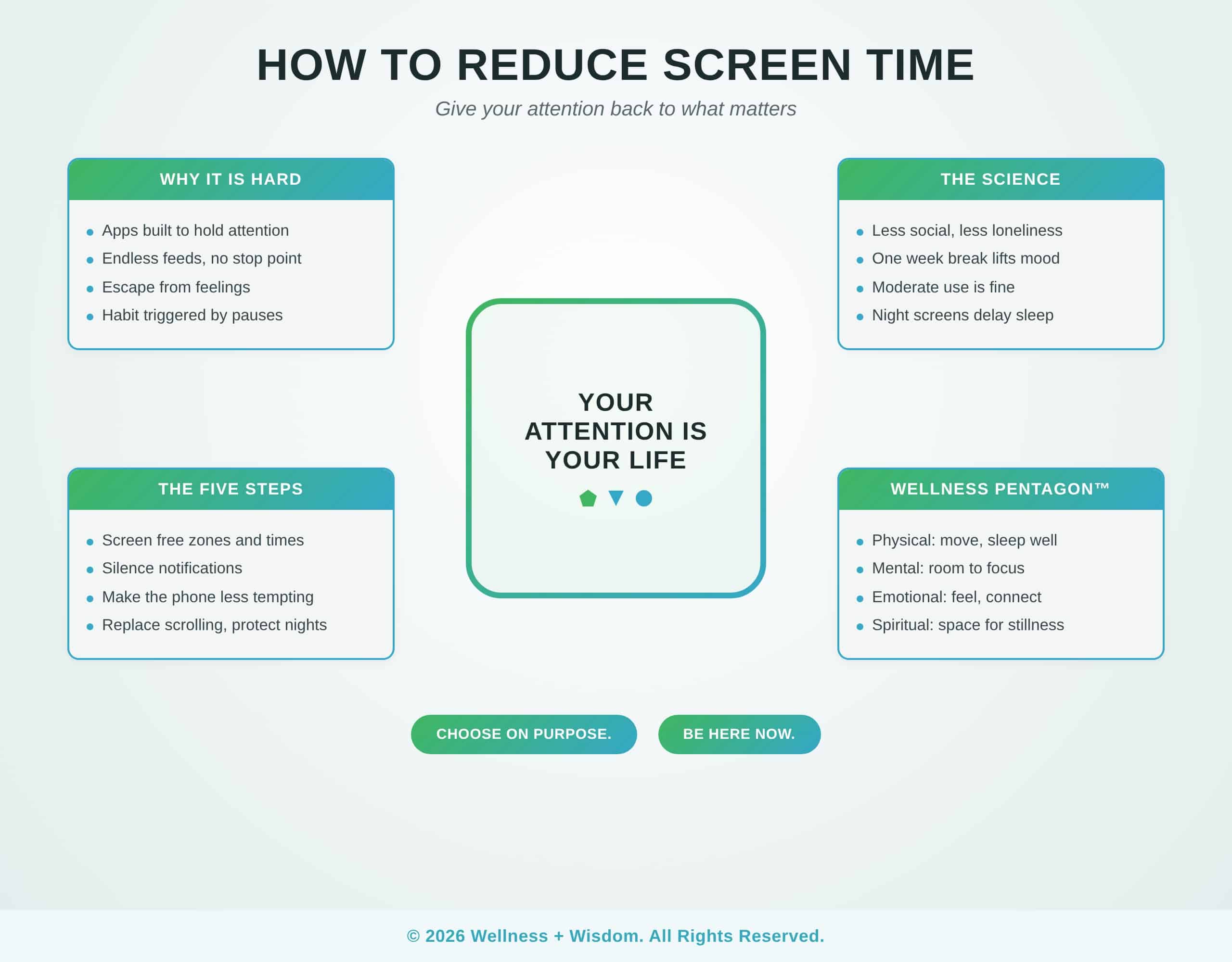
You learn how to reduce screen time by creating screen free zones and times, turning off nonessential notifications, making your phone less tempting, replacing scrolling with nourishing alternatives, and protecting your evenings. These five steps work with your brain's habits rather than relying on willpower alone. Here is how I practice and teach them.
1. Create Screen Free Zones and Times
Choose specific places and times where screens are not welcome. The bedroom, the dinner table, the first hour after waking, and conversations with loved ones are wonderful places to start. Clear boundaries remove the need to make a decision every time and make the habit easier to keep. A screen free morning pairs beautifully with the practices in how to create a morning routine.
2. Turn Off Nonessential Notifications
Every notification is an invitation to pick up your phone. Go through your settings and turn off notifications for everything that is not truly important. Keep calls and messages from key people if you need them, and silence the rest. Many people find that this single change dramatically reduces how often they reach for their phone.
3. Make Your Phone Less Tempting
Move distracting apps off your home screen or into a folder. Log out of social media so you have to sign in each time. Switch your display to grayscale, which makes the screen less visually rewarding. Charge your phone outside your bedroom. These small bits of friction interrupt automatic habits and give you a moment to choose.
4. Replace Scrolling With Nourishing Alternatives
When you reduce screen time, you need something to fill the space. Keep a book by your bed. Put a journal on the kitchen table. Plan walks, hobbies, or calls with friends. Notice what you usually scroll to avoid, like boredom or stress, and choose a nourishing response instead, such as a few slow breaths, a stretch, or stepping outside. Journaling is especially helpful, as explored in journaling and brain health.
5. Protect Your Evenings
Aim to put screens away at least an hour before bed. Use that time to wind down with reading, conversation, gentle stretching, or reflection. This protects your sleep, which in turn supports your mood, focus, and energy the next day. The full science of better rest is explored in how to sleep better.
It can also help to get honest about your patterns before you change them. For a few days, simply notice when and why you pick up your phone, without judging yourself. Is it first thing in the morning? While waiting in line? When a work task feels hard? When you feel lonely in the evening? You might even jot down a quick note each time. Patterns usually become clear surprisingly fast, and once you see them, you can design specific changes for the moments that matter most rather than trying to cut back everywhere at once.
Start with one or two of these steps this week rather than all at once. Small, steady changes build lasting habits, which is exactly the approach in how to build healthy habits. And if you would love to connect with people building more intentional lives, the Liberated Life Tribe is a warm community to join.
Intentional Use Versus Mindless Scrolling
Intentional use means picking up your device with a clear purpose and putting it down when that purpose is complete, while mindless scrolling means picking it up out of habit and losing track of time. The device is the same. The experience is completely different.
Mindless scrolling often begins with a vague impulse. A moment of boredom, an uncomfortable feeling, a pause in conversation. You pick up the phone without really deciding to, and twenty minutes later you surface feeling scattered and unsure where the time went. It rarely leaves you feeling better. Often it leaves you feeling slightly worse, comparing yourself to others or overloaded with information. If comparison is part of your scrolling experience, the practices in how to stop comparing yourself to others can help.
Intentional use looks different. Before you pick up your phone, ask yourself, “What am I here to do?” Maybe it is to reply to a message, look up a recipe, or call a friend. Do that thing, then put the phone down. This simple question turns your device from a slot machine into a tool. It puts you back in charge of your attention, and over time it becomes a natural habit. Intentional use is closely related to the presence practices in how to practice mindfulness.
How to Reduce Screen Time With the Wellness Pentagon™
The Wellness Pentagon™ shows that screen habits affect every dimension of your life: physical, mental, emotional, spiritual, and financial. When you look at screen time through each lens, it becomes easier to see what you gain by using technology more intentionally.
Physical. Long stretches of screen time often mean sitting still, poor posture, and later bedtimes. Replace some scrolling with movement and protect your evening wind down. Your body will thank you with more energy and better sleep, which is a beautiful way to honor your body.
Mental. Constant input fragments attention and makes deep focus harder. Protecting blocks of screen free time helps your mind settle, think clearly, and do meaningful work. It also quiets the mental noise explored in how to quiet the noise in your mind.
Emotional. Scrolling can numb feelings and fuel comparison. Less screen time gives you space to notice and process emotions and to connect with people face to face, which supports emotional health.
Spiritual. Stillness, prayer, and reflection need quiet space. Reclaiming time from screens makes room for your Connection to Creator and God and for the inner listening that spiritual life invites.
Financial. Screens are full of advertising and impulse purchases. Using them more intentionally can reduce unplanned spending and free your attention for wiser money decisions. To go deeper with the whole framework, explore our L.I.F.E. Method™ programs.
Celebrating Reclaimed Moments
Celebrating the moments you reclaim from screens helps reinforce your new habits and makes the change feel joyful rather than restrictive. Your brain learns through reward, so noticing how good it feels to be present makes you more likely to choose presence again.
At the end of each day, notice one moment you gave your full attention to something meaningful. Maybe you had dinner without your phone and really enjoyed the conversation. Maybe you read a few chapters before bed and slept better. Maybe you took a walk and noticed the colors of the leaves. Name it and enjoy it. These moments are the real rewards of reducing screen time.
You can also track your progress. Many phones have built in screen time reports. Watching your daily average slowly drop can be surprisingly motivating, especially when you connect it to the extra time you now have for things you love. There is a whole practice around honoring these moments in celebrating small wins, and it pairs beautifully with this work.
Mindful Technology Is a Lifelong Practice
Using technology mindfully is a lifelong practice, because new apps, devices, and habits will keep emerging, and life circumstances will keep changing. There will be seasons when your screen time creeps up, perhaps during a busy work period or a stressful time. That is completely normal. It is not failure. It is simply a cue to return to your intentions.
Remember that the goal is freedom, not perfection. Some days you will scroll longer than you meant to, and that is okay. What matters is the overall direction of your habits and the way you speak to yourself when you slip. Approach this change with curiosity and kindness, and it will feel far more like an adventure than a restriction.
Many people find it helpful to do a periodic check in. Once a month, look at how you are using technology and how it is making you feel. Which apps add value to your life? Which ones leave you drained? Adjust accordingly. Some people also enjoy regular digital sabbaths, a day or part of a day each week without screens, as a way to reset and reconnect with what matters most.
Modeling healthy technology habits is especially powerful if you have children. Kids learn far more from what we do than from what we say. When they see you put your phone away at dinner, read books, and spend time outdoors, they absorb those habits too. That is a gift that can shape their relationship with technology for life. You will find many guests sharing their own approaches to mindful technology across our latest episodes.
When Unplugging Feels Hard
If unplugging feels hard right now, you are in very good company, and it is completely understandable. Learning how to reduce screen time does not mean you will suddenly stop reaching for your phone. It means you will gently shift your habits, a little at a time, at a pace that honors where you are.
When it feels hard, start with the smallest possible change. Leave your phone in another room during one meal. Turn off one type of notification. Put one book on your nightstand. When you feel the urge to scroll, pause and take three slow breaths first, perhaps using the simple practices in BREATHE™. That pause often creates enough space to make a different choice. Helpful tools like an analog alarm clock, a quality journal, or a breath training device can make the shift easier, and you can find a few we trust in our wellness tools store.
It is also worth knowing that if screen use feels truly out of control, or if you rely on it to cope with persistent anxiety, loneliness, or low mood, a qualified health professional can offer compassionate support for both the habit and the feelings underneath it. There is real strength in asking for help. Wherever you are, be patient and kind with yourself, and trust that learning how to reduce screen time is something you can absolutely grow, one present moment at a time.
Ready to go deeper? Join the Liberated Life Tribe and receive your 10 day Self Liberation Blueprint at liberatedlife.com. It is free, it is guided, and each day offers a simple practice that helps you live with more presence and intention.
Frequently Asked Questions
What is the easiest way to reduce screen time?
Turn off nonessential notifications, charge your phone outside your bedroom, and create screen free times like meals and the first hour after waking. These small changes reduce how often you reach for your phone without relying on willpower, and they often produce noticeable results within days.
Does reducing social media really help mental health?
Research suggests it can. Students who limited social media to about ten minutes per platform per day for three weeks showed reduced loneliness and depression, and adults who took a one week break reported improved wellbeing and lower depression and anxiety.
Is all screen time bad?
No. A large study of adolescents found that moderate digital use was not harmful and may be linked with slightly better wellbeing, while heavier use was associated with lower wellbeing. How you use screens, and how much, matters more than whether you use them at all.
How do screens affect sleep?
Evening screen use can delay sleep, lower melatonin, and reduce next morning alertness. A study comparing reading on a light emitting device with reading a printed book before bed found these effects. Putting screens away an hour before bed supports better rest.
What should I do instead of scrolling?
Keep nourishing alternatives easy to reach, like a book, a journal, or walking shoes by the door. When you feel the urge to scroll, try a few slow breaths, a stretch, a quick walk, or a call to a friend. Having a plan makes it easier to choose something that truly restores you.
How can I help my family reduce screen time?
Model the habits you want to see, like putting your phone away during meals and reading before bed. Create shared screen free times and zones, plan family activities outdoors, and talk openly about how technology makes everyone feel. Children learn most from what they see you do.
Studies and External Resources
The science in this article rests on peer reviewed research. These are the sources referenced throughout.
- Hunt MG, Marx R, Lipson C, Young J. (2018). No More FOMO: Limiting Social Media Decreases Loneliness and Depression. Journal of Social and Clinical Psychology. DOI: 10.1521/jscp.2018.37.10.751
- Lambert J, et al. (2022). Taking a One Week Break from Social Media Improves Well Being, Depression, and Anxiety: A Randomized Controlled Trial. Cyberpsychology, Behavior, and Social Networking. PubMed: 35512731
- Przybylski AK, Weinstein N. (2017). A Large Scale Test of the Goldilocks Hypothesis. Psychological Science. PubMed: 28085574
- Chang AM, et al. (2015). Evening use of light emitting eReaders negatively affects sleep, circadian timing, and next morning alertness. Proceedings of the National Academy of Sciences. PubMed: 25535358
About Josh Trent
Josh Trent is an Identity Transformation Architect and the award winning host of the Wellness + Wisdom Podcast, with over 15 million downloads since 2015. He is the creator of the L.I.F.E. Method™ Identity Transformation System and steward of the Emotional Epigenetics™ and BREATHE: Breath + Wellness™ systems of self mastery, impacting over 1,000 students worldwide. Join the Liberated Life Tribe and receive your 10 day Self Liberation Blueprint at liberatedlife.com. Josh lives in Austin, Texas with his wife Carrie, daughter Nayah, and son Novah. Peace and power.
Disclosure: We may earn a commission from certain links on this site when you make a purchase, at no extra cost to you. These commissions help support Wellness + Wisdom and do not affect the products or resources we choose to recommend. Full disclosure .