
By Josh Trent | Wellness + Wisdom Podcast Host & Identity Transformation Architect
“Comparison measures your inside against everyone else's outside, and you always lose. The moment you return to your own path, joy comes rushing back, because there is no one to beat, only your own life to live.”
Josh Trent
Learning how to stop comparing yourself to others is one of the most freeing shifts you can make, because comparison quietly steals the joy and confidence from a life that is already worthy of celebration. So many of us quietly measure ourselves against everyone around us, feeling that we fall short whenever someone seems even a little ahead, and slowly losing sight of our own unique path. Stepping out of the comparison trap is the deeply liberating process of returning to your own life, your own timing, and your own worth, free at last from the endless measuring. This liberation lives at the heart of the L.I.F.E. Method™.
Here is the joy forward truth at the center of it all. Your one precious life was never meant to be measured against anyone else's, and your worth does not rise or fall based on how you happen to stack up. When you truly release comparison, you free yourself to celebrate your own journey and to feel genuine, uncomplicated joy for others at the very same time. When you learn how to stop comparing yourself to others, you reclaim your peace, your confidence, and your quiet delight in your own beautiful life. Let us explore exactly how.
Table of Contents
- What the Comparison Trap Really Is
- Why We Compare Ourselves to Others
- The Hidden Cost of Comparison
- Comparison Versus Healthy Inspiration
- How to Stop Comparing Yourself to Others
- The Science of Comparison and Wellbeing
- Comparison in the Age of Social Media
- Celebrating Your Own Path
- Liberation From Comparison in the L.I.F.E. Method
- Releasing Comparison Is a Lifelong Practice
- Frequently Asked Questions
- Studies and External Resources
- About Josh Trent
What the Comparison Trap Really Is
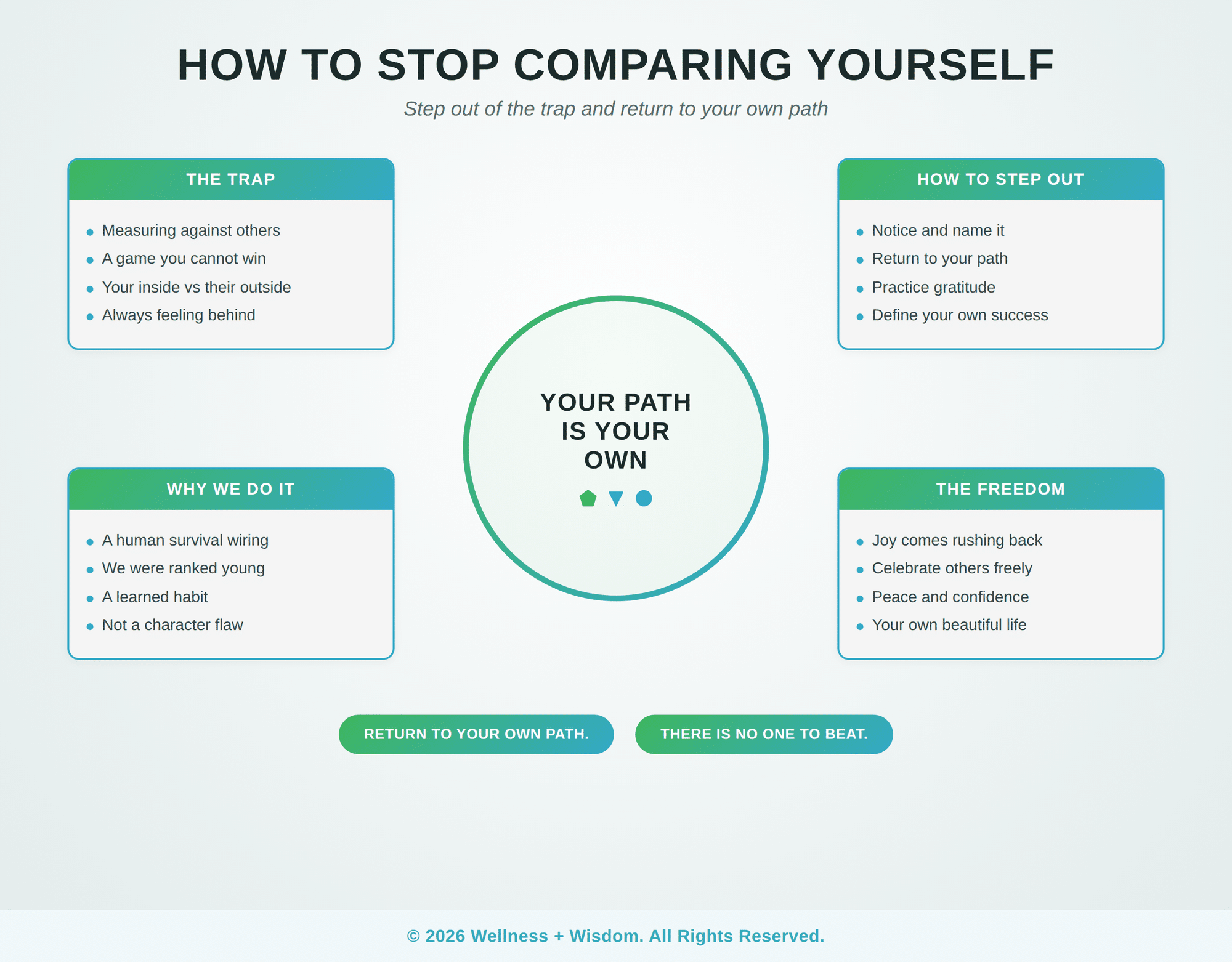
The comparison trap is the habit of measuring your worth, progress, and life against other people, and consistently feeling that you come up short. It is called a trap for good reason, because it is a game you can never actually win, since there will always be someone who appears ahead of you in some way, which keeps you perpetually feeling behind no matter how much you have.
What makes comparison especially misleading is that we usually compare our full inner reality, including our struggles and doubts, against other people's carefully presented outsides. We measure our messy behind the scenes against everyone else's polished highlight reel, which is never once a fair comparison. The result is a badly distorted picture in which we always seem to fall short, even when our own lives are genuinely rich and good.
Recognizing comparison for what it is offers real relief, because it reveals the whole pattern as a distortion rather than an accurate measure of your worth or progress. You are not actually behind at all, you are simply caught in a game that is quietly rigged to make almost anyone feel inadequate. Seeing this clearly is the first step toward freedom, a theme we explore across the Wellness + Wisdom Podcast.
Why We Compare Ourselves to Others
We compare ourselves to others because it is a deeply human tendency, one wired into us over a long evolutionary history where gauging our standing in the group helped us survive. Our minds naturally measure and rank almost automatically, always looking to others to understand where exactly we fit in. This means comparison is not a personal flaw at all but a natural human inclination, which is genuinely important to understand with real compassion.
Beyond this natural tendency, many of us also learned to compare through early experiences where we were constantly measured against siblings, classmates, or impossible standards, and where our worth felt tied to how we ranked. This can quietly install a habit of constant comparison that follows us right into adulthood, where we keep measuring ourselves against nearly everyone around us. Understanding these roots replaces self judgment with compassion, which is where real change begins.
Seeing why we compare is genuinely freeing, because it means the habit is not a character flaw but a learned and understandable pattern. What was learned can be gently unlearned, and the natural tendency can be met with awareness rather than allowed to run the show. You can honor the natural human impulse to compare while still choosing, again and again, to gently return to your own path, which is deeply connected to releasing our inherited beliefs.
The Hidden Cost of Comparison
Comparison carries a real and often hidden cost, one worth naming clearly so the invitation to step out of it feels worth accepting. Constant comparison quietly drains your joy, your confidence, and your inner peace, keeping you focused on what you seem to lack rather than on the real goodness already present in your life.
Emotionally, comparison tends to crowd out contentment and gratitude, because there is always someone who seems to have more, which keeps satisfaction perpetually out of reach. It can quietly fuel envy, anxiety, and a persistent sense of inadequacy, keeping you in a state of subtle stress as you measure yourself against everyone around you. Over time, this ongoing, invisible comparison wears on your wellbeing and quietly steals the joy you might otherwise feel in your own good life.
Comparison also disconnects us from others and from ourselves. It can turn potential friends into quiet rivals and make it genuinely hard to feel real joy for other people's good fortune, slowly isolating us. It also steadily pulls us away from our own path, as we chase what others seem to have rather than what genuinely matters to us. Naming this cost is not meant to add pressure but to offer motivation and compassion, because the freedom on the other side is so worth it, and it supports the whole person wellbeing of the Wellness Pentagon™.
Comparison Versus Healthy Inspiration
One of the most freeing distinctions on this journey is the difference between comparison and healthy inspiration, because they can look similar on the surface but feel and function very differently. Comparison quietly diminishes you, while inspiration genuinely uplifts you, and learning to tell them apart changes everything about how you relate to other people's success.
Comparison measures your worth against someone else and leaves you feeling behind, inadequate, or envious. It focuses relentlessly on the gap between you and them, and it quietly tells you, over and over, that you are somehow not enough. Inspiration, by contrast, sees someone doing something wonderful and feels uplifted and encouraged by it. It says, if that is possible for them, then perhaps something beautiful is possible for me too, and it gently draws you forward rather than pushing you down.
The practical difference is enormous. Comparison quietly drains your energy and joy, keeping you focused on lack, while inspiration energizes you and expands your whole sense of what is possible. The very same person's success can trigger either response in you, depending entirely on how you choose to hold it. When you notice yourself comparing, you can gently shift toward inspiration instead, letting another person's light encourage rather than diminish you.
This means you do not have to stop admiring others or noticing their gifts at all, you simply learn to let those observations inspire and encourage you rather than measure and diminish you. You can wholeheartedly celebrate someone's success, feel genuinely uplifted by it, and let it expand your own sense of what is possible for you, all without falling into the trap of measuring your worth against theirs, which is a beautiful part of healthy relationships.
How to Stop Comparing Yourself to Others
Learning how to stop comparing yourself to others is a gentle, gradual practice of returning your attention to your own life and worth, again and again. It is not about never noticing other people at all but about freeing yourself from the compulsive habit of measuring yourself against them. Here are practices that help.
1. Notice and Name the Comparison
Simply noticing the moment you start comparing, and gently naming it to yourself, immediately loosens its grip. Awareness gives you the quiet power to choose a different response rather than being swept along by the automatic, unconscious habit of measuring yourself against others.
2. Return to Your Own Path
The moment you catch yourself comparing, gently redirect your attention back to your own life, your own values, and your own real progress. Remembering that you are on your own entirely unique path, with your own perfect timing, returns you to what actually matters and quiets the noise of comparison.
3. Practice Gratitude for Your Own Life
Deliberately noticing and appreciating the real goodness already in your own life is one of the most powerful antidotes there is to comparison. Gratitude gently shifts your focus from what others seem to have to the real gifts already present in your own life, which is the heart of learning to cultivate everyday joy.
4. Celebrate Others Genuinely
Practice actively feeling genuine joy for other people's wins rather than immediately measuring yourself against them. Celebrating others genuinely transforms comparison into connection, and it reminds you that their success takes absolutely nothing away from your own worth.
5. Define Success on Your Own Terms
Take time to clarify what a genuinely good life actually means to you, entirely apart from anyone else's standards or expectations. Living by your own honest definition of success frees you from constantly measuring against goals that were never truly yours in the first place, and anchors you firmly in your authentic identity.
Begin with just one practice and be patient and kind with yourself, since releasing a lifelong habit like this takes real time. Every single time you return to your own path, you weaken comparison's grip a little more and reclaim your joy. When you want community and support for this journey, the Liberated Life Tribe is here for you.
The Science of Comparison and Wellbeing
The science of the mind offers real support for stepping out of comparison, because the constant measuring it involves takes a genuine toll. The researcher Bruce McEwen described in the New England Journal of Medicine how chronic stress produces allostatic load, the cumulative wear of a body whose alarm never fully rests. The ongoing, low grade stress of comparison and chronic inadequacy is one quiet but real source of that accumulated wear.
Awareness helps directly. Research by Matthew Lieberman and colleagues, published in Psychological Science, found that putting feelings into words reduces activity in the brain's alarm center. When you consciously notice and name the comparison and the feelings it brings up, you loosen its grip and help your whole system settle, which is why simply naming comparison is such a powerful first step toward freedom.
There is an uplifting dimension too. Barbara Fredrickson's research, published in American Psychologist, shows that positive emotions like joy and gratitude broaden our awareness and build lasting resources, while comparison and envy narrow us. Choosing gratitude and genuine joy for others literally opens you up, making you far more content, connected, and resilient than comparison ever could on its best day. Joy, it turns out, is the natural state that comparison interrupts, supporting the kind of neural system regulation that helps you feel at ease.
Comparison in the Age of Social Media
Comparison has always been part of being human, but social media has amplified it dramatically, making the practice of stepping out of comparison more important than ever. Scrolling through endless curated highlights of other people's lives gives us far more material for comparison than any previous generation ever faced, and it can quietly and steadily erode our contentment.
The key thing to remember is that social media shows us highlight reels, not real life. People naturally share their best moments, their biggest wins, and their most flattering angles, while the ordinary struggles and quiet difficulties almost always stay off screen. Comparing your full, real, unedited life against these carefully curated highlights is deeply unfair to yourself, and it almost always leaves you feeling worse than before. What you are seeing is not the whole truth.
This one awareness lets you engage with social media far more freely and lightly. You can enjoy real connection and inspiration online while always remembering that what you see is a carefully selected slice of someone's life, not the full picture. Taking regular breaks, curating your feed toward what genuinely uplifts you, and returning your attention to your own real life all help you stay grounded and free. The whole goal is to let other people's highlights inspire and encourage you rather than diminish you, which takes real emotional courage in a comparison driven culture.
Celebrating Your Own Path
The joyful heart of releasing comparison is learning to celebrate your own path, to honor your unique journey rather than measuring it against anyone else's. This single shift transforms your entire experience, turning a life of quietly feeling behind into a life of genuine appreciation for exactly where you are and how far you have already come.
Celebrating your own path means truly recognizing that your journey is entirely your own, with its own timing, its own lessons, and its own gifts that cannot be fairly compared to anyone else's. It means honoring your real progress, appreciating your unique qualities, and trusting deep down that you are exactly where you need to be on your own road. When you truly celebrate your own path, comparison quietly loses all its power over you, because there is simply no one left to measure yourself against, a practice we cherish in learning to celebrate yourself.
And here is the beautiful part. When you celebrate your own path rather than comparing, you free yourself to also genuinely celebrate others, because their success no longer threatens your worth. You get to feel real, genuine joy for the people around you while fully delighting in your own journey, which is a far richer and warmer way to live. Celebrating your own path gradually turns your whole life from an exhausting competition into a genuine celebration, one we share together in learning to celebrate small wins.
Liberation From Comparison in the L.I.F.E. Method
Releasing comparison is a beautiful expression of the Liberation pillar within the L.I.F.E. Method™, our system for identity transformation built on four pillars: Liberation, Integration, Frequency, and Embodiment. Comparison is honestly one of the heaviest burdens of who you are not, and stepping out of it is a genuine and joyful act of liberation.
Liberation frees you from the inherited habit of measuring your worth against others, releasing the endless comparison that has drained your joy. As that burden lifts, the other pillars come alive: Integration helps you accept and appreciate your own unique self, Frequency raises your inner state from inadequacy toward gratitude and joy, and Embodiment lets you feel the freedom of living your own life in your body rather than just understanding it in your mind.
This is why we hold releasing comparison as genuine liberation work rather than a simple mindset tip. You are not merely thinking a little differently, you are fundamentally freeing your identity from a false measure and reclaiming your inherent worth as a unique creation in your Connection to Creator and God. That is a deep and joyful freedom, one that returns you to your own beautiful life and every relationship in it, and it grows through your whole self growth journey.
Releasing Comparison Is a Lifelong Practice
Releasing comparison is not a single decision you make once and finish, but a lifelong practice of returning to your own path again and again. Comparison is a deeply human tendency, so it will arise from time to time throughout your life, and that is completely normal. What matters is not that you never compare, which no one manages, but that you learn to notice it sooner and return to your own life more quickly and more kindly each time.
This understanding takes the pressure off getting it perfect. You do not have to eliminate every single comparing thought forever, which truly no one manages, but you can gradually weaken the whole habit through consistent, gentle practice over time. Each and every time you catch a comparison and return to gratitude and your own path, you strengthen your freedom, and over time comparison holds far less power over you.
Understanding the release of comparison as an ongoing practice also keeps it light and compassionate. You will certainly have days when comparison creeps back in, especially during hard seasons or heavy scrolling, and that is simply and completely human. Meeting those harder moments with kindness, rather than harsh judgment, and gently returning to your own path is the whole practice, quietly repeated across a lifetime, and supported beautifully by a grounded morning routine.
So approach your own journey here with real patience and warmth toward yourself. There is no finish line, only the ongoing, freeing practice of returning to your own beautiful life and celebrating it, again and again, until celebration becomes far more natural than comparison ever was. This steady return is one of the kindest gifts you can give yourself, and it supports your whole mental and emotional wellbeing.
Frequently Asked Questions
What is the comparison trap?
The comparison trap is the habit of measuring your worth, progress, and life against other people and consistently feeling you come up short. It is a game you cannot win, since someone will always seem ahead, keeping you perpetually feeling behind. It is especially misleading because we compare our full inner reality against other people's carefully presented outsides.
Why do I compare myself to others so much?
Because comparison is a deeply human tendency wired into us over a long evolutionary history, where gauging our standing helped us survive. Many of us also learned to compare through early experiences of being measured against others. This means comparison is not a personal flaw but a natural and learned pattern that can be met with awareness and gently changed.
How do I stop comparing myself to others?
Begin by noticing and naming the comparison, which loosens its grip, then gently return your attention to your own path. Practice gratitude for your own life, celebrate others genuinely rather than measuring against them, and define success on your own terms. Each time you return to your own life, you weaken comparison and reclaim your joy.
Why does comparison hurt so much?
Because it keeps you focused on what you lack rather than the goodness in your life, crowding out contentment and gratitude. It can fuel envy, anxiety, and inadequacy, keeping you in subtle stress, and it disconnects you from others by turning potential friends into rivals. Comparison also pulls you away from your own path and what truly matters to you.
How do I handle comparison on social media?
Remember that social media shows highlight reels, not real life. People share their best moments while ordinary struggles stay off screen, so comparing your full life to these curated highlights is unfair to yourself. Take breaks, curate your feed toward what uplifts you, and return your attention to your own real life to stay grounded.
Is there science behind releasing comparison?
Yes. Research shows chronic stress, including the ongoing stress of comparison, creates allostatic load that wears on the body. Lieberman's work shows naming feelings calms the brain's alarm center, so noticing comparison helps. Fredrickson's research shows gratitude and joy broaden and build us while comparison narrows us, so choosing joy is genuinely freeing.
Studies and External Resources
The science in this article rests on peer reviewed research. These are the sources referenced throughout.
- McEwen BS. (1998). Protective and damaging effects of stress mediators. New England Journal of Medicine. PubMed: 9428819
- Lieberman MD, et al. (2007). Putting Feelings Into Words: Affect Labeling Disrupts Amygdala Activity in Response to Affective Stimuli. Psychological Science. PubMed: 17576282
- Fredrickson BL. (2001). The role of positive emotions in positive psychology. The broaden-and-build theory of positive emotions. American Psychologist. PubMed: 11315248
About Josh Trent
Josh Trent is an Identity Transformation Architect and the award winning host of the Wellness + Wisdom Podcast, with over 15 million downloads since 2015. He is the creator of the L.I.F.E. Method™ Identity Transformation System and steward of the Emotional Epigenetics™ and BREATHE: Breath + Wellness™ systems of self mastery, impacting over 1,000 students worldwide. Join the Liberated Life Tribe and receive your 10 day Self Liberation Blueprint at liberatedlife.com. Josh lives in Austin, Texas with his wife Carrie, daughter Nayah, and son Novah. Peace and power.
Disclosure: We may earn a commission from certain links on this site when you make a purchase, at no extra cost to you. These commissions help support Wellness + Wisdom and do not affect the products or resources we choose to recommend. Full disclosure .