
By Josh Trent | Wellness + Wisdom Podcast Host & Identity Transformation Architect
“Self trust is not believing you will never be wrong. It is knowing that whatever happens, you will have your own back. That quiet inner loyalty is where real confidence and joy begin.”
Josh Trent
Learning how to trust yourself is one of the most steadying and freeing shifts you can make, because self trust is the quiet foundation beneath a confident, joyful life. So many of us have quietly learned to doubt our own judgment, second guess our every choice, and look outside ourselves for permission and answers, slowly losing touch with our own inner knowing. Rebuilding self trust is the beautiful, freeing process of coming back into relationship with your own wisdom, learning to rely on yourself with genuine warmth and confidence. This inner homecoming lives at the heart of the L.I.F.E. Method™.
Here is the joy forward truth at the center of it all. You already carry far more wisdom than you have been giving yourself credit for, and learning to trust it genuinely changes everything about how you move through life. Self trust does not mean you will always be right, it simply means you will always be on your own side, which is a far steadier and kinder place to stand. When you learn how to trust yourself, you trade a life of anxious second guessing for a grounded, joyful confidence that steadies everything else. Let us explore exactly how.
Table of Contents
- What It Means to Trust Yourself
- Why We Lose Trust in Ourselves
- The Science of Self Trust
- How to Trust Yourself Again
- Self Trust and Your Inner Voice
- Self Trust and Better Decisions
- Rebuilding Self Trust in the L.I.F.E. Method
- Celebrating Your Own Wisdom
- When Self Trust Feels Hard
- Self Trust Is a Lifelong Practice
- Frequently Asked Questions
- Studies and External Resources
- About Josh Trent
What It Means to Trust Yourself
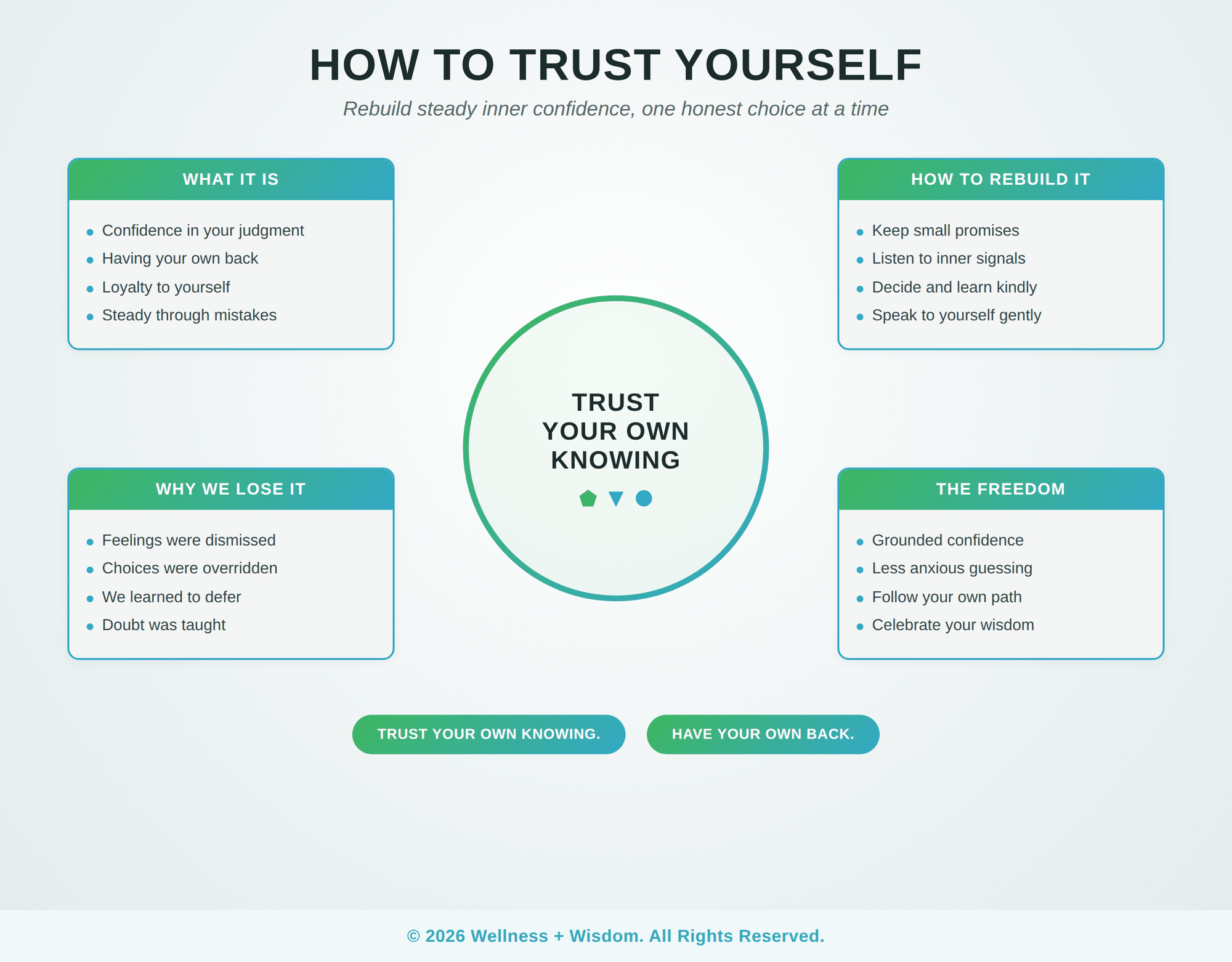
To trust yourself means to have confidence in your own judgment, feelings, and ability to handle whatever life brings, relying on your inner knowing rather than constantly seeking permission from outside. It is the felt sense that you can genuinely count on yourself, that you will listen to your own wisdom and have your own back through both good decisions and genuinely hard moments. Self trust is a quiet, steady, and unwavering loyalty to yourself, no matter what unfolds.
This does not mean believing you are always right or never make mistakes. Real self trust always includes room for being wrong, because it rests not on perfection but on the quiet confidence that you will learn, adjust, and care for yourself no matter what happens. Someone with genuinely strong self trust can make a real mistake and still trust themselves fully, because their confidence is rooted in steady self loyalty rather than in flawless outcomes.
Self trust touches every part of life. It shapes how you make decisions, how you handle challenges, and how freely you can follow your own path in life rather than living by everyone else's expectations. When you truly learn to trust yourself, your whole life begins to feel far more grounded, because you are no longer outsourcing your confidence to other people's shifting approval, a theme we return to often on the Wellness + Wisdom Podcast.
Why We Lose Trust in Ourselves
We usually lose trust in ourselves gradually, through early experiences that taught us to doubt our own knowing and defer to others. As children, many of us learned that our feelings were dismissed, our choices were overridden, or our worth depended on pleasing others, and we slowly concluded that we could not fully rely on ourselves. Over time, this quietly erodes the natural self trust we were each born with as children.
The landmark Adverse Childhood Experiences research by Vincent Felitti and colleagues, published in the American Journal of Preventive Medicine, showed how deeply early experiences shape who we become. When a young person learns that their inner world is not safe to trust or express openly, they very often grow into an adult who second guesses themselves and looks outside for the answers. Understanding this with real compassion is essential, because losing self trust was never a personal failing on your part, it was an entirely understandable adaptation to your circumstances.
Seeing the roots of self doubt clearly is genuinely freeing, because it means the doubt is not the truth of who you are. It was learned, and what was learned can be gently unlearned as you build a new, trusting relationship with yourself. The wisdom you set aside long ago did not disappear at all, it has simply been waiting quietly for you to return to it, which is deeply connected to healing our inherited beliefs.
The Science of Self Trust
The science of the mind offers real support for the practice of building self trust. One of the most powerful tools is simply learning to know and name your own inner experience. Research by Matthew Lieberman and colleagues, published in Psychological Science, found that putting feelings into words reduces activity in the brain's alarm center and helps us relate to our experience more clearly. The better you come to understand your own inner world, the more naturally you can begin to trust it.
Understanding how we were shaped matters too. The Adverse Childhood Experiences research by Felitti and colleagues shows how profoundly early environments influence our sense of self, which means part of rebuilding self trust is recognizing that our self doubt was learned rather than deserved. Seeing this clearly lets you separate old conditioning from your genuine inner wisdom with compassion and insight.
There is an uplifting dimension as well. Barbara Fredrickson's research, published in American Psychologist, shows that positive emotions broaden our awareness and build lasting inner resources, including confidence and resilience. Approaching yourself with warmth and encouragement, rather than relentless harsh criticism, literally helps build the very inner steadiness that self trust is made of. Kindness toward yourself is not soft or indulgent, it is genuinely foundational, supporting the kind of neural system regulation that helps you feel secure.
How to Trust Yourself Again
Learning how to trust yourself again is a gentle, gradual practice of rebuilding a reliable relationship with your own knowing, one honest choice at a time. It grows stronger the more you practice it, and every single small act of self loyalty quietly deepens it further. Here are practices that help.
1. Keep Small Promises to Yourself
Self trust is built the very same way trust with anyone else is built, by keeping your word. Making and keeping small promises to yourself, consistently and over time, proves to your own system that you are genuinely reliable, which steadily rebuilds your confidence in yourself.
2. Listen to Your Inner Signals
Pay real attention to your feelings, instincts, and inner responses rather than habitually dismissing them. Learning to notice and honor your own inner signals, as you would a wise friend's counsel, gradually rebuilds your relationship with your inner knowing and strengthens your emotional intelligence.
3. Make Decisions and Learn From Them
Practice making real decisions from your own judgment, then learning from the results with genuine kindness rather than harsh self blame. Each decision you make and honor, whatever the eventual outcome, quietly teaches you that you can rely on yourself to choose wisely and adjust as needed.
4. Speak to Yourself With Kindness
Notice your inner critic when it appears and practice responding instead with the warmth you would offer someone you love. A kind and steady inner voice creates the safety in which self trust can actually grow, while harsh self talk quietly erodes it over time.
5. Honor Your Own Truth
Each and every time you honor what is true for you, even in the smallest of ways, you affirm to yourself that your inner knowing genuinely matters. This steady practice of self honoring rebuilds trust in your own voice and deepens your authentic identity.
Begin with one practice and be patient and kind with yourself, since rebuilding self trust takes time. Every small act of self loyalty is like a deposit in the account of self trust, and that account grows steadily and reliably with practice over time. When you want community and support for this journey, the Liberated Life Tribe is here for you.
Self Trust and Your Inner Voice
At the heart of self trust is learning to hear and honor your own inner voice, the quiet knowing that has been with you all along beneath the noise. So many of us have grown so used to seeking answers outside ourselves that we have quietly stopped listening to our own inner wisdom, even though it is very often the truest guide we have.
Your inner voice speaks quietly through your feelings, your intuition, and your subtle sense of what feels aligned and what does not. Learning to trust yourself means learning to hear this voice again and to give it real weight, rather than automatically overriding it with other people's opinions or your own anxious second guessing. This does not mean ignoring outside input entirely, but it does mean returning real authority to your own inner knowing once again.
Reconnecting with your own inner voice is a gentle, patient practice of listening. Through stillness, breath, and honest, patient attention, you can learn to hear your own wisdom far more clearly and to distinguish it from the noise of fear and old conditioning. The more you genuinely listen to and honor this inner voice, the stronger and clearer it becomes over time, and the more naturally you come to trust yourself, which is beautifully supported by practices like breathwork.
Self Trust and Better Decisions
One of the most practical gifts of self trust is that it transforms how you make decisions, replacing anxious paralysis with grounded clarity. When you trust yourself, you can weigh your options, consult your own wisdom, and choose with far more ease, because you are no longer waiting for outside permission or certainty that will never come.
Without a foundation of self trust, even ordinary decisions can feel genuinely agonizing. We seek endless reassurance, poll everyone around us, and still second guess ourselves long afterward, because deep down we do not trust our own judgment to be enough. This is genuinely exhausting and often keeps us stuck for far too long, since no amount of outside input can ever substitute for the inner confidence to actually choose. Self doubt makes even small decisions feel heavy.
With genuine self trust, decisions become noticeably lighter and clearer. You can still gather input and think things through carefully, but ultimately you trust yourself to make a good choice and to handle whatever happens to unfold next. This does not mean every single decision will be perfect, but it does mean you can decide, act, and adjust with real confidence rather than staying frozen in doubt. The simple ability to trust yourself to choose, and then to live with that choice, is genuinely freeing.
There is also a beautiful upward spiral here. Each time you make a decision from self trust and then handle the outcome, whatever it turns out to be, you prove to yourself once again that you really can rely on your own judgment. This steadily deepens your confidence over time, making future decisions noticeably easier and reinforcing the very trust you are working to build, much like the momentum of learning to build genuine self worth.
Rebuilding Self Trust in the L.I.F.E. Method
Rebuilding self trust connects deeply to the L.I.F.E. Method™, our system for identity transformation built on four pillars: Liberation, Integration, Frequency, and Embodiment. Self trust is woven through all four, and rebuilding it is a genuine act of coming home to yourself.
Liberation frees you from the inherited doubt and conditioning that taught you to distrust your own knowing. Integration helps you accept and reconnect with all the parts of you, including the deep inner wisdom you may have set aside long ago. Frequency raises your inner state from anxious self doubt toward grounded confidence and quiet joy, and Embodiment lets you actually feel self trust as a steady presence in your body rather than just an idea in your mind.
This is exactly why we hold rebuilding self trust as real, deep transformation work rather than a simple confidence tip. You are not merely feeling a bit more sure of yourself, you are fundamentally restoring your relationship with your own inner authority and wisdom, and reclaiming your place as the trustworthy steward of your own life in Connection to Creator and God. That is a deep and joyful freedom, one that changes how you move through everything, and it grows through your whole self growth journey.
Celebrating Your Own Wisdom
The most beautiful part of rebuilding self trust is learning to celebrate your own wisdom, to honor the inner knowing you carry rather than constantly doubting it. So often we quietly dismiss our own insight and defer to others out of habit, but the deeper invitation here is to recognize and genuinely delight in the real wisdom that lives within you.
Celebrating your own wisdom means noticing the many times your instincts were right, honoring the good decisions you have made along the way, and appreciating the inner guidance that has quietly carried you this far. It means learning to look at yourself as someone genuinely worth trusting, with real warmth and quiet respect. This kind of celebration is not arrogance in the slightest but a joyful recognition of the wise, capable self you have always been, a practice we cherish in learning to celebrate yourself.
And here is the beautiful ripple. When you trust and celebrate your own wisdom, you naturally give others permission to trust themselves too. Your grounded, self trusting presence quietly becomes an invitation to everyone around you to reconnect with their own inner knowing too. In this way, learning to trust yourself becomes a gift that extends far beyond you, quietly strengthening everyone you touch, which deepens as you keep coming home to yourself.
When Self Trust Feels Hard
If trusting yourself feels difficult at times, you are in good company, and understanding the common obstacles helps you move through them with compassion. One of the most frequent is a history of harsh self judgment, where every mistake became evidence against yourself, making it hard to build the self loyalty that trust requires. Meeting your mistakes with genuine kindness instead is very often the first real step back toward trusting yourself again.
Another common obstacle is a lifetime of seeking outside validation, which can leave your own inner voice feeling faint and unfamiliar. Gently returning your attention to your own inner knowing, even when it feels faint and quiet at first, gradually strengthens it over time. Like any relationship, the one with yourself deepens through consistent, caring attention over time, which takes real emotional courage.
Sometimes self trust feels hard because of past decisions we regret, which can leave us wary of our own judgment. Yet even here, the way forward is always compassion, recognizing that you made the best choice you could with what you knew at the time, and that you can learn and grow from it rather than condemn yourself. The way through all of these obstacles is the same gentle practice, returning again and again to self kindness, self honoring, and the steady rebuilding of trust in your own beautiful wisdom, one small step at a time, much like learning to celebrate small wins.
Self Trust Is a Lifelong Practice
Self trust is not a destination you arrive at once and then possess forever, but a living relationship you tend across your whole life. Like any meaningful relationship, the one with yourself grows deeper and steadier through consistent, caring attention over time. This is wonderful news, because it means self trust is always available to be strengthened, no matter where you are starting from.
This understanding gently takes the pressure off ever getting it perfect. You do not have to build unshakeable self trust overnight, and you will certainly have moments of doubt along the way, which is completely and utterly human. What matters most is the overall direction, the steady returning again and again to self loyalty and self kindness that gradually builds a trusting relationship with yourself over the years.
Understanding self trust as a lifelong practice also keeps it alive and growing. Each new season of life offers fresh opportunities to deepen your trust in yourself, to honor your wisdom in new circumstances, and to prove to yourself once again that you truly have your own back. Over time, self trust becomes less something you have to actively work at and more simply who you are, a steady inner foundation you can always return to whenever you need it.
So approach your own journey with real patience and warmth toward yourself. There is no finish line, only the ongoing, joyful practice of coming home to yourself and trusting your own beautiful wisdom more and more fully. This steady, growing inner foundation supports every single dimension of your whole person wellness, and it only grows richer with time.
Frequently Asked Questions
What does it mean to trust yourself?
To trust yourself means to have confidence in your own judgment, feelings, and ability to handle whatever life brings, relying on your inner knowing rather than constantly seeking outside permission. It is the felt sense that you can count on yourself and will have your own back through both good decisions and hard moments. Self trust is a quiet, steady loyalty to yourself.
Why do I struggle to trust myself?
Usually because early experiences taught you to doubt your own knowing and defer to others. Many of us learned our feelings were dismissed or our choices overridden, and slowly concluded we could not rely on ourselves. Research shows early environments deeply shape our sense of self, so self doubt is a learned adaptation rather than a personal failing, and it can be unlearned.
How do I learn to trust myself again?
Begin by keeping small promises to yourself, which proves you are reliable. Listen to your inner signals rather than dismissing them, make decisions and learn from them with kindness, speak to yourself with warmth, and honor your own truth in small daily ways. Each act of self loyalty is a deposit that steadily rebuilds self trust over time.
Does self trust mean I will never be wrong?
No. Real self trust includes room for being wrong, because it rests not on perfection but on the confidence that you will learn, adjust, and care for yourself no matter what. Someone with strong self trust can make a mistake and still trust themselves, because their confidence is rooted in self loyalty rather than flawless outcomes.
Is there science behind building self trust?
Yes. Lieberman's research shows naming your inner experience calms the brain's alarm center and helps you understand yourself, which supports trusting yourself. Felitti's work shows early environments shape our self doubt, so we can see it as learned. Fredrickson's research shows positive emotion and self kindness build the inner confidence and resilience that self trust requires.
How do I reconnect with my inner voice?
Through stillness, breath, and honest attention, you can learn to hear your own wisdom more clearly and distinguish it from the noise of fear and conditioning. Your inner voice speaks through your feelings, intuition, and sense of alignment. The more you listen to and honor it, the stronger and clearer it becomes, and the more naturally you trust yourself.
Studies and External Resources
The science in this article rests on peer reviewed research. These are the sources referenced throughout.
- Lieberman MD, et al. (2007). Putting Feelings Into Words: Affect Labeling Disrupts Amygdala Activity in Response to Affective Stimuli. Psychological Science. PubMed: 17576282
- Felitti VJ, et al. (1998). Relationship of Childhood Abuse and Household Dysfunction to Many of the Leading Causes of Death in Adults. American Journal of Preventive Medicine. PubMed: 9635069
- Fredrickson BL. (2001). The role of positive emotions in positive psychology. The broaden-and-build theory of positive emotions. American Psychologist. PubMed: 11315248
About Josh Trent
Josh Trent is an Identity Transformation Architect and the award winning host of the Wellness + Wisdom Podcast, with over 15 million downloads since 2015. He is the creator of the L.I.F.E. Method™ Identity Transformation System and steward of the Emotional Epigenetics™ and BREATHE: Breath + Wellness™ systems of self mastery, impacting over 1,000 students worldwide. Join the Liberated Life Tribe and receive your 10 day Self Liberation Blueprint at liberatedlife.com. Josh lives in Austin, Texas with his wife Carrie, daughter Nayah, and son Novah. Peace and power.
Disclosure: We may earn a commission from certain links on this site when you make a purchase, at no extra cost to you. These commissions help support Wellness + Wisdom and do not affect the products or resources we choose to recommend. Full disclosure .