
By Josh Trent | Wellness + Wisdom Podcast Host & Identity Transformation Architect
“Gratitude is not waiting until life is perfect to say thank you. It is the daily practice of noticing what is already good, and in that noticing, ordinary life quietly becomes a celebration.”
Josh Trent
Learning how to practice gratitude is one of the most transformative habits you can build, because gratitude has a quiet power to shift your whole experience of life toward joy. So many of us move through our days quietly focused on what is missing, what went wrong, and what we still think we need, overlooking the countless gifts already surrounding us right now. Practicing gratitude gently reverses all of that, training your attention toward the goodness that is already here in front of you, and quietly turning ordinary days into something genuinely worth celebrating. This joyful practice sits at the heart of the L.I.F.E. Method™.
Here is the joy forward truth at the center of it all. You do not have to wait for your life to be perfect before you can feel grateful, because gratitude is genuinely available right now, in the ordinary life you already have. When you learn how to practice gratitude as a genuine daily habit, you steadily rewire your attention toward joy, and life begins to feel richer, warmer, and far more full of blessing than before. Let us explore exactly how, along with the beautiful science behind it.
Table of Contents
- What It Means to Practice Gratitude
- Why Gratitude Is So Powerful
- Gratitude Versus Forced Positivity
- The Science of Gratitude
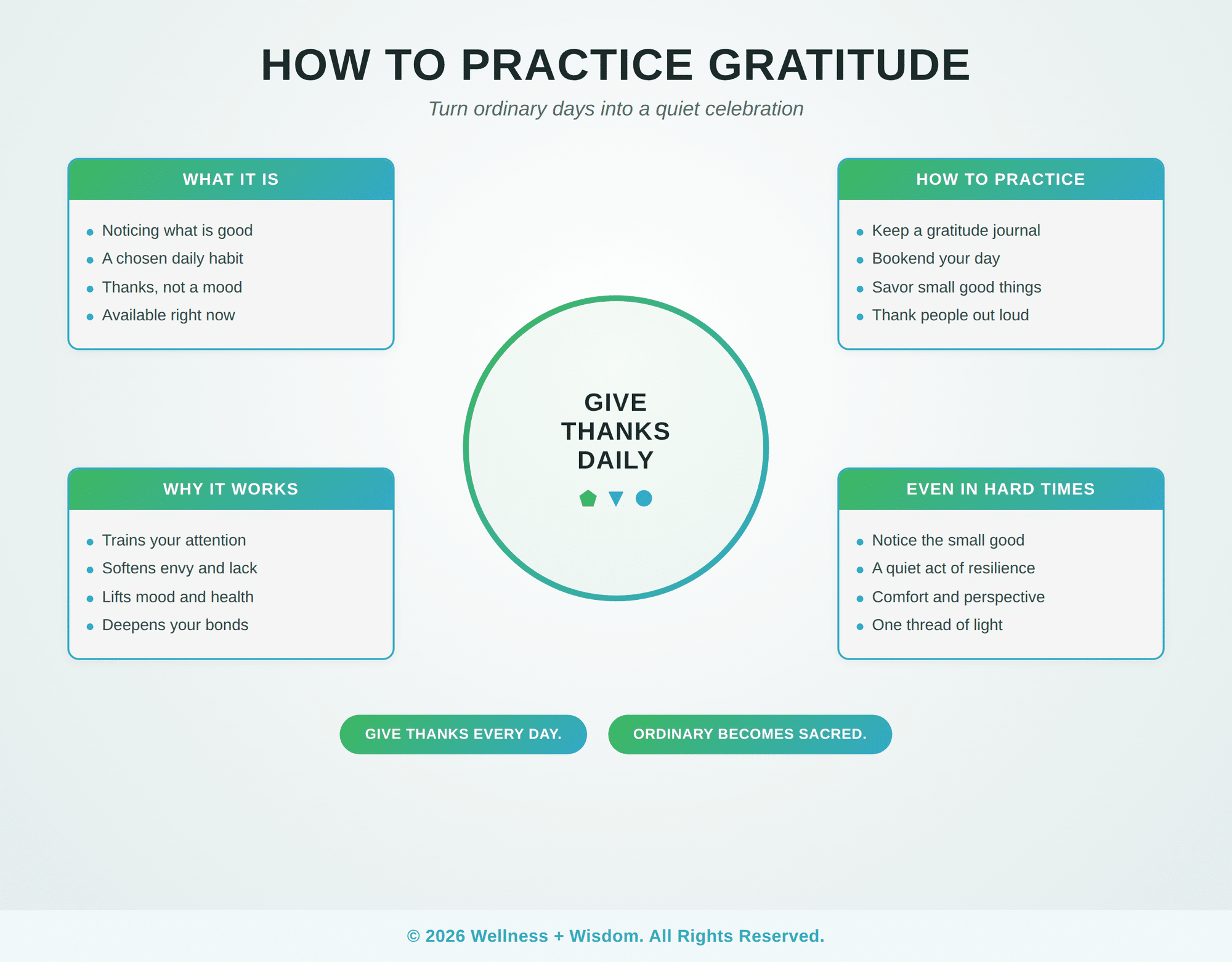
- How to Practice Gratitude Every Day
- Building a Gratitude Habit That Lasts
- Gratitude as a Spiritual Practice
- Gratitude and the Wellness Pentagon
- Gratitude Even in Hard Times
- Celebrating Life Through Gratitude
- Frequently Asked Questions
- Studies and External Resources
- About Josh Trent
What It Means to Practice Gratitude
To practice gratitude means to intentionally notice, appreciate, and give heartfelt thanks for the good things in your life, both large and small. It is an active, deliberate daily habit of turning your attention toward what is going well rather than only toward what is lacking. Gratitude is not merely a fleeting feeling that happens to visit when things go your way, it is a real practice you can cultivate on purpose, day after day, whatever the circumstances.
This is exactly what makes gratitude so wonderfully accessible and powerful. While a spontaneous feeling of thankfulness naturally comes and goes, a gratitude practice is something you actively and deliberately choose, training your mind to notice blessings whether or not you happen to feel grateful in that particular moment. Over time, this one steady practice reshapes your entire default way of seeing the world, so appreciation slowly becomes far more natural than complaint.
Understanding gratitude as an active practice, rather than just a passing mood, is genuinely freeing. It means you do not have to wait to feel grateful before you begin at all, you simply start noticing and giving thanks, and the genuine feeling follows the practice. Learning how to practice gratitude is a skill that absolutely anyone can build, and it grows stronger every single time you use it, a theme we return to often on the Wellness + Wisdom Podcast.
Why Gratitude Is So Powerful
Gratitude is powerful because it directly shifts where your attention goes, and where your attention goes shapes your entire experience of life. When you practice gratitude regularly, you train your mind to notice the good, and a mind trained toward goodness experiences far more joy, contentment, and quiet peace than a mind trained toward lack ever will.
This matters because our attention is naturally drawn toward problems and threats, an ancient survival tendency that can easily leave us overlooking the abundant good already present in our lives. Gratitude gently counterbalances this ancient tendency, deliberately turning our focus toward the many blessings we would otherwise miss entirely. Over time, this rewires our default outlook, so we begin to naturally notice and appreciate the goodness that surrounds us, which supports the whole person joy of the Wellness Pentagon™.
The ripple effects are beautiful. Gratitude reliably tends to lift our mood, deepen our relationships, and increase our overall sense of wellbeing and joy over time. It naturally softens envy and comparison, since it is genuinely hard to feel lacking when you are focused on all that you already have. In these ways, learning how to practice gratitude becomes one of the simplest and most reliable paths to a happier, more joyful life, closely connected to learning to cultivate everyday joy.
Gratitude Versus Forced Positivity
One important distinction on this journey is the difference between genuine gratitude and forced positivity, because they are not the same thing at all. Real gratitude honors the full truth of your experience while also noticing the good, whereas forced positivity denies difficult feelings and simply pretends everything is fine. Understanding this one difference keeps your whole gratitude practice honest, grounded, and healthy.
Forced positivity, sometimes called toxic positivity, insists that you should only ever feel good and dismisses any difficult emotion as mere negativity to be avoided and pushed away. This can actually be genuinely harmful, because it asks you to suppress real feelings rather than honor them, which tends to make those very feelings louder over time. Gratitude was truly never meant to be a way of bypassing or avoiding your genuine emotions.
True gratitude, by contrast, always makes room for the full range of human experience. You can feel genuinely sad, frustrated, or afraid and still notice the good that exists right alongside those feelings. Gratitude never requires you to deny your struggles, it simply invites you to also see the blessings, holding both the hard and the good together with an open heart. This kind of honest gratitude is far more nourishing and sustainable over time than any forced cheerfulness could ever be.
This is why we always practice gratitude in a grounded, honest way. We are never pretending life is perfect or pushing away real emotions, we are simply choosing to also notice and give thanks for the good that is genuinely there. This kind of authentic, honest gratitude honors your whole experience while still opening your heart to real joy, which is a beautiful expression of true emotional intelligence.
The Science of Gratitude
The science of positive emotion offers beautiful support for the practice of gratitude. The researcher Barbara Fredrickson, in work published in American Psychologist, developed the broaden and build theory of positive emotions. Her research shows that positive emotions like gratitude broaden our awareness and, over time, build lasting personal resources, everything from resilience to relationships to physical health. Gratitude is not just pleasant, it is genuinely constructive.
Gratitude reaches the body as well. Research by Bethany Kok and Barbara Fredrickson, published in Psychological Science, found that positive emotions and warm social connection support physical wellbeing in an upward spiral, each feeding the other over time. A gratitude practice, which generates real positive emotion and often deepens connection, is a genuine, lasting investment in your physical health, not merely a pleasant idea.
Even our resistance to stress is affected. The classic research by Sheldon Cohen and colleagues, published in the New England Journal of Medicine, showed that our psychological state influences our vulnerability to illness, revealing how deeply mind and body are connected. A life rich in daily gratitude supports not only our emotional wellbeing but our physical resilience over time, which is exactly why we treat gratitude as genuine medicine, supporting the kind of neural system regulation that helps you thrive.
How to Practice Gratitude Every Day
Learning how to practice gratitude every day is simple, and it grows more natural the more you do it. The goal is to gently weave small, intentional moments of thankfulness into your everyday life, so that gratitude becomes a steady daily rhythm rather than an occasional afterthought. Here are simple, powerful practices to begin.
1. Keep a Gratitude Journal
Each day, simply write down a few specific things you are grateful for, savoring each one as you write it. This one simple daily practice trains your mind to actively search for the good, and it gives you a joyful record to revisit on harder days, which pairs beautifully with journaling.
2. Begin and End Your Day With Thanks
Bookend your whole day with gratitude, naming a few genuine blessings when you first wake and again just before you sleep. This gentle morning and evening practice steadily and reliably tunes your attention toward goodness, and it works beautifully as part of a grounded morning routine.
3. Savor the Small Good Things
Slow down just enough to truly appreciate the small blessings of daily life, a warm meal, a kind word, or sunlight streaming through the window. Learning to truly savor these ordinary gifts multiplies the gratitude already quietly available in every single day.
4. Express Your Gratitude to Others
Tell the people in your life exactly what you appreciate about them, out loud and often. Expressing your gratitude out loud deepens your relationships and multiplies the joy for everyone involved, which is a beautiful part of learning to celebrate the people you love.
5. Give Thanks in Prayer or Stillness
Take a few quiet moments each day to give thanks in prayer, meditation, or simple, unhurried stillness. This quiet practice connects your gratitude to something far deeper and helps it become a steady orientation of the heart rather than just a passing mental exercise.
Begin with just one practice and let it gradually become a natural daily habit. Learning how to practice gratitude is a skill that steadily strengthens with use, and every small moment of thankfulness builds a more grateful, joyful heart over time. When you want warm community for this joyful journey, the Liberated Life Tribe is here for you.
Building a Gratitude Habit That Lasts
Knowing how to practice gratitude is one thing, and actually building a gratitude habit that lasts for years is another, so it genuinely helps to understand how to make the practice stick. The very good news is that gratitude is honestly one of the easiest habits there is to build, because it is simple, quick, and immediately rewarding in the moment.
The real key to a lasting gratitude habit is to keep it small and gently attach it to something you already do every day. Rather than committing to some elaborate practice you will abandon within a week, simply tie a small moment of gratitude to an existing daily anchor, giving thanks while you drink your morning coffee, or naming a few blessings quietly as your head hits the pillow at night. Anchoring your gratitude to an existing daily routine makes it far easier to remember and to sustain over the long run.
It also helps to make your gratitude specific and heartfelt rather than generic. Instead of vaguely noting that you are grateful for your life in general, name the particular warmth of the sun on your face, the specific kindness a friend showed you today, or the exact taste of a really good meal. Specific gratitude lands far more deeply and trains your attention much more powerfully than vague appreciation, and it keeps the whole practice feeling alive rather than rote and mechanical.
Finally, be patient and gentle with yourself as the habit forms. You will certainly miss days here and there, and that is completely fine, simply return gently to the practice without judgment. Over time, giving thanks becomes second nature to you, a natural, easy rhythm woven through your days rather than a task you have to consciously remember. This is how a simple daily practice gradually becomes a grateful, joyful, and lasting way of life, much like the steady momentum of learning to celebrate small wins.
Gratitude as a Spiritual Practice
At its deepest level, gratitude is a spiritual practice, a way of honoring the gift of life itself and opening your heart to the sacred. Across time and nearly every tradition, gratitude has been recognized as a doorway to deeper connection, humility, and joy, a way of gently acknowledging that so much of what we have is truly a gift we did not earn or deserve.
Spiritually, gratitude flows naturally from your Connection to Creator and God, from the deep recognition that your very life, your breath, and the whole world around you are gifts to be cherished. When you practice gratitude as a spiritual act, you are not merely counting blessings, you are giving thanks to the very source of all blessing, which fills your gratitude with deep reverence and meaning. This kind of grounded gratitude nourishes the soul just as deeply as it lifts the mood.
Practicing gratitude spiritually also gently cultivates deep humility and trust. It gently and steadily reminds us that we are held, provided for, and part of something far larger than ourselves, which brings a deep and steady peace that circumstances cannot easily shake. And when gratitude becomes a true way of relating to the sacred, it transforms from a merely helpful habit into a genuine spiritual path, one that grounds our whole approach to spiritual wellness.
Gratitude and the Wellness Pentagon
Practicing gratitude nourishes every dimension of your wellbeing, which is why it connects so beautifully to the Wellness Pentagon™, our whole person framework spanning the physical, mental, emotional, spiritual, and financial dimensions of a thriving life. Gratitude is not a separate category but a current that flows through them all, strengthening the whole.
Emotionally, gratitude reliably lifts your mood and builds resilience, while mentally it trains your focus toward the positive and gently calms anxious thinking. Physically, as the research clearly shows, a genuinely grateful state supports your health and resilience over time. Spiritually, gratitude deepens your sense of connection and reverence, and even in the financial dimension, a grateful heart brings contentment and generosity rather than the restless grasping of never enough. In this way, gratitude quietly nourishes the entire pentagon all at once.
This is exactly why we hold gratitude as such an essential daily practice rather than a merely pleasant extra. Cultivating thankfulness is never separate from your wellbeing, it is genuinely one of the most powerful ways to support all of it at the very same time. When you truly practice gratitude, you are caring for your whole self, raising your frequency toward joy and appreciation across every single dimension of your life, which is the very heart of learning to celebrate small wins.
Gratitude Even in Hard Times
One of the most powerful truths about gratitude is that it remains available even in hard times, offering a steady light when life feels heavy. Practicing gratitude does not mean denying difficulty or forcing false positivity in any way, it means choosing to also notice the good that exists alongside the hard, which can be a genuine and steadying source of strength.
In genuinely difficult seasons, gratitude may look different and feel much harder to reach, and that is completely understandable. The blessings you notice may be very small, a moment of rest, a kind gesture, a single breath of fresh air, but honoring them can offer real comfort and perspective when things feel heavy. This is never about pretending everything is fine, but about finding the quiet threads of goodness that remain even in hard times, which can gently sustain you through them.
Gratitude practiced in hard times is a quiet but genuine act of resilience. It does not erase the difficulty at all, but it keeps your heart open to the good that still exists alongside it, which helps you endure and eventually heal. If a season feels truly overwhelming, please also reach out to trusted people and qualified support, and let gratitude be one gentle thread of light within a wider circle of care. Even a very small practice of thankfulness can be a genuinely steadying companion through hard times, and it takes real emotional courage.
Celebrating Life Through Gratitude
The most beautiful fruit of practicing gratitude is that it becomes a way of celebrating life itself, turning your ordinary days into an ongoing appreciation of the gift of being alive. When gratitude becomes deeply woven through your daily rhythm, you stop taking your everyday blessings for granted and start genuinely delighting in them.
Celebrating life through gratitude means learning to treat each new day as an opportunity to notice and give thanks for the countless gifts that quietly fill an ordinary life, from the people you love to the simple pleasures of a warm meal or a beautiful evening sky. It means gradually letting appreciation become your steady daily orientation, so that joy and thankfulness gradually color your whole experience of life. Gratitude gradually turns life from something we rush anxiously through into something we genuinely savor and celebrate, a spirit we cherish in learning to celebrate yourself.
And here is the beautiful ripple. When you practice gratitude as a genuine way of life, your thankfulness becomes quietly contagious, gently inspiring everyone around you to notice their own blessings too. Your visible, unforced appreciation for life becomes a quiet invitation, quietly showing everyone around you that joy is truly available right here in the ordinary. In this way, learning how to practice gratitude becomes a gift that ripples far beyond yourself, brightening every relationship and community you touch, which is the spirit we share in the Liberated Life Tribe and our journey home to ourselves.
Frequently Asked Questions
What does it mean to practice gratitude?
To practice gratitude means to intentionally notice, appreciate, and give thanks for the good things in your life, both large and small. It is an active, deliberate habit of turning your attention toward what is going well rather than only what is lacking. Gratitude is not merely a fleeting feeling but a practice you can cultivate on purpose, day after day.
How do I start a daily gratitude practice?
Begin by keeping a gratitude journal, writing a few things you are thankful for each day. Bookend your day with thanks when you wake and before you sleep, savor the small good things, express appreciation to others, and give thanks in prayer or stillness. Start with one practice and let it become a natural daily habit.
Why is gratitude so powerful?
Because it directly shifts where your attention goes, and where your attention goes shapes your entire experience. Gratitude trains your mind to notice the good, which brings more joy, contentment, and peace. It lifts mood, deepens relationships, softens envy and comparison, and increases overall wellbeing, making it one of the simplest paths to a happier life.
Is there science behind gratitude?
Yes. Fredrickson's broaden and build research shows positive emotions like gratitude build lasting resources such as resilience. Kok and Fredrickson found positive emotion and connection support physical health in an upward spiral. Cohen's research shows our psychological state influences vulnerability to illness. A gratitude practice is a genuine investment in emotional and physical wellbeing.
Can I practice gratitude during hard times?
Yes, and it can be a real source of strength. Practicing gratitude in hard times does not mean denying difficulty or forcing positivity, it means also noticing the good that exists alongside the hard. The blessings may be small, but honoring them offers comfort and perspective. Please also seek trusted support when a season feels overwhelming.
Is gratitude a spiritual practice?
It can be one of the deepest. Spiritually, gratitude flows from your Connection to Creator and God, from recognizing that your life, breath, and the world are gifts. Practicing gratitude as a spiritual act fills it with reverence and meaning, cultivates humility and trust, and brings a deep peace that circumstances cannot shake.
Studies and External Resources
The science in this article rests on peer reviewed research. These are the sources referenced throughout.
- Fredrickson BL. (2001). The role of positive emotions in positive psychology. The broaden-and-build theory of positive emotions. American Psychologist. PubMed: 11315248
- Kok BE, Fredrickson BL, et al. (2013). How positive emotions build physical health. Psychological Science. PubMed: 23649562
- Cohen S, et al. (1991). Psychological stress and susceptibility to the common cold. New England Journal of Medicine. PubMed: 1713648
About Josh Trent
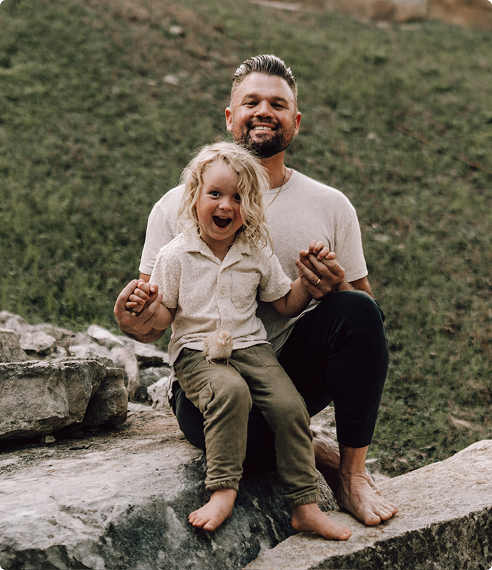
Josh Trent is an Identity Transformation Architect and the award winning host of the Wellness + Wisdom Podcast, with over 15 million downloads since 2015. He is the creator of the L.I.F.E. Method™ Identity Transformation System and steward of the Emotional Epigenetics™ and BREATHE: Breath + Wellness™ systems of self mastery, impacting over 1,000 students worldwide. Join the Liberated Life Tribe and receive your 10 day Self Liberation Blueprint at liberatedlife.com. Josh lives in Austin, Texas with his wife Carrie, daughter Nayah, and son Novah. Peace and power.
Disclosure: We may earn a commission from certain links on this site when you make a purchase, at no extra cost to you. These commissions help support Wellness + Wisdom and do not affect the products or resources we choose to recommend. Full disclosure .