
By Josh Trent | Wellness + Wisdom Podcast Host & Identity Transformation Architect
“How you begin your morning is how you introduce yourself to your own life. A morning routine is how you greet each day on purpose, with love.”
Josh Trent
Learning how to create a morning routine you truly love is one of the most quietly transformational things you can do, because the first hour of your day sets the emotional tone for every hour that follows. So many of us start the day in reaction mode, grabbing the phone before our feet touch the floor and letting other people's urgency become our first feeling. A morning routine flips that. It gives you a few protected moments to arrive in your own body, connect with what matters, and choose the energy you want to carry into the world. It also happens to be the perfect home for the identity work inside our L.I.F.E. Method™ programs and a daily breath practice like BREATHE™.
Here is the joy forward truth at the center of it all. A great morning routine is not about waking up at four or squeezing in twenty productivity hacks. It is about creating a simple rhythm that makes you feel alive, grounded, and ready. When you build a morning routine that fits your real life, mornings stop feeling like a race and start feeling like a gift you give yourself every single day. Let us explore exactly how.
Table of Contents
- What a Morning Routine Really Is
- Why Most Mornings Feel Rushed
- The Gift of an Intentional Morning
- The Science of a Great Morning
- How to Create a Morning Routine
- A Rhythm Versus a Rigid Checklist
- How to Create a Morning Routine With the Wellness Pentagon™
- Celebrating Each Good Morning
- Your Morning Routine Will Grow With You
- When Mornings Feel Hard
- Frequently Asked Questions
- Studies and External Resources
- About Josh Trent
What a Morning Routine Really Is
A morning routine is a consistent sequence of simple, supportive actions you do shortly after waking to prepare your body, mind, and spirit for the day ahead. It can take five minutes or an hour. What makes it a routine is not its length but its consistency and its intention.
Think of your morning routine as a ritual of arrival. You are moving from the stillness of sleep into the activity of the day, and that transition matters. Done with care, it helps your body wake up gently, settles your mind, and reminds you who you are before the world starts asking things of you. Done in a rush, the transition can leave you feeling scattered for hours.
A beautiful morning routine usually blends a few simple elements: something for the body, like light, water, or movement; something for the mind, like setting an intention; something for the heart, like gratitude; and something for the spirit, like prayer or stillness. You do not need all of them every day, and you certainly do not need a complicated system. You need a rhythm that feels like you. Conversations about morning rituals come up often on the Wellness + Wisdom Podcast, and I am always struck by how simple the most powerful ones are.
Why Most Mornings Feel Rushed
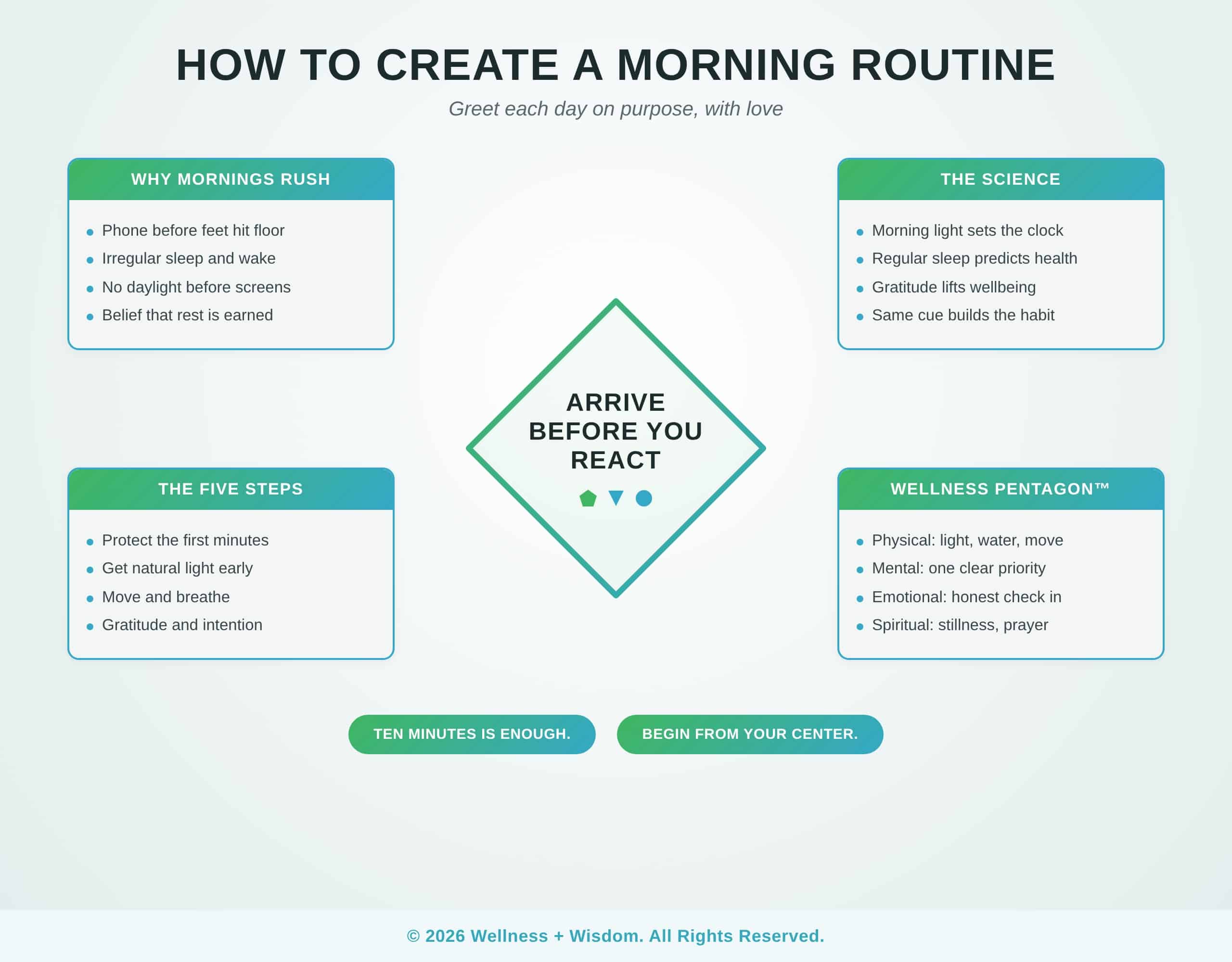
Most mornings feel rushed because we wake up into other people's priorities before we have connected with our own. The phone comes first, then the news, then the inbox, and before we have taken a conscious breath, our neural system has already shifted into a hurried, reactive state.
Irregular sleep plays a big role too. When bedtimes and wake times swing widely from day to day, your internal clock struggles to know when to release the hormones that help you feel alert in the morning. Many of us also go straight from bed to screen to car without ever seeing natural daylight, which is one of the main signals your body uses to set its daily rhythm. It is not that you are bad at mornings. It is that your mornings have not been designed to support you yet.
There is a deeper layer as well. Many of us carry a quiet belief that we have to earn rest and that every minute must be productive. So we skip the very practices that would make us calmer and more effective. Seeing this clearly is freeing. A slower, more intentional morning is not a luxury. It is a foundation that lets you move from survival into creation, which is beautifully explored in shifting from survival mode to creation mode.
The Gift of an Intentional Morning
An intentional morning gives you more calm, more energy, clearer focus, and a deeper sense of being the author of your own day. When you start from a grounded place, you carry that steadiness into every meeting, conversation, and decision that follows.
The first gift is emotional. When you spend even ten minutes connecting with yourself before connecting with the world, you are far less likely to be knocked off center by the first stressful email or unexpected change of plans. You have already filled your own cup, so you are not running on empty. The people around you feel the difference, especially the ones you love most.
The second gift is momentum. Small wins early in the day create a feeling of capability that spreads. When you have already moved your body, hydrated, breathed, and set an intention by eight in the morning, you have kept several promises to yourself. That builds self trust, and self trust is the fuel for everything else you want to create. This is why a morning routine is one of my favorite ways to practice learning to trust yourself again.
The third gift is presence. A morning practiced slowly teaches you that life does not have to be rushed. You start noticing the light through the window, the warmth of your mug, the quiet of the house before everyone wakes. These moments were always there. Your routine simply makes room for them.
The Science of a Great Morning
The science of a great morning shows that daylight helps set your internal clock, that regular sleep and wake times are strongly linked with long term health, that gratitude practices lift wellbeing, and that routines become automatic through repetition in a consistent context. A morning routine brings all of these together.
Start with light. A review by Christine Blume, Corrado Garbazza, and Manuel Spitschan in Somnologie explains that light is the most powerful signal for your circadian system. Light in the morning tends to shift your internal clock earlier, helping you feel alert during the day and sleepy at night, while bright light in the evening tends to push it later. Light also influences mood and alertness directly. Stepping outside for morning light is one of the simplest ways to tell your body that the day has begun.
Next, consider consistency. In a study published in Sleep, Daniel Windred and colleagues analyzed accelerometer data from about 60,000 adults in the UK Biobank and found that sleep regularity, meaning how consistent sleep and wake times are from day to day, was a stronger predictor of mortality risk than sleep duration. A consistent wake time anchors your morning routine and supports a healthier rhythm overall.
Then there is gratitude. In a classic experiment published in the Journal of Personality and Social Psychology, Robert Emmons and Michael McCullough found that people who regularly wrote down things they were grateful for felt better about their lives, were more optimistic about the coming week, and reported fewer physical complaints than people who wrote about hassles. Finally, research summarized by Benjamin Gardner and colleagues in the British Journal of General Practice shows that repeating a simple action in response to the same daily cue is one of the most reliable ways to make it automatic. Morning is the perfect cue, because it happens every single day.
How to Create a Morning Routine
You learn how to create a morning routine by protecting the first minutes from your phone, getting natural light, moving and breathing, practicing gratitude and intention, and keeping it simple enough to repeat every day. These five steps can be woven together in as little as ten minutes. Here is how I practice and teach them.
1. Protect the First Minutes
Keep your phone out of reach for the first part of your morning, ideally charging outside the bedroom. Give yourself at least ten minutes to wake up in your own body before you invite the world in. This single boundary changes how the whole day feels, because your first feeling becomes your own rather than a reaction to someone else's message.
2. Get Natural Light Early
Step outside, open the curtains wide, or sit by a bright window soon after waking. Even a few minutes of morning daylight helps signal to your body that the day has begun. If you can combine it with a short walk, even better. On grey days, outdoor light is still far brighter than most indoor lighting, so it is worth heading outside when you can.
3. Move and Breathe
Give your body a few minutes of gentle movement, like stretching, a short walk, or a few yoga poses, followed by a simple breath practice. Movement wakes up your circulation, and slow, intentional breathing settles your neural system. A few rounds of box breathing is a wonderful place to start. Some people also love a brief cold splash or cold shower as part of this step, and the science behind that is explored in cold exposure epigenetics.
4. Practice Gratitude and Set an Intention
Take a moment to name three things you are grateful for and one intention for the day. Your intention can be a quality, like patience or courage, or a simple focus, like being fully present with your family tonight. Writing these down in a journal makes them even more powerful, which is beautifully supported by the research on journaling and brain health. This is also a natural moment for prayer or quiet stillness.
5. Keep It Simple and Repeatable
Start with a routine so simple you could do it on your busiest day. Ten minutes is plenty. Anchor it to something that already happens every morning, like waking up or making coffee, and repeat it in the same order each day so it becomes automatic. This is exactly the approach in how to build healthy habits. You can always add more later once the foundation feels natural.
Choose two or three of these steps to begin, rather than all five at once, and let your routine grow over time. And if you would love daily encouragement from people building intentional lives, the Liberated Life Tribe is a beautiful community to grow with.
A Rhythm Versus a Rigid Checklist
A healthy morning routine is a flexible rhythm that supports you, not a rigid checklist you have to complete perfectly. This distinction matters, because a routine that becomes a source of pressure defeats its own purpose.
Rigid checklists tend to break the first time life gets messy. A child wakes up early. You have a flight. You slept poorly. If your routine only works when everything goes perfectly, you will find yourself abandoning it and feeling like you failed. Many of us have been through this cycle more times than we can count, and it often comes from a perfectionist streak that is worth gently softening, which is the heart of learning to let go of perfectionism.
A rhythm is different. It has a core that stays consistent, like light, breath, and gratitude, and it bends to fit the day you are actually having. On a full morning, your routine might take ten minutes. On a slow Sunday, it might stretch to an hour with a long walk and a leisurely journal session. On a hard day, it might shrink to three breaths and one grateful thought. All of these count. The goal is connection, not completion. When your routine flexes with you, it stays with you for years.
How to Create a Morning Routine With the Wellness Pentagon™
The Wellness Pentagon™ offers a simple way to design a morning routine that nourishes your whole self, by touching each of the five dimensions of wellness: physical, mental, emotional, spiritual, and financial. You do not need a long ritual for each. A single small action per dimension is enough to begin the day feeling whole.
Physical. Drink a glass of water, get morning light, and move your body for a few minutes. These small acts tell your body it is time to wake up with energy and care, and they are a beautiful way to honor your body first thing.
Mental. Choose one clear priority for the day. Rather than starting with a list of fifty tasks, ask yourself what single thing would make today feel meaningful. This brings focus and calms the mental noise that often greets us in the morning.
Emotional. Check in with how you are feeling, without judgment. Simply naming your emotional state, whether it is excitement, tiredness, or worry, helps you meet the day with honesty and self compassion.
Spiritual. Spend a few quiet moments in prayer, meditation, or stillness, nurturing your Connection to Creator and God. Even one minute of silence before the noise of the day can anchor your whole morning in something larger than your to do list.
Financial. Take one intentional money moment, like reviewing your plan for the day's spending or appreciating the resources you have. This small practice builds a calmer, more abundant relationship with money over time. To explore the full framework, visit our mission and the Wellness Pentagon™.
Celebrating Each Good Morning
Celebrating each good morning is one of the simplest ways to make your routine stick, because your brain repeats what feels rewarding. When you take a moment to appreciate the morning you just gave yourself, you strengthen the habit and make tomorrow's routine more likely.
Try a small ritual of celebration at the end of your routine. A deep breath and a smile. A check mark in your journal. A quiet “that was a good start.” It may feel simple, but these tiny moments of recognition send a powerful message to your neural system: this is good, let us do it again. Over time, your mornings begin to feel like something you look forward to rather than something you get through.
You can also celebrate the ripple effects. Notice when you handle a stressful moment with more calm than usual, or when you feel more energy in the afternoon. Connect those wins back to your morning. This helps you see that your routine is working, which keeps you motivated through the inevitable busy weeks. There is a whole practice around honoring these moments in celebrating small wins, and it pairs beautifully with an intentional morning.
Your Morning Routine Will Grow With You
Your morning routine will grow and change with you, because every season of life brings new needs and new possibilities. The routine that serves you as a new parent will look different from the one that serves you during a quiet season of creativity, and both are perfect for their time.
Some seasons call for more stillness. Others call for more movement. During a busy launch at work, your routine might focus on breath and one clear priority. During a season of healing, it might focus on gentle stretching, prayer, and journaling. Let your routine be a living practice that listens to you, rather than a fixed rule you have to obey.
Evenings matter too. A peaceful morning often begins the night before, with a consistent bedtime, a screen free wind down, and permission to rest fully, which is beautifully explored in how to rest without guilt. You will find many guests sharing their own morning and evening rituals across our latest episodes, and it is a joy to hear how different and personal they are.
When Mornings Feel Hard
If mornings feel hard right now, you are in very good company, and it is completely understandable. Building a morning routine does not mean you will suddenly become a cheerful early riser. It means you will gently build a rhythm that supports you, a little at a time, at a pace that honors your real life.
When mornings feel heavy, start with the smallest possible step. One glass of water. One minute of light by the window. One slow breath before you reach for your phone. These tiny actions still count, and they build the foundation for more over time. If you have young children, shift work, or an unpredictable schedule, focus on a portable routine you can do whenever your day begins, rather than a fixed time on the clock. Simple tools like a sunrise alarm, a quality journal, or a breath training device can help, and you can find a few we trust in our wellness tools store.
It is also worth knowing that persistent trouble waking, ongoing exhaustion, or mornings that feel consistently dark and heavy can sometimes point to sleep or mood concerns that deserve care from a qualified health professional. There is real strength in asking for support. Wherever you are, be patient and kind with yourself, and trust that learning how to create a morning routine is something you can absolutely grow into, one gentle morning at a time. If slowing down feels hard in general, the practices in how to slow down are a lovely next step.
Ready to go deeper? Join the Liberated Life Tribe and receive your 10 day Self Liberation Blueprint at liberatedlife.com. It is free, it is guided, and each day's practice fits perfectly into a new morning routine.
Frequently Asked Questions
What should a good morning routine include?
A good morning routine usually includes a few minutes without your phone, natural light, water, gentle movement, a breath practice, and a moment of gratitude and intention. You do not need every element every day. Choose the ones that help you feel grounded and keep the routine simple enough to repeat.
How long should a morning routine be?
Ten minutes is plenty to begin. Consistency matters far more than length. A short routine you do every day will serve you better than a long one you abandon after a week. Many people start small and naturally expand their routine on slower days once the habit feels automatic.
Why is morning sunlight important?
Light is the most powerful signal for your circadian system. Morning light tends to shift your internal clock earlier, helping you feel alert during the day and sleepy at night. Daylight also supports mood and alertness, so stepping outside soon after waking is a simple, powerful habit.
Should I check my phone first thing in the morning?
It helps to wait. Checking your phone immediately invites other people's priorities and urgency into your first moments. Giving yourself at least ten minutes to wake up, breathe, and set an intention lets you start the day from your own center rather than in reaction.
What if I am not a morning person?
You do not need to wake up early to have a great morning routine. Your routine simply begins whenever your day begins. Focus on a consistent wake time, some light, and a few supportive actions. Over time, regular sleep and morning light often make mornings feel easier.
How do I stick to a morning routine?
Keep it small, anchor it to something you already do each morning, and repeat it in the same order. Prepare the night before by setting out your journal or water. Celebrate each completed morning, and if you miss a day, simply return the next morning with the smallest version.
Studies and External Resources
The science in this article rests on peer reviewed research. These are the sources referenced throughout.
- Blume C, Garbazza C, Spitschan M. (2019). Effects of light on human circadian rhythms, sleep and mood. Somnologie. PubMed: 31534436
- Windred DP, et al. (2024). Sleep regularity is a stronger predictor of mortality risk than sleep duration: A prospective cohort study. Sleep. PubMed: 37738616
- Emmons RA, McCullough ME. (2003). Counting blessings versus burdens: an experimental investigation of gratitude and subjective well being in daily life. Journal of Personality and Social Psychology. PubMed: 12585811
- Gardner B, Lally P, Wardle J. (2012). Making health habitual: the psychology of habit formation and general practice. British Journal of General Practice. PubMed: 23211256
About Josh Trent
Josh Trent is an Identity Transformation Architect and the award winning host of the Wellness + Wisdom Podcast, with over 15 million downloads since 2015. He is the creator of the L.I.F.E. Method™ Identity Transformation System and steward of the Emotional Epigenetics™ and BREATHE: Breath + Wellness™ systems of self mastery, impacting over 1,000 students worldwide. Join the Liberated Life Tribe and receive your 10 day Self Liberation Blueprint at liberatedlife.com. Josh lives in Austin, Texas with his wife Carrie, daughter Nayah, and son Novah. Peace and power.
Disclosure: We may earn a commission from certain links on this site when you make a purchase, at no extra cost to you. These commissions help support Wellness + Wisdom and do not affect the products or resources we choose to recommend. Full disclosure .