
By Josh Trent | Wellness + Wisdom Podcast Host & Identity Transformation Architect
“Being heard is so close to being loved that most people cannot tell the difference. Becoming a better listener is learning to offer the people you love the rarest gift on earth: your full presence.”
Josh Trent
Learning how to be a better listener is one of the most loving skills you can ever build, because almost everyone you meet is quietly longing to feel truly heard. After hosting the Wellness + Wisdom Podcast for over a decade, I can tell you that the conversations that changed my life were not the ones where I said the smartest thing. They were the ones where I finally stopped waiting for my turn to talk and actually listened. Listening is not passive. It is one of the most active, generous, and healing things a human being can do.
Here is the joy forward truth at the center of it all. Deep listening does not just help the person speaking. It transforms you too, softening your reactivity, deepening your empathy, and filling your relationships with trust. When you learn how to be a better listener, the people in your life begin to open up in ways that might surprise you, and connection that once felt distant becomes warm and alive. Let us explore exactly how.
Table of Contents
- What Deep Listening Really Means
- Why Listening Feels So Hard
- The Gift of Feeling Heard
- The Science of Listening
- How to Be a Better Listener
- Listening to Understand Versus Listening to Reply
- How to Be a Better Listener With Emotional Epigenetics™
- Celebrating Each Moment of Presence
- Listening Is a Lifelong Practice
- When Listening Feels Difficult
- Frequently Asked Questions
- Studies and External Resources
- About Josh Trent
What Deep Listening Really Means
Deep listening means giving another person your full attention with the intention to understand their experience, rather than to fix, judge, or reply. It is listening with your ears, your eyes, your body, and your heart. It is the difference between hearing words and receiving a person.
Most of us listen at the surface level. We catch the main idea, start forming our response, and wait for the other person to pause so we can jump in. Deep listening goes further. It notices the feeling underneath the words, the pause before a hard sentence, the softening in someone's voice when they talk about something they love. It holds space for what is said and what is not yet said.
Deep listening also has a quality of curiosity and warmth. You are not interrogating someone or analyzing them. You are genuinely interested in their inner world, and they can feel it. That feeling of being received without judgment is what makes people feel safe, and safety is the soil in which every healthy relationship grows. It is also one of the core skills of emotional intelligence, and it can be learned at any age.
Why Listening Feels So Hard
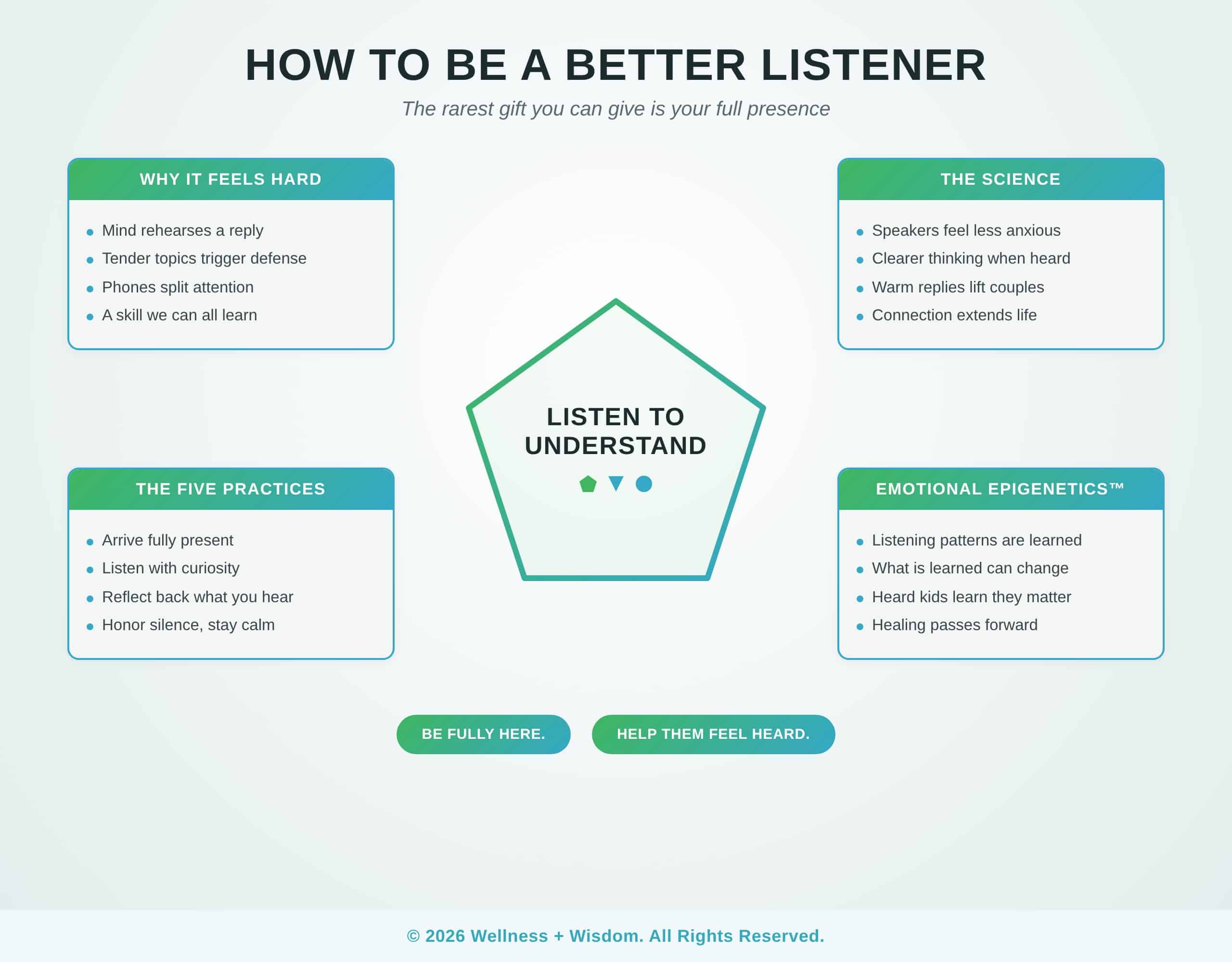
Listening feels hard because our minds are wired to scan for relevance, prepare responses, and protect ourselves, which pulls our attention away from the person in front of us. While someone is talking, your brain is often busy deciding whether you agree, what you will say next, and how their words relate to your own experience. That inner noise competes with the person you are trying to hear.
Emotions make it even harder. When a conversation touches something tender, like criticism, conflict, or an old wound, your neural system can shift into a protective state. In that state, you stop listening to understand and start listening to defend. You might interrupt, explain, or go quiet and shut down. This is a completely human response, and it is the reason difficult conversations can feel so challenging.
Our modern world adds another layer. Phones buzzing, notifications lighting up, and a constant flow of information train our attention to jump rather than rest. Many of us have simply never practiced sustained, undivided presence with another human being. The beautiful news is that listening is a skill, not a fixed trait. Like any skill, it grows with intention and gentle practice, and the practices that help you be present are the very same ones that make you a better listener.
The Gift of Feeling Heard
Feeling heard is one of the deepest human needs, because it tells us we matter, we make sense, and we belong. When someone listens to you fully, something inside you relaxes. You think more clearly, feel more like yourself, and often discover answers you did not know you had.
Think about the last time someone truly listened to you. Maybe you were working through a hard decision, sharing a dream, or processing a loss. They did not rush to fix it. They did not turn the conversation toward themselves. They simply stayed with you. How did that feel? For most of us, those moments are rare and unforgettable. That is the gift you get to give when you become a better listener.
Listening also builds trust faster than almost anything else. When people feel heard by you, they share more honestly, which deepens intimacy, which creates even more safety. This upward spiral is the foundation of secure attachment in adult relationships. Your partner, your children, your friends, and your coworkers all feel it. And here is the part I love: as you give this gift, you receive it back, because people naturally offer presence to those who offer presence to them.
The Science of Listening
The science of listening shows that high quality listening helps speakers feel less anxious, think more clearly, and feel closer to the listener, while strong relationships built on connection are linked to better health and longer life. Listening is not a soft skill. It is a measurable force in human wellbeing.
Researchers Guy Itzchakov, Avraham Kluger, and Dotan Castro have studied what happens when people are listened to with genuine attention, empathy, and no judgment. In a series of experiments published in Personality and Social Psychology Bulletin, speakers who received high quality listening reported less social anxiety and more self awareness, and they were able to explore more nuanced, balanced views on the topic they discussed. In a follow up paper in the same journal, high quality listening helped speakers feel clearer about their own attitudes. When you listen well, you help the other person hear themselves.
Listening matters in the good moments too, not only the hard ones. Research led by Shelly Gable, published in the Journal of Personality and Social Psychology, studied how partners respond when one person shares good news. When the listener responded with active, genuine enthusiasm, couples reported greater relationship satisfaction and both partners experienced more positive emotion. How you listen to joy is just as important as how you listen to pain.
And the stakes reach all the way to your health. A landmark meta analysis by Julianne Holt Lunstad and colleagues in PLoS Medicine combined data from 148 studies and found that people with stronger social relationships had about a 50 percent greater likelihood of survival over the study periods. Listening is one of the most direct ways we build those strong relationships. Every time you listen well, you are investing in the health of your connections and, in a very real way, the health of everyone involved.
How to Be a Better Listener
You learn how to be a better listener by arriving fully present, listening with curiosity, reflecting back what you hear, honoring silence, and regulating your own reactions. These five practices are simple to understand and deeply rewarding to master. Here is how I practice and teach them.
1. Arrive Fully Present
Before a meaningful conversation, put your phone away, turn toward the person, and take one slow breath. Let your body arrive with your attention. Eye contact, an open posture, and a relaxed face all tell the other person they have your full presence. This small ritual shifts you out of multitasking mode and into connection mode, and the other person can feel the difference immediately.
2. Listen With Curiosity, Not Judgment
Approach the conversation as if you are learning about someone for the first time. Ask open questions like “What was that like for you?” or “Tell me more about that.” Notice when your mind starts judging, fixing, or comparing, and gently bring it back to curiosity. Curiosity tells the other person that their experience is worth exploring, which makes it safe for them to speak their truth.
3. Reflect Back What You Hear
Every so often, summarize what you are hearing in your own words. “It sounds like you felt really overlooked in that meeting.” “So part of you wants to go, and part of you is scared.” Reflecting does not mean agreeing. It means showing the other person that you understand. If you got it wrong, they will correct you, and that correction is a gift that brings you closer to their truth.
4. Honor the Silence
Resist the urge to fill every pause. Silence often means the other person is feeling, thinking, or gathering the courage to say something important. When you let the quiet breathe, you give them space to go deeper. Many of the most meaningful things people share come right after a pause that someone was brave enough not to interrupt.
5. Regulate Your Own Reactions
When you notice yourself getting defensive, anxious, or eager to jump in, return to your breath. A slow exhale tells your body it is safe to stay open. You can even say, “Give me a moment, I want to really hear this.” Learning to stay calm while someone shares something hard is the advanced level of listening, and it grows naturally as you practice the tools in neural system regulation.
Start with one practice in your very next conversation. Notice what changes. You do not need to be perfect. Every moment of real presence counts. And if you want a community that practices this kind of deep connection together, the Liberated Life Tribe is a warm place to grow.
Listening to Understand Versus Listening to Reply
Listening to understand means focusing on the other person's experience, while listening to reply means focusing on what you will say next. Both can look the same from the outside. Both involve nodding and making eye contact. But they create completely different feelings in the person speaking.
When you listen to reply, part of your attention is always somewhere else, rehearsing your point, finding your story, or preparing your advice. The other person may feel that they are talking to someone who is waiting rather than receiving. Even well meaning advice can land as dismissal if it arrives before the person feels understood.
When you listen to understand, you let go of the need to have the perfect response. You trust that if you truly understand, the right words will come, or perhaps no words will be needed at all. This shift is incredibly freeing, because it takes the pressure off you to be clever or helpful and puts the focus where it belongs: on connection. It also helps you stop taking things personally, because you are curious about the other person's world rather than defending your own.
There is a simple question that can help you tell which mode you are in. Ask yourself, “Am I trying to understand, or am I waiting to talk?” If you notice that you are waiting, that is not a failure. It is awareness, and awareness is the doorway to change. Gently set your reply aside, return your attention to the other person's face and voice, and ask one more curious question. Over time, this small redirection becomes second nature, and people will begin to describe you as someone who truly gets them.
How to Be a Better Listener With Emotional Epigenetics™
Emotional Epigenetics™ shows that the way you listen today was shaped by the emotional patterns you grew up with, and that you can consciously rewrite those patterns for yourself and the generations after you. Many of our listening habits were learned in childhood, long before we chose them.
Think about how listening worked in your family. Did people interrupt each other? Did conflict get loud, or did it go silent? Were feelings welcomed, or brushed aside with “you are fine” or “stop overreacting”? If you grew up without being deeply heard, it makes complete sense that listening deeply now might feel unfamiliar. Your neural system learned its patterns from the emotional atmosphere around you, which is the heart of how emotions shape your biology.
The beautiful truth is that what was learned can be relearned. Every time you choose to listen with presence instead of reacting the old way, you create a new emotional experience, both for yourself and for the person you are listening to. If you are a parent, this is especially powerful. When your children grow up feeling heard, they learn that their inner world matters, and they carry that capacity forward to their own relationships. That is how one generation's healing becomes the next generation's normal, which is beautifully explored in conscious parenting. To go deeper into identity level change, explore our L.I.F.E. Method™ programs.
Celebrating Each Moment of Presence
Celebrating each moment of real presence helps you grow as a listener, because your brain strengthens the patterns you notice and appreciate. Every time you catch yourself about to interrupt and choose to stay quiet, or reflect back a feeling instead of offering advice, you are building a new habit of connection.
Take a moment after meaningful conversations to notice what went well. Maybe your partner opened up more than usual. Maybe a friend thanked you for really listening. Maybe your child kept talking instead of shutting down. These moments are evidence that your practice is working, and they deserve to be honored.
Celebration also keeps you gentle with yourself on the days you fall back into old habits. You will interrupt sometimes. You will drift into planning your reply. That is human. When you focus on the growth instead of the slips, the whole practice feels lighter and more joyful, and you keep showing up. This is the same spirit behind learning to celebrate the people you love.
Listening Is a Lifelong Practice
Listening is a lifelong practice, because every person and every season of a relationship asks you to listen in a new way. The way you listen to a toddler is different from the way you listen to a grieving friend, a frustrated coworker, or a partner sharing a dream. Each relationship is its own classroom.
Over time, you will notice that listening changes you as much as it changes your relationships. You become more patient, more curious, and more at peace with not having all the answers. You start to hear yourself more clearly too, because the same presence you offer others becomes available for your own inner world. This connects deeply to the Wellness Pentagon™, where emotional, mental, and spiritual wellness all grow together, including your Connection to Creator and God, which often begins with learning to listen in stillness.
A simple daily practice can accelerate this growth. Choose one conversation each day to treat as a listening practice. It might be dinner with your family, a call with a friend, or a check in with a coworker. During that conversation, your only goal is to understand. No fixing, no advising, no steering the topic back to yourself. Afterward, take thirty seconds to notice what you learned about the other person that you might have missed before. Most people are amazed by how much richer their everyday conversations become when they give this kind of attention, and how quickly the people around them begin to respond with more openness and warmth.
Some of my greatest teachers have been guests on the show who modeled extraordinary listening. If you want to hear what deep presence sounds like in real conversation, you will find hundreds of examples across our latest episodes.
When Listening Feels Difficult
If listening feels difficult right now, you are in very good company, and it is completely understandable. Growing as a listener does not mean you will never interrupt or drift again. It means you will keep returning to presence, a little more often and a little more gracefully over time.
Listening can feel especially hard when you are tired, stressed, or carrying your own unprocessed feelings. In those moments, it is okay to be honest. “I want to give you my full attention, and right now I am a little depleted. Can we talk tonight?” That kind of honesty is itself a form of respect, and it protects the quality of your presence. Taking care of your own energy, through rest, breath, and movement, makes deep listening far more possible. Simple tools that support calm, like a quality journal or breath training device, can help, and you can find a few we trust in our wellness tools store.
If you find that certain conversations consistently overwhelm you, or if listening to loved ones brings up painful memories or strong emotions, a qualified therapist or counselor can offer real support. There is strength in seeking help. Wherever you are, be patient and kind with yourself, and trust that learning how to be a better listener is something you can absolutely grow, one present conversation at a time.
Ready to go deeper? Join the Liberated Life Tribe and receive your 10 day Self Liberation Blueprint at liberatedlife.com. It is free, it is guided, and it is a beautiful way to practice presence in community.
Frequently Asked Questions
What makes someone a good listener?
A good listener gives full attention, listens with curiosity instead of judgment, reflects back what they hear, honors silence, and stays calm when the conversation gets tender. Most of all, a good listener focuses on understanding the other person rather than preparing a reply, which helps the speaker feel truly heard.
How can I be a better listener in my relationship?
Put your phone away, turn toward your partner, and listen to understand rather than to respond. Reflect back their feelings, ask open questions, and respond with genuine enthusiasm to their good news. Research shows that how partners respond to each other's joys strongly predicts relationship satisfaction.
What is the difference between hearing and listening?
Hearing is the physical act of receiving sound. Listening is the intentional act of paying attention to understand meaning, feeling, and experience. You can hear every word someone says and still miss what they mean, while deep listening receives the whole person, including what is felt but not yet spoken.
Why do I interrupt people?
Interrupting usually comes from eagerness, anxiety, or a habit of listening to reply. When a topic feels tender, your neural system may also shift into a protective state. Slowing your breath, noticing the urge, and choosing to let the other person finish are simple ways to gently change this habit.
Is there science behind good listening?
Yes. Studies show that high quality listening helps speakers feel less anxious and more self aware, and that responding warmly to a partner's good news increases relationship satisfaction. Strong social relationships, which listening helps build, are linked with about a 50 percent greater likelihood of survival in large meta analysis.
How do I listen when I feel triggered?
Pause, take a slow breath with a long exhale, and remind yourself that understanding is not the same as agreeing. You can say, “Give me a moment, I want to really hear this.” If the feeling is too strong, it is okay to ask to continue the conversation later when you feel calmer.
Studies and External Resources
The science in this article rests on peer reviewed research. These are the sources referenced throughout.
- Itzchakov G, Kluger AN, Castro DR. (2017). I Am Aware of My Inconsistencies but Can Tolerate Them: The Effect of High Quality Listening on Speakers' Attitude Ambivalence. Personality and Social Psychology Bulletin. PubMed: 27856728
- Itzchakov G, et al. (2018). The Listener Sets the Tone: High Quality Listening Increases Attitude Clarity and Behavior Intention Consequences. Personality and Social Psychology Bulletin. PubMed: 29347879
- Gable SL, et al. (2004). What do you do when things go right? The intrapersonal and interpersonal benefits of sharing positive events. Journal of Personality and Social Psychology. PubMed: 15301629
- Holt Lunstad J, Smith TB, Layton JB. (2010). Social relationships and mortality risk: a meta analytic review. PLoS Medicine. PubMed: 20668659
About Josh Trent
Josh Trent is an Identity Transformation Architect and the award winning host of the Wellness + Wisdom Podcast, with over 15 million downloads since 2015. He is the creator of the L.I.F.E. Method™ Identity Transformation System and steward of the Emotional Epigenetics™ and BREATHE: Breath + Wellness™ systems of self mastery, impacting over 1,000 students worldwide. Join the Liberated Life Tribe and receive your 10 day Self Liberation Blueprint at liberatedlife.com. Josh lives in Austin, Texas with his wife Carrie, daughter Nayah, and son Novah. Peace and power.
Disclosure: We may earn a commission from certain links on this site when you make a purchase, at no extra cost to you. These commissions help support Wellness + Wisdom and do not affect the products or resources we choose to recommend. Full disclosure .